
The convergence of artificial intelligence and robotics marks one of the most significant technological frontiers of our era. At the apex of this convergence stands the humanoid robot, a sophisticated embodiment of mechanics, sensing, and cognition. For decades, the development of humanoid robots has been dominated by challenges in mechanical design, stable locomotion, and basic environmental interaction. While these feats of engineering are remarkable, they often relied on pre-programmed behaviors or narrowly trained models, limiting their adaptability and intelligence. The recent, meteoric rise of foundation models—large-scale AI systems trained on vast, diverse datasets—has fundamentally altered this trajectory. These models are endowing humanoid robots with unprecedented capabilities in language understanding, visual generalization, and commonsense reasoning, effectively providing them with an “embodied mind.” This article explores this transformative fusion, detailing the core large model technologies, their specific applications in driving humanoid robot intelligence, the resulting practical applications, and the formidable challenges that lie ahead.
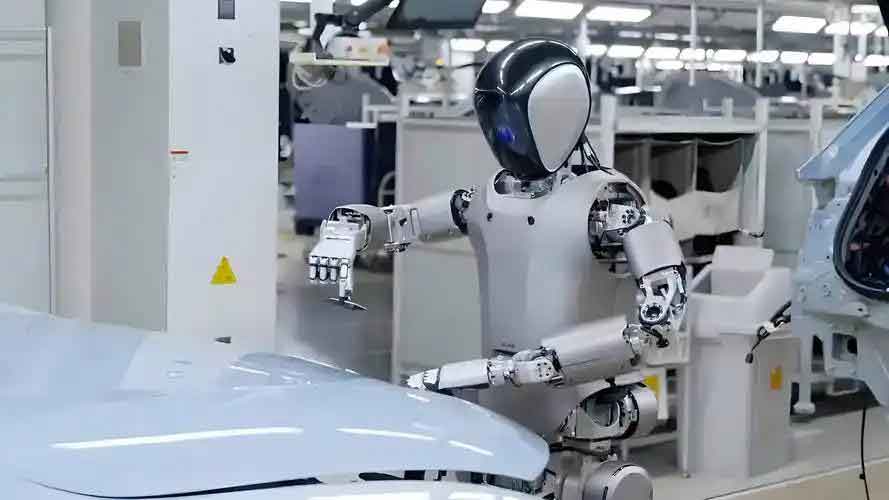
The journey of robotic intelligence has evolved through distinct phases: from mechanical automation and programmable control to system-level integration. The current phase, ignited around 2015, is defined by the deep integration of AI, particularly deep learning. The introduction of Transformer architectures and subsequent large-scale models post-2020 has been a game-changer. These models moved beyond pattern recognition to enable complex reasoning and self-optimization. For humanoid robots, this shift is profound. Early robots like WABOT-1 or ASIMO were marvels of locomotion and pre-scripted interaction. Modern systems, empowered by large models, aim for a level of cognitive autonomy where they can understand ambiguous commands, reason about dynamic environments, and generate appropriate physical actions. This transition from automated tools to intelligent entities is why nations worldwide have prioritized humanoid robot development in their strategic plans, recognizing their potential to revolutionize sectors from manufacturing to defense and elderly care.
Foundation Model Technologies: Building Blocks for an Embodied Mind
The intelligence of a modern humanoid robot is increasingly orchestrated by a suite of large AI models. Each type of model contributes a critical cognitive faculty, which, when integrated, aims to create a cohesive and capable embodied agent.
1. Large Language Models (LLMs): The Kernel of Reason
LLMs, such as the GPT series and open-source counterparts like LLaMA, form the core reasoning engine. Trained on internet-scale text corpora, they excel at understanding, generating, and reasoning with natural language. Their power stems from the Transformer architecture’s self-attention mechanism, which allows them to model long-range dependencies in data. The self-attention for a sequence is computed as:
$$
\text{Attention}(Q, K, V) = \text{softmax}\left(\frac{QK^T}{\sqrt{d_k}}\right)V
$$
where \(Q\), \(K\), and \(V\) are query, key, and value matrices derived from the input. Architecturally, LLMs primarily follow an autoregressive language modeling objective, predicting the next token given all previous ones: \(P(x_t | x_{<t})\). This training grants them not just linguistic fluency but also emergent abilities like in-context learning and chain-of-thought reasoning. For a humanoid robot, an LLM acts as the high-level task interpreter and planner. It can parse a complex user command like “Please tidy up the workshop by placing the tools on the blue shelf and throwing the empty bottle in the recycling bin,” decompose it into a logical sequence of sub-tasks, and reason about object properties and spatial relationships.
2. Vision Transformer (ViT) Models: Reimagining Visual Perception
While convolutional neural networks (CNNs) long dominated robot vision, Vision Transformers have emerged as powerful alternatives for holistic scene understanding. A ViT model splits an input image \(I \in \mathbb{R}^{H \times W \times C}\) into a sequence of flattened 2D patches \(x_p \in \mathbb{R}^{N \times (P^2 \cdot C)}\), where \((P, P)\) is the patch size and \(N = HW / P^2\) is the number of patches. These patches, after linear projection and addition of positional embeddings, are fed into a standard Transformer encoder. The model’s global self-attention mechanism allows it to integrate information across the entire image from the first layer, making it exceptionally good at capturing contextual relationships. For a humanoid robot, ViT-based models provide robust and generalizable feature representations for tasks like object recognition, scene classification, and—when adapted—dense prediction tasks such as segmentation and depth estimation, forming a rich and unified visual understanding of the environment.
3. Vision-Language Models (VLMs): Bridging Sight and Semantics
VLMs like Flamingo, BLIP-2, and GPT-4V are pivotal for grounded intelligence. They align visual features from an encoder (e.g., ViT) with linguistic representations from an LLM, enabling cross-modal understanding. A common architecture involves a Querying Transformer (Q-Former) that acts as an information bottleneck, learning to extract the most salient visual features relevant to a text query. These features are then projected into the LLM’s embedding space. The training often involves contrastive and generative objectives, such as maximizing the similarity between correct image-text pairs and generating text descriptions from images. The core capability can be summarized as learning a joint probability distribution \(P(\text{Text}, \text{Image})\). For a humanoid robot, a VLM allows it to connect what it sees with what it is told. It can answer questions about a scene (“Is the cabinet door open?”), follow instructions that refer to visual elements (“Pick up the red wrench next to the vice”), and even generate descriptive captions of its surroundings for human feedback.
4. Vision Generation Models: Imagination and Prediction
Models like Stable Diffusion and DALL-E, typically based on diffusion processes, learn to generate high-fidelity images from noise, guided by text or other conditioning signals. The diffusion process involves a forward noising process \(q(x_t | x_{t-1})\) that gradually adds Gaussian noise to data \(x_0\) over \(T\) steps, and a learned reverse denoising process \(p_\theta(x_{t-1} | x_t)\). For a humanoid robot, these models are not just for creating art. They enable critical capabilities like:
- Mental Simulation: The robot can imagine the outcome of an action (“What would this table look like if I wiped it?”), aiding in planning.
- Trajectory Prediction: Forecasting future frames in a video, which is essential for anticipating human movement or object dynamics.
- Data Augmentation: Generating synthetic training data for rare or dangerous scenarios the physical robot has not encountered.
5. Embodied Multimodal and Vision-Language-Action (VLA) Models: Closing the Perception-Action Loop
This is the most direct incarnation of large models for robotics. VLAs aim to directly map high-dimensional observations (images, language instructions) to low-level robot actions (joint torques, end-effector velocities). They represent the pursuit of end-to-end control. A canonical example is the RT (Robotics Transformer) series. RT-1 was trained on a large dataset of robot trajectories, learning to output actions conditioned on images and instructions. RT-2 took a significant leap by co-fine-tuning a large pre-trained VLM on robotics data. This allowed it to transfer knowledge from the vast web-scale data in the VLM to robotic control, exhibiting remarkable generalization to novel objects and semantic reasoning. The learning objective is to model \(P(\text{Action} | \text{Image}, \text{Language})\). For a humanoid robot, a VLA model is the closest approximation to a unified “brain” that can directly translate intent into motion, handling the complexity of high-degree-of-freedom control in a single, scalable model.
| Model Type | Core Function | Key Architecture/Principle | Primary Value for Humanoid Robot |
|---|---|---|---|
| Large Language Model (LLM) | Language Understanding & Reasoning | Transformer Decoder, Autoregressive Training | High-level task decomposition, planning, and dialog |
| Vision Transformer (ViT) | Holistic Visual Perception | Image Patching + Transformer Encoder | Unified, context-aware scene feature extraction |
| Vision-Language Model (VLM) | Cross-Modal Grounding | Visual Encoder + LLM Fusion (e.g., Q-Former) | Connecting language commands to visual scenes |
| Vision Generation Model | Image/Video Synthesis | Denoising Diffusion Probabilistic Models | Mental simulation, trajectory prediction, data synthesis |
| Vision-Language-Action Model (VLA) | End-to-End Robotic Control | VLM fine-tuned on action sequences | Direct mapping from perception and instruction to motion |
Large Model-Driven Key Technologies for Humanoid Robots
The infusion of foundation models into humanoid robot systems is being realized through several key technological paradigms, each with its own advantages and implementation strategies.
1. Distributed & Modular Large Model Technology
This approach treats large models as specialized “cognitive modules” within a more traditional robotic architecture (Sense-Plan-Act). Each module handles a specific sub-problem, and their outputs are integrated by a central system.
| Robot Subsystem | Large Model Role | Example Techniques |
|---|---|---|
| Perception | Universal scene understanding and segmentation. | Models like Segment Anything Model (SAM) or TAP for zero-shot segmentation and recognition of any object. VLMs for visual question answering about the environment. |
| Planning | Task decomposition and trajectory synthesis. | LLMs used as high-level planners (e.g., SayCan, VoxPoser) that output a sequence of symbolic actions or code-like spatial constraints from language instructions. |
| Decision-Making | Complex reasoning under uncertainty. | LLMs evaluate possible action outcomes, access embedded knowledge (e.g., “glass is fragile”), or engage in Socratic dialogues between multiple models to reach a consensus decision. |
| Control | Generating executable control code or policies. | LLMs generate Python code for robot motion (RoboCodeX) or parameterize motion primitives. VLMs fine-tuned for action prediction (RoboFlamingo) translate visual goals into actions. |
The primary advantage is reliability and interpretability—each component can be validated separately. However, errors can propagate through the pipeline, and the integration itself can be complex.
2. End-to-End Integrated Large Model Technology
This paradigm seeks to collapse the entire pipeline into a single, monolithic model—a VLA. The model, often built upon a pre-trained VLM, is fine-tuned on massive datasets of robot experience \(\mathcal{D} = \{ (o_i, l_i, a_i) \}\), where \(o\) is observation (image), \(l\) is language instruction, and \(a\) is the action sequence. The model learns to directly predict actions: \(a = \text{VLA}_\theta(o, l)\).
The training objective typically involves behavior cloning or a combination of imitation learning objectives. The success of RT-2 demonstrates that this approach can leverage the semantic and conceptual knowledge embedded in internet-trained VLMs, granting the humanoid robot remarkable generalization. For instance, a model might recognize an “object for recycling” even if it has never seen that specific trash bin before, because the VLM understands the concept. The challenge lies in acquiring vast, diverse, and high-quality robot interaction data and the immense computational cost of training.
3. Cloud-Edge-End Collaborative Large Model Technology
Given the computational heaviness of large models and the real-time, safety-critical nature of robot operation, a hybrid cloud-edge architecture is emerging as a pragmatic solution. In this framework:
- Cloud: Hosts the most powerful, up-to-date large models (LLMs, VLMs). It handles non-latency-critical, complex reasoning tasks, long-term planning, and model training/updates.
- Edge (Robot/On-premise Server): Runs distilled, specialized, or quantized versions of models. It handles real-time perception, immediate reaction control loops, and local data processing for privacy.
- End (Robot Actuators/Sensors): Executes low-level, deterministic control and data acquisition.
A collaborative learning framework can be formalized as a joint optimization problem. Let \(\theta_c\) be the cloud model parameters and \(\theta_e\) be the edge model parameters. The goal is to minimize a global loss \(\mathcal{L}\) over distributed data:
$$
\min_{\theta_c, \theta_e} \sum_{k=1}^{N} \mathcal{L}_k(f(\theta_c, \theta_e; x_k), y_k)
$$
where \(f(\cdot)\) represents the collaborative inference function between cloud and edge, and the sum is over \(N\) edge devices or data batches. This allows the powerful cloud model to guide and update the efficient edge models on the humanoid robot, enabling sophisticated intelligence without compromising responsiveness or data security.
Application Scenarios: From Factories to Frontier Environments
The synergy of large models and advanced mechatronics is unlocking transformative applications for humanoid robots.
Intelligent Manufacturing
The flexible, human-like form factor of a humanoid robot makes it ideal for unstructured factory environments built for people. Large models amplify this:
- Task Generalization: Instead of being programmed for one task (e.g., welding), a model-driven humanoid robot can be instructed to “inspect the car door for scratches,” “assemble this gearbox following the digital manual,” or “fetch the maintenance toolkit from the storage area.”
- Adaptive Operation: Using VLMs for visual recognition and LLMs for process reasoning, the robot can handle variations in part presentation, identify defects, and even troubleshoot simple assembly errors.
- Human-Robot Collaboration: Natural language interaction allows workers to give complex, ad-hoc instructions safely and intuitively. Companies like Tesla (Optimus), Figure (with BMW), and Chinese firms like Ubtech (Walker S in NIO factories) and Fourier (GR-1) are actively piloting these systems for logistics, inspection, and assembly tasks.
Unmanned Systems and Frontier Operations
In hazardous or inaccessible environments—disaster zones, conflict areas, or space—humanoid robots offer a unique advantage: they can operate infrastructure designed for humans. Large models are critical for autonomy in such chaotic settings:
- High-Level Mission Execution: A soldier or operator can give a command: “Reconnoiter the building for structural hazards and report.” The LLM-based planner decomposes this into navigation, visual inspection, and communication sub-tasks.
- Environmental Understanding: VLMs help the robot identify threats (e.g., “unexploded ordnance”), assets (e.g., “medical supplies”), and structural features in complex, cluttered scenes.
- Resilient Decision-Making: In communication-denied environments (edge mode), the on-board, distilled models must make autonomous decisions for navigation and safety. Projects like Boston Dynamics’ Atlas for DARPA challenges exemplify the physical platform, which, when combined with robust large-model intelligence, could perform lifesaving reconnaissance and manipulation in disasters.
The table below contrasts the role of large models in these two primary domains.
| Domain | Core Challenge | Large Model Contribution | Example |
|---|---|---|---|
| Intelligent Manufacturing | Unstructured tasks, high-mix production, need for flexibility. | Zero-shot task understanding, visual anomaly detection, natural language programming, process reasoning. | An LLM+VLM system instructs a humanoid robot to perform quality inspection on a novel product variant by reading a spec sheet and visually comparing. |
| Unmanned Systems | Extreme environmental uncertainty, sparse communication, critical decision-making. | High-level mission planning from vague orders, visual scene interpretation for threat/asset identification, autonomous contingency planning. | A humanoid robot in a disaster zone uses a VLM to identify a survivor under rubble and an LLM to plan a safe extraction trajectory, requesting help via generated text if needed. |
Technical Challenges and Future Perspectives
Despite the exciting progress, the path to truly capable, large-model-driven humanoid robots is fraught with significant challenges.
Core Technical Challenges
- The “Data Famine” for Embodied AI: Foundation models for language and vision are trained on petabytes of web data. Equivalent-scale datasets of physical humanoid robot interactions are scarce, expensive, and dangerous to collect. Solving this requires breakthroughs in simulation-to-real transfer, diffusion model-based synthetic data generation, and efficient data-sharing ecosystems.
- Real-time Performance and Latency: The inference time of large models can be hundreds of milliseconds, unacceptable for dynamic balancing or responsive manipulation in a humanoid robot. This demands relentless model compression, distillation, specialized hardware (neuromorphic chips), and clever cloud-edge splitting of computational graphs.
- Safety, Reliability, and Interpretability: The black-box nature of large models is a major concern for safety-critical robotics. A humanoid robot must not only act correctly but also be able to explain its decisions and have built-in safeguards against model “hallucinations” or adversarial prompts. Research into verifiable AI, robust alignment, and interpretability tools for embodied agents is crucial.
- Unified Multimodal World Models: Current models often treat perception, language, and action as separate or loosely coupled modules. The future lies in developing truly unified world models that inherently combine these modalities, allowing the humanoid robot to learn a consistent, predictive model of its environment and the effects of its actions. This can be seen as learning a dynamics model \(P(s_{t+1} | s_t, a_t)\) where the state \(s_t\) is a multimodal representation encompassing visual, physical, and semantic information.
- Cost and Energy Efficiency: The training and deployment costs are currently prohibitive for widespread adoption. More efficient architectures (e.g., Mixture of Experts, state-space models) and sustainable power solutions for mobile humanoid platforms are necessary.
Future Outlook
The fusion of large models and humanoid robotics is steering the field toward the long-envisioned goal of General-Purpose Humanoid Robots. We can anticipate several directions:
- From Co-pilots to Autonomous Agents: Large models will evolve from being tools that assist in programming robots to becoming the core autonomous “pilots” that continuously perceive, plan, and act with minimal human oversight.
- Emergence of Foundation Models for Embodiment: Just as LLMs are foundation models for language, we will see the rise of pre-trained “Embodiment Models”—massive neural networks trained on diverse robotic interaction data that can be quickly adapted (few-shot) to control any new humanoid robot platform or task.
- Symbiotic Human-Robot Teams: The natural language and reasoning capabilities will enable fluid, intuitive teamwork. A humanoid robot will understand not just explicit commands but also intent, context, and social cues, acting as a true collaborative partner in homes, hospitals, and factories.
- Democratization via Open Platforms: Initiatives like Open X-Embodiment are creating large, shared datasets and models. This, combined with cloud-based robotics and simulation, will lower the barrier to entry, accelerating innovation and application discovery.
The mathematical and engineering journey is toward creating an agent that optimizes a universal objective: maximizing the successful completion of a vast set of human-intended tasks in the physical world. If we denote \(\mathcal{T}\) as the space of all possible tasks, \(E\) as the environment, and \(\pi_\theta\) as the robot’s policy parameterized by a large model, the ultimate goal is to find:
$$
\theta^* = \arg\max_\theta \mathbb{E}_{\tau \sim \mathcal{T}, e \sim E} [R(\pi_\theta, \tau, e)]
$$
where \(R\) is a success reward function. Large models provide the parameterization \(\pi_\theta\) with the necessary priors—language, vision, common sense, and physics—to make this optimization tractable. The humanoid robot, therefore, transitions from a mechanically sophisticated machine to an economically viable, generally intelligent entity, poised to become an integral part of our social and industrial fabric.