
As a researcher in the field of robotics, I have observed that the development of humanoid robots is not merely about achieving high-fidelity anthropomorphic designs; instead, the core focus lies in their potential to act as “intelligent nodes” that enhance efficiency in the physical world. This article delves into the global dynamics of humanoid robot applications, offering a comprehensive analysis from technological foundations to industrial ecosystems. I will systematically explore application practices in key sectors such as manufacturing and services, dissect critical challenges and opportunities in industrialization, and propose developmental recommendations from perspectives of technological innovation, scenario expansion, and ecological construction.
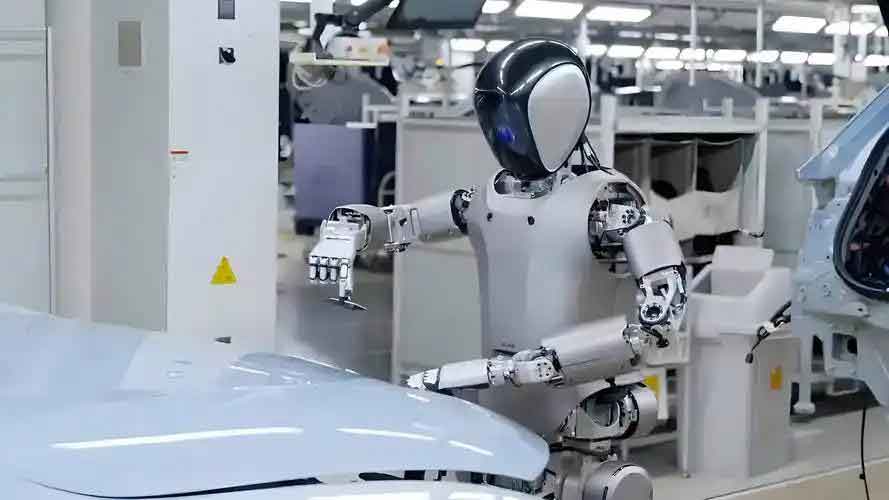
The advancement of humanoid robots is underpinned by a holistic industrial framework, which can be categorized into three interconnected domains: the “brain” (encompassing perception, decision-making, and human-robot interaction), the “cerebellum” (focusing on motion control), and the “limbs” (involving physical actuation and hardware). The “brain” aims for advanced cognitive capabilities, leveraging general-purpose AI large models to enable complex task planning and environmental understanding. For instance, integrating deep learning and natural language processing allows a humanoid robot to comprehend and execute intricate commands, fostering autonomous learning and adaptation. The “cerebellum” is dedicated to real-time responsiveness and motor control, involving low-level reflexive action generation and autonomous mobility, enabling the humanoid robot to react swiftly based on sensor inputs without external control—exemplified by balance maintenance, dynamic walking, and precise manipulation through advanced control algorithms. The “limbs” concentrate on the physical structure and kinematic abilities, optimizing designs for limbs and dexterous hands to improve operational capability and adaptability in complex environments, often drawing inspiration from human biomechanics.
To summarize this framework, I present the following table outlining the core components and their objectives:
| Component | Primary Focus | Key Technologies | Example Capabilities |
|---|---|---|---|
| Brain | Cognitive Decision-Making | AI Large Models (LLMs, VLMs), Deep Learning, NLP | Task planning, environmental understanding, natural language interaction |
| Cerebellum | Motion Control | Control Algorithms, Sensor Fusion, Reinforcement Learning | Balance control, dynamic locomotion, real-time reflex actions |
| Limbs | Physical Actuation | Precision Actuators, Lightweight Materials, Kinematic Design | Dexterous manipulation, adaptive walking, load-bearing |
The progression of humanoid robots relies heavily on the development of core subsystems. In the realm of the “brain” and “cerebellum”—the AI-centric systems—global technology giants and leading robotics firms drive innovation through advantages in AI large models, core computing power, software platforms, and extensive R&D accumulation. For example, companies like Tesla integrate autonomous driving neural networks and Dojo supercomputing to empower their humanoid robot with robust perception and task planning. NVIDIA supports developers with platforms like Isaac for building multimodal models, while Google explores fusing large language models with robotic control for flexible interaction. Domestically, enterprises are actively pursuing embodied AI large models, such as Huawei’s PanGu embodied model and Fourier Intelligence’s collaboration with NVIDIA’s Project GR00T, though challenges persist in software platform maturity and high-quality training dataset construction. The following table contrasts key international and domestic players in AI system development for humanoid robots:
| Region | Representative Entities | AI System Characteristics | Dataset Initiatives |
|---|---|---|---|
| International | Tesla, NVIDIA, Google DeepMind, Figure AI | End-to-end AI, open foundation models, multimodal processing, strong simulation tools | Proprietary datasets from real-world deployments (e.g., factory settings), synthetic data generation |
| Domestic | UBTECH, Fourier Intelligence, Unitree, AgiBot | Self-developed AI models (e.g., BrainNet, UnifoLM), integration with international platforms, emphasis on imitation learning | Open-source datasets (e.g., Fourier ActionNet), real-world capture in industrial scenarios, but limited scale and quality |
Regarding the “limbs”—key hardware and execution components—the performance of a humanoid robot is directly constrained by core parts such as precision reducers, high-performance servo systems, multi-dimensional force/torque sensors, advanced vision sensors, and emerging electronic skin. Globally, suppliers like Harmonic Drive (Japan) for reducers, ATI Industrial Automation (USA) for force sensors, and Tekscan (USA) for electronic skin dominate the market. Domestically, companies are making strides but still depend on imports for high-end components, with local firms like LHD Harmonic Drive and ESTUN pushing for localization. The cost and technological barriers in these areas significantly impact the commercialization of humanoid robots. For instance, the high expense of planetary roller screws, which can constitute up to 19% of a humanoid robot’s total cost, poses a bottleneck. To quantify performance metrics, we can express the torque-density ratio of an actuator as: $$ \text{Torque Density} = \frac{\tau}{V} $$ where $\tau$ is the output torque and $V$ is the volume. Improving this ratio is critical for compact, powerful joints in humanoid robots.
The technological evolution of humanoid robots is characterized by deep integration across multiple domains and continuous enhancement of intelligence levels. In AI algorithms, embodied AI is central, focusing on autonomous learning through interaction with the physical world. Techniques like reinforcement learning optimize behavior policies, while imitation learning enables rapid skill acquisition. The integration of large language models with robotic systems is transforming AI architectures, and multimodal models fuse sensory inputs for better perception. A reinforcement learning objective can be formulated as: $$ J(\theta) = \mathbb{E}_{\tau \sim \pi_\theta} \left[ \sum_{t=0}^{T} \gamma^t r(s_t, a_t) \right] $$ where $\pi_\theta$ is the policy, $r$ is the reward, and $\gamma$ is the discount factor. For a humanoid robot, this involves maximizing cumulative rewards from environmental interactions.
In architecture and computing power, edge-cloud fusion and in-memory computing chips are pivotal trends. The edge-cloud architecture balances the computational might of cloud-based large models with the real-time responsiveness of lightweight on-device models, crucial for tasks like dynamic control in humanoid robots. Short-term, heterogeneous computing prevails; long-term, self-developed in-memory computing chips aim to reduce energy consumption. The efficiency of such systems can be modeled as: $$ \text{Efficiency} = \frac{\text{Useful Computational Output}}{\text{Total Energy Input}} $$ Optimizing this is vital for extending the operational duration of humanoid robots.
Core hardware is advancing toward higher power density, precision, responsiveness, lower energy consumption, and miniaturization. Actuators, for example, are evolving to improve motion performance, while sensor technology emphasizes multimodal fusion, with electronic skin enabling finer tactile perception. Energy systems require high-density, lightweight batteries, and material science innovations support agile structures. The dynamics of a humanoid robot’s limb can be described using the Lagrangian formulation: $$ \frac{d}{dt} \left( \frac{\partial L}{\partial \dot{q}_i} \right) – \frac{\partial L}{\partial q_i} = \tau_i $$ where $L$ is the Lagrangian, $q_i$ are generalized coordinates, and $\tau_i$ are generalized forces. Solving these equations in real-time is essential for stable locomotion.
Software platforms see the continued evolution of ROS, deep application of simulation and digital twin technologies, and accelerated construction of open platforms and open-source ecosystems. High-fidelity simulators like NVIDIA Isaac Sim generate synthetic data and streamline development, while open-source initiatives lower barriers to entry. Data processing and security are also focal points, with efficient data闭环 (closed-loop) systems being built for continuous model improvement, coupled with measures like federated learning to ensure privacy: $$ \min_{\theta} \sum_{k=1}^{K} f_k(\theta) $$ where $f_k$ represents local loss functions on distributed data, preserving data confidentiality during training for humanoid robot AI.
The application landscape for humanoid robots, driven by AI, is expanding but remains uneven in depth and breadth. In large model applications, AI enhances cognitive abilities for tasks like natural language understanding and visual scene analysis. For instance, humanoid robots from Figure AI demonstrate multi-turn dialogue and object manipulation. However, challenges like “hallucinations” in models and generalization gaps persist. In design and R&D, AI accelerates iteration through high-fidelity simulation and digital twins, yet the Sim2Real gap and multi-physics coupling complexities hinder progress. In manufacturing, AI is used for visual inspection and assembly automation, but full-process automation is limited by the intricate structure of humanoid robots and immature supply chains. The following table assesses AI application depth across key stages:
| Application Stage | Primary AI Uses | Current Depth | Key Challenges |
|---|---|---|---|
| Large Model Integration | Natural language interaction, task planning, vision-language grounding | Medium (effective in controlled settings but limited generalization) | Model hallucinations, high computational costs, data scarcity |
| Design and R&D | Kinematics/dynamics simulation, reinforcement learning training, digital twin analysis | Medium-High (simulation widespread, but AI generative design nascent) | Sim2Real transfer, complexity of multi-disciplinary optimization |
| Production Manufacturing | Visual quality inspection, robotic assembly assistance, process monitoring | Low-Medium (limited to repetitive tasks, overall智能化水平 low) | High-precision assembly demands, supply chain dependencies, lack of standards |
Guidance for scenario applications highlights promising domains for humanoid robots, though most are in early exploration. In automotive manufacturing, humanoid robots can handle complex assembly in unstructured environments, addressing labor shortages. In home services, they offer potential for domestic assistance and elderly care, but face hurdles in safety, cost, and user acceptance. In warehousing and logistics, humanoid robots complement AGVs by performing flexible picking and last-mile delivery, as seen with Agility Robotics’ Digit. For special operations like border patrol or hazardous environment inspection, humanoid robots provide all-weather monitoring and risk reduction. Exhibition and guidance roles serve as early commercial试验场s. The economic potential is significant; Morgan Stanley forecasts that by 2050, about 90% of humanoid robots could be deployed in industrial and commercial repetitive tasks. The adoption rate in a sector can be modeled as: $$ A(t) = \frac{A_{\text{max}}}{1 + e^{-k(t – t_0)}} $$ where $A_{\text{max}}$ is maximum adoption, $k$ is growth rate, and $t_0$ is midpoint time. For humanoid robots, accelerating $k$ requires overcoming current barriers.
However, the development of humanoid robots faces multifaceted challenges. In core technologies, algorithm bottlenecks include “black-box” issues in reinforcement learning and poor cross-scenario generalization. Perception-control difficulties involve fusing multimodal sensor data and achieving stable bipedal locomotion on rough terrain. Hardware constraints stem from reliance on imported key components like precision reducers and high-torque-density motors, with costs remaining prohibitive. For example, the force control accuracy in a humanoid robot’s hand can be expressed as: $$ \epsilon_f = | F_{\text{desired}} – F_{\text{actual}} | $$ minimizing $\epsilon_f$ requires advanced sensors and control loops, which are costly.
In industrialization and commercial application, unreasonable cost structures deter market uptake—a domestic humanoid robot may cost around ¥700,000. Application scenario adaptability is insufficient; in industrial settings, low comprehensive success rates for complex tasks prevail, while in homes, users expect immediate competence beyond current capabilities. Business model innovation lags, with traditional sales models facing long ROI periods and RaaS still experimental.
Innovation ecosystem elements also pose constraints. Acquiring high-quality training data is expensive and inefficient, with single action data points costing several yuan to process. Professional talent is structurally scarce, lacking interdisciplinary experts in AI, robotics, and hardware. Supply chain ecology suffers from fragmentation and external dependencies, with weak collaboration among upstream and downstream firms. Policy, regulation, and standard systems are incomplete, lacking tailored laws for humanoid robots in areas like safety liability and ethics.
To address these challenges, I propose several recommendations. First, strengthen core technology攻关 and autonomous innovation capacity. Support research in next-gen AI algorithms for embodied intelligence, explainable AI, and edge-side large model deployment. Encourage development of proprietary robot OS and open AI platforms. Boost R&D and industrialization of key hardware like servo motors, reducers, and electronic skin to achieve localization and cost reduction. Establish national-level major projects for humanoid robots to tackle common technical hurdles. Prioritize high-quality training dataset construction, exploring national or industry-level platforms for data collection, annotation, sharing, and security management. The optimization of a model parameter $\theta$ can be framed as: $$ \theta^* = \arg\min_{\theta} \mathbb{E}_{(x,y) \sim \mathcal{D}} [\mathcal{L}(f_\theta(x), y)] $$ where $\mathcal{D}$ is a robust dataset—expanding $\mathcal{D}$ is crucial for humanoid robot AI.
Second, build a sound industrial ecology and robust standard system. Enhance top-level design to foster an integrated chain spanning upstream components, midstream manufacturing, and downstream applications. Encourage leading firms to open platforms and supply chains to drive协同 innovation. Support establishment of humanoid robot industrial clusters in regions like Yangtze River Delta. Accelerate formulation of technical standards, safety norms, and ethical guidelines for humanoid robots, participating in international standard-setting. Improve product testing and certification systems to ensure quality and safety.
Third, accelerate typical scenario application demonstrations and cultivate emerging markets. Select high-potential scenarios with urgent labor substitution needs, such as advanced manufacturing, special operations (e.g., power inspection), healthcare, and education, to conduct large-scale demonstration projects. Use these real-environment tests to collect data and refine technologies for humanoid robots. Introduce targeted policies like procurement subsidies and tax incentives to encourage early adoption. Cultivate consumer markets through科普 and体验, exploring sustainable models like RaaS to lower entry barriers. The net present value (NPV) of deploying a humanoid robot can be calculated as: $$ \text{NPV} = \sum_{t=0}^{T} \frac{C_t}{(1 + r)^t} $$ where $C_t$ are net cash flows and $r$ is discount rate; positive NPV requires cost reductions and efficiency gains from humanoid robots.
Fourth, optimize high-end talent cultivation systems and reinforce all-around policy guarantees. Incorporate humanoid robot and embodied AI education into strategic plans, promoting university-industry collaboration to train interdisciplinary talent. Support construction of实训 bases and industry-education integration platforms. Attract top global talent and teams. Improve the business environment, streamline approvals, and strengthen IP protection. Perfect investment and financing systems to channel capital into humanoid robot硬科技. Monitor global trends and adjust policies to balance open cooperation with autonomous control, ensuring sustainable development for the humanoid robot industry.
In conclusion, the trajectory of humanoid robots is shaped by rapid AI advancements and growing practical demands. By addressing technical bottlenecks, fostering collaborative ecosystems, and strategically deploying in key scenarios, humanoid robots can evolve from prototypes to pervasive intelligent agents. As research progresses, continuous innovation in algorithms, hardware, and standards will be paramount to unlocking their full potential across diverse sectors, ultimately making humanoid robots integral to our physical world.