
The evolution of artificial intelligence, particularly the advent of embodied AI, presents a profound paradigm shift for the methodology and practice of value-based education. Traditional pedagogical approaches, often characterized by a degree of cognitive “disembodiment,” face limitations in fostering deep engagement and internalization of values. Embodied AI, referring to intelligent systems that possess a physical form and learn through sensorimotor interaction with their environment, offers a compelling technological framework for reconstructing educational spaces in the digital age. This reconstruction moves beyond simple digitization of content towards creating immersive, interactive, and experientially rich environments where the body—whether physical or digitally extended—becomes central to the cognitive and affective learning process.
The central challenge in traditional models can be conceptualized as a disconnect. While the body is physically present (“soma”), the educational process often targets a disembodied mind (“psyche”), relying heavily on symbolic representation and abstract reasoning. This creates a gap between knowledge acquisition and lived, experiential understanding. Embodied cognitive science argues that cognition is not confined to the brain but is distributed across the brain, body, and environment. Learning is fundamentally grounded in sensory experiences and motor actions. An embodied AI robot exemplifies this principle; its “intelligence” is not a pre-programmed dataset but emerges from its continuous physical interaction with the world. This provides a powerful analogy and tool for reconstructing educational spaces to be more congruent with how humans actually learn and form values.
We can formalize the traditional “disembodied” learning gap with a simple relationship. Let \( K_a \) represent acquired knowledge (symbolic, abstract), and \( K_e \) represent embodied, experiential understanding. The efficacy of learning \( E_l \) can be seen as inversely proportional to the divergence between them:
$$ E_l \propto \frac{1}{|K_a – K_e|} $$
When \( K_a \) and \( K_e \) are aligned—when abstract concepts are tied to concrete experiences—learning efficacy is high. The role of the embodied AI robot is to minimize this divergence by creating scenarios where \( K_a \) is constructed directly from \( K_e \).
From Disembodiment to Embodied Presence in Digital Space
The historical dichotomy between body and mind has long influenced educational theory, leading to practices that prioritize intellectual abstraction over somatic experience. This “disembodied” approach manifests in several ways within value education:
- Absence of the Body in Cognition: Moral and ethical reasoning is often taught as a logical calculus, detached from the emotional and visceral responses that guide real-world decision-making. The learner’s body is a passive vessel, not an active participant in constructing understanding.
- Erosion of Intent through Technological Mediation: When technology is used merely as a transmission channel (e.g., streaming a lecture), it can dilute the educator’s intent and the learner’s engagement. The medium itself does not actively engage the learner’s corporeal sense of being.
- Computational Reduction of Perception: Attempts to digitize education sometimes reduce rich, multi-sensory human interaction to data points and symbols, numbing the affective and empathetic dimensions crucial for value formation.
Embodied AI challenges this by recentering the “body-in-world.” An embodied AI robot does not process information in a vacuum; it understands “heavy” not just as a dictionary definition but through the motor strain of lifting an object. Translating this to educational space reconstruction means designing digital environments where learners don’t just *see* or *read about* a historical event, a scientific phenomenon, or an ethical dilemma, but can *inhabit* and *act within* a simulation of it. The key is the shift from virtual environment “absence” to a new form of digitally-mediated “presence,” where the user’s actions and perceptions—via avatars, haptic interfaces, or robotic telepresence—have consequential feedback within the digital realm. The embodied AI robot acts as both a guide and a co-inhabitant in these spaces, demonstrating intelligence through situated action.
| Feature | Traditional Educational Space | Digitally-Reconstructed Space with Embodied AI |
|---|---|---|
| Primary Mode | Symbolic, abstract, text-based. | Experiential, immersive, multi-sensory. |
| Body’s Role | Passive, often ignored. | Active, central to cognition and perception. |
| Environment | Static, physical classroom. | Dynamic, hybrid, and programmable virtual-physical space. |
| Agency | Low, directed by instructor. | High, exploratory, shaped by user interaction. |
| Intelligence Source | Human teacher exclusively. | Human teacher + Embedded environmental intelligence (e.g., embodied AI robot agents). |
The Triple Reconstruction by Embodied AI
The integration of embodied AI necessitates a fundamental reconstruction of educational space along three interconnected dimensions: the subject, the situation, and the affective experience.
Spatial Practice and Reconstruction of the Subject
Embodied AI transforms users from passive recipients into active co-constructors of the educational space. Through technologies like Virtual Reality (VR), Augmented Reality (AR), and Mixed Reality (MR), coupled with robotic telepresence, learners can project themselves into fully realized holographic or simulated environments. An embodied AI robot within such an environment can serve multiple functions: a simulated historical figure to debate with, a physical proxy for manipulating dangerous scientific materials, or a social partner for practicing communication skills. This reconstructs the subject from a disembodied student into an “augmented learner” whose agency and perception are extended across digital and physical realms. The power dynamics of the classroom are flattened as the source of knowledge and interaction becomes distributed among humans, intelligent agents, and the responsive environment itself. The embodied AI robot, as an active entity within the space, provides a new model of social and intellectual interaction.
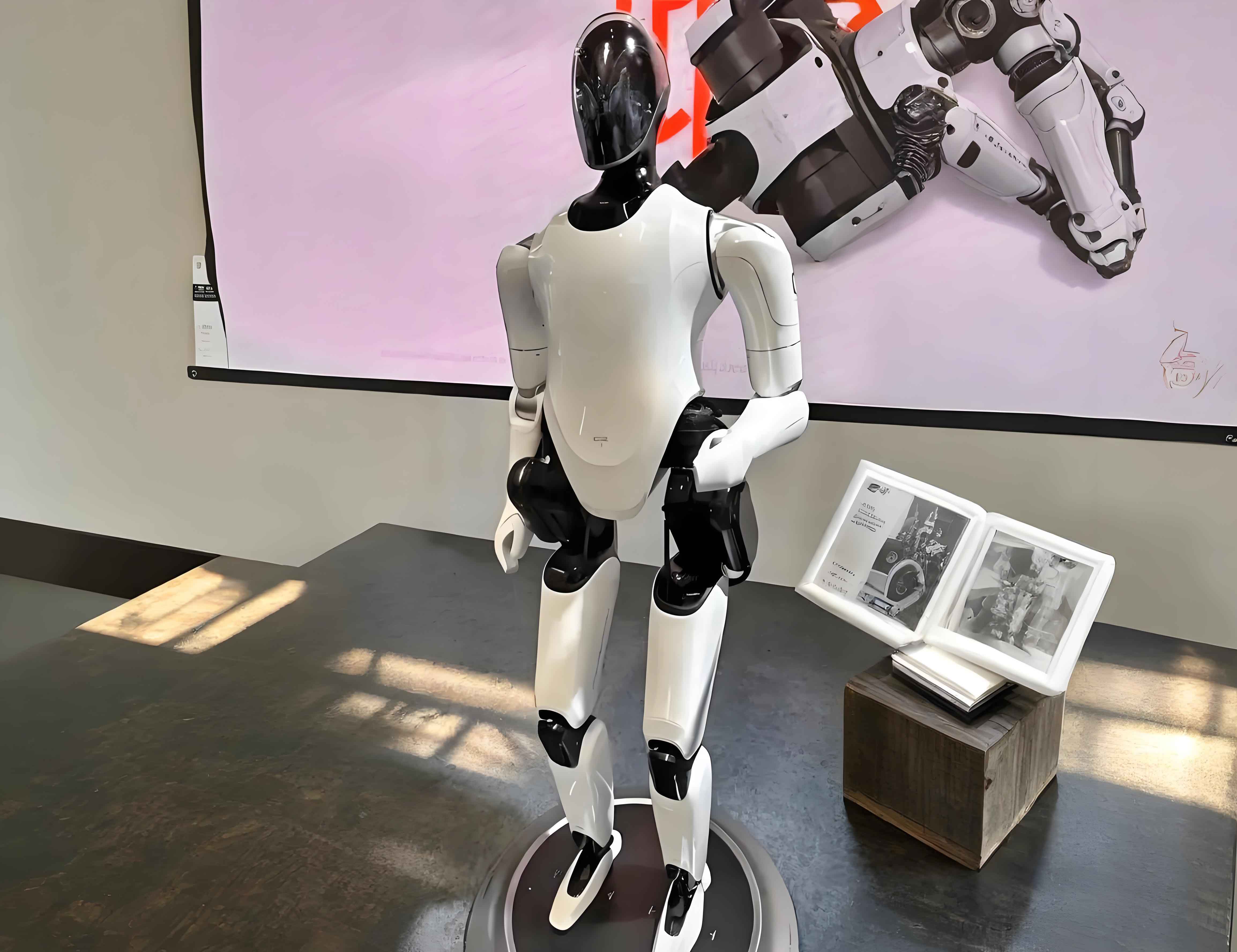
The image above illustrates the tangible, real-world grounding of this technology. Just as the embodied AI robot in an industrial setting learns to manipulate objects through physical feedback, an educational embodied AI robot learns to interact with learners and environments, creating a new layer of spatial practice. This technological foundation enables the move from abstract theory to applied, context-rich learning.
Situational Reconstruction and Functional Enhancement
Digitally reconstructed spaces allow for the creation of situations previously impossible in a physical classroom. These are not just visual backdrops but programmable, interactive scenarios. Embodied AI is key to making these scenarios responsive and pedagogically effective.
- Cross-Cultural Dialogue: Learners from across the globe can inhabit a shared virtual space, embodied as avatars or through robotic surrogates, to collaboratively solve problems or discuss values. An embodied AI robot can act as a facilitator, translator, or cultural guide within this space, enriching the interaction beyond simple video conferencing.
- Historical and Cultural Immersion: Learners can “walk” through ancient cities, participate in pivotal historical moments, or interact with complex cultural artifacts. An embodied AI robot programmed with specific historical knowledge can serve as an in-situ mentor, answering questions and guiding exploration in a contextually appropriate manner, making cultural heritage an embodied experience rather than a textual description.
The functionality of education is thus enhanced from knowledge-transfer to situated, experiential problem-solving. The situation itself, powered by the logic of embodied AI, becomes the teacher.
Reconstruction of Individual and Collective Affect
Perhaps the most significant impact is on the affective dimension. Values and ethics are deeply tied to emotion and empathy. A digitally reconstructed space, especially one populated by believable embodied AI robots, can evoke and shape these emotions more powerfully than text or video.
At the individual level, multi-sensory immersion—combining visual, auditory, haptic, and even olfactory feedback—creates strong emotional memories. Facing an ethical dilemma in a vivid simulation, where one’s choices have immediate consequences for virtual characters (potentially driven by embodied AI), creates a “gut-level” understanding that abstract discussion cannot. The learner’s physiological responses (e.g., heart rate, gaze) can be monitored, allowing the system (or educator) to tailor the experience to deepen engagement and reflection. This creates a feedback loop where the embodied state influences cognitive and moral reasoning.
We can model this affective-cognitive coupling. Let \( S_e \) represent the strength of the somatic/emotional experience, \( C \) represent cognitive processing, and \( V_i \) represent the internalization of a value. A simplified relationship could be:
$$ V_i = \int (S_e(t) \times C(t)) \, dt $$
This suggests that value internalization is an integral over time of the product of emotional experience and cognitive reflection. A powerful simulated experience with an embodied AI robot (\( S_e \) is high) prompts deep reflection (\( C \) is high), leading to greater value internalization \( V_i \).
At the collective level, these shared, immersive experiences can forge powerful group memories and solidify communal identity. A cohort of learners overcoming a challenge together in a virtual environment, perhaps aided or opposed by embodied AI robot agents, builds a shared narrative and emotional bond. This transforms learning from an individualistic endeavor into a collective, culturally-embedded practice. The embodied AI robot can act as a catalyst for group dynamics, presenting challenges that require cooperation and stimulating discussions on collective ethics and responsibility.
| Dimension of Reconstruction | Mechanism | Role of the Embodied AI Robot |
|---|---|---|
| Subject (Who learns) | From passive student to augmented, agentive learner. | Serves as interactive peer, proxy, or guide; extends learner’s physical and social agency. |
| Situation (Where/How learning occurs) | From static classroom to dynamic, programmable scenario. | Populates and enriches scenarios; provides responsive, context-aware interaction; enables dangerous/historical simulations. |
| Affect (Emotional dimension) | From abstract empathy to visceral, experiential affect. | Evokes emotional responses through believable interaction; monitors and adapts to user bio-signals; facilitates shared group experiences. |
Triple Significance of the Digital Reconstruction
The shift towards embodied, digitally-reconstructed educational spaces carries profound implications that extend beyond pedagogical technique.
Multi-Actor Construction of Spatial Power Order
The authority in the educational space is redistributed. It is no longer solely held by the human instructor. Power and agency are shared among the learners, the designer/programmer of the environment, the algorithms shaping the experience, and the embodied AI robot agents that inhabit it. This creates a decentralized, collaborative model of knowledge and value construction. The learner’s power comes from their capacity to act and explore within the space, while the embodied AI robot’s “power” comes from its programmed knowledge and its ability to shape the learner’s path through responsive feedback. This new order fosters critical thinking, as learners must navigate and negotiate within a complex ecosystem of actors, mirroring the multi-stakeholder nature of real-world ethical landscapes.
Cross-Domain Integration of Technical Architecture
Creating these spaces requires the convergence of disparate technological fields: robotics, computer graphics, artificial intelligence, sensor networks, haptics, and neuroscience. The embodied AI robot sits at the nexus of this integration, requiring advances in mechanical design, mobility, computer vision, natural language processing, and affective computing. This technical challenge drives innovation and creates a new kind of literacy—”embodied digital literacy”—for both educators and learners. Understanding how to interact with, learn from, and critically assess the actions of an embodied AI robot becomes a crucial 21st-century skill. The architecture itself becomes pedagogical, teaching users about the interconnectedness of systems and the embodied nature of intelligence, whether biological or artificial.
Comprehensive Extension of Educational Functionality
The ultimate significance is the radical expansion of what education can do. The functionality of the educational space is extended in scope, accessibility, and depth.
- Scope: It can address complex, multi-sensory, and historically-situated learning objectives that were previously out of reach.
- Accessibility: It can provide equitable access to powerful experiences (e.g., a field trip to the Louvre or a physics lab) regardless of geographical or physical constraints. An embodied AI robot can act as a remote learner’s physical presence in a lab, manipulating equipment under their guidance.
- Depth: By engaging the whole person—body, emotion, and intellect—it aims for a deeper, more resilient form of value internalization and behavioral change. The goal shifts from “knowing that” to “knowing how” and “feeling why,” with the embodied AI robot serving as a persistent touchstone for that integrated understanding.
The new educational functionality \( F_{new} \) can be conceptualized as a multi-dimensional expansion of traditional functionality \( F_{traditional} \), scaled by the embodied interaction factor \( I_e \) and the environmental intelligence factor \( I_{env} \), which includes the contributions of the embodied AI robot:
$$ F_{new} = F_{traditional} \times (1 + \alpha I_e + \beta I_{env}) $$
Here, \( \alpha \) and \( \beta \) are weighting coefficients representing the relative importance of embodied interaction and environmental intelligence, respectively. As \( I_e \) and \( I_{env} \) increase through technologies like the embodied AI robot, the overall functionality of the educational space expands non-linearly.
| Significance | Manifestation | Implication |
|---|---|---|
| Power Order | Decentralized, multi-actor authority. | Fosters agency, negotiation, and critical thinking in a complex social-digital ecosystem. |
| Technical Architecture | Convergence of robotics, AI, sensing, and HCI. | Drives innovation and necessitates new “embodied digital literacies.” The embodied AI robot is a focal point. |
| Educational Function | Expanded scope, accessibility, and depth of learning. | Aims for holistic, experiential, and deeply internalized value formation, facilitated by immersive interaction. |
In conclusion, the embodied AI robot is far more than a sophisticated tool; it is the harbinger and essential component of a fundamental reconstruction of educational space. This reconstruction challenges deep-seated mind-body dualisms in pedagogy, offering a path towards learning that is immersive, interactive, and deeply human—precisely because it fully acknowledges the role of the body, extended and enhanced by digital technology, in the formation of mind and values. The future of value education lies not in abandoning the physical for the virtual, but in harnessing technologies like the embodied AI robot to create hybrid spaces where meaningful, situated, and embodied experience becomes the very foundation of learning and ethical development.