
The global manufacturing landscape is undergoing a profound paradigm shift, moving from rigid, dedicated production lines towards highly flexible and intelligent systems. This transformation is particularly accelerated by the dual trends of electrification and digitalization within the automotive industry. Traditional manufacturing setups, characterized by fixed layouts and specialized machinery, struggle with the market’s demand for product diversification and rapid iteration. In contrast, Flexible Manufacturing Systems (FMS), built upon modular design, reconfigurable processes, and intelligent control, enable dynamic resource allocation and swift response to change. At the heart of this industrial revolution lies the embodied AI robot. By integrating advanced technologies such as machine vision, force feedback, and adaptive control, the embodied AI robot possesses the ability to perceive, decide, and act autonomously within a complex production environment, making it the fundamental enabler of next-generation flexible manufacturing.
The core theoretical framework driving this evolution is Embodied Intelligence. Unlike conventional AI that processes data in isolation, Embodied Intelligence emphasizes the seamless integration of perception, cognition, planning, and execution within a physical agent—the embodied AI robot. This “situated” intelligence allows the manufacturing system to understand its environment in real-time, make informed decisions, and execute precise physical tasks, thereby achieving unparalleled adaptability. This article explores the innovative multi-level application of embodied AI robots in flexible manufacturing, detailing their technical architecture, implementation across logistics, equipment, and information layers, and validating the approach through a detailed case study.
The Imperative for Flexibility and the Embodied AI Framework
Core Challenges of Flexible Manufacturing
The transition to flexible manufacturing is driven by three critical demands that traditional systems fail to meet:
1. Shortened Product Introduction Cycles: The rapid evolution of products, especially in new energy vehicles, necessitates drastically reducing the time from design to production. Flexible systems must cut this cycle from years to months.
2. Process Agility: Production lines must handle high-mix, low-volume scenarios, requiring the ability to quickly reconfigure assembly sequences, tools, and parameters for different product variants without major downtime.
3. Dynamic Production Decision-Making: Systems must respond to real-time fluctuations in orders, material availability, and equipment status, enabling on-the-fly rescheduling and anomaly response.
Technical Architecture of the Embodied AI Robot
The embodied AI robot addresses these challenges through a cohesive three-layer architecture that forms a perception-cognition-action closed loop, as summarized in the table below.
| Architecture Layer | Key Technologies | Function in Flexible Manufacturing |
|---|---|---|
| Perception Layer | Multi-modal Sensor Fusion (3D Vision, Force/Torque, Acoustic), Environmental Dynamic Modeling | Real-time acquisition of workpiece pose, quality status, equipment health, and ambient conditions. Provides the “senses” for the embodied AI robot. |
| Cognition Layer | AI Algorithms for Task Decomposition, Path Planning, Anomaly Diagnosis, Adaptive Decision-Making | Processes perceptual data, generates optimal action plans, and makes high-level decisions (e.g., selecting alternative assembly strategies). Forms the “brain” of the system. |
| Execution Layer | High-Precision Motion Control, Modular End-Effectors, Compliant Manipulation | Physically carries out the planned actions with dexterity and accuracy (e.g., precise insertion, adaptive screwing). Serves as the “body” of the embodied AI robot. |
The synergy between these layers is governed by principles of real-time feedback and learning. The cognitive layer’s planning can be modeled as an optimization problem, for instance, minimizing the total non-value-added time $T_{NVA}$ for a set of tasks $J$ on a reconfigurable line:
$$
\min \ T_{NVA} = \sum_{j \in J} (t_{setup}(j, R) + t_{wait}(j, S))
$$
where $t_{setup}$ is the reconfiguration time dependent on the robot state $R$, and $t_{wait}$ is the waiting time dependent on system state $S$. The embodied AI robot continuously updates its model to solve this.
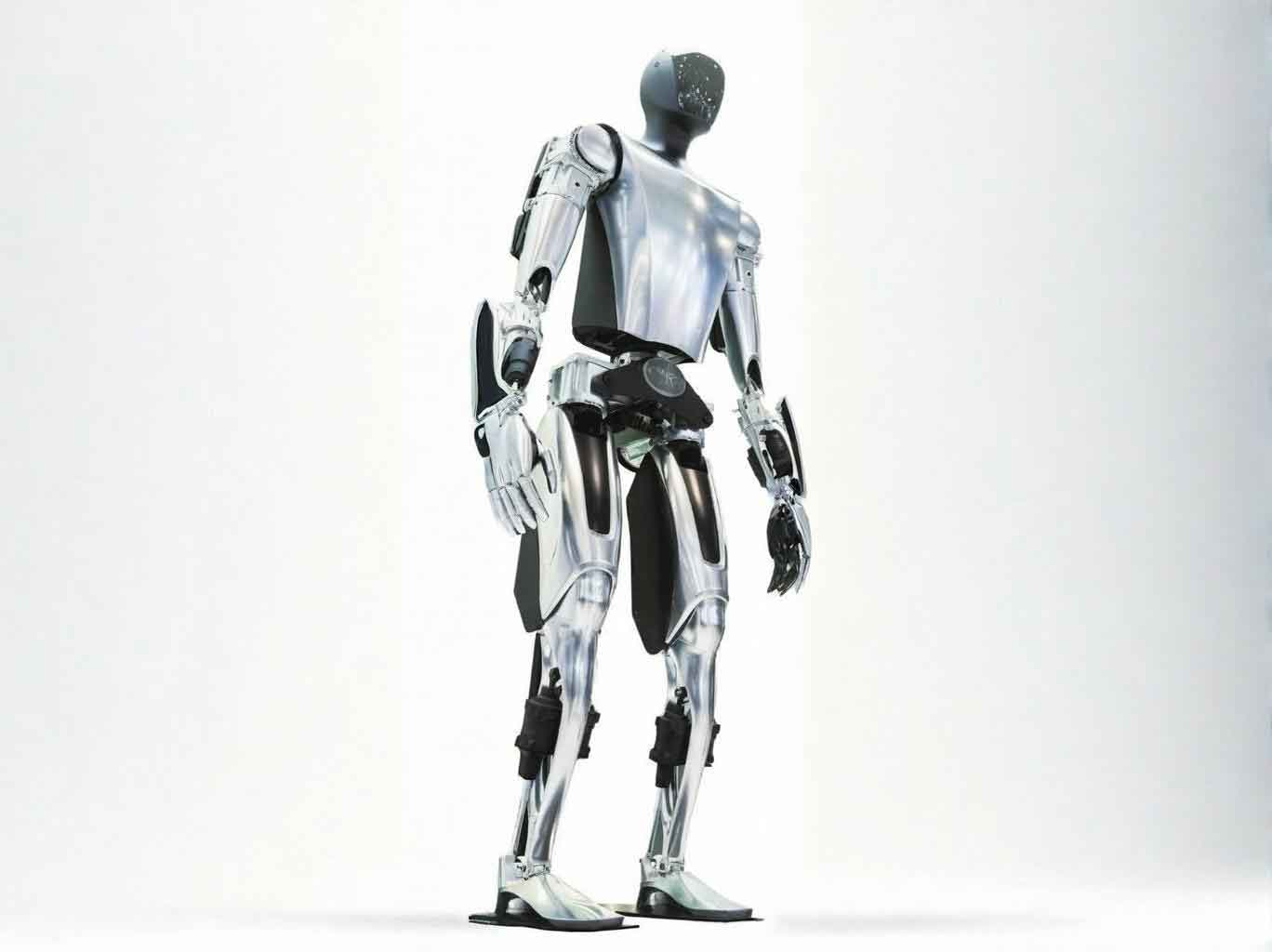
Multi-Level Application of Embodied AI Robots in Flexible Manufacturing
1. Logistics Layer: Cellular Production and AGV-Robot Synergy
At the macro-logistics level, flexible manufacturing adopts a cellular or “island-based” layout. The production flow is decomposed into self-contained process islands (e.g., engine head sub-assembly, piston-rod assembly). The embodied AI robot operates within these cells, while Automated Guided Vehicles (AGVs) manage the material transport between them. The true flexibility emerges from their synergy. A mobile manipulator—an AGV integrated with a robotic arm—acts as a super-flexible embodied AI robot, performing “last-meter” material handling, precise kitting, and even on-the-move inspections. This decouples process timing from fixed conveyor speeds, allowing asynchronous production flow.
2. Equipment Layer: The Modular, Low-Code Smart Robot Platform
At the workstation level, the embodied AI robot is the core of modular process units. Complex tasks like screwdriving, dispensing, or press-fitting are broken down into standardized, plug-and-play modules. The innovation lies in a low-code control platform that allows rapid reconfiguration. Instead of traditional time-intensive PLC reprogramming (taking 3-4 hours), process engineers can visually drag-and-drop pre-validated functional blocks (e.g., “Pick Screw,” “Torque Tighten,” “Verify Torque”) to define a new assembly sequence. This reduces changeover time to under 15 minutes.
The adaptive control of an embodied AI robot during a critical process like precision insertion can be described by an impedance control model, allowing compliant interaction with the environment:
$$
F = M_d(\ddot{x}_d – \ddot{x}) + B_d(\dot{x}_d – \dot{x}) + K_d(x_d – x)
$$
where $F$ is the interaction force, $x_d$ and $x$ are the desired and actual positions, and $M_d$, $B_d$, $K_d$ are the desired inertia, damping, and stiffness matrices adjusted in real-time by the cognitive layer based on force-torque sensor feedback.
| Module Name | Configurable Parameters | Output to System |
|---|---|---|
| Vision Locate | Template ROI, Tolerance | Workpiece Coordinates (x, y, θ) |
| Pick Fastener | Feeder ID, Suction Force | Pick Success/Fail Status |
| Adaptive Tighten | Target Torque, Angle, Speed Profile | Final Torque, Angle, Curve Data |
| Quality Check | Torque-Angle Window, OK/NOK Limits | Pass/Fail Judgment, Defect Code |
3. Information Layer: The Upgraded, Cognitive MES System
The Manufacturing Execution System (MES) evolves from a passive tracker to an active, cognitive orchestrator—the “central nervous system” interacting with multiple embodied AI robots. The upgraded MES features digital twin integration, creating a virtual replica of the physical line. This allows for simulation and validation of new production schedules or layouts before implementation. It dynamically dispatches tasks to the most suitable embodied AI robot or AGV based on real-time OEE (Overall Equipment Effectiveness) data, which is calculated as:
$$
OEE = Availability \times Performance \times Quality
$$
Where $Availability = \frac{Runtime}{Planned Time}$, $Performance = \frac{Ideal Cycle Time \times Total Count}{Runtime}$, and $Quality = \frac{Good Count}{Total Count}$. The MES uses this and other sensor data to predict maintenance needs and prevent downtime.
Case Study: A Flexible Engine Assembly Line
Background: A leading automotive manufacturer required a high-mix engine assembly line capable of producing multiple engine variants with minimal changeover time, replacing a rigid, model-dedicated line.
Solution: A fully flexible cell-based line centered on embodied AI robots and AGVs was implemented. The line was divided into major process islands: Cylinder Head Sub-assembly, Piston-Rod Sub-assembly, and Main Assembly Line. AGVs facilitated material transport between islands, while robots within each cell performed all precise operations.
Implementation and Results
Logistics Layer Hardware:
| Hardware Component | Quantity | Function |
|---|---|---|
| Cylinder Head AGV | 4 | Transport head sub-assemblies to main line |
| Kitting AGV | 5 | Deliver piston-rod kits and small parts |
| Engine Pallet AGV | 28 | Carry engine block through main assembly stations |
Equipment Layer – Smart Fastening: A low-code smart screwdriving platform was deployed. For a model change requiring a different bolt type and torque pattern, the reconfiguration was done via a graphical interface in ~15 minutes, versus the previous 3-4 hours of manual reprogramming.
Information Layer – Cognitive MES: The MES managed dynamic routing. Each AGV-pallet carrying an engine block was assigned an optimal sequence of stations based on the engine variant. The system provided visual work instructions at each embodied AI robot station and collected comprehensive traceability data (torque curves, leak test results, vision inspection images).
Key Outcomes:
- Extreme Flexibility: Introducing a new engine variant now only requires updating software (robot paths, MES routing), with no physical line rearrangement.
- Enhanced Quality: In-process inspection by embodied AI robots (vision, force) immediately identifies defects. Non-conforming products are autonomously diverted to a rework cell by AGVs.
- Data-Driven Transparency: Full digital traceability and real-time OEE dashboards enable proactive management and continuous improvement.
Future Trends and Persistent Challenges
Evolutionary Trends
The future lies in the deeper convergence of the embodied AI robot with broader digital technologies. We will see:
- Self-Evolving Systems: Embodied AI robots will employ lifelong learning algorithms to continuously optimize their own performance and strategies based on production data, moving from pre-programmed flexibility to learned adaptability.
- Hyper-Automation: The integration of embodied AI robots with AI-based process mining and discovery tools will enable the automatic identification and automation of new, previously manual tasks.
- Swarm Intelligence: Fleets of heterogeneous embodied AI robots (mobile manipulators, stationary arms, drones) will collaborate in a decentralized manner, dynamically forming and dissolving teams to tackle complex production tasks.
The mathematical formulation for such a multi-robot scheduling problem could evolve into a distributed optimization:
$$
\min_{A_i} \sum_i C_i(A_i, \mathcal{I}_i) \quad \text{subject to} \quad \bigcup_i A_i = \mathcal{T}, \ A_i \cap A_j = \emptyset \ \text{for} \ i \neq j
$$
where $A_i$ is the task allocation for robot $i$, $C_i$ is its local cost function, $\mathcal{I}_i$ is its local information set, and $\mathcal{T}$ is the total task set. Robots would negotiate to find a near-optimal global solution.
Challenges and Strategic Recommendations
Despite the promise, significant hurdles remain:
1. Data Governance and Standardization: The heterogeneous data generated by sensors, robots, and legacy machines poses immense integration challenges. Strategy: Invest in Industrial DataOps platforms and advocate for industry-wide semantic data models (e.g., Asset Administration Shell).
2. Integration Complexity: Merging IT (MES, ERP), OT (robot controllers, PLCs), and AI layers is non-trivial. Strategy: Adopt modular, microservices-based platform architectures (e.g., cloud-edge robotics) to manage complexity.
3. Skills Gap: A severe shortage of cross-disciplinary talent proficient in robotics, AI, and manufacturing engineering exists. Strategy: Foster deep industry-academia partnerships for curriculum co-development, hands-on “innovation factory” training, and continuous upskilling programs for the current workforce.
Conclusion
The transition to flexible, responsive, and efficient manufacturing is inexorably linked to the advancement and deployment of the embodied AI robot. By framing the manufacturing challenge through the lens of Embodied Intelligence, we can design systems where physical agency and cognitive processing are unified. As demonstrated, a multi-level approach—spanning agile logistics with AGV-robot synergy, modular and reconfigurable equipment platforms, and a cognitive, data-fusion MES—delivers transformative gains in flexibility, quality, and productivity. The embodied AI robot is not merely a tool but an autonomous participant in the manufacturing process, capable of perceiving uncertainty, planning around it, and executing with precision. This paradigm is foundational to developing the new qualitative productive forces that will define the future of global industry.