
In the field of precision transmission systems, the rotary vector reducer stands out as a critical component due to its high reduction ratio, efficiency, and overload capacity. As an engineer specializing in mechanical design and robotics, I have extensively studied the impact of manufacturing errors on the transmission accuracy of rotary vector reducers. This article presents a comprehensive analysis based on tooth contact analysis (TCA) methods, focusing on how various machining errors influence transmission error and how to optimize tolerance levels under reliability constraints. The goal is to provide insights that balance precision and cost in manufacturing rotary vector reducers.
The rotary vector reducer, commonly referred to as an RV reducer, is widely used in industrial robots, machine tools, and other high-precision applications. Its performance heavily depends on minimizing transmission errors, which are primarily caused by manufacturing inaccuracies such as gear profile deviations, assembly misalignments, and part tolerances. In my research, I developed a detailed TCA model that incorporates tooth profile modifications, machining errors, and assembly errors for both the involute gear stage and the cycloidal pinwheel stage of the rotary vector reducer. This model allows for the prediction of transmission errors and the assessment of sensitivity to different error sources.
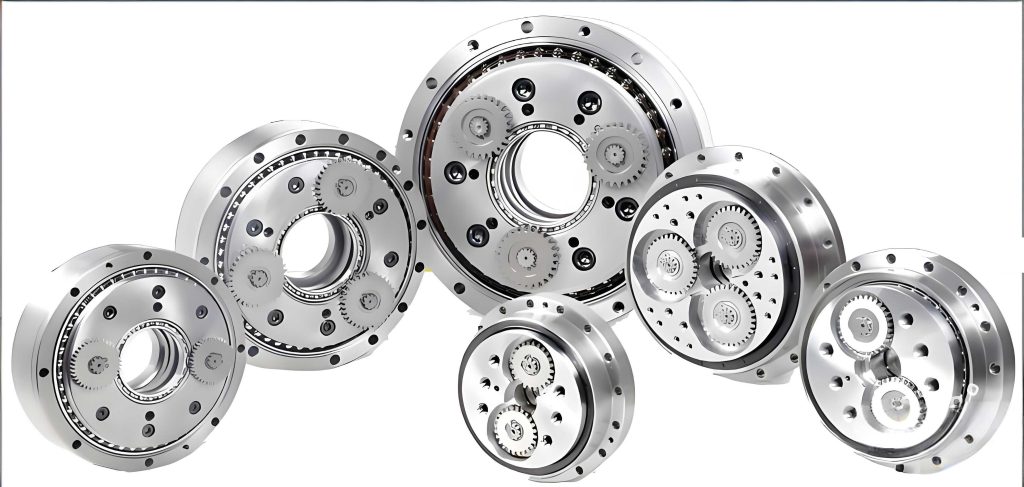
To begin, I established the geometric models for the involute gears and cycloidal gears, considering common profile modifications. For the involute gear stage, which serves as the first reduction stage in a rotary vector reducer, the tooth profile is generated using a rack-cutter method. The parametric equation in the gear coordinate system can be expressed as follows, where $u$ is the profile parameter and $\theta$ is the rotation angle:
$$ r_w(u, \theta) = \begin{bmatrix} \rho(\cos \theta + \theta \sin \theta) – \sin \theta \left( \frac{m\pi}{4} + u \sin \alpha_n – u \cos \alpha_n \cos \theta \right) \\ \rho(\sin \theta – \theta \cos \theta) + \cos \theta \left( \frac{m\pi}{4} + u \sin \alpha_n – u \cos \alpha_n \sin \theta \right) \\ 0 \\ 1 \end{bmatrix} $$
Here, $\rho$ is the pitch radius, $m$ is the module, and $\alpha_n$ is the pressure angle. For the cycloidal gear stage, which is the second reduction stage in a rotary vector reducer, I integrated both equidistant and offset profile modifications. The cycloidal tooth profile in its local coordinate system is given by:
$$ x_c = (R_p + \Delta R_p) \cos \frac{\phi_p}{n_c} + (R_{rp} + \Delta R_{rp}) \cos \left( \alpha – \frac{\phi_p}{n_c} \right) – e \cos \frac{\phi_p n_p}{n_c} $$
$$ y_c = – (R_p + \Delta R_p) \sin \frac{\phi_p}{n_c} + (R_{rp} + \Delta R_{rp}) \sin \left( \alpha – \frac{\phi_p}{n_c} \right) – e \sin \frac{\phi_p n_p}{n_c} $$
In these equations, $R_p$ is the pin position radius, $R_{rp}$ is the pin radius, $e$ is the crank eccentricity, $n_c$ and $n_p$ are the numbers of cycloidal gear teeth and pins, respectively, and $\Delta R_p$ and $\Delta R_{rp}$ are modification amounts. The parameter $\alpha$ is derived from the engagement condition. These equations form the basis for the TCA of the rotary vector reducer.
Next, I constructed the TCA equations by unifying the coordinate systems for both transmission stages. For the involute gear pair, the contact conditions require that the position vectors and unit normal vectors of the sun gear and planetary gear match in a fixed coordinate system. Similarly, for the cycloidal pinwheel pair, the contact between the cycloidal gear and the pins must satisfy analogous conditions. The combined TCA equations result in a system of six equations with six unknowns, which can be solved numerically to determine the output rotation angle $\phi_{out}$ for a given input angle $\phi_{in}$. The transmission error $\Delta \phi_{out}$ is then computed as the deviation from the ideal output angle based on the theoretical reduction ratio $z$:
$$ \Delta \phi_{out} = \max(\phi_{out}) – \frac{\phi_{in}}{z} $$
This transmission error metric is crucial for evaluating the performance of a rotary vector reducer under various manufacturing errors.
Manufacturing errors in a rotary vector reducer arise from multiple sources. I focused on key non-standard components, including errors in the involute gears (e.g., eccentricity and pitch errors) and the cycloidal stage (e.g., pin radius error, pin position error, cycloidal gear pitch error, and crank eccentricity error). To incorporate these into the TCA model, I modified the geometric equations accordingly. For instance, the pin tooth profile with errors becomes:
$$ r_p = \begin{bmatrix} R_p \cos \left( i \frac{2\pi}{n_p} \right) + (R_{rp} + d_r) \cos \beta + d_R \cos \theta_e \\ R_p \sin \left( i \frac{2\pi}{n_p} \right) + (R_{rp} + d_r) \sin \beta + d_R \sin \theta_e \\ 0 \\ 1 \end{bmatrix} $$
where $d_r$ is the pin radius error, $d_R$ is the pin position error, and $\theta_e$ is the pin angular error. For the cycloidal gear, the pitch error $E_{pr}$ is converted to an angular error $\theta_c = E_{pr} / (R_p – R_{rp})$, which is applied as a rotational transformation. Similarly, errors in the involute gears, such as sun gear eccentricity $d_{es}$ and planetary gear eccentricity $d_{ep}$, are embedded in the coordinate transformation matrices. These adjustments allow the TCA model to simulate the effects of real-world manufacturing imperfections on the rotary vector reducer.
To quantify the impact of each error type, I conducted a sensitivity analysis. By varying individual errors within a range of ±0.01 mm, I calculated the resulting changes in transmission error. The sensitivities, expressed as the slope of the transmission error versus error magnitude, are summarized in the table below. This analysis highlights which errors most significantly affect the performance of a rotary vector reducer.
| Error Type | Sensitivity (arcsec/mm) |
|---|---|
| Pin radius error | -1189 |
| Pin position error | 16327 |
| Crank eccentricity error | -50 to -1540 |
| Cycloidal gear cumulative pitch error | 8934 |
| Sun gear cumulative pitch error | 2809 |
| Planetary gear cumulative pitch error | 2931 |
| Sun gear eccentricity error | 3954 |
| Planetary gear eccentricity error | 3781 |
From this table, it is evident that pin position error and cycloidal gear pitch error have the highest sensitivities, meaning they greatly influence transmission error in a rotary vector reducer. In contrast, pin radius error and crank eccentricity error show lower sensitivities. These findings guide the selection of tolerance levels: errors with high sensitivity may require tighter tolerances (e.g., IT5 grade), while those with low sensitivity can accommodate looser tolerances (e.g., IT6 grade) to reduce manufacturing costs without compromising accuracy.
Building on the sensitivity results, I developed a reliability-based method for optimizing manufacturing tolerances in rotary vector reducers. The reliability here refers to the probability that the reducer operates without interference (e.g., collision between gears) and meets a specified transmission error limit. Using Monte Carlo simulation, I generated random error samples based on Gaussian distributions corresponding to different tolerance grades—IT5 and IT6, as per international standards. The standard deviations for these grades are derived from typical tolerance values for the dimensions involved in a rotary vector reducer.
For the reliability analysis, I defined a sample size of 20,000 to ensure a low error margin in reliability estimation, as per the formula:
$$ \epsilon\% = \sqrt{\frac{p}{M_s \times (1 – p)}} \times 200\% $$
where $p$ is the reliability and $M_s$ is the sample size. With $p = 0.98$, a sample size of 20,000 yields an error below 10%. For each sample, I checked for interference by calculating the minimum distance between the cycloidal profile and pin centers. If no interference occurred, I computed the transmission error. The reliability is then the proportion of samples that pass both interference and error criteria.
I evaluated three tolerance allocation scenarios for the rotary vector reducer: all errors at IT5, all at IT6, and a mixed approach with high-sensitivity errors at IT5 and low-sensitivity errors at IT6. The mixed allocation is detailed in the following table, which aligns with the sensitivity analysis to balance precision and cost.
| Error Type | IT5 Allocation | IT6 Allocation | Mixed Allocation (IT5/IT6) |
|---|---|---|---|
| Pin radius error | IT5 (0.005 mm) | IT6 (0.008 mm) | IT6 (0.008 mm) |
| Crank eccentricity error | IT5 (0.004 mm) | IT6 (0.006 mm) | IT5 (0.004 mm) |
| Cycloidal gear pitch error | IT5 (0.020 mm) | IT6 (0.028 mm) | IT5 (0.020 mm) |
| Involute gear pitch error | IT5 (0.016 mm) | IT6 (0.020 mm) | IT6 (0.020 mm) |
| Sun gear eccentricity error | IT5 (0.011 mm) | IT6 (0.016 mm) | IT6 (0.016 mm) |
| Planetary gear eccentricity error | IT5 (0.011 mm) | IT6 (0.016 mm) | IT6 (0.016 mm) |
The reliability results for these scenarios are as follows: the IT5-only case achieved a reliability of 98.03%, the IT6-only case 96.09%, and the mixed allocation 98.16%. This indicates that the mixed approach, which assigns IT5 to critical errors like cycloidal gear pitch and crank eccentricity while using IT6 for less sensitive errors, can achieve similar or even better reliability than full IT5 grading. Moreover, the distribution of transmission errors across samples shows that the mixed allocation yields error concentrations comparable to IT5, primarily in the range of 60 to 100 arcseconds, whereas IT6 leads to slightly higher errors (80 to 100 arcseconds). Thus, for a rotary vector reducer, optimizing tolerance grades based on sensitivity can effectively maintain high reliability while lowering production costs.
In conclusion, my analysis demonstrates that manufacturing errors significantly impact the transmission accuracy of rotary vector reducers. Through detailed TCA modeling and sensitivity assessment, I identified pin position error and cycloidal gear pitch error as the most influential factors. By implementing a reliability-based tolerance optimization strategy, I showed that selective use of IT5 and IT6 grades can ensure a reliability above 98% for the rotary vector reducer, comparable to using all IT5 tolerances but at reduced cost. This approach provides a practical framework for manufacturers to enhance the precision and affordability of rotary vector reducers in high-demand applications. Future work could extend this method to dynamic loading conditions or incorporate more complex error distributions for further refinement.
The mathematical models and simulations presented here underscore the importance of integrating geometric accuracy with statistical reliability in the design of rotary vector reducers. As the demand for high-performance robotics grows, such optimization techniques will become increasingly valuable for advancing transmission system technology. Throughout this study, the rotary vector reducer served as a focal point for exploring the interplay between manufacturing tolerances and operational reliability, highlighting its critical role in modern mechanical systems.