
As I observe the relentless expansion and increasing complexity of global urban rail transit (URT) networks, a fundamental question occupies my thoughts: how can we build an operation and maintenance (O&M) system that is not only resilient for today but can sustainably evolve for the next three decades? The answer, I am increasingly convinced, lies not in incremental improvements to existing paradigms, but in a foundational shift powered by a specific form of artificial intelligence. The convergence of the physical and digital worlds through embodied AI robots presents the most compelling pathway to this future.
The traditional URT O&M model, largely based on scheduled inspections and manual diagnostics, is reaching its breaking point. Asset portfolios are massive and aging, skilled labor is scarce and costly, and the demand for near-perfect safety and availability has never been higher. While data collection has increased, the value locked within it—particularly for mechanical systems—remains largely untapped. We have moved from “humans finding problems” to “systems detecting faults,” but the holy grail of “machines predicting and preventing failures” requires a more intimate connection between intelligence and the physical environment. This is the precise domain of embodied intelligence.
In my view, embodied AI robot is not merely a mobile sensor platform. It represents the deep integration of perception, cognition, and action within a physical entity capable of autonomous interaction with complex, real-world settings. For URT environments—encompassing confined tunnels, vast depots, and equipment-rich stations—this capability is transformative. An embodied AI robot does not just see; it understands context. It doesn’t just collect data; it makes real-time decisions and can execute physical tasks. This creates a continuous, adaptive loop between the digital model and the physical asset, which is essential for a true full-lifecycle management system.
The challenges necessitating this shift can be starkly summarized. The predominant O&M models and their limitations are contrasted below:
| O&M Paradigm | Core Driver | Key Limitation in Modern URT | Resulting Systemic Risk |
|---|---|---|---|
| Manual & Experience-Driven | Human expertise and periodic checks | Inconsistent, non-scalable, prone to fatigue-based error, knowledge attrition | High hidden failure rates, unsustainable labor dependency |
| Sensor & Data-Driven (Current State-of-the-Art) | Fixed IoT sensors and historical fault databases | Limited spatial coverage (“blind spots”), poor adaptability to new failure modes, data richness without actionable insight | Predictive gaps, inability to address mechanical component aging proactively |
| Embodied Intelligence-Driven (The Future) | Autonomous, mobile embodied AI robots with multi-modal sensing and edge cognition | High initial integration complexity, requires new skill sets | Transforms risk into managed, predictable lifecycle parameters |
The economic and operational imperative for the third paradigm is clear. We can model the total cost of ownership (TCO) under the traditional model versus an embodied intelligence model. A simplified representation highlights the shift:
$$ \text{TCO}_{\text{Traditional}} = C_{\text{Capital}} + \sum_{t=1}^{L} (C_{\text{Labor}, t} + C_{\text{Reactive Repair}, t} + C_{\text{Downtime}, t}) $$
$$ \text{TCO}_{\text{Embodied}} = C_{\text{Capital}} + C_{\text{Robot & Platform}} + \sum_{t=1}^{L’} (C_{\text{Human Oversight}, t} + C_{\text{Predictive Parts}, t} + C_{\text{Planned Downtime}, t}) $$
Where \(L\) represents the often-shortened effective life due to unpredicted failures, and \(L’ > L\) represents an extended, optimized asset life. The key is that \(C_{\text{Reactive Repair}, t}\) and \(C_{\text{Downtime}, t}\) are high-variance, unpredictable costs in the traditional model, while in the embodied model, costs shift towards predictable, planned activities (\(C_{\text{Predictive Parts}, t}, C_{\text{Planned Downtime}, t}\)). The embodied AI robot is the agent that enables this transformation by generating the high-fidelity, context-rich data and actionable insights needed for precise prediction.
So, what does this look like in practice? The value of an embodied AI robot manifests across several interconnected dimensions:
1. Omnipresent, Multi-Modal Perception: An embodied AI robot transcends the limitations of fixed infrastructure. It navigates to the asset, deploying a suite of sensors—visible spectrum cameras, infrared thermal imagers, acoustic emission sensors, laser scanners, and gas detectors—in optimal configuration. This allows for holistic inspection of a train undercarriage, a tunnel wall, or a switch machine, creating a composite health signature impossible to obtain from static points. The robot acts as a dynamic, reconfigurable sensor network.
2. Real-Time Diagnosis and Prognostics: The intelligence is not deferred to the cloud. Powered by edge computing, the embodied AI robot processes data streams in real-time. A visual model instantly flags a crack below a certain width (\( \delta_c \)); an acoustic model identifies the anomalous friction signature (\( f(t) \)) of a failing bearing. Crucially, these discrete findings are synthesized. The robot doesn’t just report “crack” and “abnormal sound”; it correlates them, potentially diagnosing a primary structural issue causing secondary effects. This data feeds prognostic models that estimate remaining useful life (RUL), moving from condition monitoring to health management.
3. Codification and Evolution of Knowledge: Every inspection by an embodied AI robot is a learning opportunity. Detected anomalies, along with their context, are structured and fed back into central AI models. This creates a virtuous cycle: $$ A_{t+1} = A_t + \eta \cdot \Delta D_{\text{robot}} $$ where \(A\) represents algorithm accuracy, \( \eta \) is the learning rate, and \( \Delta D_{\text{robot}} \) is the novel, contextual data provided by the robot fleet. Tacit human expertise (“this sound means the gearbox is about to fail”) is gradually captured, quantified, and replicated, building a self-improving, institutional knowledge base.
4. The Human-Robot Synergy: The goal is not replacement, but elevation. The embodied AI robot assumes the “3D” tasks—dirty, dull, and dangerous. It performs midnight tunnel scans, inspects high-voltage compartments, and logs thousands of bolt torque measurements. This liberates human experts from routine collection and frees their cognitive capacity for deep analysis, complex decision-making, and strategy optimization. The human interprets the prognosis, plans the intervention, and oversees the execution, often guided by digital work instructions derived from the robot’s findings. This synergy amplifies both safety and intellectual ROI.
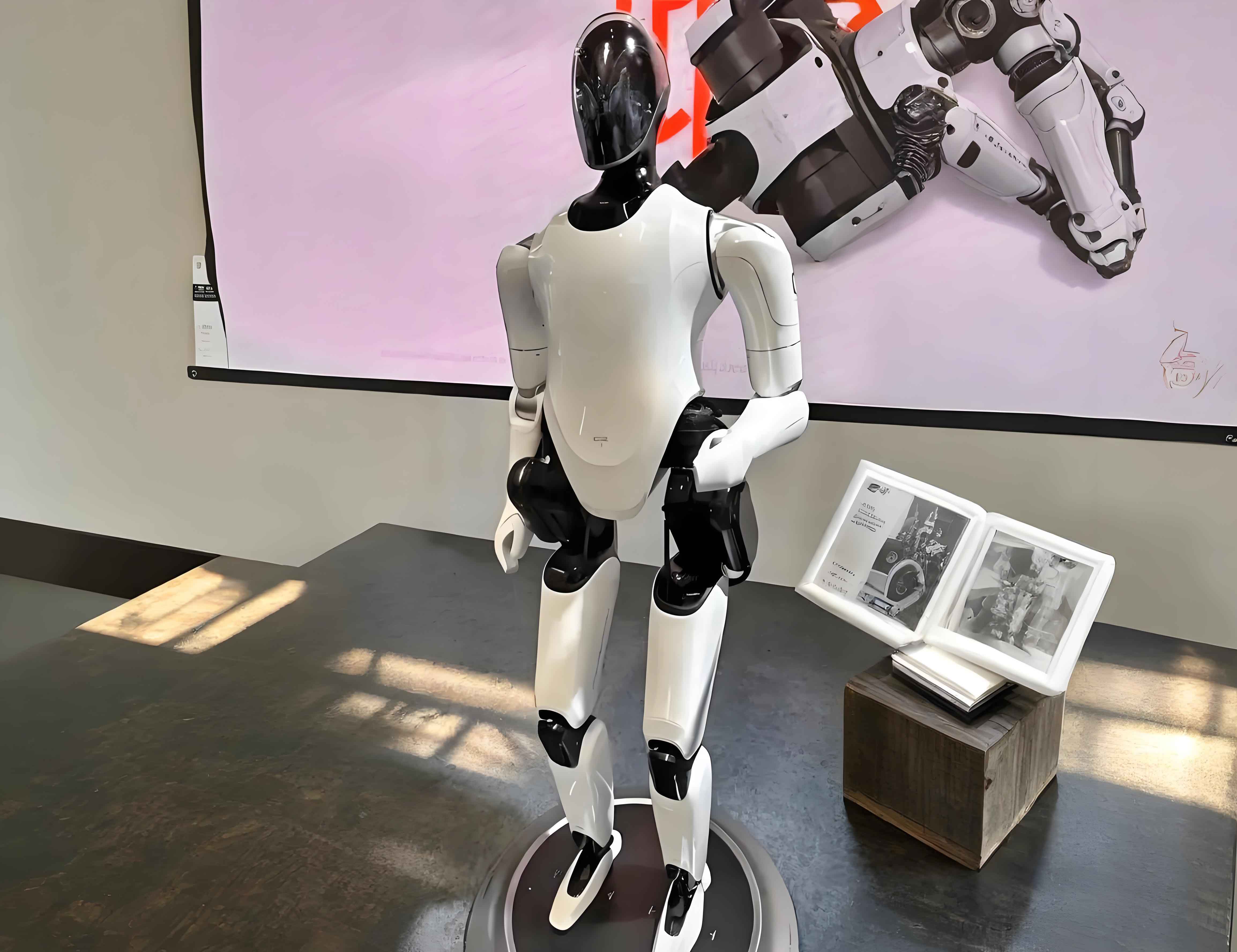
The integration of embodied AI robots is catalyzing a new industrial ecosystem, as visualized above, moving from isolated automation to a connected, intelligent value chain. This evolution underpins the reconstruction of the O&M system itself. We can formalize the core capabilities of the system around the robot:
| System Capability | Role of the Embodied AI Robot | Output & Value |
|---|---|---|
| Data Acquisition & Fusion | Mobile, multi-modal sensing node; provides spatial and temporal context. | Rich, 4D (3D + time) asset health digital twin. |
| State Detection & Diagnosis | Edge-based processing and pattern recognition; performs first-level analysis. | Real-time alerts, classified anomalies, root-cause hypotheses. |
| Prognosis & Lifecycle Optimization | Primary data source for degradation and usage models. | RUL forecasts, dynamic maintenance schedules, spare parts optimization. |
| Execution & Verification | Can be equipped for simple interventions (e.g., cleaning sensors, marking locations) and post-maintenance inspection. | Closed-loop verification of work quality, reduced human re-entry into hazardous zones. |
The mathematical essence of the embodied AI robot‘s cognitive loop in this system can be described as a continuous function: $$ \text{Action}_{t+1} = \pi(\text{State}_t, \text{Model}( \Theta, \text{Sensor}(\text{Env}_t, \text{Action}_t) )) $$ Here, \( \pi \) is the policy governing the robot’s decision (planning), based on the current perceived State and the output of an internal World Model (\( \text{Model} \)) with parameters \( \Theta \). This model is constantly updated by Sensor inputs from the Environment (\( \text{Env} \)) affected by the robot’s previous Action. This loop of perception, model-updating, planning, and action is what enables truly autonomous and adaptive O&M.
Ultimately, the value created is multidimensional. Financially, it directly reduces labor hours for inspection and lowers costs from unplanned outages and consequential damage. Operationally, it dramatically increases the early detection rate of critical faults, enhancing network safety and availability. Strategically, it transforms the workforce and business model. Technicians evolve into data analysts and system managers. The O&M function itself can evolve from a cost center into a value-generating service, potentially offering “Uptime-as-a-Service” guarantees, underpinned by the relentless, precise oversight of the embodied AI robot fleet.
The future URT O&M system will be a self-adapting organism. Its nervous system is the network of embodied AI robots, its brain is the cloud-based AI platform that learns from their experiences, and its conscious decision-makers are the human experts empowered by their synthesized intelligence. The foundational principles are data-driveness, intelligent decision-making, and continuous evolution. Embracing embodied intelligence is no longer a speculative technological choice; it is the fundamental engineering imperative for building urban rail systems that are safe, efficient, and sustainable for generations to come. The era of the embodied AI robot as the cornerstone of industrial O&M has arrived.