
Introduction
As a researcher deeply immersed in the field of robotics and medical technology, I have witnessed the transformative impact of medical robots on modern healthcare. The integration of robotics into medicine represents a convergence of multiple disciplines, including computer science, mechanical engineering, materials science, electronics, biomimetics, and control theory. Initially developed for industrial applications, robotics technology has rapidly expanded into the medical domain, offering unprecedented precision, minimal invasiveness, and enhanced patient outcomes. The journey of medical robots began in 1985 with the introduction of a robotic system for neurosurgical biopsies, which marked a pivotal moment in surgical assistance by improving accuracy in clinical procedures. Since then, advancements such as MRI-guided robotic systems in 1995, which offered six degrees of freedom and clearer imaging, and later developments like the NeuRobot for endoscopic operations, have steadily evolved. By 2007, the ROSA surgical robot system, incorporating navigation, multi-modal image fusion, and haptic feedback, gained widespread adoption in various surgeries. Today, medical robots are integral to minimally invasive surgery, outperforming traditional laparoscopic techniques in flexibility, stability, and precision. In this review, I aim to delve into the current research, application status, and future trends of medical robots, highlighting their advantages, limitations, and potential directions. The global market for medical robots has grown significantly, from $11.9 billion in 2017 to $20.7 billion in 2021, a 73.9% increase, while in China, the industry has maintained an annual growth rate of 30%, reaching a scale of ¥7.9 billion in 2021, with surgical robots accounting for 66.5% of that share. This growth underscores the critical role of medical robots in shaping the future of healthcare.
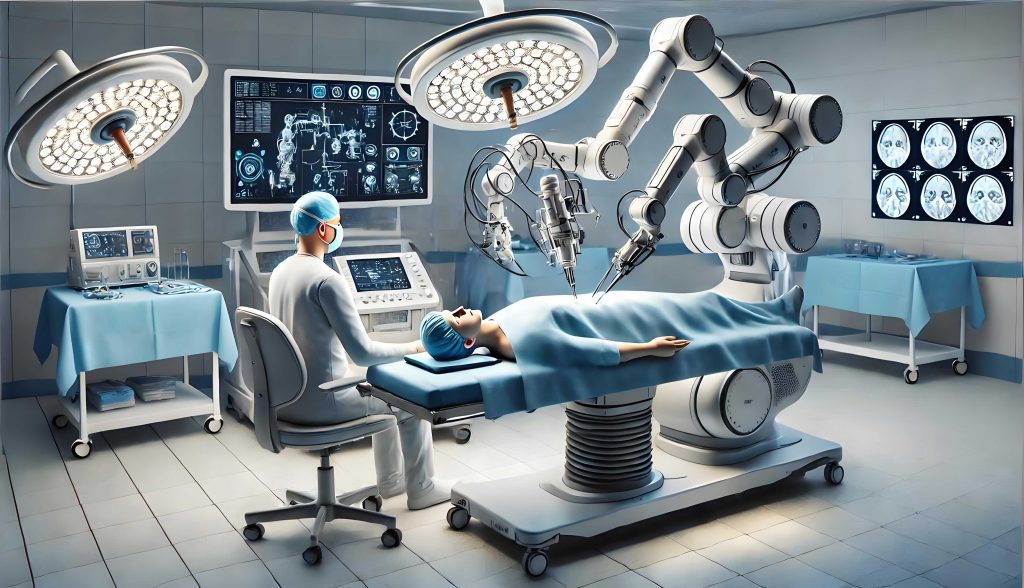
To illustrate the visual representation of medical robots in clinical settings, consider the following image that captures their application in surgery and rehabilitation. This depiction aligns with the rapid technological advancements discussed throughout this review.
Classification of Medical Robots
Medical robots are sophisticated devices that combine information systems, control mechanisms, mechanical structures, and imaging technologies to assist in diagnosis, treatment, and rehabilitation. They can be broadly categorized based on their clinical applications, such as surgical robots, rehabilitation robots, and social assistive robots. Surgical robots, in particular, dominate the market and are further divided into subtypes like orthopedic, endoscopic, neurosurgical, and remote surgery robots. Each type leverages unique technologies to address specific medical challenges, contributing to the overall efficacy of robotic-assisted procedures. The classification reflects the diverse functionalities of medical robots, which are designed to enhance human capabilities rather than replace them. In this section, I explore these categories in detail, emphasizing how medical robots have revolutionized various medical fields through innovative designs and applications.
The table below summarizes the key categories of medical robots, their primary applications, and representative systems, highlighting the diversity and specialization within the field.
| Category | Primary Applications | Representative Systems | Key Features |
|---|---|---|---|
| Surgical Robots | Minimally invasive surgery, precision operations | Da Vinci, ROSA, Tianji | High dexterity, 3D visualization, tremor filtering |
| Orthopedic Robots | Spinal surgery, joint replacement | Spine Assist, MAKO, Excelsius GPS | Accuracy in implant placement, haptic feedback |
| Endoscopic Robots | Laparoscopic procedures, natural orifice surgery | NeuRobot, “Miao Shou” series | Enhanced flexibility in confined spaces |
| Neurosurgical Robots | Stereotactic surgery, brain interventions | Neuromate, “Rui Mi” | Sub-millimeter precision, image guidance |
| Rehabilitation Robots | Motor recovery, cognitive training | Armeo Power, ReStore | Adaptive assistance, data tracking |
| Social Assistive Robots | Elderly care, emotional support | Resyone, companion robots | Human-robot interaction, daily task aid |
Surgical Robots: A Deep Dive
Surgical robots represent the most advanced segment of medical robots, offering unparalleled precision in complex procedures. These systems typically consist of a console for surgeon control, robotic arms with specialized instruments, and an imaging system for real-time visualization. The kinematics of a surgical robot can be described using mathematical models, such as the forward kinematics equation that relates joint angles to the end-effector position. For a robotic arm with n joints, the position and orientation of the end-effector can be expressed as: $$ \mathbf{x} = f(\mathbf{q}) $$ where $\mathbf{x}$ is the pose vector in Cartesian space, and $\mathbf{q}$ is the joint angle vector. This formulation allows for precise control, which is critical in surgeries where millimeter-level accuracy is required. The dynamics of a medical robot can further be modeled using Lagrangian mechanics: $$ \tau = M(\mathbf{q})\ddot{\mathbf{q}} + C(\mathbf{q}, \dot{\mathbf{q}})\dot{\mathbf{q}} + G(\mathbf{q}) $$ where $\tau$ is the torque vector, $M$ is the inertia matrix, $C$ represents Coriolis and centrifugal forces, and $G$ accounts for gravitational effects. Such models enable the development of stable control algorithms that enhance the performance of medical robots in volatile surgical environments.
Orthopedic surgical robots, for instance, have evolved from early systems like ROBODOC to modern platforms like MAKO, which incorporate haptic feedback to prevent bone damage during joint replacements. The accuracy of these medical robots can be quantified using error metrics, such as the root-mean-square error (RMSE) between planned and actual implant positions: $$ \text{RMSE} = \sqrt{\frac{1}{N} \sum_{i=1}^{N} (\mathbf{p}_{\text{planned},i} – \mathbf{p}_{\text{actual},i})^2} $$ where N is the number of measurement points. Clinical studies report RMSE values below 1 mm for systems like Tianji, demonstrating the high precision of medical robots in orthopedic applications. Similarly, endoscopic surgical robots, exemplified by the Da Vinci system, provide magnified 3D views and wristed instruments that mimic human hand movements, overcoming the limitations of traditional laparoscopy. The control law for such robots often includes impedance control to ensure safe interaction with tissues: $$ F = K_p e + K_d \dot{e} $$ where $F$ is the force applied, $e$ is the position error, and $K_p$ and $K_d$ are proportional and derivative gains. This approach minimizes trauma and improves patient recovery times, showcasing the advantages of medical robots in minimally invasive surgery.
Remote Surgery and 5G Integration
The advent of 5G technology has propelled remote surgery into a new era, enabling surgeons to operate on patients across vast distances with minimal latency. Remote surgical robots rely on teleoperation principles, where the master console transmits commands to the slave robot via high-speed networks. The time delay $\Delta t$ in such systems can be modeled as: $$ \Delta t = t_{\text{transmission}} + t_{\text{processing}} $$ where $t_{\text{transmission}}$ depends on network bandwidth and distance, and $t_{\text{processing}}$ involves data encoding and decoding. With 5G offering peak rates up to 20 Gbps and latency reduced to milliseconds, remote surgery has become feasible, as demonstrated in trials like transatlantic telesurgery in 2001 and recent 5G-assisted procedures in China. The stability of these medical robots under network constraints can be analyzed using control theory, such as the passivity framework to ensure robustness against delays: $$ \int_0^T \mathbf{u}^T(t) \mathbf{y}(t) dt \geq 0 $$ where $\mathbf{u}$ and $\mathbf{y}$ are input and output vectors, respectively. This inequality guarantees that the system does not generate energy, preventing instability during remote operations. The integration of 5G with medical robots not only expands access to healthcare but also paves the way for future innovations like 6G-based systems, which promise even lower latency and higher reliability.
Rehabilitation and Social Assistive Robots
Beyond surgery, medical robots play a crucial role in rehabilitation and social assistance, addressing the growing needs of aging populations and individuals with disabilities. Rehabilitation robots, such as exoskeletons, employ sensor-based control to provide adaptive support during gait training. The assistive torque $\tau_a$ generated by these robots can be expressed as: $$ \tau_a = K_s (q_d – q) + B_s (\dot{q}_d – \dot{q}) $$ where $K_s$ and $B_s$ are stiffness and damping coefficients, $q_d$ is the desired joint angle, and $q$ is the actual angle. This proportional-derivative control helps patients regain motor function through repetitive, data-driven exercises. Studies show that using rehabilitation robots can improve mobility scores by up to 30% in stroke survivors, highlighting their therapeutic value. Social assistive robots, on the other hand, focus on human-robot interaction, using natural language processing and emotion recognition to offer companionship and daily living aid. The effectiveness of these medical robots can be measured through user engagement metrics, such as interaction time and satisfaction surveys. For example, robots like Resyone have reduced caregiver burden by automating transfers between beds and wheelchairs, demonstrating the multifaceted applications of medical robots in non-surgical settings.
The table below compares the key performance indicators of different types of medical robots, illustrating their impact on healthcare outcomes.
| Robot Type | Precision (Error Range) | Clinical Benefits | Common Applications |
|---|---|---|---|
| Orthopedic Robots | < 1 mm | Reduced surgery time, lower complication rates | Spinal fusion, knee replacement |
| Endoscopic Robots | 1-2 mm | Smaller incisions, faster recovery | Prostatectomy, hysterectomy |
| Neurosurgical Robots | < 1 mm | Minimized brain trauma, accurate targeting | Biopsy, deep brain stimulation |
| Rehabilitation Robots | N/A (functional gains) | Improved motor function, reduced therapist workload | Stroke rehab, spinal cord injury |
| Social Assistive Robots | N/A (interaction quality) | Enhanced quality of life, emotional support | Elderly care, autism therapy |
Advantages of Medical Robots
The advantages of medical robots are manifold, stemming from their ability to enhance human precision and consistency. Compared to traditional open or laparoscopic surgery, robotic-assisted procedures offer superior visualization through high-definition 3D imaging, elimination of physiological tremors via filtering algorithms, and increased dexterity in confined anatomical spaces. Mathematically, the tremor reduction can be modeled as a low-pass filter in the control system: $$ G(s) = \frac{1}{1 + \tau s} $$ where $\tau$ is the time constant that attenuates high-frequency hand movements. This results in smoother instrument motion, reducing the risk of tissue damage. Additionally, medical robots often incorporate haptic feedback, though it remains a developing area, to provide force sensations to the surgeon. The benefits extend to patient outcomes: for instance, in endometrial cancer surgery, robotic approaches have been associated with lower conversion rates to open surgery, shorter hospital stays, and increased lymph node yields. The learning curve for surgeons is also accelerated with medical robots; while laparoscopic techniques may require 40-90 cases for proficiency, robotic systems can be mastered in 15-25 cases, as shown in thyroid surgery studies. This efficiency is quantified by the learning curve equation: $$ T(n) = T_0 + \alpha e^{-\beta n} $$ where $T(n)$ is the surgery time for the n-th case, $T_0$ is the asymptotic time, and $\alpha$ and $\beta$ are constants reflecting the learning rate. Such advantages underscore why medical robots are becoming indispensable in modern operating rooms.
Limitations and Challenges
Despite their promise, medical robots face significant limitations that hinder widespread adoption. The high cost of acquisition, installation, and maintenance poses a substantial barrier, particularly in resource-limited settings. A cost-benefit analysis can be expressed as: $$ \text{CBR} = \frac{\sum \text{Benefits}}{\sum \text{Costs}} $$ where benefits include reduced complication rates and shorter recovery times, but costs often exceed millions of dollars per system, leading to a CBR that may not justify investment in all healthcare facilities. Moreover, current medical robots lack full autonomy, requiring constant human supervision, which limits their scalability. The reliance on pre-programmed algorithms also introduces risks, such as software failures or mechanical errors that could harm patients. From a control perspective, the robustness of a medical robot can be assessed using Lyapunov stability theory: $$ V(\mathbf{x}) > 0, \quad \dot{V}(\mathbf{x}) < 0 $$ for all states $\mathbf{x}$, but achieving this in dynamic surgical environments remains challenging. Ethical concerns, including accountability for robotic errors and the potential dehumanization of care, further complicate the integration of medical robots. These limitations highlight the need for ongoing research to improve affordability, reliability, and ethical frameworks surrounding medical robots.
Future Trends and Directions
The future of medical robots is poised for groundbreaking advancements, driven by trends toward miniaturization, enhanced intelligence, and deeper integration with emerging technologies. Minimally invasive and non-invasive approaches, such as nanorobots for targeted drug delivery, represent a frontier where medical robots could operate at cellular levels. The motion of a nanorobot in a fluid environment can be described by the Stokes equation: $$ \nabla p = \mu \nabla^2 \mathbf{u} $$ where $p$ is pressure, $\mu$ is viscosity, and $\mathbf{u}$ is velocity, but at nanoscales, Brownian motion also plays a role. Research in DNA-based nanorobots has shown promise in cancer therapy, with efficacy models indicating tumor reduction rates higher than conventional chemotherapy. Another trend is the fusion of medical robots with advanced imaging modalities, such as real-time MRI or ultrasound, to improve spatial registration of soft tissues. This can be formulated as an optimization problem: $$ \min_{\mathbf{T}} \| I_{\text{robot}} – I_{\text{image}} \|^2 $$ where $\mathbf{T}$ is the transformation matrix aligning robotic coordinates with imaging data. Additionally, the development of haptic feedback systems is critical to restore tactile sensations for surgeons; force reflection can be modeled using Hooke’s law: $$ F = k \Delta x $$ where $k$ is stiffness and $\Delta x$ is displacement, but incorporating variable stiffness based on tissue properties is an active area of research. The integration of artificial intelligence (AI) will further enable autonomous functionalities, such as anomaly detection during surgery, using convolutional neural networks (CNNs): $$ y = \sigma(W * x + b) $$ where $y$ is the output, $x$ is the input image, $W$ are weights, $b$ is bias, and $\sigma$ is an activation function. These trends suggest that future medical robots will become more adaptive, collaborative, and integral to personalized medicine.
The table below outlines key future trends in medical robots, along with their potential impacts and associated technological challenges.
| Trend | Potential Impact | Technological Challenges | Expected Timeline |
|---|---|---|---|
| Nanorobots | Non-invasive disease treatment at cellular level | Power supply, navigation in vivo | 2030+ |
| AI Integration | Autonomous decision-making in surgery | Data privacy, algorithm transparency | 2025-2030 |
| 6G Remote Surgery | Ultra-low latency telesurgery worldwide | Network security, standardization | 2030+ |
| Haptic Feedback | Improved surgeon tactile perception | Sensor accuracy, real-time processing | 2025+ |
| Soft Robotics | Enhanced safety in human-robot interaction | Material durability, control complexity | 2030+ |
Conclusion
In conclusion, medical robots have revolutionized healthcare by offering precision, minimally invasive options, and improved patient outcomes across surgical, rehabilitation, and assistive domains. From their early beginnings in neurosurgery to the current era of 5G-enabled remote procedures, the evolution of medical robots reflects relentless innovation and interdisciplinary collaboration. The advantages of these systems, including enhanced dexterity, reduced learning curves, and better clinical results, are tempered by challenges like high costs, limited autonomy, and ethical considerations. Looking ahead, trends such as nanorobotics, AI integration, and advanced haptics promise to address these limitations, pushing medical robots toward greater autonomy and accessibility. As a researcher, I believe that the future of medical robots lies in their ability to complement human skills, ensuring that technology serves humanity without compromising safety or empathy. Continued investment in research, coupled with robust regulatory frameworks, will be essential to harness the full potential of medical robots in creating a smarter, more equitable healthcare ecosystem. The journey of medical robots is far from over, and their ongoing development will undoubtedly shape the next frontier of medical science.