
As a researcher immersed in the field of advanced robotics, I observe the evolution of legged machines not merely as a technological trend, but as a fundamental shift in how we conceive of machines interacting with the physical world. The bionic robot, particularly its quadrupedal embodiment, stands at the confluence of multiple disciplines—mechanics, electronics, control theory, computer science, sensor fusion, and artificial intelligence. It represents a quintessential mechatronic system where mechanization, informatization, and intellectualization converge. My focus is on understanding and advancing these machines, which are engineered to perform critical tasks in hazardous or complex terrains, from reconnaissance and search-and-rescue to inspection and payload delivery. Their defining characteristics—maneuverability, survivability, rapid response, and operational endurance—are derived from a bionic design philosophy that seeks to emulate the principles of biological locomotion.
The fundamental concept and advantage of legged systems lie in their discrete footfall strategy. Unlike wheeled or tracked vehicles that require a continuous support surface, a legged bionic robot utilizes independent footholds. This allows it to optimize support and traction point-by-point. Consequently, the mobility of a wheeled system is limited by the worst terrain feature along its path, while a legged system’s agility is bounded by the availability of viable footholds within reachable terrain. A further, critical advantage is the decoupling of the body’s path from the paths of the feet. This enables an effect analogous to active suspension, allowing the main body and its payload to move smoothly and steadily even as the terrain changes dramatically. The performance of a legged bionic robot thus becomes largely independent of ground roughness. This decoupling can be strategically exploited to enhance speed and energy efficiency over rugged landscapes. The mathematical representation of this body-foot decoupling in a simplified model can be expressed through the relationship between body velocity \( \dot{X}_b \) and foot placement \( p_f \):
$$ \dot{X}_b = J(\theta)^{-1} (\dot{p}_f – \frac{\partial J}{\partial \theta} \dot{\theta}) $$
Where \( J(\theta) \) is the Jacobian matrix mapping joint velocities \( \dot{\theta} \) to foot velocity \( \dot{p}_f \). Strategic planning of \( p_f \) allows for independent body trajectory control.
This paradigm has ignited global research and development. Supported by national strategic funding initiatives, the pursuit of high-dynamic, large-payload, and strongly adaptive quadruped bionic robots has become a focal point. Universities, research institutes, and corporations are demonstrating prototypes capable of traversing sand, gravel, stairs, and slopes, laying a practical foundation and significantly propelling technological advancement.
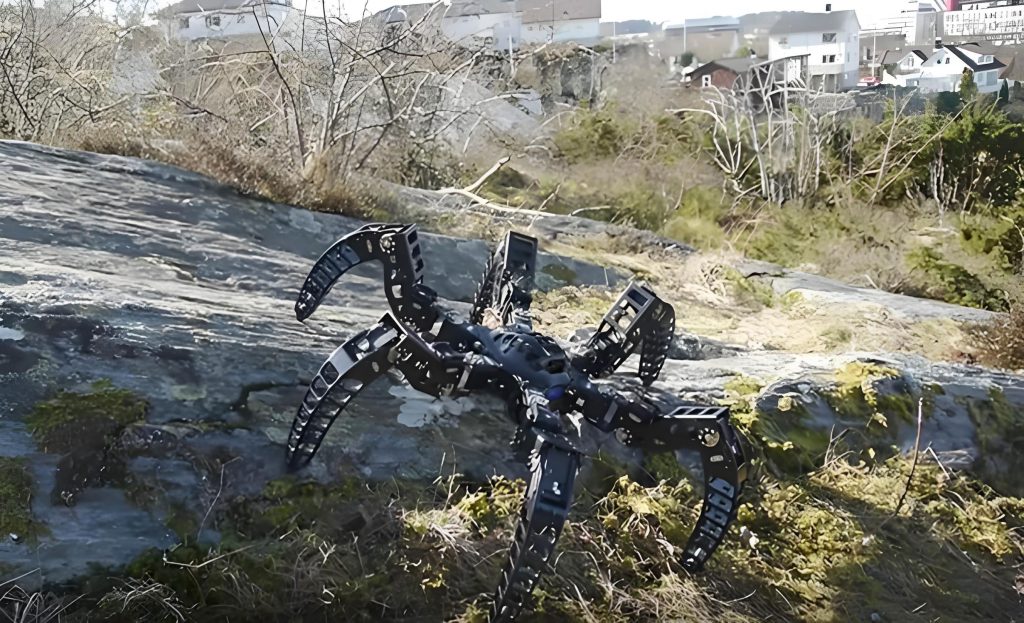
The engine of progress in this field is driven by a triad: demand-pull, problem-orientation, and technology-push. While societal and industrial needs for versatile robots are clear, the true catalyst for industry growth is the breakthrough of key technical bottlenecks. Intelligence is the essence of the machine’s way. Therefore, I will delineate the core technologies underpinning the modern quadruped bionic robot.
Core Technology Pillars of the Bionic Robot
1. Terrain Perception and Modeling
Animals navigating cliffs rely heavily on visual perception to adjust posture, gait, and rhythm. For a robot, the dynamic and coupled nature of its movement makes the real-time fusion of terrain data with proprioceptive state information crucial for stable control. The grand challenge is constructing a closed-loop behavioral control model integrating “Terrain Understanding and Behavioral Gait.” The prerequisite is terrain perception.
Autonomous dynamic obstacle negotiation primarily depends on environment perception via SLAM (Simulation Localization and Mapping) technology using vision or LiDAR. Core sensors like LiDAR and advanced cameras have seen mature development abroad. A quintessential example is a robot navigating urban environments using a front-mounted 3D vision system. Current research in autonomous mobility for legged platforms, while advancing, still grapples with issues like limited perceived elements, misjudgment, significant navigation drift, and inadequate synchronization between gait adaptation and perceptual input, leading to inaccurate foot placement.
The SLAM process can be summarized by its core Bayesian estimation framework, often implemented via a filter like the Extended Kalman Filter (EKF):
$$
\begin{aligned}
\text{Prediction:} & \quad \hat{x}_{k|k-1} = f(\hat{x}_{k-1|k-1}, u_k) \\
& \quad P_{k|k-1} = F_k P_{k-1|k-1} F_k^T + Q_k \\
\text{Update:} & \quad y_k = z_k – h(\hat{x}_{k|k-1}) \\
& \quad S_k = H_k P_{k|k-1} H_k^T + R_k \\
& \quad K_k = P_{k|k-1} H_k^T S_k^{-1} \\
& \quad \hat{x}_{k|k} = \hat{x}_{k|k-1} + K_k y_k \\
& \quad P_{k|k} = (I – K_k H_k) P_{k|k-1}
\end{aligned}
$$
Where \( x \) is the state vector (robot pose and map features), \( u \) is control input, \( z \) is observation, \( f \) and \( h \) are nonlinear motion and observation models, and \( F_k \), \( H_k \) are their Jacobians. \( Q_k \) and \( R_k \) represent process and measurement noise covariance.
2. Dynamic Gait and Stability Control
The field of bionics evolves through stages: morphological, structural, functional, and coupled imitation. The design inspiration for a quadruped bionic robot comes from animals, but its effectiveness hinges on replicating their fluid motion. Modern robots switch between walk, trot, pace, gallop, and even jump, enabled by multi-gait dynamic stability control. The mainstream approach involves: establishing a body pose control model based on virtual model control for sudden terrain changes or disturbances; creating a joint driving control model based on force distribution principles; analyzing the interaction between the platform and various ground types; and finally, implementing autonomous balance control via force feedback and slip-rate loops.
Gait and stability methodologies have crystallized into several dominant directions, as summarized below:
| Control Model | Core Principle | Key Characteristics | Exemplar Platform |
|---|---|---|---|
| Central Pattern Generator (CPG) | Neuronal oscillator networks generating rhythmic signals. | Bio-inspired, robust rhythmicity, simple modulation. | Early bio-robots, adaptive oscillators. |
| Spring-Loaded Inverted Pendulum (SLIP) | Template model reducing leg to a spring-mass system. | Captures core dynamics of running/hopping, energy-efficient. | Boston Dynamics robots (e.g., early BigDog). |
| Model Predictive Control (MPC) | Online optimization over a future horizon subject to dynamics/constraints. | Explicitly handles constraints, optimal future actions. | MIT Cheetah series. |
| Whole-Body Control (WBC) | Hierarchical optimization of task-space objectives and contact forces. | Full-body coordination, precise task execution. | MIT Cheetah, ANYbotics ANYmal (combined). |
| Machine Learning (ML) / Reinforcement Learning (RL) | Policy learned from data/simulation to map state to action. | Adaptive, can discover novel strategies, less reliant on accurate models. | ANYmal (for locomotion skills), Berkeley’s RL advances. |
The SLIP model dynamics for a single leg in stance can be described by:
$$ m \ddot{r} = mr\dot{\theta}^2 – k(r – r_0) + mg\cos\theta $$
$$ mr^2\ddot{\theta} + 2mr\dot{r}\dot{\theta} = -mgr\sin\theta $$
Where \( m \) is body mass, \( r \) and \( \theta \) are leg polar coordinates, \( k \) is spring constant, and \( r_0 \) is leg rest length. MPC, often used in conjunction, solves a finite-time optimal control problem at each step:
$$
\begin{aligned}
\min_{u_{0:N-1}} & \quad \sum_{k=0}^{N-1} (x_k^T Q x_k + u_k^T R u_k) + x_N^T P x_N \\
\text{s.t.} & \quad x_{k+1} = f(x_k, u_k), \quad k=0,\ldots,N-1 \\
& \quad g(x_k, u_k) \leq 0
\end{aligned}
$$
The trend is moving from fused algorithms towards self-evolving, learnable control architectures.
3. Swing Leg Trajectory and Foot Placement Planning
To enhance obstacle negotiation and task efficiency, the robot must make intelligent decisions post-environment perception. Real-time planning of the swing leg’s foot placement breaks the constraint of periodic, rhythmic motions ill-suited for complex terrains, enabling true intelligent behavior. The goal is to measure obstacles, create virtual boundaries, and adjust the behavioral rhythm accordingly.
Traditional methods like simple sinusoidal trajectory planning lack middle-point velocity constraints and flexibility for complex, segmented path fitting on uneven ground, increasing instability. A superior approach employs high-order Bézier curves. Defined by control points \( P_0, P_1, …, P_n \), a Bézier curve offers smooth, controllable paths:
$$ B(t) = \sum_{i=0}^{n} \binom{n}{i} (1-t)^{n-i} t^i P_i, \quad t \in [0,1] $$
This allows explicit planning of foot endpoint position, velocity, and acceleration with minimal control points, providing strong descriptive power for complex spatial paths. Once the foot trajectory \( p_f(t) \) is planned, joint angles \( \theta \) are computed via inverse kinematics: \( \theta = IK(p_f(t)) \).
4. Manipulation from a Floating Base
For a bionic robot to be functional, it must carry task payloads, with the robotic arm being the most versatile. Thus, manipulation technology from a floating base is the key to transitioning from a proof-of-concept to an industrial product. The core difficulty lies in the dynamic coupling: the arm controller must map the load at the end-effector to the robot’s center of mass (CoM). When grasping a heavy object, the weight must be estimated in real-time using joint sensor information and kinematic relations. An impedance control model is established at the arm’s end-effector:
$$ M_d (\ddot{x} – \ddot{x}_d) + B_d (\dot{x} – \dot{x}_d) + K_d (x – x_d) = F_{ext} $$
Where \( M_d, B_d, K_d \) are desired inertia, damping, and stiffness matrices; \( x, x_d \) are actual and desired end-effector poses; and \( F_{ext} \) is the external force. This load force model is then mapped to the robot’s CoM through the arm-base kinematic chain. The mapped force is integrated into the robot’s whole-body balance controller, which optimizes force distribution across supporting feet to achieve coordinated, stable whole-body control. This integration poses a significant “foot-eye-brain-hand” collaboration challenge. Its breakthrough will enable highly fused manipulation, elevating single-robot task ability and multi-robot cooperation for logistics, construction, domestic service, security, and rescue.
Typical Application Scenarios and Case Studies
A universal “cure-all” quadruped bionic robot remains unrealistic. Identifying typical application scenarios validates technological maturity and fuels industry growth. These robots are already stepping into reality, as shown below:
| Application Domain | Core Requirement | Robot Capabilities Demonstrated | Example Case |
|---|---|---|---|
| Counter-Terrorism & EOD | Safe approach to suspicious objects; traversal of complex, hazardous paths (stairs, rubble). | High terrain mobility, payload capacity for sensors (X-ray, chemical sniffer). | Quadruped robots deployed for remote inspection of potential explosive devices in military or police scenarios, acting as a mobile sensor platform. |
| Industrial Plant Inspection | Long endurance, precise navigation, ability to cross pipes and negotiate uneven factory floors, valve operation. | Autonomous navigation, precise foot placement, integrated manipulator for valve turning, visual recognition for gauge reading. | Testing of quadruped robots on offshore energy platforms for autonomous patrol and inspection tasks in complex industrial environments. |
| Public Security & Reconnaissance | Stealthy mobility in urban/indoor environments, real-time situational awareness. | Quiet operation, agile movement, high-definition video and thermal streaming. | Police departments using legged robots as mobile reconnaissance units for building clearance, suspect location, and surveillance in high-risk situations. |
| Search & Rescue / Public Safety | Operation in disaster debris (unstructured), payload versatility for victim detection (thermal, CO2), hazard sensing (gas). | Extreme terrain adaptability, payload interoperability, remote operation. | Deployment in parks for public safety announcements and crowd monitoring; potential use in disaster zones for victim localization and environment sensing. |
Prospect and Challenges
Robotics, hailed as the “pearl atop the crown of manufacturing,” is pivotal for innovation, national strength, and economic development. As a key research hotspot for the next generation of intelligent mobile robots, the agile, autonomous bionic robot is being vigorously pursued worldwide. National research initiatives have provided dedicated funding to advance this field.
Despite significant progress and a burgeoning industrial interest, a performance gap persists when comparing domestic products with international state-of-the-art. The discrepancies are evident in core technologies like bionic mechanisms, motion control, and autonomous navigation, as well as in key metrics such as power-to-weight ratio, joint drive unit performance, and autonomous task execution capabilities. The path forward necessitates concentrated efforts on fundamental research and development to overcome these bottlenecks.
In conclusion, the robot, a crystallization of modern science and technology, synthesizes mechanics, computing, control, and AI. It holds the promise of assisting or replacing humans in repetitive, heavy, or dangerous tasks, with profound social and economic impacts. The legged mobile robot is now transitioning from a stage focused on灵巧 mobility to one centered on mobile manipulation. The quadruped bionic robot, as a典型 platform for机动 operation in complex terrain, is destined to hold a lasting position within the特种 robotics industry. Intelligence remains the machine’s true path. The quest for industrial升级 and efficiency enhancement continues, demanding collaborative exploration and pioneering innovation in the realm of the bionic robot.