
The quest to create mobile machines capable of traversing complex, unstructured terrain with the agility and stability of living organisms has long been a central pursuit in robotics. Among the various solutions, bionic robot designs, particularly legged platforms, offer unparalleled advantages. Their ability to isolate body motion from foot placement allows for stable navigation over obstacles and rough ground where wheeled or tracked vehicles would fail. The hexapod, or six-legged, bionic robot configuration, inspired by insects like cockroaches, provides an excellent balance between static stability, payload capacity, and control complexity. A critical capability for such a bionic robot, especially when functioning as a mobile platform for manipulation or transport, is the deliberate and steady adjustment of its body posture—its orientation in three-dimensional space.
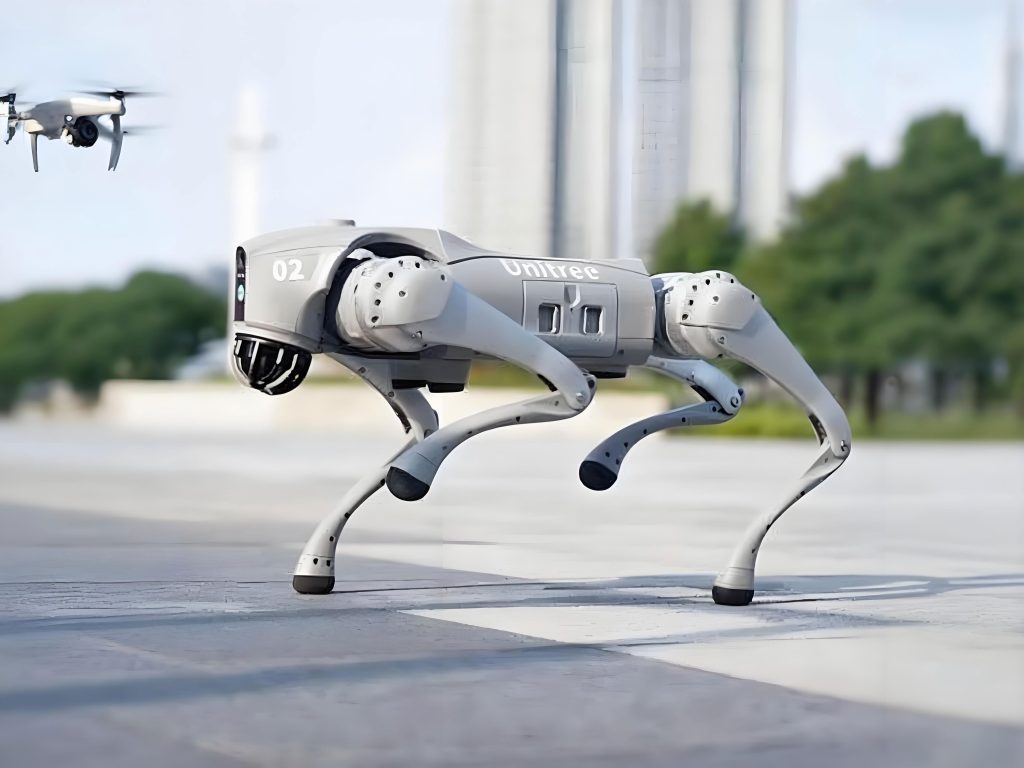
This article delves into the methodologies for achieving stable posture control in a bionic robot with a hexapod architecture. We will systematically explore the kinematic foundations, define the feasible workspace for posture adjustment, and formulate a dynamic mapping strategy that enables smooth transitions between body orientations. The core objective is to develop a control framework that not only achieves a desired posture but does so with continuity in angle, angular velocity, and within the physical limits of the robot’s actuators, thereby minimizing unwanted body oscillations and ensuring operational stability.
1. Kinematic Modeling of a Hexapod Bionic Robot
The foundation for any motion control, including posture adjustment, lies in a precise kinematic model. We consider a bionic robot with an insect-like, dual-tripod morphology. The body is typically a symmetrical polygon, and each leg possesses three rotational degrees of freedom (DOF): a yaw joint at the hip (connecting leg to body), a pitch joint at the hip, and a pitch joint at the knee. For simplicity, we assume the robot’s center of mass (CoM) coincides with the geometric center of its body.
To describe the robot’s configuration, we establish several coordinate frames:
- World/Reference Frame (ΣO): Fixed to the ground. The ZO-axis opposes gravity, YO points in the initial heading direction, and XO completes the right-handed system. This frame provides an inertial reference.
- Body Frame (ΣC): Attached to the robot’s body at its CoM. ZC is normal to the body plane pointing upward, YC points forward along the body’s longitudinal axis, and XC points to the right.
- Hip Frame for leg-i (ΣGi): Originating at the connection point of leg-i to the body, with axes parallel to those of ΣC.
The posture of the bionic robot is defined by three Euler angles: yaw (ψ), pitch (θ), and roll (φ), representing rotations about ZO, YO, and XO respectively. The rotation matrix transforming coordinates from ΣC to ΣO is:
$$ ^O\mathbf{R}_C = \mathbf{Rot}(Z, \psi) \mathbf{Rot}(Y, \theta) \mathbf{Rot}(X, \varphi) = \begin{bmatrix}
c\psi c\theta & -s\psi c\varphi + c\psi s\theta s\varphi & s\psi s\varphi + c\psi s\theta c\varphi \\
s\psi c\theta & c\psi c\varphi + s\psi s\theta s\varphi & -c\psi s\varphi + s\psi s\theta c\varphi \\
-s\theta & c\theta s\varphi & c\theta c\varphi
\end{bmatrix} $$
where $c\cdot$ and $s\cdot$ denote cosine and sine, respectively.
The forward kinematics for a single leg relates the joint angles to the foot-tip position in its hip frame. Using the Denavit-Hartenberg (D-H) convention for a 3R leg with link lengths $l_1$ (coxa), $l_2$ (femur), and $l_3$ (tibia), the position of foot $i$ in ΣGi is:
$$ ^{Gi}\mathbf{P}_i = \begin{bmatrix} ^{Gi}x_i \\ ^{Gi}y_i \\ ^{Gi}z_i \end{bmatrix} = \begin{bmatrix}
\eta_i c\theta_{i1} (l_1 + l_2 c\theta_{i2} + l_3 c\theta_{i23}) \\
s\theta_{i1} (l_1 + l_2 c\theta_{i2} + l_3 c\theta_{i23}) \\
l_2 s\theta_{i2} + l_3 s\theta_{i23}
\end{bmatrix} $$
where $\theta_{i1}, \theta_{i2}, \theta_{i3}$ are the yaw, hip pitch, and knee pitch joint angles for leg $i$, $\theta_{i23} = \theta_{i2}+\theta_{i3}$, and $\eta_i$ is a sign factor (±1) accounting for the left/right symmetry of the bionic robot‘s leg mounting.
The inverse kinematics, crucial for control, computes the joint angles from a desired foot position. For our leg design, the solution is:
$$ \theta_{i1} = \text{atan2}(^{Gi}y_i, \eta_i \cdot ^{Gi}x_i) $$
$$ \theta_{i2} = \arccos\left( \frac{l_2^2 + D_i^2 – l_3^2}{2 l_2 D_i} \right) – \text{atan2}(^{Gi}z_i, x’_i) $$
$$ \theta_{i3} = \arccos\left( \frac{l_2^2 + l_3^2 – D_i^2}{2 l_2 l_3} \right) – \pi $$
where $D_i = \sqrt{(x’_i)^2 + (^{Gi}z_i)^2}$ and $x’_i = \sqrt{(^{Gi}x_i)^2 + (^{Gi}y_i)^2} – l_1$.
The differential kinematics relates joint velocities to foot-tip velocity via the leg Jacobian matrix $\mathbf{J}_i(\boldsymbol{\theta}_i)$:
$$ \dot{\mathbf{P}}_i = \mathbf{J}_i(\boldsymbol{\theta}_i) \dot{\boldsymbol{\theta}}_i \quad \Rightarrow \quad \dot{\boldsymbol{\theta}}_i = \mathbf{J}_i^{-1}(\boldsymbol{\theta}_i) \dot{\mathbf{P}}_i $$
For a 3-DOF leg, the Jacobian is a 3×3 matrix whose elements are functions of the joint angles and link lengths.
2. Posture Modeling and Feasible Adjustment Workspace
When a bionic robot is in a statically stable stance (with at least three legs on the ground), its body and the stationary foot points form a parallel mechanism. The body is the moving platform, and the polygon defined by the contact points is the fixed base. Adjusting the body posture requires coordinated motion of the support legs’ joints while their feet remain fixed relative to the ground.
The fundamental relationship between a fixed foot point in the world frame ($^O\mathbf{P}_i$), its location in the body frame ($^C\mathbf{P}_i$), the hip location ($^C\mathbf{P}_{Gi}$), and the foot point in the hip frame ($^{Gi}\mathbf{P}_i$) is:
$$ ^O\mathbf{P}_i = ^O\mathbf{R}_C ( ^C\mathbf{P}_{Gi} + ^{Gi}\mathbf{P}_i ) $$
Since $^O\mathbf{P}_i$ is constant during a posture adjustment and $^C\mathbf{P}_{Gi}$ is a fixed design parameter, we can solve for the required hip-frame foot point given a target body rotation $^O\mathbf{R}_C$:
$$ ^{Gi}\mathbf{P}_i = ^O\mathbf{R}_C^T \, ^O\mathbf{P}_i – ^C\mathbf{P}_{Gi} $$
This equation is the cornerstone of posture control. It dynamically maps a desired body orientation to the required kinematic configuration for each support leg, which is then achieved via the inverse kinematics.
Determining the Feasible Posture Workspace: Not all desired postures are physically achievable. The constraints are:
- Joint Angle Limits: Each joint has mechanical limits: $\theta_{i,min} \leq \theta_i \leq \theta_{i,max}$.
- Static Stability: The CoM projection must remain inside the support polygon formed by the grounded feet.
- Kinematic Reachability: The fixed foot point $^O\mathbf{P}_i$ must be within the workspace of leg $i$ when its hip is positioned according to the body orientation.
The feasible posture workspace is the intersection of all permissible orientations satisfying these constraints for all support legs. For a bionic robot in a minimal three-legged stance (a tripod), the body posture is uniquely determined by the three fixed foot points. The rotation matrix can be computed directly:
$$ ^O\mathbf{R}_C = [ ^O\mathbf{P}_a \, ^O\mathbf{P}_b \, ^O\mathbf{P}_c ] [ ^C\mathbf{P}_a \, ^C\mathbf{P}_b \, ^C\mathbf{P}_c ]^{-1} $$
where $a, b, c$ are indices of the supporting legs. The Euler angles can be extracted from this matrix. By varying the body orientation and checking the joint angle constraints via inverse kinematics, the feasible workspace $Q_{3}$ for the tripod stance can be mapped.
For stances with $N > 3$ support legs, the system is over-constrained. The overall feasible workspace $Q_N$ is the intersection of the feasible workspaces of all possible tripod subsets that maintain stability:
$$ Q_N = \bigcap_{\forall \text{ stable tripods } T \subset S} Q_{T} $$
where $S$ is the set of all supporting legs. This intersection is often smaller than any individual tripod workspace, reflecting the additional constraints imposed by the extra legs. A target posture must lie within $Q_N$ to be achievable.
| Parameter | Symbol | Typical Constraint/Role |
|---|---|---|
| Link Lengths | $l_1, l_2, l_3$ | Define leg workspace volume and geometry. |
| Joint Limits | $[\theta_{min}, \theta_{max}]$ | Primary determinant of feasible posture boundaries. |
| Support Polygon | Vertices: $^O\mathbf{P}_i$ | Defines the stability boundary for CoM projection. |
| Body Dimension | $^C\mathbf{P}_{Gi}$ | Affects the kinematic coupling between legs during posture change. |
3. Strategy for Steady Posture Transition
Simply commanding an instantaneous change in posture setpoint will lead to discontinuous joint velocities, causing jerky motion, vibrations, and high peak torques. A bionic robot requires a steady transition. The goals for such a transition are:
- Continuity: The posture trajectory $\mathbf{E}(t)=[\psi(t), \theta(t), \varphi(t)]^T$ and its first derivative (angular velocity $\boldsymbol{\omega}(t)$) must be continuous.
- Smooth Start/Stop: Angular velocity should be zero at the beginning and end of the maneuver to avoid sudden starts/stops: $\boldsymbol{\omega}(0)=\boldsymbol{\omega}(T)=\mathbf{0}$.
- Actuator Limits: The resulting joint velocity commands must not exceed the motors’ maximum capabilities: $|\dot{\theta}_{ij}(t)| \leq \dot{\theta}_{j,max}$.
- Feasibility: The entire planned trajectory $\mathbf{E}(t)$ for $t \in [0, T]$ must lie within the feasible workspace $Q_N$.
We propose a trajectory planning approach to meet these goals. Let the initial and target postures be $\mathbf{E}_0$ and $\mathbf{E}_T$, with a transition time of $T$. A fifth-order polynomial is an excellent choice for planning each Euler angle, as it allows specification of initial/final position, velocity, and acceleration. For a scalar angle component $e(t)$, we define a normalized time $\tau = t/T$ and a polynomial function $s(\tau)$:
$$ e(t) = e_0 + (e_T – e_0) \cdot s(\tau) $$
$$ s(\tau) = b_0 + b_1\tau + b_2\tau^2 + b_3\tau^3 + b_4\tau^4 + b_5\tau^5 $$
To satisfy $e(0)=e_0, \dot{e}(0)=0, \ddot{e}(0)=0, e(T)=e_T, \dot{e}(T)=0, \ddot{e}(T)=0$, the coefficients are uniquely determined, yielding:
$$ s(\tau) = 10\tau^3 – 15\tau^4 + 6\tau^5 $$
This $s(\tau)$ function provides a smooth “S-curve” profile for the angle, ensuring continuous and smooth velocity and acceleration profiles. The angular velocity in the body frame is derived from the time derivative of the Euler angles, though careful attention must be paid to the singularity-free representation or conversion to axis-angle rates for control.
Joint Velocity Calculation and Limit Checking: The required joint velocities to track the planned body rotation while keeping feet stationary are found by differentiating the kinematic constraint $^O\mathbf{P}_i = \text{constant}$. This leads to:
$$ \mathbf{0} = \boldsymbol{\omega} \times (^O\mathbf{R}_C \, ^C\mathbf{P}_i) + ^O\mathbf{R}_C \, ^C\dot{\mathbf{P}}_i $$
Recognizing that $^C\dot{\mathbf{P}}_i = \mathbf{J}_i \dot{\boldsymbol{\theta}}_i$, and rearranging, we get the required joint velocities:
$$ \dot{\boldsymbol{\theta}}_i = -\mathbf{J}_i^{-1} \left( ^O\mathbf{R}_C^T \left[ \boldsymbol{\omega} \times (^O\mathbf{R}_C \, ^C\mathbf{P}_i) \right] \right) = -\mathbf{J}_i^{-1} \left( ^O\mathbf{R}_C^T [\boldsymbol{\omega}]_{\times} ^O\mathbf{R}_C \, ^C\mathbf{P}_i \right) $$
where $[\boldsymbol{\omega}]_{\times}$ is the skew-symmetric cross-product matrix of the angular velocity vector $\boldsymbol{\omega}$ derived from $\dot{\mathbf{E}}(t)$.
The planned trajectory $\mathbf{E}(t)$ and its derivative $\dot{\mathbf{E}}(t)$ are substituted into the above equation to generate the joint velocity commands $\dot{\boldsymbol{\theta}}_i(t)$ for all support legs. The transition time $T$ is a key design parameter. If the maximum joint velocity magnitude over the entire trajectory exceeds the actuator limit $ \dot{\theta}_{max}$, the time $T$ must be increased, and the polynomial trajectory is recalculated. A longer $T$ results in lower required joint speeds. This iterative process ensures the planned motion is dynamically feasible for the bionic robot‘s hardware.
| Strategy | Trajectory Profile | Advantages | Disadvantages |
|---|---|---|---|
| Instantaneous Setpoint | Step function | Simple to implement. | Causes severe jerk, high transient forces, likely unstable. |
| Linear Interpolation | $\mathbf{E}(t)=\mathbf{E}_0 + (\mathbf{E}_T-\mathbf{E}_0)\tau$ | Simple, continuous position. | Discontinuous velocity at start/end ($\dot{\mathbf{E}}(0)=\dot{\mathbf{E}}(T)\neq 0$), causes jerks. |
| 5th Order Polynomial (Proposed) | $s(\tau)=10\tau^3-15\tau^4+6\tau^5$ | Continuous position, velocity, and acceleration. Smooth start/stop. | Slightly more complex computation; requires limit checking on $T$. |
4. Integration and Control Architecture
Implementing steady posture control on a physical bionic robot requires integrating the planning layer with a real-time control system. A hierarchical architecture is effective:
- Planning Layer:
- Input: Desired target posture $\mathbf{E}_T$, current posture $\mathbf{E}_0$, support leg configuration.
- Process: Checks if $\mathbf{E}_T \in Q_N$ (feasible workspace). If feasible, generates the smooth time-parameterized trajectory $\mathbf{E}(t)$ using the 5th-order polynomial with an initial guess for $T$.
- Output: A sequence of reference postures $\mathbf{E}_{ref}(k)$ and body angular velocities $\boldsymbol{\omega}_{ref}(k)$ at discrete control timesteps $k$.
- Inverse Kinematics & Jacobian Layer:
- Input: $\mathbf{E}_{ref}(k)$, $\boldsymbol{\omega}_{ref}(k)$, known fixed foot positions $^O\mathbf{P}_i$.
- Process: For each support leg $i$, compute $^{Gi}\mathbf{P}_i(k)$ using the dynamic mapping formula. Solve inverse kinematics for $\boldsymbol{\theta}_{i,ref}(k)$. Compute required joint velocities $\dot{\boldsymbol{\theta}}_{i,ref}(k)$ using the differential mapping formula.
- Joint Servo Layer:
- Input: Reference joint angles $\boldsymbol{\theta}_{i,ref}(k)$ and velocities $\dot{\boldsymbol{\theta}}_{i,ref}(k)$.
- Process: Typically uses a high-gain PID or model-based torque controller at each joint to track the reference trajectory accurately.
This architecture decouples the high-level planning from the low-level actuation. The critical feedback for the planner is the verification of workspace feasibility and the joint limit check, which may require an iterative adjustment of the total maneuver time $T$.
5. Design Considerations and Challenges for Bionic Robots
Applying this posture control framework to a practical bionic robot involves addressing several design challenges:
Leg Configuration and Workspace: The morphology of the leg directly impacts the size and shape of the feasible posture workspace $Q_N$. A bionic robot with longer tibia and femur segments will generally have a larger vertical and tilting range. The arrangement of the hip joints on the body (spacing, forward/backward offset) influences the coupling between posture adjustment and stability margin.
Actuator Selection and Torque-Speed Characteristics: The maximum joint velocity $\dot{\theta}_{max}$ is not a fixed number but depends on the load torque. During a posture adjustment, gravitational and inertial loads shift between legs. A sophisticated planner would consider the torque-speed curves of the actuators (e.g., DC motors or servos) to ensure the planned trajectory is within sustainable torque limits, not just velocity limits. This is particularly important for a heavily loaded bionic robot.
Ground Contact and Compliance: The model assumes perfectly rigid, non-slipping point contacts. In reality, terrain is compliant and contact may slip. For a robust bionic robot, the posture controller should be integrated with a force/ impedance control layer at each leg to manage interaction forces and adapt to small terrain irregularities during the adjustment.
Singularities and Configuration Management: The leg Jacobian $\mathbf{J}_i$ becomes singular at certain joint configurations (e.g., fully extended leg), leading to theoretically infinite joint velocities for a desired foot motion. The inverse kinematics and trajectory planner must either avoid these configurations or implement singularity-robust algorithms.
Dynamic Effects: For very fast posture adjustments, inertial forces of the moving body and legs become significant. A purely kinematic planner may become insufficient. A full dynamic model could be incorporated to plan torque-optimal trajectories or to provide feedforward terms in the joint servo layer, enhancing the performance of an agile bionic robot.
6. Conclusion and Future Directions
Steady posture adjustment is a fundamental capability that elevates a bionic robot from a simple walking machine to a competent mobile platform. By establishing a dynamic mapping between body orientation and support leg kinematics, we can treat the multi-legged stance as a parallel manipulator. The core of the problem lies in planning a smooth trajectory within the robot’s feasible posture workspace—a space bounded by joint limits, reachability, and stability—and ensuring the resulting joint motions adhere to actuator constraints.
The method outlined, utilizing fifth-order polynomial trajectory planning combined with inverse and differential kinematics, provides a systematic framework for achieving smooth, jerk-free posture transitions. This approach directly addresses the challenge of unwanted body oscillations at the start and end of a maneuver, a common issue in simpler control schemes.
Future work for advancing posture control in bionic robot systems lies in several directions. Integrating real-time force feedback will allow for compliant adjustments on uneven or soft ground. Combining posture control with adaptive foothold planning could enable a bionic robot to maneuver on extreme slopes or very rough terrain by strategically adjusting its body and choosing secure footholds in tandem. Furthermore, the application of optimal control techniques could yield time- or energy-optimal posture transition trajectories, pushing the efficiency and speed of these machines closer to their biological counterparts. As these techniques mature, the operational competence and autonomy of legged bionic robot systems in real-world applications will continue to grow substantially.