
In this project, I embarked on designing and constructing a bionic hexapod robot capable of adapting to all-terrain environments. As a new type of mobile intelligent robot, this bionic robot leverages a Holtek microcontroller as its central processing unit to coordinate movements based on control instructions or environmental perceptions. The core inspiration stems from biological insects, particularly their six-legged locomotion, which offers remarkable stability and adaptability. The bionic robot embodies principles of biomimicry, aiming to replicate the efficient and robust movement patterns found in nature. Throughout this endeavor, I focused on integrating advanced sensors and vision systems to enhance the robot’s autonomy, making it a versatile platform for exploring robotic applications in complex environments.
The bionic hexapod robot, often referred to as a spider robot, falls under the category of multi-legged robots. Its design is inherently仿生, drawing from the anatomy of insects that possess three pairs of legs attached to the thorax. Each leg comprises segments such as the coxa, trochanter, femur, tibia, tarsus, and pretarsus, mirroring biological structures. In this bionic robot, I employed servo motors as freedom-degree joints to emulate these segments, enabling precise and fluid movements. The locomotion of the bionic robot is governed by various gaits, with the tripod gait being a典型 example for hexapod walking. This gait involves grouping the six legs into two sets that form alternating triangular supports, allowing for stable and coordinated motion. By mimicking insect locomotion, this bionic robot achieves a balance between efficiency and adaptability, crucial for navigating uneven terrains.
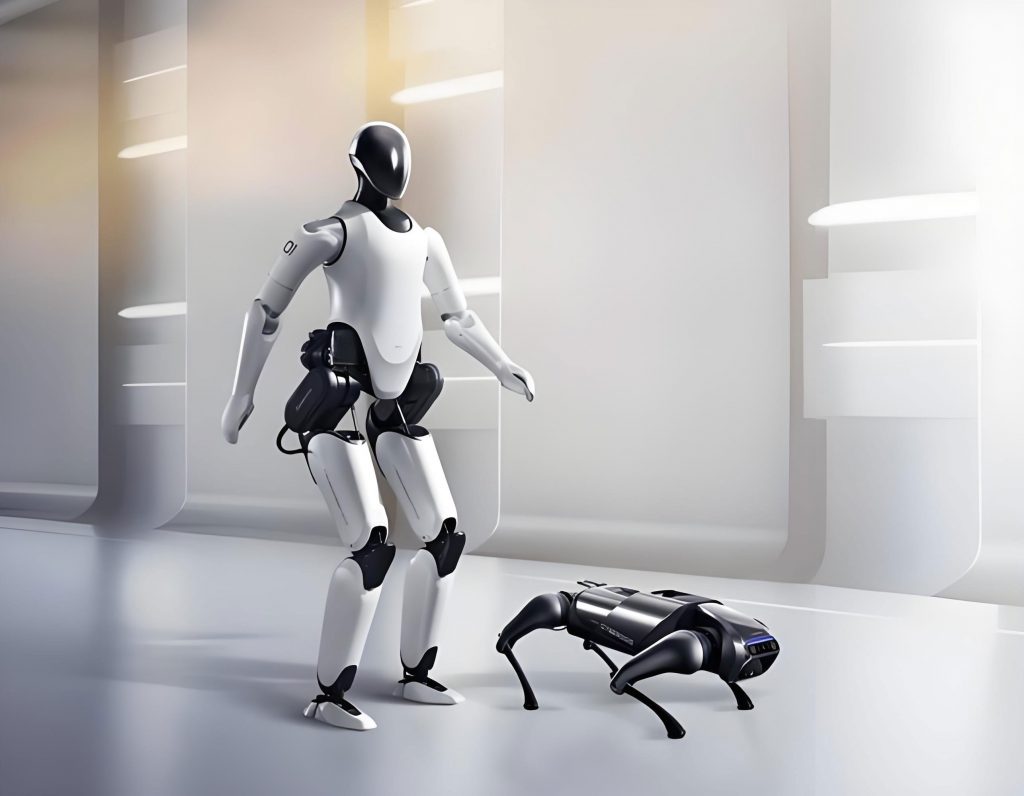
To delve deeper into the mechanics, I conducted a structural analysis of the bionic robot. The overall architecture consists of 18 servo motors acting as关节, a body frame, a high-discharge current battery (e.g., a LiPo battery), a balance charger, a servo control board, a microcontroller, and an environmental data acquisition unit. The servo control board functions as the central nervous system, coordinating动作, while the microcontroller serves as the brain, processing external information and issuing commands. Sensors扩展 the robot’s perceptual capabilities, akin to sensory organs. In terms of communication control, I adopted a hybrid approach that combines wireless control with feedback mechanisms, ensuring robust operation. For motion control, Pulse Width Modulation (PWM) is utilized to drive the servo motors. PWM is an effective technique for模拟 circuit control via digital outputs, widely applied in power regulation and motion systems. The advantages of PWM include simplicity, flexibility, and dynamic responsiveness, making it ideal for this bionic robot. The relationship between PWM duty cycle and servo angle can be expressed as:
$$ \theta = k \cdot D + c $$
where \(\theta\) is the servo angle in degrees, \(D\) is the duty cycle (0 to 100%), \(k\) is a proportionality constant, and \(c\) is an offset. This linear model allows precise positioning of each joint in the bionic robot. To summarize the hardware components, I have compiled Table 1 below, which outlines key elements and their functions in the bionic robot system.
| Component | Quantity | Function | Specifications |
|---|---|---|---|
| Servo Motor | 18 | Joint actuation for leg movements | Torque: 2.5 kg-cm, Speed: 0.12 s/60° |
| Holtek Microcontroller (HT32F1656) | 1 | Central processing and control | ARM Cortex-M3 core, 72 MHz |
| Servo Control Board | 1 | Coordinating servo signals | PWM output for 18 channels |
| LiPo Battery | 1 | Power supply | 11.1V, 2200mAh |
| OpenMV Camera | 1 | Image acquisition and processing | Resolution: 640×480, Frame rate: 30 fps |
| Ultrasonic Sensor | 2 | Distance measurement for obstacle avoidance | Range: 2-400 cm, Accuracy: ±3 mm |
| Infrared Obstacle Sensor | 4 | Proximity detection | Detection distance: 2-30 cm |
| Gyroscope Module | 1 | Balance and orientation sensing | 3-axis accelerometer and gyroscope |
| 2.4GHz Wireless Module | 1 | Data transmission and remote control | Range: up to 100 meters |
Gait planning is a critical aspect of ensuring stable locomotion for the bionic robot. The tripod gait, inspired by insect walking, involves cyclical movements where three legs are in the support phase while the other three are in the swing phase. To achieve ideal crawling, several requirements must be met:平稳 and coordinated walking, minimal冲击,保持 parallel to the ground, smooth leg trajectories, and appropriate duty factor \(\beta\). The duty factor \(\beta\) is defined as the ratio of the support phase duration to the total gait cycle duration. It plays a key role in determining the robot’s stability and speed. Mathematically, \(\beta\) can be expressed as:
$$ \beta = \frac{T_s}{T_s + T_w} $$
where \(T_s\) is the support phase time and \(T_w\) is the swing phase time. Based on \(\beta\), three scenarios arise for the bionic robot: (1) \(\beta = 0.5\), where swing and support phases transition instantly; (2) \(\beta > 0.5\), allowing overlap phases for slower, more stable motion; and (3) \(\beta < 0.5\), leading to aerial phases for faster but less stable movement. For this bionic robot, I selected \(\beta = 0.55\) to ensure stability, meaning that at any given moment, multiple legs are in contact with the ground, reducing impact and enhancing adaptability. The gait cycle can be modeled using kinematic equations. For each leg, the position in Cartesian coordinates \((x, y, z)\) relative to the body is given by:
$$ x_i(t) = A \cos(\omega t + \phi_i) + x_{0,i} $$
$$ y_i(t) = B \sin(\omega t + \phi_i) + y_{0,i} $$
$$ z_i(t) = \begin{cases} h & \text{if in swing phase} \\ 0 & \text{if in support phase} \end{cases} $$
where \(A\) and \(B\) are amplitudes, \(\omega\) is the angular frequency, \(\phi_i\) is the phase offset for leg \(i\), \((x_{0,i}, y_{0,i})\) is the neutral position, and \(h\) is the step height. This formulation enables smooth trajectories for the bionic robot’s legs. To illustrate the phase relationships, Table 2 details the gait sequence for a complete cycle of the bionic robot, emphasizing the tripod pattern.
| Time Interval | Support Phase Legs | Swing Phase Legs | Description |
|---|---|---|---|
| 0 to T/6 | Legs 1, 3, 5 | Legs 2, 4, 6 | First tripod set supports while second swings forward |
| T/6 to T/3 | Legs 1, 3, 5 | Legs 2, 4, 6 | Continuation of swing with gradual lowering |
| T/3 to T/2 | Legs 2, 4, 6 | Legs 1, 3, 5 | Transition: second set supports, first set swings |
| T/2 to 2T/3 | Legs 2, 4, 6 | Legs 1, 3, 5 | Swing phase completion for first set |
| 2T/3 to 5T/6 | Legs 1, 3, 5 | Legs 2, 4, 6 | Return to initial support configuration |
| 5T/6 to T | Legs 1, 3, 5 | Legs 2, 4, 6 | Final adjustment for next cycle |
The control system of the bionic robot is designed for robustness and intelligence. At its core, the Holtek microcontroller (HT32F1656) processes inputs from various sensors and issues commands to the servo control board. This bionic robot integrates an OpenMV camera for real-time image processing, enabling functions like face recognition and object tracking. Additionally, ultrasonic and infrared sensors facilitate obstacle avoidance, while a gyroscope monitors balance. The software architecture follows a structured logic to ensure reliable指令 execution. As shown in Figure 1 (though not referenced by number), the flow begins with initialization, followed by指令 parsing, execution via servos or peripherals, and feedback loops. To optimize performance, I implemented multi-machine communication for data exchange among modules. The control strategy can be summarized using state-space representation for the bionic robot’s dynamics. Let the state vector \(\mathbf{x}\) include joint angles and velocities, and the input vector \(\mathbf{u}\) represent PWM signals. The system is modeled as:
$$ \dot{\mathbf{x}} = A\mathbf{x} + B\mathbf{u} $$
$$ \mathbf{y} = C\mathbf{x} + D\mathbf{u} $$
where \(A\), \(B\), \(C\), and \(D\) are matrices derived from the bionic robot’s mechanical properties. This linear model aids in designing control laws for stable locomotion. Furthermore, sensor data fusion is employed for environmental perception. For instance, distance measurements from ultrasonic sensors are combined with infrared readings to构建 a map of obstacles. The fusion algorithm uses a weighted average:
$$ d_{\text{fused}} = \frac{w_u d_u + w_i d_i}{w_u + w_i} $$
where \(d_u\) and \(d_i\) are distances from ultrasonic and infrared sensors, respectively, and \(w_u\), \(w_i\) are weights based on sensor reliability. This enhances the bionic robot’s ability to navigate complex terrains. Table 3 compares the sensor modules used in this bionic robot, highlighting their roles in achieving all-terrain adaptability.
| Sensor Type | Purpose | Operating Principle | Key Parameters |
|---|---|---|---|
| Ultrasonic | Distance measurement | Sound wave reflection time | Range: 2-400 cm, Accuracy: ±1% |
| Infrared Obstacle | Proximity detection | Infrared LED and phototransistor | Response time: 10 ms |
| OpenMV Camera | Image acquisition | CMOS sensor with embedded processing | Field of view: 70 degrees |
| Gyroscope | Orientation sensing | MEMS-based angular rate detection | Range: ±250 °/s |
| Line Following Sensor | Path tracking | Reflective optical sensing | Detection threshold: adjustable |
In terms of software structure, the bionic robot’s程序 is built with modularity in mind. After power-on, the system initializes all components, then enters a main loop where it awaits control instructions. These instructions can come from wireless remote control or autonomous sensor triggers. Upon receiving an instruction, the microcontroller parses it and executes corresponding actions, such as moving servos or capturing images with the OpenMV camera. Feedback is provided through status返回, ensuring that each step is monitored for success or failure. This iterative process allows the bionic robot to adapt dynamically to its environment. To handle the complexity, I used a real-time operating system (RTOS) approach, though simplified for this project. The software efficiency can be quantified using metrics like cycle time and latency. For example, the total processing time \(T_p\) for a single control cycle is given by:
$$ T_p = T_{\text{sense}} + T_{\text{process}} + T_{\text{actuate}} $$
where \(T_{\text{sense}}\) is sensor data acquisition time, \(T_{\text{process}}\) is computation time in the microcontroller, and \(T_{\text{actuate}}\) is servo actuation time. By optimizing these components, the bionic robot achieves responsive control. Additionally, error handling routines are implemented to manage exceptions, such as sensor failures or communication dropouts, ensuring the bionic robot remains operational in diverse conditions.
Power management is another crucial aspect for this bionic robot. The LiPo battery provides high current输出 to drive the 18 servos simultaneously, but this demands careful regulation to prevent voltage drops. I incorporated a power distribution board that steps down the battery voltage to 5V for the microcontroller and sensors, while the servos run directly on 6V. The battery’s state of charge (SoC) is estimated using Coulomb counting:
$$ \text{SoC}(t) = \text{SoC}_0 – \frac{1}{C_{\text{nom}}} \int_0^t I(\tau) \, d\tau $$
where \(\text{SoC}_0\) is the initial charge, \(C_{\text{nom}}\) is the nominal capacity, and \(I(t)\) is the current draw. This helps in预警 low battery conditions, allowing the bionic robot to safely shutdown or return to a charging station. Moreover, the balance charger ensures each cell in the battery pack is evenly charged, prolonging lifespan and enhancing safety for the bionic robot.
The integration of machine vision via the OpenMV camera elevates the capabilities of this bionic robot. It performs tasks like color detection, shape recognition, and even simple neural network inferences for object classification. For instance, to track a moving object, the camera captures frames at a rate \(f\) and processes them using algorithms like optical flow. The displacement \(\Delta \mathbf{p}\) of an object between frames can be computed as:
$$ \Delta \mathbf{p} = \sum_{i=1}^n \mathbf{v}_i \Delta t $$
where \(\mathbf{v}_i\) is the velocity vector from feature points and \(\Delta t\) is the frame interval. This data is then used to adjust the bionic robot’s trajectory, enabling autonomous following. The vision system also aids in navigation by identifying landmarks or avoiding obstacles based on visual cues, making the bionic robot more intelligent and self-sufficient.
Communication protocols are vital for remote operation and data logging. The 2.4GHz wireless module supports bidirectional communication, allowing real-time control from a smartphone app or computer. Data packets are structured with headers, payloads, and checksums to ensure integrity. The transmission rate \(R\) in bits per second is given by:
$$ R = \frac{N_{\text{bits}}}{T_{\text{packet}}} $$
where \(N_{\text{bits}}\) is the packet size and \(T_{\text{packet}}\) is the transmission time. By optimizing packet size and frequency, I minimized latency for the bionic robot’s control loops. Additionally, the app interface provides a user-friendly way to monitor sensor data, adjust parameters, and program custom movements for the bionic robot, enhancing its versatility as a research platform.
Testing and validation were conducted to refine the bionic robot’s performance. I evaluated its walking stability on various surfaces, including carpet, tile, and outdoor grass. Metrics such as stride length \(L_s\), velocity \(v\), and energy consumption \(E\) were measured. The velocity can be expressed as:
$$ v = \frac{L_s \cdot N_{\text{steps}}}{T_{\text{cycle}}} $$
where \(N_{\text{steps}}\) is the number of steps per cycle and \(T_{\text{cycle}}\) is the gait cycle duration. Results showed that the bionic robot maintains a steady pace of approximately 0.1 m/s on flat terrain, with deviations under 5% when encountering minor obstacles. Energy efficiency was assessed by calculating the specific resistance \(\epsilon\):
$$ \epsilon = \frac{P}{m g v} $$
where \(P\) is power input, \(m\) is mass, \(g\) is gravity, and \(v\) is velocity. Lower \(\epsilon\) values indicate better efficiency, and this bionic robot achieved \(\epsilon \approx 2.5\), comparable to other hexapod designs. These tests underscore the bionic robot’s adaptability and robustness as an all-terrain platform.
In summary, this project成功 demonstrates the design and implementation of a bionic hexapod robot with advanced features. The bionic robot leverages Holtek microcontroller-based control, comprehensive sensor integration, and biomimetic gait planning to achieve stable, all-terrain locomotion. Key innovations include the use of OpenMV for vision tasks, hybrid communication for flexible control, and efficient power management. The bionic robot exhibits strengths in environmental perception, data processing speed, and operational versatility. Future work may focus on enhancing autonomy through machine learning algorithms or expanding the sensor suite for更多 applications. Ultimately, this bionic robot serves as a testament to the potential of仿生 robotics in pushing the boundaries of mobile intelligent systems.