
The evolution of fire investigation, a critical domain within the firefighting sector, is increasingly characterized by the integration of advanced technologies to transform traditional methodologies. A significant technological frontier now emerging involves the deployment of bionic robot platforms, specifically quadrupedal systems. Inspired by the President’s directive to prioritize robotics and integrate them for societal benefit, the field of bionic robotics has accelerated dramatically. These systems offer a compelling solution to the inherent challenges of post-fire scenes—challenges related to accessibility, personnel safety, evidence preservation, and operational efficiency. Traditional investigation tools and even wheeled or tracked robots are often stymied by the unpredictable, debris-laden, and structurally compromised environments typical of fire scenes. This article explores the application of quadruped bionic robots as mobile, adaptive platforms, detailing their development, implementation in fire investigation protocols, and the promising avenues for future research.
The journey of the quadruped bionic robot began decades ago. Early iterations, such as the General Electric Walking Truck in the 1960s, demonstrated the concept but were limited by size, weight, and crude hydraulic control, lacking the agility required for complex terrain. The modern era was arguably inaugurated by Boston Dynamics’ BigDog in 2005. This marked a paradigm shift from simple mechanical coupling to sophisticated sensor-driven, computer-controlled dynamic balancing. BigDog utilized joint sensors, inertial measurement units, and LIDAR to monitor posture and terrain, with an onboard computer adjusting hydraulic flow for stable locomotion. This foundation spurred global research, with significant contributions from institutions like the Italian Institute of Technology, ETH Zurich, and Seoul National University, each refining the core technologies of actuation, perception, and control that define today’s advanced bionic robot.
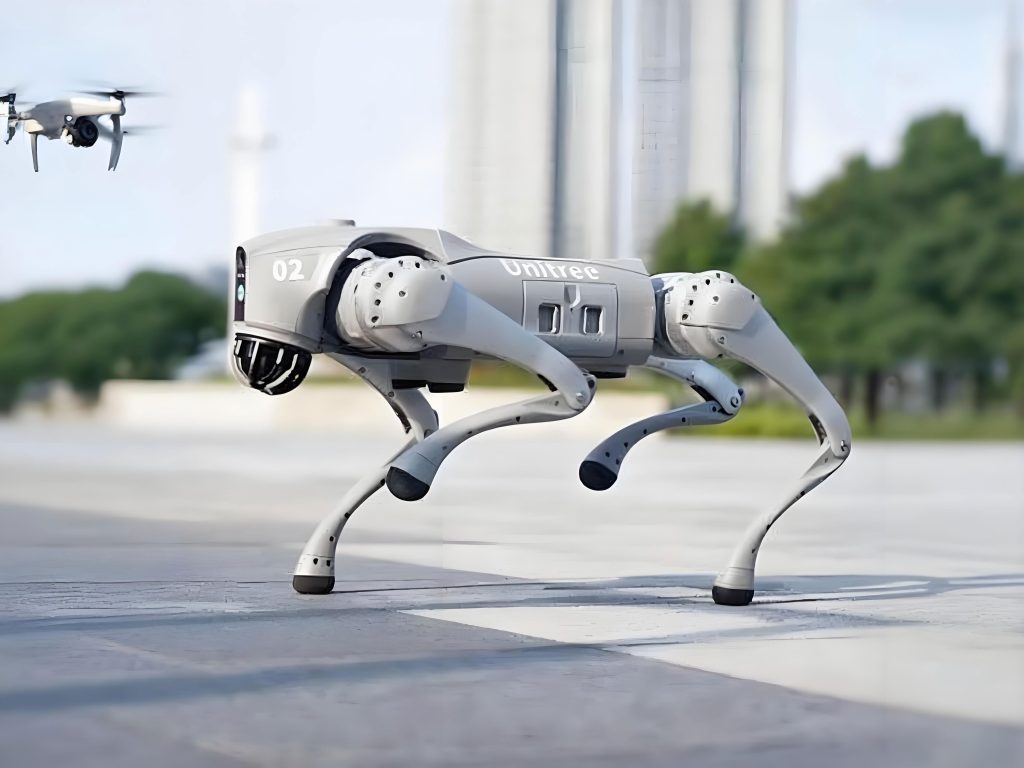
In parallel, domestic research has matured rapidly. Pioneering work from Shanghai Jiao Tong University on the JTUWM series laid early groundwork. Subsequently, laboratories at Tsinghua University, Harbin Institute of Technology, and Zhejiang Sci-Tech University have produced substantial academic output. The landscape has been further energized by innovative private enterprises like Unitree Robotics, whose Laikago and subsequent A1 and Go1 models feature highly responsive servo motors and full-state control (position and orientation in 3D space), enabling dynamic movement over rough terrain, stair climbing, and robust recovery from disturbances. This thriving ecosystem provides a robust technological base for developing specialized applications for the bionic robot in fields like fire investigation.
Application Scenarios in Fire Investigation
The primary advantage of a quadruped bionic robot in fire investigation lies in its superior terrain adaptability. Unlike wheeled platforms, it can traverse ash, rubble, standing water, and highly irregular surfaces without significantly disturbing potential evidence. Its ability to step over obstacles, navigate through narrow gaps, and climb stairs allows it to operate within the complex, multi-level, obstacle-filled spaces common after a fire, areas often inaccessible to human investigators or conventional equipment.
As a mobile power and payload platform, the bionic robot can be equipped with various modular investigation tools, transforming it into a multi-functional assistant. Potential payloads and their functions include:
| Payload Module | Primary Function | Investigation Benefit |
|---|---|---|
| Multi-gas Detector / PID | Real-time air monitoring for VOCs, CO, H2S, etc. | Ensures investigator safety by identifying atmospheric hazards prior to entry. |
| 360° HD Camera & LiDAR Scanner | High-resolution panoramic imaging and 3D point cloud mapping. | Creates a precise, navigable digital record of the scene for remote analysis and permanent documentation. |
| Robotic Manipulator Arm | Remote grasping, lifting, and manipulation of objects. | Allows for safe retrieval of fragile or potentially hazardous evidence from unstable areas. |
| Portable QCL Spectrometer | Rapid on-site chemical analysis for ignitable liquid residues (ILRs). | Provides immediate forensic data, guiding the investigation focus without lab delay. |
| Non-Linear Junction Detector (NLJD) | Detection of concealed electronic devices. | Useful in investigations where electronic tampering or timing devices are suspected. |
| Adjustable Forensic Lighting | Deployable area lighting or specific wavelength sources (UV/IR). | Enables high-quality photography and reveals latent evidence (e.g., blood, fingerprints, fire patterns). |
Beyond payload carriage, the intelligence of the bionic robot enables advanced operational modes. AI-driven features like intelligent following allow a robot to autonomously shadow an investigator, acting as a “sherpa” for equipment. Autonomous navigation and obstacle avoidance enable pre-programmed area scans. Most powerfully, a coordinated swarm of heterogeneous bionic robots could operate semi-autonomously: one maps the scene, another monitors air quality, a third performs preliminary scans for accelerants, all simultaneously, drastically increasing the efficiency and scope of the initial assessment. This paradigm effectively allows a single investigator to command a full team of specialized robotic assistants.
Technical Implementation and Research Outcomes
Our research initiative, focused on adapting quadruped bionic robots for fire investigation, has involved iterative testing and collaboration with technology partners. Key technical challenges and our implemented solutions are summarized below.
1. Gait Optimization for Complex Surfaces: Standard walking gaits are insufficient for the unpredictable, soft, and sloped surfaces of a fire scene. We implemented and refined a trot gait for general traversal. For inclined or highly irregular terrain modeled as compound slopes, we utilize a fuzzy logic-based posture adjustment method. This system dynamically adjusts the joint angles of the supporting legs to minimize roll and pitch fluctuations of the main body. The control principle can be simplified as finding the optimal joint configuration $\theta^*$ that minimizes the body orientation error $e$ relative to the desired horizon, given terrain input $T$ and current state $S$:
$$
\theta^* = \arg\min_{\theta} \left( e(\theta, T, S) \right)
$$
Complementing this, we engineered specialized footpads with larger, compliant contact surfaces to increase grip and distribute weight, preventing the robot’s feet from sinking into weak flooring like charred wood or gypsum.
2. Obstacle Negotiation: Fire scenes are littered with longitudinal (beams, pipes) and vertical (steps, piles) obstacles. We employ a two-strategy approach:
- For low-lying obstacles (< leg clearance height): The robot’s vision system (RGB-D camera) identifies the obstacle and executes a deliberate adaptive foot placement sequence, lifting and placing each leg precisely to step over it.
- For higher obstacles or gaps: The robot uses a dynamic jumping maneuver. High-torque motors in the legs generate explosive force for launch, while a pre-programmed body trajectory ensures clearance. Crucially, passive compliant elements (series elastic actuators or mechanical springs) in the joints absorb the significant landing impact, protecting the actuators and maintaining stability. The jump dynamics involve solving for the required take-off velocity $v_0$ and joint torque profile $\tau(t)$ to achieve a desired parabolic trajectory over an obstacle of height $h$ and distance $d$.
3. Modular Payload Integration: We utilize medium-sized bionic robot platforms and have developed a standardized dorsal and ventral mounting interface with quick-release mechanical locks and unified electronic connectors (e.g., USB-C for power/data). This allows rapid hot-swapping of modules like gas detectors, spectroscopic sensors, or comms relays in the field. The robot’s onboard controller dynamically adjusts its gait parameters and center of mass based on the weight and geometry of the attached payload to maintain stability. Emergency fall-recovery algorithms are always active to mitigate the effects of slips or collisions.
| Strategy | Best For | Key Mechanism | Advantage | Limitation |
|---|---|---|---|---|
| Adaptive Trotting Gait | General traversal on rubble, ash, mild slopes. | Fuzzy logic posture control & compliant footpads. | Energy efficient, stable, preserves scene integrity. | Slow for large, open areas; requires continuous terrain perception. |
| Precision Foot Placement | Negotiating scattered debris, low beams, cables. | Computer vision for obstacle localization and leg trajectory planning. | High precision, minimizes disruption to evidence underneath. | Computationally intensive; fails if obstacle is visually occluded. |
| Dynamic Jumping | Clearing large vertical gaps, ascending high steps. | High-torque burst actuation & pre-computed ballistic trajectory. | Overcomes impassable barriers quickly. | High energy consumption; high impact on landing; risk of toppling. |
Future Research Directions
The integration of the bionic robot into fire investigation is nascent, with several critical research frontiers to advance.
1. Enhanced Locomotion Stability: Future work must focus on more sophisticated state estimation and balance control algorithms. Techniques like Model Predictive Control (MPC) could allow the robot to proactively plan several steps ahead, optimizing for stability on highly discontinuous surfaces. Furthermore, research into advanced passive and active damping mechanisms for joints will be vital to endure the repetitive high-impact loads from running and jumping in harsh environments, thereby increasing durability and reducing maintenance.
2. Expanded Leg Degrees of Freedom (DoF): Most commercial bionic robots feature 3-DoF legs (hip roll/pitch, knee pitch). Increasing this to 4 or 5 DoF (e.g., adding an ab/adduction joint or an ankle) would enable more animal-like dexterity. This could allow for complex maneuvers like side-stepping in confined spaces, bracing against walls, or using a leg as a temporary manipulator to move small obstacles. The control complexity grows exponentially, requiring advanced learning-based controllers.
3. Increased Payload Capacity and Endurance: Current platforms are limited to ~10-20kg payloads. For fire investigation, carrying multiple heavy sensors simultaneously is desirable. Research into higher-torque-density actuators (e.g., hydraulic hybrids, custom high-flux electric motors), more efficient drivetrains, and novel structural materials (carbon composites, additive-manufactured meta-materials) is needed. Concurrently, alternative power sources like compact fuel cells or hybrid systems must be explored to extend mission time beyond the current 2-3 hour battery limit.
4. Specialized Environmental Hardening: A fire investigation bionic robot requires a casing that exceeds standard IP ratings. It must be resistant to:
- High Temperature: Brief exposure to residual heat.
- Chemical Corrosion: From acids, alkalis, and fire suppression agents.
- Particulate Ingress: Fine ash and dust that can damage actuators and sensors.
- Water and High Humidity: From firefighting efforts and damp debris.
Developing composite shells and sealed joint systems meeting these criteria is an essential materials engineering challenge.
5. Integration with Artificial Intelligence (AI): The ultimate goal is a fully autonomous or semi-autonomous investigative partner. This requires fusion of:
- Scene Understanding AI: To recognize common fire scene objects (outlets, appliances, furniture remnants), identify potential evidence, and classify burn patterns.
- Mission-Level AI: To interpret high-level investigator commands (“map the kitchen,” “find the point of origin,” “sample that stained carpet”) and decompose them into sequences of navigation, scanning, and manipulation tasks for the bionic robot.
- Multi-Robot Coordination AI: To manage a heterogeneous swarm of bionic robots and potentially aerial drones, enabling collaborative scene processing and data fusion.
Conclusion
The quadruped bionic robot represents a transformative technological vector for the field of fire investigation. Its unique combination of all-terrain mobility, modular payload capacity, and evolving intelligence directly addresses long-standing limitations in scene access, evidence collection, and investigator safety. While current implementations have proven their utility in preliminary applications, significant research opportunities remain in stability control, mechanical design, endurance, and cognitive autonomy. As these platforms continue to evolve through interdisciplinary collaboration between robotics engineers, material scientists, and fire investigation experts, the bionic robot is poised to transition from a novel assistant to an indispensable core component of the modern fire investigation toolkit, enabling more thorough, efficient, and safe resolution of fire events.