
In the realm of underwater operations, the inspection and maintenance of large subsea infrastructure, such as offshore drilling platforms and submarine cables, are critical tasks. Failure to address damages promptly can lead to substantial economic losses and severe environmental pollution. Currently, these tasks rely heavily on manual intervention or a combined approach using Autonomous Underwater Vehicles (AUVs) and Remotely Operated Vehicles (ROVs). However, these methods present significant drawbacks: manual operations pose high risks to human divers, while the AUV-ROV collaboration is often inefficient, costly, and complex to coordinate. Specifically, when an AUV detects a target and signals the mother ship to deploy an ROV, the target may shift during the delay, and the ROV’s limited mobility can hinder further search efforts. Thus, there is a pressing market need for an integrated underwater robot that combines the cruising capabilities of an AUV with the precise定点作业 abilities of an ROV. Our work addresses this gap by designing a multi-mode underwater bionic robot that seamlessly integrates these functions, overcoming the limitations of traditional methods and enhancing operational efficiency.
This bionic robot is engineered to perform both long-range cruising and precise定点作业, mimicking biological systems to achieve versatility in dynamic underwater environments. By leveraging biomimicry, we have created a robot that can transition between swimming and crawling modes, ensuring optimal performance across diverse terrains. The design philosophy centers on merging the efficient locomotion of fish with the stable traversal of insects, resulting in a hybrid system that excels in fluid environments and on rugged seabeds. This integration not only boosts the robot’s adaptability but also reduces dependency on specific environmental conditions, making it a robust solution for various underwater applications. Throughout this article, we will delve into the overall design, mechanical and hardware systems, software control algorithms, and performance metrics of this innovative bionic robot, emphasizing its potential to revolutionize underwater operations.
The core innovation of our bionic robot lies in its dual-mode locomotion system, which enables it to operate as both an AUV and an ROV. In swimming mode, the robot emulates the undulatory motion of fish, utilizing body wave propulsion for efficient and agile movement through water. This mode is ideal for covering large distances during巡航 missions, such as inspecting extensive cable networks or surveying marine habitats. Upon approaching a target for定点作业, the robot seamlessly switches to crawling mode: the lateral fins retract beneath the body, and mechanical legs extend from the interior to engage with the seabed. This crawling capability allows for precise positioning and stable operation on uneven surfaces, such as rocky terrains or around infrastructure, enabling tasks like repair, sampling, or detailed inspection. The transition between modes is smooth and energy-efficient, minimizing noise and disruption to the surrounding environment—a crucial factor in sensitive ecosystems.
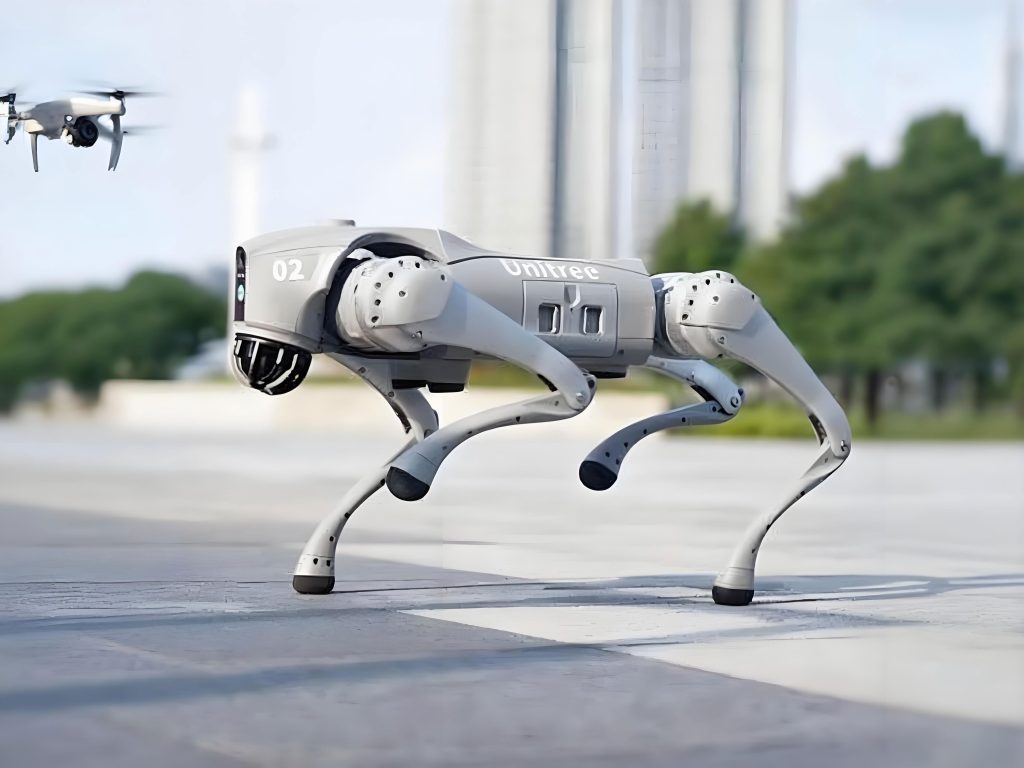
To achieve this multi-mode functionality, the mechanical design of the bionic robot incorporates a sophisticated system of actuators and linkages. The swimming mechanism features a flexible tail composed of multiple segments, each driven by servo motors to generate sinusoidal waves that mimic fish locomotion. The tail’s design is optimized for thrust generation and maneuverability, with parameters derived from biological studies of aquatic species. In crawling mode, the robot transforms into a hexapod structure, with six legs that provide stability and traction on challenging substrates. Each leg has three degrees of freedom, allowing for complex步态 patterns that adapt to varying terrain. The transition mechanism uses a combination of sliding rails and rotational joints to retract the fins and deploy the legs, ensuring minimal hydrodynamic drag during swimming and robust grounding during crawling. This mechanical versatility is key to the bionic robot’s success, as it enables rapid adaptation to changing operational demands.
The hardware architecture of the bionic robot is built around a hierarchical control system to ensure reliable performance in harsh underwater conditions. At the top level, the mission computer utilizes an NVIDIA Jetson TX2 development board, which handles high-level tasks such as sensor fusion, path planning, and target recognition. This platform provides sufficient computational power for running advanced algorithms, including computer vision for identifying underwater objects and machine learning models for autonomous decision-making. At the底层控制器, a STM32H7 microcontroller manages real-time control of actuators and sensors. The主板 includes USB interfaces for receiving commands from上位机 systems, as well as RS485 interfaces and servo control modules for precise motor signal generation and current monitoring. To mitigate interference from high-current servos, the design isolates control circuits from power驱动 circuits. The servo power supply employs a dedicated circuit with high-power output capabilities, preventing burnout due to insufficient供电. Additionally, reverse-polarity protection circuits are integrated at the电源输入端 to safeguard the system. This modular hardware design reduces electromagnetic interference and enhances the overall reliability of the bionic robot.
Software control is pivotal for coordinating the bionic robot’s movements in both swimming and crawling modes. The control algorithms are inspired by biological Central Pattern Generators (CPGs), which produce rhythmic outputs for locomotion without continuous high-level input. For crawling mode, the bionic robot operates as a hexapod, and its motion is governed by a三足步态, where three legs move simultaneously as one group. The步态 matrix defines the joint movements over a cycle. Let the joints be numbered from 1 to 19 (with joint 1 as a fixed base joint), and the步态周期 divided into 9 steps. The步态 matrix \( G \) is a \( 9 \times 19 \) matrix where each row represents the state of all joints at a given step, and each column represents the state of a joint over the cycle. Using 1 for positive rotation, -1 for negative rotation, and 0 for no movement, the matrix for a slow三足步态 is:
$$ G = \begin{bmatrix}
0 & 0 & 0 & 0 & 0 & 0 & 0 & 0 & 0 & 1 & 0 & 0 & 0 & 1 & 0 & 0 & 0 & 1 & 0 \\
0 & 0 & 1 & 0 & 1 & 0 & 1 & 0 & 0 & 0 & 0 & 0 & 0 & 0 & 0 & 0 & 0 & 0 & 0 \\
0 & 0 & 0 & 0 & 0 & 0 & 0 & 0 & 0 & 1 & 0 & 0 & 0 & 1 & 0 & 0 & 0 & 1 & 0 \\
0 & 0 & 0 & 0 & 0 & 0 & 0 & 1 & 0 & 0 & 0 & 1 & 0 & 0 & 0 & 1 & 0 & 0 & 0 \\
0 & 0 & 1 & 0 & 1 & 0 & 1 & 0 & 0 & 0 & 0 & 0 & 0 & 0 & 0 & 0 & 0 & 0 & 0 \\
0 & 1 & 0 & 1 & 0 & 1 & 0 & 0 & 0 & 0 & 0 & 0 & 0 & 0 & 0 & 0 & 0 & 0 & 0 \\
0 & 0 & 0 & 0 & 0 & 0 & 0 & 1 & 0 & 0 & 0 & 1 & 0 & 0 & 0 & 1 & 0 & 0 & 0 \\
0 & 0 & 0 & 0 & 0 & 0 & 0 & 0 & 0 & 1 & 0 & 0 & 0 & 1 & 0 & 0 & 0 & 1 & 0 \\
0 & 1 & 0 & 1 & 0 & 1 & 0 & 0 & 0 & 0 & 0 & 0 & 0 & 0 & 0 & 0 & 0 & 0 & 0
\end{bmatrix} $$
In this matrix, rows 2 to 9 represent cyclic steps, and the robot’s legs are grouped as follows: legs 1, 4, and 5 form one set, and legs 2, 3, and 6 form another. The joints are similarly grouped into six sets for synchronized control. To validate this步态, we conducted simulations using ADAMS software. The hexapod model was imported with material properties, connections, drives, and contact conditions. The simulation demonstrated that over a周期 \( T = 8 \, \text{s} \), the bionic robot advances approximately 55 mm, confirming stable and efficient crawling. The包容体系结构 is employed for behavioral control, where higher-priority layers can modify or suppress outputs from lower layers, enhancing the robot’s adaptability to complex terrains. This approach ensures that the bionic robot can maintain functionality even if some limbs are compromised, increasing system robustness.
For swimming mode, the control focuses on the undulatory motion of the tail and caudal fin. The tail consists of three joints that oscillate with phased differences to generate propulsive waves. In ADAMS simulations, the tail model was analyzed kinematically, with drives applied to each joint. The results show a摆动周期 of 2 seconds, with joint rotations matching design specifications: joint 1 rotates \( 30^\circ \), joint 2 rotates \( 20^\circ \), and joint 3 rotates \( 10^\circ \). These angles are derived from the equation for body wave propagation in fish, often modeled as:
$$ y(x,t) = A(x) \sin(kx – \omega t) $$
where \( y \) is the lateral displacement, \( x \) is the position along the body, \( t \) is time, \( A(x) \) is the amplitude envelope, \( k \) is the wave number, and \( \omega \) is the angular frequency. For our bionic robot, the joint angles are computed to approximate this wave, optimizing thrust and efficiency. The CPG algorithm generates these rhythmic patterns autonomously, allowing the robot to adjust swimming speed and direction based on environmental feedback. This biomimetic control strategy reduces computational load and enables natural-like motion, crucial for stealth and energy conservation in underwater missions.
The performance of the bionic robot is evaluated through a series of metrics that highlight its capabilities in both cruising and定点作业 scenarios. Key parameters are summarized in the table below, demonstrating the robot’s efficiency and versatility. These data are derived from simulations and prototype testing, ensuring reliability for real-world applications.
| Performance Parameter | Value | Description |
|---|---|---|
| Average System Power Consumption | 450 W | Measured during continuous operation in mixed modes |
| Stabilization Time | 2.5 s | Time to achieve stable locomotion after mode transition |
| Endurance | 13 hours | Maximum operational duration on a single charge |
| Maximum Cruising Speed | 3 knots | Top speed in swimming mode, suitable for rapid surveys |
| Maximum Crawling Speed | 0.5 m/s | Speed in crawling mode on平整 terrain |
| Positioning Accuracy | 8.6 cm | Precision in reaching target locations for定点作业 |
| Turning Radius | 0.2–0.3 m | Range for maneuverability in tight spaces |
These metrics underscore the bionic robot’s superiority over traditional AUV-ROV systems. For instance, the low power consumption and long endurance enable extended missions without frequent recharging, while the high positioning accuracy ensures effective定点作业. The turning radius allows the robot to navigate complex underwater structures, such as pipelines or coral reefs, with ease. Moreover, the seamless mode switching enhances operational flexibility, reducing the time and energy costs associated with deploying separate vehicles. This performance profile makes the bionic robot an ideal candidate for a wide range of underwater tasks, from industrial maintenance to scientific research.
Beyond technical specifications, the bionic robot’s design incorporates several advanced features to enhance its practicality. For example, the sensor suite includes高清 cameras, sonar, and inertial measurement units (IMUs) for comprehensive environmental perception. Data from these sensors are processed by the Jetson TX2 to implement real-time target recognition using convolutional neural networks (CNNs). The robot can identify anomalies, such as cracks in cables or debris on platforms, and autonomously initiate inspection or repair procedures. Communication is facilitated through acoustic modems for long-range underwater data transmission, enabling remote monitoring and control from surface vessels. The modular design also allows for easy integration of additional tools, such as manipulator arms or sampling devices, expanding the robot’s functionality for specific missions. These features collectively ensure that the bionic robot is not only a technological marvel but also a practical tool for addressing real-world challenges.
The development of this multi-mode bionic robot aligns with global trends toward automation and sustainability in marine industries. As nations invest in海洋强国 strategies, there is growing demand for innovative solutions that can enhance ocean exploration and resource management. Our bionic robot contributes to this effort by offering a versatile platform for underwater operations, potentially reducing reliance on human divers and minimizing environmental impact. Applications span multiple sectors: in offshore energy, it can inspect and maintain oil rigs and wind turbines; in telecommunications, it can repair submarine cables; in aquaculture, it can monitor fish farms and detect diseases; and in environmental science, it can collect samples and assess ecosystem health. By combining the strengths of AUVs and ROVs, this bionic robot represents a significant leap forward in underwater robotics, paving the way for more autonomous and efficient海洋 operations.
In conclusion, the multi-mode underwater bionic robot we have designed exemplifies the power of biomimicry in solving complex engineering problems. By integrating fish-like swimming with insect-inspired crawling, it achieves unprecedented adaptability in diverse underwater environments. The mechanical, hardware, and software systems work in harmony to enable seamless transitions between cruising and定点作业 modes, supported by robust control algorithms and efficient power management. Performance evaluations confirm its capabilities in terms of speed, accuracy, and endurance, making it a viable alternative to traditional methods. As technology advances, further improvements can be made, such as enhancing artificial intelligence for fully autonomous决策 or incorporating soft robotics for even greater flexibility. We believe that this bionic robot will play a crucial role in the future of underwater exploration and maintenance, contributing to safer, more cost-effective, and environmentally friendly practices. Its development underscores our commitment to innovation in robotics and our dedication to supporting sustainable marine industries.