
Long hailed as the “world’s factory,” China is undergoing a profound transformation that promises to reshape the global landscape of manufacturing and automation. Driven by demographic shifts and strategic economic ambitions, the nation is rapidly scaling its adoption and production of industrial robotics, positioning itself not just as the world’s largest market but as a future leader in the industry itself. This analysis, drawing from expert insights, examines the forces propelling China’s robot revolution and its potential global ramifications.
The traditional pillars of China’s manufacturing dominance—abundant, low-cost labor and a permissive policy environment—are eroding. Wage levels are steadily rising, and the nation’s demographic structure, significantly altered by past family planning policies, is tilting towards an aging population. The proportion of the labor force within the total population is set to decline, with projections indicating that the population aged 60 and above will surge from 15% to 25% over the next fifteen years. These converging factors foretell a future of severe labor shortages, compelling a fundamental shift in China’s economic model.
To sustain economic growth and achieve sustainable development, China is actively transitioning from being the hub of low-end manufacturing to a powerhouse in high-value, advanced manufacturing. This shift demands unprecedented levels of precision, stability, and consistent product quality—standards that human labor alone can scarcely meet. Consequently, automation and robotic technology have become indispensable to China’s manufacturing upgrade. The deployment of industrial robots is viewed as the dual solution to the impending labor crunch and the key to securing a competitive position in high-margin industrial sectors.
The numbers underscore the staggering scale of this push. In 2013 alone, China deployed approximately 38,000 new industrial robots. In the following years, the nation’s robot installation rate achieved a blistering annual growth of around 30%. To provide global context, worldwide sales of industrial robots (excluding electronic packaging robots) in 2013 stood at about 168,000 units, with over 20% of these robots being installed in China. This unequivocally established China as a pivotal market for the global industrial robot industry.
The following table illustrates the disparity in robot adoption between China and leading industrialized nations in 2014, highlighting the immense room for growth in the China robot market:
| Country/Region | Average Robot Density (Robots per 10,000 Workers in Manufacturing) |
|---|---|
| South Korea | 396 |
| Japan | 332 |
| Germany | 273 |
| China | 23 |
Despite this significant gap, the trajectory is clear. Experts reasonably believe that China’s robot density will climb to 200 robots per 10,000 workers in the coming years. This leap would translate into an annual demand for approximately 400,000 robots—a prospect of colossal opportunity for robot manufacturers worldwide. The growth of the China robot sector is not merely about importing technology; it is increasingly about indigenous innovation and production.
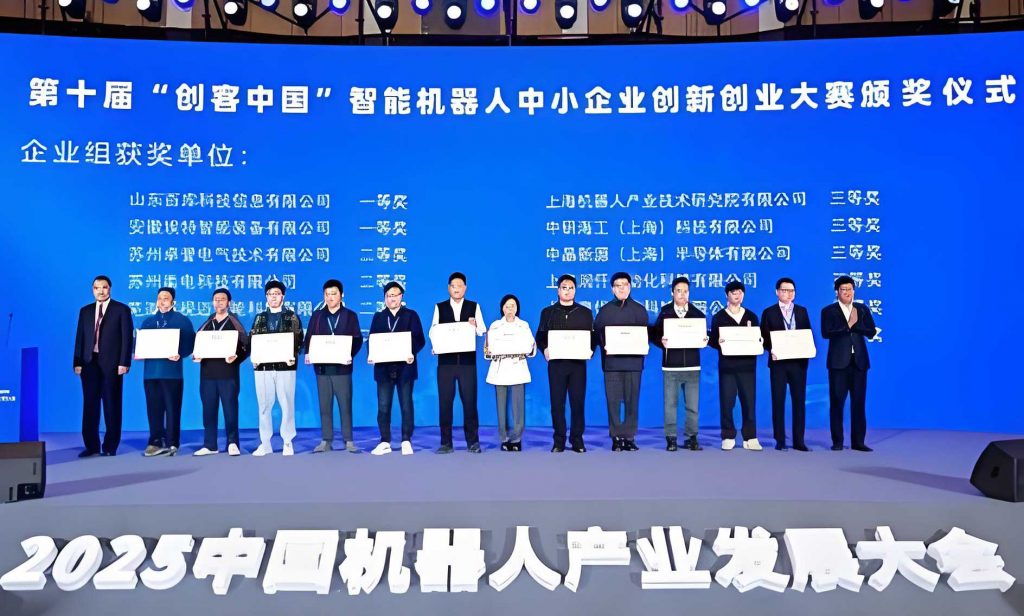
China has moved decisively into the practical phase of developing its own industrial robots. In 2013, domestic China robot manufacturers sold nearly 10,000 units of their own design. The prevailing view among specialists is that these locally produced robots will eventually achieve widespread adoption within China’s vast manufacturing base. If the domestic China robot industry can capture 75% of its own burgeoning market, its annual sales could reach the projected 400,000 units. Such a volume would mean that China’s share of the global industrial robot market would surpass the combined share of the United States, Europe, Japan, and South Korea. The rise of the China robot industry is therefore a development with global strategic implications.
Some skeptics argue against this potential, citing China’s historical reliance on imported high-end manufacturing equipment, such as fiber-optic manufacturing systems, IC fabrication tools, and CNC machine tools. They contend that without a mature domestic equipment manufacturing sector, China cannot play a major role in the global industrial robot value chain. However, this perspective fails to account for a critical distinction between robots and other precision machinery.
- Fundamental Difference: Equipment like CNC machine tools leaves a direct “fingerprint” on the components it produces. The performance and quality of a machined part are intrinsically tied to the accuracy and precision of the machine itself. Therefore, manufacturers are compelled to invest in high-performance machines to gain a competitive edge.
- Robot Functionality: In contrast, industrial robots in many applications primarily perform material handling tasks—moving parts from one location to another. Once a part is released from a robot’s gripper, it bears no trace of which specific robot handled it. There is no way to inspect a finished product and determine which robot was used in the process.
This distinction is crucial. For a vast number of simple pick-and-place, loading, and unloading operations, factories require a robot that can reliably move a component, not necessarily a ultra-high-precision, high-performance machine. The China robot industry is deemed fully capable of manufacturing robots that excel at these fundamental tasks. Furthermore, achieving massive economies of scale should drive down the cost of domestically produced robots significantly. Analysts draw an analogy: if India’s Tata Motors can produce and sell a car for under $3,000, then China robot manufacturers should feasibly be able to offer an industrial robot for less than $5,000. Government support, which China has strong incentives to provide, will be instrumental in reaching this cost target.
The prospective dominance of the China robot industry raises several pivotal questions for the future of global manufacturing:
- If Chinese manufacturers succeed in mass-producing low-cost industrial robots, will they export these machines to other countries? Such exports could significantly impact the market share of established international robotics firms.
- Assuming other nations can also supply inexpensive robots, what core technological advantages might the China robot industry develop to compete? Could the rise of China’s robot sector actually aid manufacturing competitiveness in other countries by providing them with affordable automation tools?
- Many business leaders in developed nations believe that the widespread adoption of automation and robotics will erode China’s manufacturing cost advantage, but this hinges on robots being available at similar prices globally. What if China chooses not to export its robots? In such a scenario, a robot costing $5,000 in China might carry a price tag of $25,000 or more elsewhere, creating an unlevel competitive playing field for global manufacturing.
- If China successfully transitions to advanced manufacturing, which nation or region is positioned to become the next “world factory” for low-end manufacturing?
The implications extend far beyond market statistics. The strategic deployment of robotics is central to China’s “Made in China 2025” initiative and related industrial policies aimed at technological self-sufficiency. The focus on the China robot ecosystem encompasses not just robot assembly but also critical components like reducers, servo motors, and control systems. While challenges in high-end precision and advanced AI-driven robotics remain, the progress in the mid-range and high-volume segment is undeniable.
International robotics corporations continue to invest heavily in China, establishing local production facilities and R&D centers to capture market share. However, they now face growing competition from a maturing cohort of domestic China robot companies. This dynamic is fostering a more diverse and competitive global supply chain for automation solutions. The evolution of the China robot market will also influence global standards, training requirements for roboticists and technicians, and the pace of automation adoption across different industries worldwide.
In conclusion, the convergence of demographic necessity, strategic industrial policy, and accelerating technological capability is propelling China to the forefront of the industrial robotics revolution. While the nation currently trails in robot density, its vast manufacturing base, coupled with determined government and corporate efforts, points toward exponential growth. The development of a cost-competitive domestic China robot industry has the potential to alter global trade dynamics, manufacturing geography, and the technological pecking order. Whether through exporting affordable automation or leveraging it to retain manufacturing supremacy, China’s trajectory in robotics is set to be a defining narrative of 21st-century industrial evolution. The world will be watching closely as the China robot story unfolds, reshaping the very foundations of global production.