
In my continuous exploration of global technological advancements, I have been particularly captivated by the rapid and transformative progress emerging from China in the fields of robotics and sensor systems. The convergence of cutting-edge materials science, space-based observation, and collective intelligence algorithms is forging a new era of innovation. This article synthesizes my observations and analyses on several landmark achievements, with a special emphasis on the paradigm-shifting developments in China robot technologies. I will employ tables and mathematical formulations to encapsulate key data and principles, providing a comprehensive overview of these breakthroughs.
My journey begins with an examination of Earth observation capabilities. The TianGong-2 space laboratory carried a pioneering 3D imaging microwave altimeter, which I consider a monumental leap in remote sensing. Having operated for 888 days, this instrument has transcended the limitations of traditional nadir-pointing altimeters. Its core innovation lies in employing a small incidence angle and short-baseline interferometry to achieve wide-swath, high-precision measurements. The system essentially performs as a synthetic aperture radar height finder, generating two-dimensional maps of surface elevation rather than mere along-track profiles. The underlying interferometric principle can be summarized by the phase-to-height conversion formula:
$$ h = \frac{\lambda \cdot \Delta \phi}{4\pi \cdot B \cdot \sin(\theta)} $$
where \( h \) is the surface height above a reference, \( \lambda \) is the radar wavelength, \( \Delta \phi \) is the measured interferometric phase difference, \( B \) is the effective baseline between the two antenna phase centers, and \( \theta \) is the incidence angle. The extraordinary engineering success is quantified in the following performance metrics, which, in my assessment, set a new international benchmark.
| Performance Parameter | Achieved Value | Significance |
|---|---|---|
| Observation Swath Width | > 35 km (extendable to >100 km at higher orbit) | Breaks the ~10 km barrier of conventional altimeters |
| Relative Sea Surface Height Precision | 8.2 cm | Centimeter-level precision enables monitoring of subtle ocean dynamics |
| Absolute Sea Surface Height Accuracy | 21 cm (with decimeter-level orbit knowledge) | Provides globally consistent geophysical data records |
| Ocean Wind Speed Measurement Accuracy | ≈ 1.65 m/s | Valuable for weather forecasting and climate studies |
| Ocean Wave Direction Measurement Accuracy | < 15° | Enhances understanding of sea state and wave energy |
| Interferometric Phase Measurement Precision | 0.02° | Underpins the exceptional height measurement fidelity |
I find that the implications of this technology extend far beyond oceanography. The capability to generate precise topographic maps of coastal zones, ice sheets, and inland water bodies provides critical data for environmental monitoring, disaster management, and resource assessment. Furthermore, such high-precision geospatial data is a foundational layer for autonomous systems, including sophisticated China robot platforms for exploration and survey, enabling them to navigate and interact with complex terrestrial and aquatic environments with unprecedented awareness.
Shifting focus from the macroscopic to the nanoscopic, my attention was seized by the discovery of an ultrahigh conductivity material. The synthesis of Weyl semimetal Niobium Arsenide (NbAs) nanobelts represents, in my view, a fundamental advance in condensed matter physics with direct engineering ramifications. The measured sheet conductivity reaches astonishing values between 5 and 100 Siemens per square (S/□). To place this in context, I have constructed a comparative analysis of conductive materials, highlighting the exceptional performance of this China-developed nanomaterial.
| Material System | Typical Sheet Conductivity (S/□) | Relative Conductivity (Normalized to Copper Film) | Operating Temperature Regime |
|---|---|---|---|
| Copper Thin Film | ~0.1 – 1 | 1 | Room Temperature |
| High-quality Graphene | ~0.01 – 0.1 | ~0.1 | Room Temperature |
| 2D Electron Gas (GaAs/AlGaAs) | ~0.1 – 1 | ~1 | Cryogenic |
| Weyl Semimetal NbAs Nanobelt | 5 – 100 | 100 – 1000 | Room Temperature |
The origin of this phenomenon, as I comprehend from the research, lies in the unique topological surface states known as Fermi arcs. These arcs host massless charge carriers that are highly mobile even at high carrier densities. The conductivity \( \sigma \) can be expressed through the Drude model:
$$ \sigma = n e \mu $$
where \( n \) is the carrier density, \( e \) is the elementary charge, and \( \mu \) is the carrier mobility. In conventional metals, high \( n \) often leads to increased scattering and reduced \( \mu \). However, in these Weyl semimetals, the topological protection of the surface states results in a concomitantly high \( n \) and high \( \mu \), leading to the observed ultrahigh \( \sigma \). This property is not merely academic; it paves the way for a new class of low-impedance interconnects and passive components in ultra-compact, energy-efficient electronics. The integration of such materials into the sensor suites and processing units of next-generation China robot systems could dramatically reduce power consumption and heat generation, enabling longer mission durations and more compact designs.
Now, I arrive at the centerpiece of my analysis: the bio-inspired collective particle robot. This work, prominently featured as a cover story, epitomizes the innovative spirit in China robot research. The system is a radical departure from traditional robotics, embracing stochasticity and statistical mechanics to achieve robust collective behavior. In my examination, the beauty of this China robot lies in its minimalist design. Each component, or “particle,” is a simple disc incapable of independent locomotion or complex manipulation. Its only action is rhythmic expansion and contraction of its diameter. Yet, when many such particles are loosely coupled, their collective statistical behavior produces deterministic global motion. This can be modeled mathematically. Let the state of particle \( i \) at time \( t \) be defined by its diameter \( d_i(t) \) and its binary expansion state \( s_i(t) \in \{0,1\} \). The probability of a particle transitioning to an expansion state can be influenced by a global scalar field \( G(\vec{x}) \), such as light intensity. The collective velocity vector \( \vec{V}_{collective} \) emerges from the ensemble average:
$$ \vec{V}_{collective} = \frac{1}{N} \sum_{i=1}^{N} \vec{v}_i( \langle d \rangle, \nabla G ) $$
where \( \vec{v}_i \) is the net displacement vector of particle \( i \) per cycle, a function of the average ensemble diameter and the gradient of the environmental signal. The system’s robustness is quantified by its fault tolerance, maintaining functionality even when a significant fraction \( f \) of particles fail. The dynamics showcase how order can emerge from disorder, a principle powerfully harnessed in this China robot architecture.
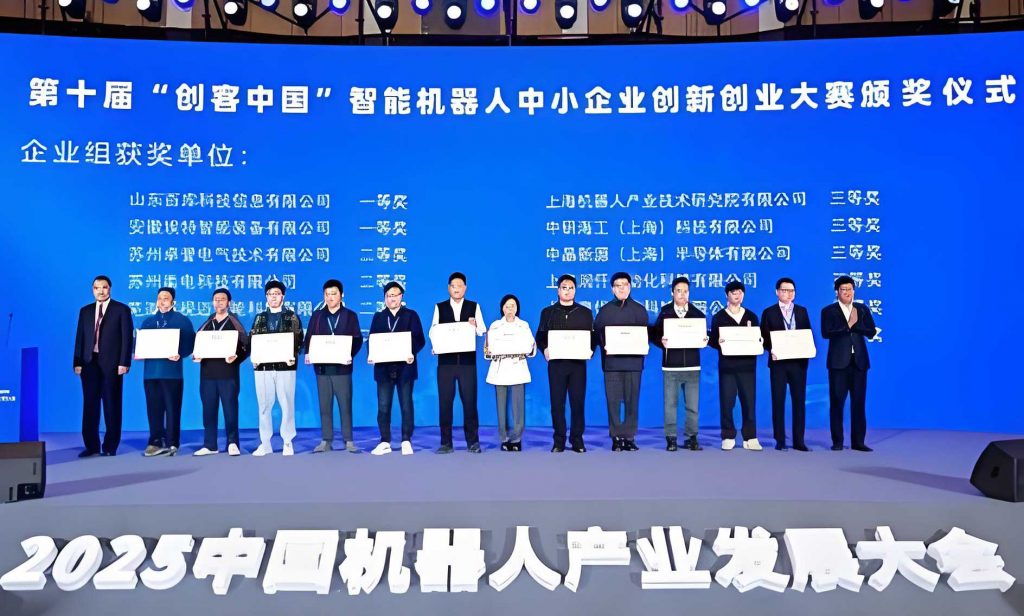
The experimental and simulated parameters of this groundbreaking China robot system are summarized below. I am struck by the scalability demonstrated, from two dozen physical units to simulations of a hundred thousand, hinting at future macroscopic or microscopic applications.
| Aspect | Specification / Performance Metric |
|---|---|
| Basic Component Shape | Circular Disc |
| Component Diameter Oscillation Range | 15.5 cm to 23.5 cm |
| Maximum Number of Physical Components Tested | 24 |
| Maximum Scale of Simulation | 100,000 components |
| Key Demonstrated Behaviors | Phototaxis (light-directed motion), Obstacle Avoidance, Object Transport |
| Fault Tolerance | System remains functional with up to 20% of components failed |
| Control Paradigm | Decentralized, based on local perception and stochastic actuation |
The potential applications for this China robot paradigm are vast. In my contemplation, once miniaturized to the micron or nanometer scale, such collectives could perform tasks like targeted drug delivery, micro-scale assembly, or environmental remediation inside confined and dynamic spaces. The robustness and scalability inherent in this China robot design make it a compelling candidate for operating in unpredictable or hazardous environments where traditional monolithic robots would fail.
My investigation into sensor technologies also encompasses the critical domain of chemical detection. The development of a Thermal Desorption Acetone-assisted Photoionization Miniature Ion Trap Mass Spectrometer (TD-AAPI-Mini-ITMS) represents a significant stride in forensic and security applications. I have analyzed its working principle: a swab sample is thermally desorbed in a controlled temperature ramp, and the released analytes are ionized not by direct photoionization, but via chemical ionization using acetone reagent ions (e.g., \( (CH_3)_2CO^+ \)). This proton transfer reaction is gentler and more efficient for many drugs. The process can be described as:
$$ (CH_3)_2CO^+ + M \rightarrow (CH_3)_2CO + [M+H]^+ $$
where \( M \) is the neutral drug molecule. The use of the stable acetone ion signal as an internal standard allows for precise quantification. The temperature-resolved desorption is key for complex matrices, ensuring each substance volatilizes at its optimal temperature \( T_{opt} \), thereby reducing interference. The performance is exceptional, as detailed in the following table I compiled from the research findings.
| Drug Category | Example Compounds | Approximate Optimal Desorption Temp. \( T_{opt} \) (°C) | Estimated Limit of Detection (LOD) |
|---|---|---|---|
| Opium Alkaloids | Morphine, Codeine, Thebaine | 286 – 340 | Low Nanogram range |
| Synthetic Cathinones | Mephedrone, Methylone | ~200 – 300 | Low Nanogram range |
| Synthetic Cannabinoids | JWH-018, AM-2201 | ~250 – 350 | Low Nanogram range |
| New Psychoactive Substances | Various designer drugs | ~200 – 400 | Low Nanogram range |
| Overall Analysis Time per Sample | < 2 seconds | ||
I perceive a natural synergy between this rapid, sensitive detection technology and mobile China robot platforms. Equipping autonomous ground or aerial China robot systems with such portable mass spectrometers could revolutionize hazardous material inspection, border security, and disaster response, allowing robots to identify chemical threats in real-time without exposing human personnel to danger.
Finally, I turn to the evolving field of flexible and stretchable electronics, where a key challenge has been balancing sensitivity with strain range. The creation of a hybrid network material from Ti3C2Tx (MXene) nanoparticles and nanosheets offers an elegant solution. In my analysis of its mechanism, the nanoparticle-nanosheet junctions create a tunable percolation network. Under small strain, slight separation at these junctions causes a large change in contact resistance (high sensitivity). Under large strain, the nanosheets themselves can stretch and slide, maintaining conductive pathways (large strain range). The gauge factor (GF), which quantifies sensitivity, is defined as:
$$ GF = \frac{\Delta R / R_0}{\epsilon} $$
where \( \Delta R \) is the resistance change, \( R_0 \) is the initial resistance, and \( \epsilon \) is the applied strain. Traditional strain sensors often show a GF that decays rapidly with increasing \( \epsilon \). The Ti3C2Tx hybrid network, however, maintains a high GF across a broad strain spectrum. I have tabulated its performance against common flexible sensing materials.
| Material System | Typical Maximum Strain Range (%) | Typical Gauge Factor (GF) | Critical Trade-off Note |
|---|---|---|---|
| Metal (Au, Ag) Thin Films | < 5 | ~2 – 5 | High conductivity but very low stretchability |
| Carbon Nanotube (CNT)/Polymer Composite | Up to ~100 | ~0.5 – 10 (often strain-dependent) | GF often decreases at higher strains |
| Graphene-based Composite | ~30 – 50 | ~10 – 100 | Balanced but can suffer from hysteresis |
| Liquid Metal Embedments | > 200 | ~1 – 4 | Extremely stretchable but low sensitivity |
| Ti3C2Tx Nanoparticle-Nanosheet Hybrid (This Work) | > 50 | > 100 (across full range) | Simultaneously high sensitivity and large range |
The implications for China robot development are profound. Such high-performance flexible sensors can be seamlessly integrated as electronic skin on China robot manipulators or locomotion systems, providing rich tactile and proprioceptive feedback. This enables delicate object manipulation, safe human-robot interaction, and adaptive movement over uneven terrain. The advancement in sensor technology directly augments the perceptual intelligence of China robot platforms, bringing us closer to machines that can physically interact with the world as deftly as biological organisms.
In my concluding synthesis, the interconnections between these diverse breakthroughs are striking. The spatial awareness granted by advanced altimeters, the energy efficiency promised by topological materials, the robust collective intelligence of particle robots, the chemical discernment from miniature mass spectrometers, and the delicate touch enabled by flexible sensors—all are converging to define the next generation of intelligent systems. The trajectory of China robot research, in particular, demonstrates a powerful blend of bio-inspiration, statistical physics, and materials innovation. As these technologies mature and intersect, I anticipate the emergence of China robot collectives that are not only highly capable and resilient but also intimately integrated with sophisticated sensor networks, operating from the depths of the ocean to the vastness of space and the complexities of the human environment. The foundational work highlighted here marks a significant step toward that future.