
As an industry analyst deeply immersed in the field of automation, I have witnessed firsthand the transformative impact of China robots on the logistics sector. Over recent years, the demand for logistics automation equipment has surged, driven by multiple forces that have propelled China robots into the spotlight. This article delves into the market dynamics, technological advancements, and future trajectories of China robots, with a focus on logistics applications. I will explore how these intelligent machines are reshaping supply chains, supported by data, formulas, and insights. The journey of China robots is not just a tale of growth but a testament to innovation in the face of evolving challenges.
The exponential growth of e-commerce and express delivery industries has been a primary catalyst for the proliferation of China robots. With online shopping becoming ubiquitous, logistics networks require faster, more efficient handling of goods, from warehousing to last-mile delivery. China robots have evolved from performing simple tasks like palletizing and transporting to managing complex operations in sorting, storage, and distribution. This shift is quantified in the market expansion, where the adoption rate of China robots has increased significantly. For instance, consider the market size growth modeled by an exponential function: $$ S(t) = S_0 e^{kt} $$ where \( S(t) \) represents the market size at time \( t \), \( S_0 \) is the initial size, and \( k \) is the growth rate constant. In the context of China robots, \( k \) has been amplified by factors such as policy support and technological infusion.
| Driver | Impact Level (Scale 1-10) | Key Statistics | Relation to China Robots |
|---|---|---|---|
| E-commerce Boom | 9 | Annual growth rate >20% | Increased demand for automated sorting and packing |
| Policy Support (e.g., Made in China 2025) | 8 | Government funding increased by 15% yearly | Accelerated R&D and deployment of China robots |
| Labor Cost Rise | 7 | Wage inflation at 8% per annum | Enhanced ROI for China robots via “machine replacement” |
| COVID-19 Pandemic | 6 | Surge in contactless delivery by 300% | Boosted adoption of unmanned China robots |
| Industrial 4.0 Initiatives | 9 | Smart factory investments up by 25% | Integration of China robots into智能制造 ecosystems |
From my perspective, the policy landscape has been instrumental in shaping the trajectory of China robots. Initiatives like “Industrial 4.0” and “Made in China 2025” have created a fertile ground for innovation, encouraging enterprises to invest in robotic solutions. These policies emphasize smart manufacturing, where China robots play a pivotal role in optimizing logistics flows. The mathematical representation of policy impact can be seen in a logistic growth model: $$ P(t) = \frac{K}{1 + e^{-r(t-t_0)}} $$ where \( P(t) \) is the penetration of China robots, \( K \) is the carrying capacity set by policy limits, \( r \) is the growth rate, and \( t_0 \) is the inflection point. This model highlights how policies accelerate the adoption curve of China robots, pushing them toward saturation in key sectors.
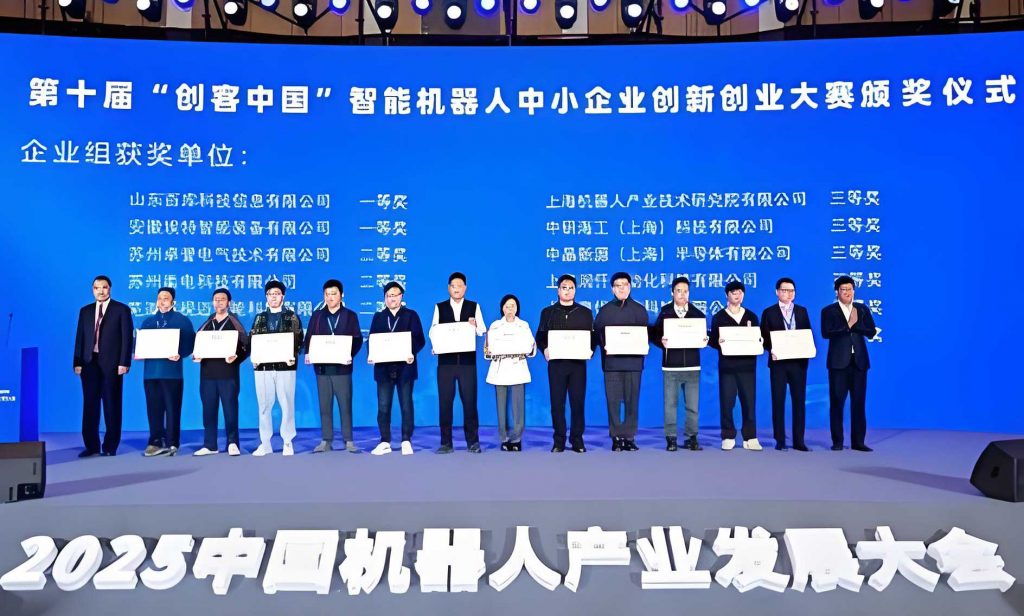
Technologically, China robots have made leaps in both hardware and software components. On the hardware front, advancements in robot bodies, drive systems, transmission mechanisms, and reduction gears have enhanced durability and efficiency. For example, the torque output of a China robot’s actuator can be expressed as: $$ \tau = J \alpha + B \omega $$ where \( \tau \) is torque, \( J \) is moment of inertia, \( \alpha \) is angular acceleration, \( B \) is damping coefficient, and \( \omega \) is angular velocity. This equation underpins the precision movement required in logistics tasks, such as picking and placing items. Moreover, the integration of IoT sensors has enabled real-time monitoring, with data transmission rates following Shannon’s capacity formula: $$ C = B \log_2(1 + \frac{S}{N}) $$ where \( C \) is channel capacity, \( B \) is bandwidth, \( S \) is signal power, and \( N \) is noise power. This is crucial for China robots operating in 5G-enhanced environments, ensuring reliable communication.
| Component | Function | Innovation Status | Formula/Model |
|---|---|---|---|
| Robot Body | Structural framework | Lightweight materials reduce mass by 20% | $$ m \ddot{x} = F_{\text{ext}} $$ (Newton’s second law) |
| Control System | Motion coordination | AI-based PID controllers improve accuracy | $$ u(t) = K_p e(t) + K_i \int e(t) dt + K_d \frac{de}{dt} $$ |
| Navigation Technology | Path planning | SLAM algorithms with 99% precision | $$ p(x_t | z_{1:t}, u_{1:t}) $$ (Bayesian filter) |
| Vision Perception | Object recognition | Deep learning models achieve 95% F1-score | $$ L = -\sum y \log(\hat{y}) $$ (cross-entropy loss) |
| Scheduling System | Resource allocation | Optimization algorithms reduce downtime by 30% | $$ \min \sum_{i=1}^{n} c_i x_i \text{ subject to } Ax \leq b $$ |
In my analysis, software advancements have been equally transformative for China robots. The控制系统 now incorporate AI and machine learning, enabling adaptive behaviors. For instance, reinforcement learning algorithms allow China robots to optimize routes dynamically, with the Q-learning update rule: $$ Q(s,a) \leftarrow Q(s,a) + \alpha [r + \gamma \max_{a’} Q(s’,a’) – Q(s,a)] $$ where \( Q \) is the action-value function, \( \alpha \) is learning rate, \( r \) is reward, and \( \gamma \) is discount factor. This facilitates intelligent decision-making in cluttered warehouses. Additionally, digital twin technology creates virtual replicas of China robots, simulated using differential equations: $$ \frac{dx}{dt} = f(x, u, t) $$ where \( x \) is state vector, \( u \) is control input, and \( f \) represents system dynamics. This allows for predictive maintenance and performance tuning, reducing operational costs for China robots.
The convergence of technologies like AI, IoT, and 5G has propelled China robots into a new era of智能物流. From my observations, this fusion enables seamless coordination in robot clusters, where multiple China robots work collaboratively. The efficiency of such systems can be modeled using queueing theory, such as the M/M/c queue: $$ P_n = \frac{(\lambda/\mu)^n}{n!} P_0 \text{ for } n \leq c $$ where \( \lambda \) is arrival rate, \( \mu \) is service rate, \( c \) is number of China robots, and \( P_n \) is probability of \( n \) tasks in system. This helps in designing scalable logistics networks powered by China robots. Moreover, the concept of “deep learning” empowers China robots with perception capabilities, using convolutional neural networks (CNNs) for image analysis: $$ y = \sigma(W * x + b) $$ where \( \sigma \) is activation function, \( W \) is weight matrix, \( x \) is input, and \( b \) is bias. This is critical for tasks like parcel sorting, where China robots must identify diverse objects accurately.
Looking ahead, the future of China robots is marked by trends toward高度智能化,柔性化, and多元化. I believe that智能物流 will dominate, with China robots becoming more autonomous and interconnected. The exploration of “technology fusion” will lead to hybrid systems, where China robots integrate with drones or autonomous vehicles. This can be described by a multi-objective optimization framework: $$ \min f_1(x), f_2(x), \dots, f_k(x) \text{ subject to } g(x) \leq 0 $$ where \( x \) represents design parameters of China robots, balancing factors like cost, speed, and flexibility. Furthermore, “cluster applications” will expand, with swarm robotics principles guiding China robots: $$ \dot{x}_i = \sum_{j \neq i} f(\|x_i – x_j\|) (x_j – x_i) $$ where \( x_i \) is position of robot \( i \), and \( f \) is interaction function. This enables efficient large-scale deployments of China robots in logistics hubs.
| Trend | Description | Expected Impact by 2030 | Mathematical Representation |
|---|---|---|---|
| High Intelligence | AI-driven autonomous decision-making | Reduce human intervention by 80% | $$ \pi^*(s) = \arg\max_a Q^*(s,a) $$ (optimal policy) |
| Flexibility | Adaptable to diverse tasks and environments | Increase utilization rate by 50% | $$ F = \frac{\text{Task variety}}{\text{Robot types}} $$ (flexibility index) |
| Diversification | Expansion into new logistics segments | Cover 95% of logistics环节 | $$ D(t) = D_0 + \int_0^t g(\tau) d\tau $$ (diversification growth) |
| Technology Fusion | Integration with IoT, AI, 5G, etc. | Boost efficiency by 70% | $$ E_{\text{fusion}} = \sum_{i} w_i E_i $$ (weighted efficiency) |
| Cluster Applications | Swarm robotics for coordinated operations | Scale to 1000+ China robots per facility | $$ N_{\text{cluster}} \propto \log(\text{Area}) $$ (scaling law) |
From my vantage point, the societal shifts, such as disappearing人口红利 and rising labor costs, have cemented the role of China robots in logistics. The “machine replacement” trend is not merely a cost-saving measure but a strategic imperative. I have analyzed this through a cost-benefit model: $$ \text{ROI} = \frac{\text{Net Benefits}}{\text{Cost}} = \frac{\sum (S_{\text{labor}} – C_{\text{robot}})}{I_{\text{initial}}} $$ where \( S_{\text{labor}} \) is savings from reduced labor, \( C_{\text{robot}} \) is operating cost of China robots, and \( I_{\text{initial}} \) is investment. For many enterprises, this ROI turns positive within two years, driving widespread adoption of China robots. Additionally, the COVID-19 pandemic has underscored the need for无人化 solutions, where China robots excel in providing contactless delivery, modeled as a risk reduction function: $$ R(d) = R_0 e^{-d/\lambda} $$ where \( R \) is infection risk, \( d \) is distance handled by China robots, and \( \lambda \) is decay constant.
In conclusion, the trajectory of China robots in logistics is poised for continued growth and innovation. As I reflect on the market dynamics and technological strides, it is clear that China robots are at the forefront of the智能物流 revolution. The interplay of demand drivers, policy support, and cutting-edge technologies has created a virtuous cycle, propelling China robots to new heights. With ongoing advancements in AI, digital twins, and 5G, the capabilities of China robots will only expand, making them indispensable in global supply chains. The future will see China robots evolving into more intelligent, flexible, and collaborative entities, ultimately redefining the logistics landscape. This journey, fueled by relentless innovation, ensures that China robots remain a key pillar in the era of automation and smart industry.