
SHANGHAI — The 2026 URKL City Tour Challenge opened its first stop at Baoshan Gymnasium in Shanghai, placing a full-size, high-dynamic humanoid robot in a live combat setting and bringing autonomous machine intelligence before a public audience. The event followed the July unveiling of the URKL free-combat league in Shenzhen, which drew attention to competitive humanoid robot sport. In Shanghai, the city tour translated that attention into a focused demonstration of how a humanoid robot can perceive its surroundings, assess an opponent, make decisions, plan movement and execute high-dynamic actions within a single end-to-end loop.
The Shanghai stop was hosted by Baoshan District Government and organized by Shenqing Robot Technology (Shanghai) Co., Ltd., with support from Shanghai Robot Industrial Park. The event was designed as more than a display of mechanical strength. It presented a public test of whether a humanoid robot can combine perception, situational judgment, tactical choice, motion planning and motor execution in real time. For the humanoid robot sector, the significance lies in the integration of these capabilities rather than in any single movement or isolated technical feature.
| Key element | Details from the 2026 URKL City Tour opening event |
|---|---|
| Event | 2026 URKL City Tour Challenge, first stop |
| Location | Baoshan Gymnasium, Shanghai |
| Featured humanoid robot | T800, a full-size high-dynamic general-purpose humanoid robot built by Zhongqing |
| Core demonstration | Autonomous combat, punching and kicking, evasive movement, falling and recovery, opponent tracking and re-engagement |
| Intelligence chain | Perception, situational assessment, strategy decision, motion planning and motor execution |
| Organizing structure | Hosted by Baoshan District Government; organized by Shenqing Robot Technology (Shanghai) Co., Ltd.; supported by Shanghai Robot Industrial Park |
| Strategic themes | Industry-competition integration, ecosystem building, tourism and culture linkage, commercial operation and international layout |
| Upcoming development | The world’s first humanoid robot combat club is planned to appear in October at Baoshan Smart Bay |
1. A Full-Size Humanoid Robot Enters the Arena
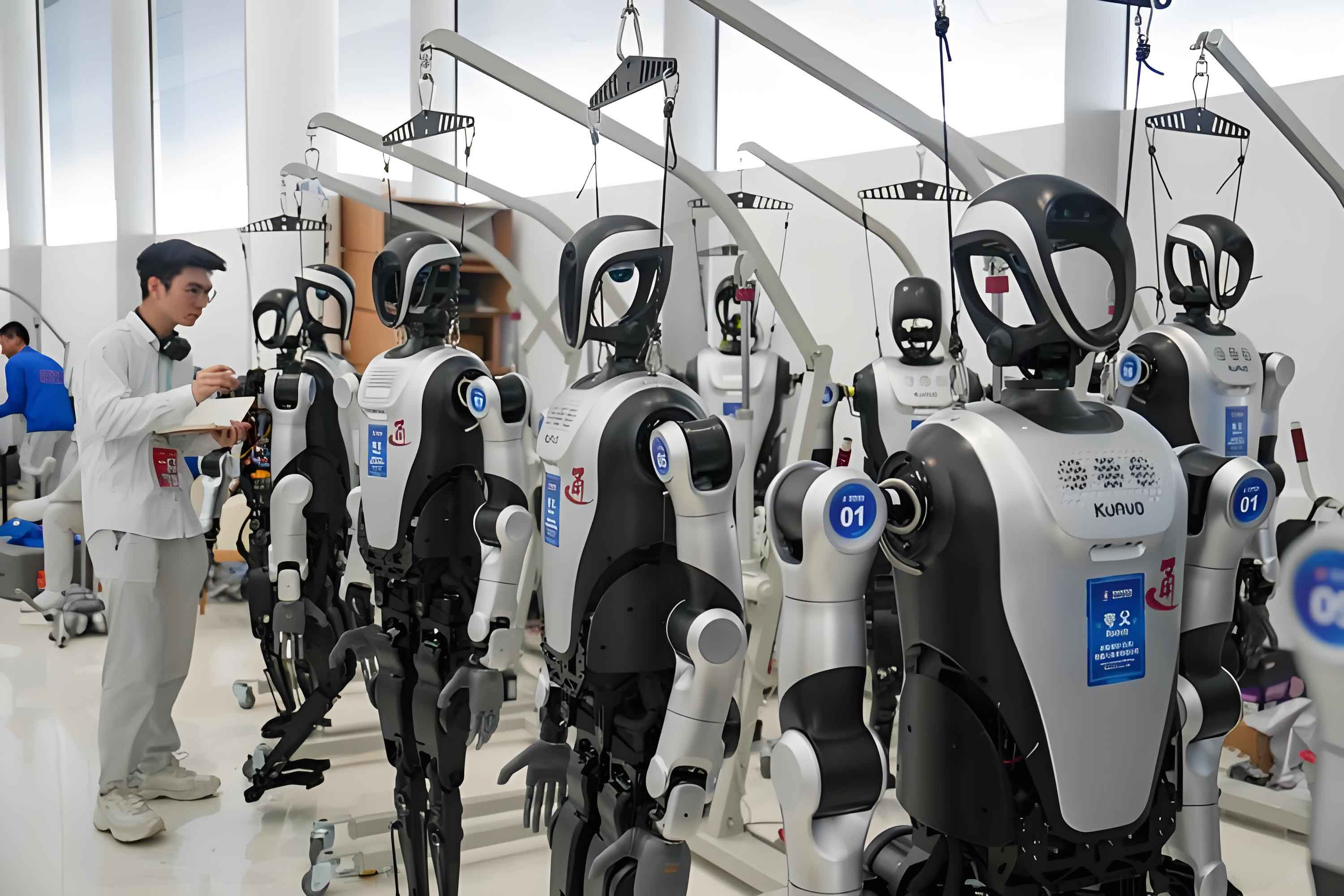
The central figure of the Shanghai event was the T800, a full-size high-dynamic general-purpose humanoid robot developed by Zhongqing. The humanoid robot entered the arena through autonomous navigation, then moved into a sequence of combat actions that included punches, kicks, evasive footwork and rapid re-positioning. The performance was not limited to forward aggression. The humanoid robot also demonstrated the ability to fall, rise and return to confrontation in a continuous flow, a capability that places significant demands on balance, joint control, structural design and real-time decision-making.
For the audience, the most visible qualities were speed, agility and the apparent coordination between upper and lower body movement. For engineers and industry observers, the more important qualities lay beneath the surface. The humanoid robot had to locate its opponent, maintain awareness of relative position, respond to movement, choose an appropriate action and convert that choice into motor commands. Each of these steps must operate within a coherent system. A humanoid robot that can punch or kick in a controlled demonstration is one thing; a humanoid robot that can chase, sidestep, recover from a fall and re-enter combat is a substantially different level of technical integration.
The event commentary and audience response reflected this difference. The arena atmosphere rose repeatedly as the humanoid robot shifted from attack to defense, from pursuit to evasion and from loss of balance to recovery. These transitions gave the public a visible way to understand a technical argument: the humanoid robot is moving from the stage of being able to move toward the stage of being able to act, react and compete. The humanoid robot is no longer only a platform for displaying gait or gesture. It is becoming a system that must interpret a changing environment and produce purposeful behavior under pressure.
2. End-to-End Autonomy Behind the Humanoid Robot’s Combat Performance
The Shanghai event concentrated on what the organizers described as full autonomous arena combat capability. The humanoid robot did not simply follow a fixed sequence. It combined perception, situational assessment, strategy decision, motion planning and motor execution into an end-to-end AI autonomous closed loop. This phrase is important because it describes a chain rather than a collection of separate features. A humanoid robot may have advanced sensors, strong joints or sophisticated algorithms, but competitive combat requires these elements to work together without a human operator supplying each action.
In a combat setting, perception must identify the opponent and track changes in position. Situational assessment must convert that information into an understanding of advantage, risk and opportunity. Strategy decision must choose between attacking, defending, retreating, circling or recovering. Motion planning must translate the chosen strategy into a feasible sequence of body movements. Motor execution must deliver those movements through the humanoid robot’s joints and limbs while maintaining balance and structural stability. When these layers operate as a loop, the humanoid robot can adjust continuously instead of waiting for a pre-set routine to finish.
| Capability layer | Function in the humanoid robot combat demonstration | Why it matters for the humanoid robot sector |
|---|---|---|
| Perception | Locate the opponent and read movement and position | Provides the real-time information base for autonomous behavior |
| Situational assessment | Interpret relative position, movement and immediate risk | Supports tactical awareness rather than blind reaction |
| Strategy decision | Choose attack, defense, evasion, pursuit or recovery | Moves the humanoid robot beyond preset routines |
| Motion planning | Plan footwork, body alignment and limb movement | Connects high-level intent with physical action |
| Motor execution | Deliver punches, kicks, side-steps and recovery | Tests high-dynamic control, balance and joint performance |
| End-to-end loop | Integrate all layers into continuous action and reaction | Demonstrates the humanoid robot’s autonomous closed-loop intelligence |
The demonstration therefore served as a public validation of a humanoid robot architecture. The T800’s movements were not presented as disconnected tricks. They were presented as outputs of a system that senses, evaluates, decides, plans and executes. This distinction matters for commercial deployment. A humanoid robot intended for real environments must cope with uncertainty, changing conditions and unexpected events. Competitive combat compresses these challenges into a visible arena. The humanoid robot must respond to another moving agent, maintain equilibrium and recover from disruptions while continuing to pursue an objective.
From an engineering perspective, the fall-and-recovery sequence was especially revealing. A humanoid robot that can stand and walk has already solved a difficult control problem. A humanoid robot that can fall, rise and immediately rejoin combat must manage impact, joint stress, balance recovery and reorientation. The ability to return to action after a disruption is relevant far beyond sport. It points toward a humanoid robot that can operate in less structured environments, where slips, collisions and unexpected contact may occur. The arena thus becomes a concentrated testing ground for capabilities that can later be adapted to industrial, service, logistics, inspection and public-facing scenarios.
3. From Perception to Action: The Humanoid Robot as an Integrated System
The event’s technical narrative centered on the idea that a humanoid robot must possess both a complete body and a complete brain. Zhongqing’s work was described as spanning full-stack self-developed joint modules and a human-brain-inspired embodied intelligence engine. The joint modules represent the physical foundation: the humanoid robot’s ability to move, absorb impact, generate force and maintain control. The embodied intelligence engine represents the cognitive layer: the humanoid robot’s ability to interpret sensory information, form judgments and generate behavior. The combination is what allows a humanoid robot to move from basic motion to competitive interaction.
This integrated approach is significant because the humanoid robot sector often faces a split between hardware and software narratives. One narrative emphasizes actuators, structures, power systems and mechanical performance. Another emphasizes algorithms, models, perception and decision-making. Competitive combat requires both to be addressed at once. A strong decision that cannot be executed with stability is not useful. A powerful movement that cannot be selected at the right moment is equally limited. The humanoid robot must close the gap between intention and action under time pressure.
The Shanghai event showed how that gap can be narrowed through an end-to-end loop. The humanoid robot’s perception informs assessment; assessment informs strategy; strategy informs planning; planning informs execution; and execution generates new sensory information that feeds back into the loop. This continuous cycle is the foundation of autonomous behavior. It is also the reason the event was described as a test of technical boundaries rather than a simple sporting spectacle. The humanoid robot was not only asked to perform; it was asked to adapt.
The public format added another dimension. Competitive events create clear objectives, visible consequences and immediate feedback. For a humanoid robot, this means that errors become observable and recovery becomes part of the performance. The audience can see when the humanoid robot loses balance, adjusts position or changes strategy. That transparency can build understanding of both the progress and the remaining challenges in humanoid robot development. It also creates a compelling platform for industry communication, because technical capabilities can be demonstrated in a way that is accessible to non-specialists.
4. A Public Platform for Humanoid Robot Technology Validation
The URKL city tour is positioned as a platform where humanoid robot technology can be tested, displayed and discussed in public. The first stop in Baoshan brought together competition, exhibition and industrial communication. The humanoid robot’s performance was the focal point, but the event also carried a broader message about the maturity path of the sector. A humanoid robot must move through stages of capability. It must first be able to move. It must then be able to interact, resist disruption and sustain purposeful action. Competitive combat represents a demanding intermediate stage between controlled demonstration and open-ended real-world deployment.
This stage is valuable because it stress-tests the humanoid robot in ways that a staged demonstration may not. The opponent is dynamic. The arena is shared. The timing of actions matters. The humanoid robot must manage both its own body and the behavior of another agent. These conditions resemble, in a compressed form, the challenges of operating in human-centered or unpredictable environments. The humanoid robot that can track an opponent, evade a strike, recover from a fall and re-enter engagement is developing capabilities that can be transferred to other tasks requiring balance, awareness and rapid response.
The event also provided a platform for public engagement. Competitive robotics can communicate technical progress through action rather than explanation. When a humanoid robot steps into an arena, the audience can see the relationship between sensing, decision-making and movement. The humanoid robot becomes a visible system rather than an abstract research topic. This visibility can support industrial recruitment, public understanding and investment interest. It can also help set expectations by showing both what a humanoid robot can do today and what remains difficult.
The organizers framed the event as a collision between robot technology and competitive sport, but also as a deep connection between technology and the city, between enterprises and industry. That framing places the humanoid robot within a wider ecosystem. A humanoid robot is not developed in isolation. It depends on components, software, testing environments, application scenarios, talent and public acceptance. A city-level event can connect these elements around a shared focal point. The humanoid robot becomes a meeting place for mechanical engineering, artificial intelligence, control systems, industrial design, event operations and cultural expression.
5. Industry-Competition Integration and the Humanoid Robot Ecosystem
Baoshan is accelerating the construction of a humanoid robot technology sourcing, achievement transformation and scenario demonstration model zone. The district has gathered a group of robot and intelligent manufacturing upstream and downstream enterprises, and it offers what the event described as a solid industrial foundation and fertile innovation environment. With support from the Baoshan District Government, the first stop of the URKL city tour was placed in this district. The choice reflects an effort to link competition with industrial development rather than treating the event as a standalone spectacle.
Yao Qiyuan, co-founder and marketing head of Zhongqing Robotics, said the company will use an industry-competition integration model as a牵引—a guiding force—to build a humanoid robot industry benchmark ecosystem in Baoshan. The ecosystem is described as combining a technology platform, application scenarios, distinctive cultural intellectual property and a regional headquarters. The aim is to support Shanghai in accelerating the construction of a world-class robot industry cluster. In this model, the humanoid robot is both a product and a platform. The competition provides a visible application scenario, while the industrial ecosystem provides the supply chain, talent and commercial pathways needed to sustain progress.
| Ecosystem participant | Role in the Baoshan event and humanoid robot ecosystem | Contribution to the broader development path |
|---|---|---|
| Baoshan District Government | Host and policy supporter | Advances the humanoid robot demonstration zone and industrial clustering |
| Shenqing Robot Technology (Shanghai) Co., Ltd. | Organizer | Operates the competition platform and connects technology with public presentation |
| Shanghai Robot Industrial Park | Supporter | Links industrial resources and provides an ecosystem backdrop for the humanoid robot sector |
| Zhongqing Robotics | Humanoid robot developer | Provides the T800 humanoid robot and integrated hardware and intelligence capabilities |
| Baoshan Smart Bay | Future venue for the humanoid robot combat club | Extends the event into regular operation and consumer experience |
| 2026 Shanghai Tourism Festival | Cultural and tourism platform | Connects humanoid robot competition with city culture, sport and tourism consumption |
The industry-competition integration model has several layers. At the technical level, competition creates demanding scenarios that can reveal strengths and weaknesses in the humanoid robot system. At the industrial level, it brings together developers, component suppliers, event organizers, venue operators and public institutions. At the commercial level, it creates opportunities for ticketing, experiences, media content, brand collaboration and related services. At the cultural level, it gives the humanoid robot a public narrative that can travel beyond engineering circles. Each layer reinforces the others, provided that the event is developed with continuity rather than treated as a one-time showcase.
For the humanoid robot industry, continuity is essential. A single demonstration can prove that a capability exists under controlled conditions. A recurring competition series can track improvement, compare approaches and build public familiarity. It can also generate operational knowledge: how to stage safe humanoid robot combat, how to present technical achievements to audiences, how to manage venue and production demands, and how to translate competition content into sustainable business models. The humanoid robot becomes part of an ongoing industrial and cultural rhythm rather than a brief news moment.
6. Baoshan as a Humanoid Robot Demonstration Zone
The selection of Baoshan as the first stop of the 2026 URKL city tour highlights the district’s ambition in the humanoid robot sector. Baoshan is described as building a model zone for humanoid robot technology sourcing, achievement transformation and scenario demonstration. This means the district is not only seeking to attract enterprises but also to connect research, commercialization and public application. A humanoid robot demonstration zone requires more than factory space. It requires venues where humanoid robots can be tested in realistic conditions, partners who can translate laboratory results into products, and audiences who can experience and evaluate the technology.
The event at Baoshan Gymnasium illustrated how a public venue can serve as a demonstration space. The humanoid robot performed in front of a live audience, with commentary and audience response forming part of the atmosphere. This format can help normalize the presence of humanoid robots in public life. It can also generate feedback for developers. The humanoid robot’s movements, recoveries and interactions are observed not only by engineers but also by potential users, students, cultural producers and city residents. That diversity of observation can reveal new application ideas and new expectations.
The district’s industrial base includes robot and intelligent manufacturing enterprises across the upstream and downstream chain. This matters for the humanoid robot because the sector depends on a wide range of components and services: actuators, sensors, structural parts, control systems, power management, software tools, testing services and integration expertise. A strong local ecosystem can shorten development cycles and support collaboration. When a humanoid robot competition is held in such a district, it can serve as a focal point for these capabilities. The competition is not separate from the industrial base; it is an expression of that base and a stimulus for its further development.
The model zone concept also implies policy coordination. Support from the Baoshan District Government was explicitly noted in the event organization. Such support can take the form of venue access, industrial planning, ecosystem building and public communication. For the humanoid robot sector, policy attention is important because the technology spans multiple domains and requires coordination across research institutions, enterprises and public services. A district-level demonstration zone can act as a testbed for these coordination mechanisms. The humanoid robot becomes a shared project that brings together different parts of the city’s innovation system.
7. A Humanoid Robot Combat Club and New Consumption Scenarios
Zhang Ying, general manager of Shanghai Robot Industrial Park, disclosed that the world’s first humanoid robot combat club will officially appear in October at Baoshan Smart Bay. The club is planned to operate regular humanoid robot combat events, cyber-themed immersive consumer experiences and other diverse business formats. The goal is to explore a fusion model of artificial intelligence technology, embodied culture and new consumption. This plan extends the humanoid robot from a competition event into a recurring venue-based experience.
The club concept is significant because it suggests a commercial format around the humanoid robot. Competitive events can attract audiences, but a club can build repeat engagement. It can host regular matches, provide behind-the-scenes experiences, offer educational content and create a cultural atmosphere around humanoid robot sport. The cyber-themed immersive consumer experience adds another layer. It connects the humanoid robot to entertainment, design, media and retail. The humanoid robot becomes part of a destination rather than only a technical exhibit.
The fusion of artificial intelligence technology, embodied culture and new consumption is a notable positioning. Embodied culture refers to the cultural expressions that emerge around physical, embodied technology. Humanoid robot combat is inherently embodied: it involves bodies in motion, contact, balance and recovery. That physicality can generate strong visual and emotional engagement. When combined with immersive environments and consumer experiences, the humanoid robot can become a platform for storytelling. Visitors are not only watching a machine; they are entering a world shaped by machine capability.
The club’s planned location at Baoshan Smart Bay adds an urban dimension. Smart Bay is positioned as a place where technology, culture and consumption can intersect. A humanoid robot club can contribute to the identity of such a district. It can draw visitors, support local businesses and create media content. It can also provide a stable venue for testing audience response to different formats. Regular events allow organizers to learn what audiences find compelling, what safety and operational standards are needed, and how the humanoid robot narrative can evolve over time.
The humanoid robot combat club also has implications for the athletes—or, more precisely, the machines and their development teams. Regular competition creates a cycle of preparation, performance, evaluation and improvement. Teams can test new control strategies, new joint modules or new perception approaches in a public setting. The results can feed back into the next iteration. This cycle is analogous to the development pathways seen in other competitive technologies. The humanoid robot becomes a living platform for continuous improvement, with the club providing a recurring stage.
8. Culture, Tourism and the Humanoid Robot as a City Experience
The 2026 URKL City Tour opening event was included in the 2026 Shanghai Tourism Festival as an important themed activity. The现场—the event site—incorporated Shanghai urban cultural entertainment performances and interactive experiences, linking humanoid robot competition with sport, culture and tourism consumption. This integration shows how the humanoid robot can become part of a city’s cultural offering. The technology is not presented only as an industrial achievement. It is also presented as an experience that residents and visitors can share.
Using an event intellectual property to drive urban tourism scenarios is a growing strategy in many cities, and the humanoid robot offers a distinctive focus. A humanoid robot competition combines novelty, spectacle and technological meaning. It can attract audiences who are interested in robotics, sports, entertainment or general science and technology. It can also generate content for media, social platforms and educational programs. When placed within a tourism festival, the humanoid robot event can contribute to the city’s image as an innovation center while providing an accessible cultural activity.
The inclusion of Shanghai urban cultural entertainment performances and interactive experiences suggests a layered approach. The humanoid robot competition is the core, but it is surrounded by cultural and participatory elements. This can broaden the audience beyond specialist circles. A family audience may come for the overall festival atmosphere and leave with a stronger understanding of humanoid robot capabilities. A student may be inspired by seeing a full-size humanoid robot in action. An industry visitor may use the event to observe public reaction and identify collaboration opportunities. The same event can serve multiple audiences without reducing the technical focus.
The connection between humanoid robot competition and tourism also points toward repeatable city-level programming. If the format can travel across cities, it can build a broader audience and a shared vocabulary around humanoid robot sport. Each city can add its own cultural elements while maintaining a common competitive structure. This combination of standardization and localization is important for commercial scaling. The humanoid robot event can become a recognizable brand while adapting to local venues, partners and cultural contexts.
9. Commercialization and International Layout for the Humanoid Robot Sector
The event organizers described the humanoid robot competition industry as accelerating from an initial debut toward regular commercial operation, with international layout advancing in parallel. This transition is central to the long-term development of the sector. A debut event proves that a concept can be realized. Regular commercial operation requires sustainable venues, repeatable formats, audience demand, partner networks and clear operational standards. International layout adds another layer: it requires adaptation to different markets, regulations, languages and cultural expectations.
The humanoid robot is a global technology category, and competitive events can provide a shared platform for international exchange. Different development teams may approach perception, control, actuation and decision-making in different ways. A common competition format allows these approaches to be compared and discussed. It can also support the development of safety norms, performance metrics and public communication practices. For a humanoid robot to succeed in real-world applications, the sector needs not only technical breakthroughs but also standards, trust and familiarity. Public competition can contribute to all three.
The path from debut to regular operation also affects the business model. A one-time event may rely on sponsorship, public support or promotional budgets. A recurring club or tour must build a more diversified model. Potential elements include event tickets, premium experiences, media rights, brand partnerships, educational programs, merchandise, venue services and content production. The exact mix will depend on local conditions, but the principle is clear: the humanoid robot event must create value for audiences, partners and the technology ecosystem. Commercial sustainability, in turn, supports continued technical development.
International layout should not be understood as simply exporting an event format. It involves building relationships with local organizers, venues, technology communities and cultural partners. It also involves adapting the humanoid robot presentation to local expectations. Some markets may emphasize sport and entertainment; others may emphasize education, industry or research. A flexible format can accommodate these differences while preserving a core competitive structure. The humanoid robot remains the central attraction, but the surrounding experience can vary.
For the humanoid robot industry, international visibility can attract talent, investment and collaboration. It can also help companies understand different application requirements. A humanoid robot that performs well in a competition may still need significant adaptation for factories, hospitals, homes or public services. International engagement can expose developers to diverse use cases and regulatory environments. The competition platform can therefore serve as a front door to broader market learning, provided that organizers and developers treat it as part of a longer strategy rather than an end in itself.
10. Outlook: The Humanoid Robot Moves From Arena to Ecosystem
The 2026 URKL City Tour opening in Baoshan demonstrated that the humanoid robot is entering a new phase of public and industrial engagement. The T800’s autonomous entry, combat actions, evasive movement and fall-and-recovery sequence showed a humanoid robot operating within an end-to-end AI autonomous closed loop. The event connected this technical demonstration to a wider ecosystem of government support, industrial parks, enterprise development, cultural IP, tourism and new consumption. It also announced a next step: the planned humanoid robot combat club at Baoshan Smart Bay in October.
The significance of this next step lies in continuity. A humanoid robot competition can capture attention, but a recurring club can build a durable platform. It can support regular technical iteration, audience development and commercial experimentation. It can also strengthen the connection between the humanoid robot sector and the city. If successful, the club model can be adapted to other locations and integrated into broader tourism and cultural programs. The humanoid robot becomes part of the urban experience while continuing to serve as a testbed for advanced technology.
The Baoshan event also highlighted the importance of integration. The humanoid robot’s performance depended on the coordination of hardware and software, body and brain, perception and action. The event organization depended on the coordination of government, enterprises, industrial parks and cultural platforms. The future development of the humanoid robot sector will depend on similar integration across technology, industry, policy and public engagement. No single capability or single event is sufficient. Progress comes from connecting many capabilities into a coherent system and connecting many stakeholders into a sustainable ecosystem.
For the humanoid robot, the arena is a powerful symbol. It concentrates the challenges of balance, movement, perception, decision-making and recovery into a visible contest. It also concentrates the excitement of technological progress into a shared public experience. The humanoid robot that can compete is not yet a humanoid robot that can perform every real-world task, but it is a humanoid robot that has crossed an important threshold. It can sense, decide, act and adapt in a dynamic environment. That threshold is relevant to every future application, from industrial work to public service to home assistance.
As the 2026 URKL City Tour continues and as the planned humanoid robot combat club prepares to open, the sector will be watched for signs of technical maturation and commercial sustainability. The key questions are practical: Can the humanoid robot competition format maintain audience interest? Can it support repeated technical improvement? Can it create viable business models? Can it contribute to safety standards and public trust? Can it help cities build innovation ecosystems around the humanoid robot? The Baoshan opening provided an early answer by showing that the humanoid robot can command an arena and connect with a city. The next stage will determine how far that connection can travel.
The humanoid robot has moved from the laboratory into public view. In Shanghai’s Baoshan District, it entered a gymnasium, faced an opponent and demonstrated an autonomous loop of perception, judgment, planning and action. It also entered a broader narrative about industrial transformation, cultural experience and urban innovation. The humanoid robot is no longer only a machine to be examined. It is becoming a platform for competition, collaboration and commercial exploration. The first stop of the 2026 URKL City Tour made that shift visible, and the planned humanoid robot combat club suggests that the next chapter will be built on repetition, refinement and scale.