
China’s robot exports are moving into a new stage of global expansion, with stronger shipment volumes, broader commercial applications and a visible shift from product sales toward localized production. Customs data for the first half of 2026 showed that China’s robot exports reached 24.85 billion yuan, up 359.0 percent year on year, while export volume reached 12.947 million units and imports stood at 575,000 units. The figures point to a rapidly expanding export machine, but they also reveal a more important change in the structure of outbound activity: Chinese robot makers are no longer only selling equipment abroad. They are entering overseas factories, farms, warehouses, hotels, retail spaces and agricultural operations, and they are increasingly building capacity in the markets they serve.
Among the strongest categories, industrial robot exports reached 6.29 billion yuan in the first half of 2026, up 18.6 percent year on year, with products sold to 141 countries and regions. Surgical robot exports reached 480 million yuan, up 3.3 times year on year, and the export market expanded from 23 markets in the same period of the previous year to 49 markets. The humanoid robot category was especially prominent. The 2026 Humanoid Robot Industry Development Report showed that China’s humanoid robot shipments exceeded 40,000 units in the first half of 2026, and the country’s global share rose further to 97 percent. For the humanoid robot sector, the combination of strong shipment growth and a high global share has made international deployment a central theme.
The export data tell a story of scale, but the more significant story is about where robots are going and how they are being supported. China’s robot outbound activity is now characterized by two parallel trends: deeper application scenarios and the落地 of production capacity. In other words, robots are moving into more complex commercial environments abroad, while Chinese companies are building factories closer to overseas customers. This dual movement is reshaping the global robot industry and creating new opportunities and new risks for humanoid robot developers, industrial robot suppliers, agricultural robot providers and consumer robot brands.
1. Export data show scale, speed and category diversification
The first-half figures provide a broad picture of China’s robot export momentum. Total robot exports of 24.85 billion yuan represented a year-on-year increase of 359.0 percent, a rate that reflects both rising external demand and the rapid expansion of China’s robot supply chain. Export volume of 12.947 million units and imports of 575,000 units further illustrate the scale of China’s participation in the global robot trade. The numbers do not stand alone. They are supported by growth across industrial robots, surgical robots, humanoid robots, agricultural robots and consumer service robots.
Industrial robots remain a core export category. Exports of 6.29 billion yuan in the first half of 2026, up 18.6 percent year on year, reached 141 countries and regions. That broad geographic reach shows that Chinese industrial robots are not confined to a small number of markets. They are being deployed across a wide range of manufacturing and production environments. The growth is moderate compared with the overall robot export surge, but it is significant because industrial robots are often integrated into complex production lines and require after-sales support, commissioning and local service capacity.
Surgical robots represent another important category. Exports reached 480 million yuan, up 3.3 times year on year, and the export market expanded from 23 markets to 49 markets. The expansion in market count is as important as the value growth. Surgical robots are high-value, high-precision products that require regulatory approval, clinical validation and service support. A jump from 23 to 49 markets indicates that Chinese surgical robot makers are making progress in market access and commercial deployment. It also shows that overseas buyers are increasingly willing to consider Chinese surgical robot systems in specialized medical environments.
The humanoid robot category has become the most visible symbol of China’s robot export ambition. With shipments exceeding 40,000 units in the first half of 2026 and a global share of 97 percent, the humanoid robot sector has moved from laboratory demonstrations and pilot projects toward early commercial deployment. The humanoid robot is no longer only a showcase technology. It is becoming a platform for testing applications, building data, refining cost structures and developing localized service models. The strong position of the humanoid robot category also reflects the depth of China’s supplier network, the speed of product iteration and the willingness of overseas customers to trial new forms of automation.
| Indicator | First half of 2026 | Year-on-year change or coverage | Additional detail |
|---|---|---|---|
| Total robot exports | 24.85 billion yuan | Up 359.0 percent | 12.947 million units exported; 575,000 units imported |
| Industrial robot exports | 6.29 billion yuan | Up 18.6 percent | Sold to 141 countries and regions |
| Surgical robot exports | 480 million yuan | Up 3.3 times | Export markets expanded from 23 to 49 |
| Humanoid robot shipments | More than 40,000 units | Global share reached 97 percent | Humanoid robot commercialization continued to expand |
| Global home cleaning robot top five | Dreame, Roborock, Ecovacs, Narwal and Xiaomi | All Chinese brands | Combined global market share exceeded 70 percent |
| MOVA LiDAR lawn mower robots | Italy sales up more than 1,290 percent; Germany sales up more than 2,360 percent | Sales growth | Consumer robot expansion in European markets |
| Serbia humanoid robot plant | Target annual output of more than 5,000 humanoid robots | Mass production began on August 29 | Built by Zhiyuan and Minth Group in Sabac, Serbia |
2. Humanoid robot becomes a standout export category
The humanoid robot has become the most closely watched segment of China’s robot export story. The first-half shipment figure of more than 40,000 units and the 97 percent global share show that China’s humanoid robot supply chain has achieved a strong position in early commercial deployment. This does not mean that the humanoid robot market is mature. It means that the humanoid robot is moving through an important transition: from prototypes and controlled trials to broader field testing, customer validation and early volume delivery.
The humanoid robot category is also attracting attention because it sits at the intersection of artificial intelligence, high-end manufacturing, new materials and software systems. A humanoid robot requires not only mechanical hardware but also perception, decision-making, motion control and data feedback. The ability to deliver a humanoid robot at scale depends on coordination across a long supply chain. China’s strong manufacturing base, dense supplier network and rapid iteration capability have supported the humanoid robot sector’s progress. At the same time, overseas deployment of the humanoid robot is testing companies’ ability to meet local compliance requirements, build service networks and adapt products to different working environments.
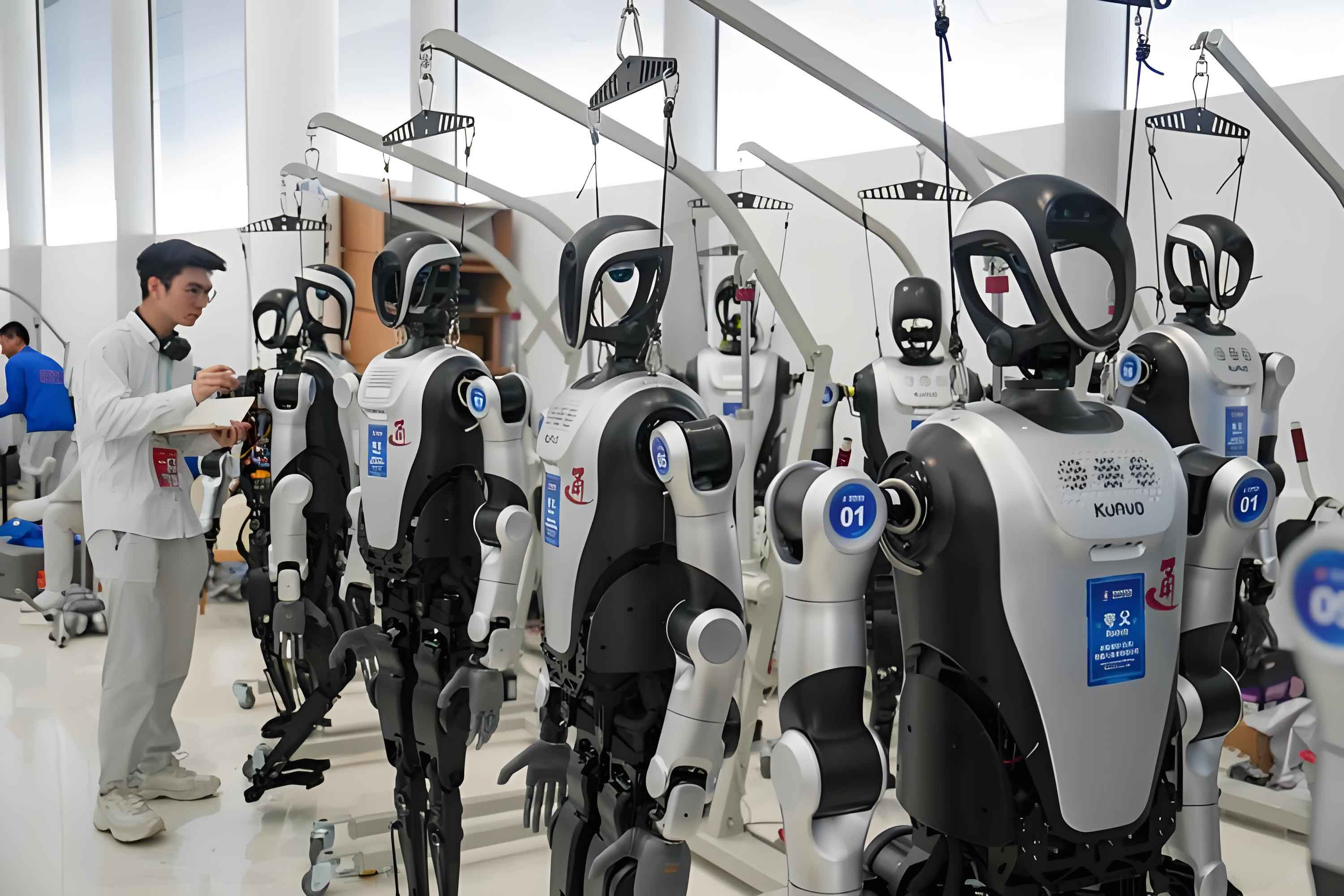
The humanoid robot is not the only category benefiting from China’s export momentum, but it has become a focal point for policy attention, investment interest and customer curiosity. The first half of 2026 showed that the humanoid robot can be shipped in meaningful volumes. The next challenge is to ensure that the humanoid robot creates measurable value in real applications. That requires more than shipment numbers. It requires application data, service capability and cost reduction. The humanoid robot sector is therefore entering a phase in which commercial proof will matter as much as technical demonstration.
Industry observers note that the humanoid robot market is still in an early stage, and that the gap between shipment volume and profitable deployment remains a key issue. The humanoid robot must prove its reliability, safety and return on investment in factories, farms, healthcare settings, logistics operations and service environments. The strong first-half export data provide a foundation, but the humanoid robot sector will need to convert early orders into repeat orders and long-term service contracts. That conversion process will determine whether the humanoid robot can move from a high-growth export category to a stable global industry.
3. Commercial applications move into more complex sectors
China’s robot outbound activity is accelerating toward more complex commercial applications. During the 2026 World Robot Conference, Jack Perry, chairman of the 48 Group Club in the United Kingdom, brought a European robot procurement demand. The key purchasing sectors included construction, logistics warehousing, hotel catering, retail services and agriculture. Perry suggested that companies could first allow robots to be tested in real scenarios for a period of time, and then decide whether to expand procurement after the results are verified. That approach reflects a broader pattern in overseas markets: customers want evidence before scale.
The trial-first model is particularly relevant for the humanoid robot. A humanoid robot operating in a factory, warehouse or hotel must interact with people, navigate dynamic environments and perform tasks that may vary from site to site. Overseas customers are often willing to begin with small-scale deployment, observe performance and then expand if the humanoid robot meets operational requirements. This approach reduces risk for the buyer and gives the robot supplier valuable data for product improvement. It also means that export success depends not only on the product itself but also on training, integration, maintenance and local support.
Unbounded Power, a company established just over a year ago, offers an example of early humanoid robot deployment in Europe. Wang Yingyun, co-founder of the company, said that its first batch of humanoid robots had been sent to France, and South Korea could be the second stop for overseas expansion. The company has signed about 700 million yuan in global orders, including an order worth 500 million yuan for a battery factory project in France involving Envision Technology. In the European market, Unbounded Power has obtained EU industrial CE certification, allowing it to enter the European industrial market with the required certification. For a young humanoid robot company, the combination of orders, certification and overseas delivery is a meaningful step.
The agricultural sector is another area where Chinese robots are finding overseas opportunities. Li Nan, founder, chairman and chief executive officer of Maimai Technology Group, said that agriculture is widely considered one of the most difficult sectors for artificial intelligence and robotics because of scattered scenarios, complex environments and weak digital foundations. However, agriculture also has a unique advantage of latecomer development: companies can build intelligent technology paths from the beginning. This year, Maimai Technology, together with several domestic robot manufacturers, secured an overseas order for 20,000 robots. The company provides the embodied brain, while partner companies provide the robot body. These robots are mainly used in rubber, durian, palm and other crop operations where labor is insufficient but economic value is high.
Maimai Technology is also addressing the local talent challenge. In response to the difficulty of finding local engineers in Southeast Asia, the company established its first overseas subsidiary and ASEAN headquarters in Malaysia. Its target for this year is to deliver 1,000 agricultural robots. The model illustrates how Chinese robot companies are combining technology, partnerships and local presence. The humanoid robot may attract the most headlines, but agricultural robots show that overseas demand is broad and that application-specific robots can create value in difficult environments. The humanoid robot and the agricultural robot may operate in different settings, but both depend on localization, data and service capability.
Consumer robots are also delivering strong overseas results. In the first quarter, the top five global home cleaning robot shipment brands were Dreame, Roborock, Ecovacs, Narwal and Xiaomi, all Chinese brands, together accounting for more than 70 percent of the global market. MOVA LiDAR lawn mower robots under Dreame recorded sales growth of more than 1,290 percent in Italy and more than 2,360 percent in Germany. These figures show that Chinese consumer robot brands have already built strong positions in European markets. The consumer segment provides a useful contrast to the humanoid robot sector: consumer robots have already achieved large-scale market acceptance, while the humanoid robot is still working toward broader commercial validation.
The expansion into construction, logistics, hotels, retail, agriculture and consumer lawn care shows that robot exports are no longer limited to a single category or a single type of buyer. The humanoid robot is part of this wider wave, but it is not the only driver. The diversity of applications is important because it creates multiple paths for overseas growth. Industrial robots support manufacturing; surgical robots support healthcare; agricultural robots support food and crop production; consumer robots support household work; and the humanoid robot has the potential to connect several of these domains through general-purpose capabilities. The more diverse the application base, the more resilient the export ecosystem becomes.
4. From going out to landing: compliance, trust and localized delivery
Moving from “going out” to “landing” is not a simple step. Market access and localized delivery remain critical hurdles. The European Union’s General Data Protection Regulation imposes requirements on data security and privacy protection, and companies must invest substantial time and effort to comply. Robot algorithm software is also subject to local compliance rules, which test the operational capabilities of every outbound company. These requirements are not peripheral. They affect product design, data architecture, service workflows and contractual arrangements. For the humanoid robot, which may collect visual, audio and environmental data, compliance is especially important.
Industry figures acknowledge that overseas market expansion requires a long cycle to build trust. Small-scale deployment followed by large-scale replication is becoming a common approach. This is particularly true for the humanoid robot. A customer may begin with a limited pilot in a controlled environment, evaluate safety and performance, and then expand to more complex tasks. The pilot model helps companies manage expectations and gather data. It also helps customers understand the limits of the technology. The humanoid robot sector is likely to follow this path in many overseas markets, because the humanoid robot must demonstrate reliability before it can be entrusted with higher-value tasks.
Local production is emerging as a strategic response to these challenges. Building capacity in the market where products are sold can reduce cross-border logistics and tariff costs, enable faster delivery and support localized operation and maintenance. It can also help companies respond more quickly to customer needs and regulatory requirements. For the humanoid robot, local production can support customization, spare parts management and service training. It can also strengthen relationships with local suppliers, research institutions and industrial partners. The shift from exporting products to building capacity is therefore not only a cost decision but also a market development decision.
The localization trend is visible across the robot industry. Companies are setting up subsidiaries, service centers, assembly facilities and research partnerships in overseas markets. The humanoid robot sector is part of this trend. A humanoid robot is a complex system that requires integration with local workflows, safety standards and data rules. Local production and local service can reduce the distance between the manufacturer and the customer. That distance matters not only in physical terms but also in terms of response time, cultural understanding and regulatory adaptation.
5. Serbia humanoid robot plant marks a capacity-building phase
On August 29, a humanoid robot factory in Sabac, Serbia, officially began mass production. Serbian President Vucic attended the launch ceremony, toured the production workshop and product exhibition venue, and interacted with a humanoid robot. The factory was built through cooperation between Zhiyuan Innovation (Shanghai) Technology Co., Ltd., referred to as Zhiyuan, and Minth Group. It aims to produce more than 5,000 humanoid robots annually and can be widely used in medical, agricultural, industrial and national defense fields. Its products are aimed at the European and global markets, and it is described as Europe’s first large-scale humanoid robot production base.
The first batch of robots to be delivered from the factory this year will be used first at the 2027 Belgrade Specialized Expo. The significance of the plant extends beyond its output target. It marks a shift in China’s robot outbound activity from selling products and solutions to building production capacity. The humanoid robot is at the center of this shift. By locating production in Serbia, the project places the humanoid robot closer to European customers and creates a platform for localized delivery, service and cooperation. The plant also provides a visible example of how Chinese humanoid robot companies can work with manufacturing partners to establish overseas capacity.
Industry analysis suggests that local factories can effectively reduce cross-border logistics and tariff costs and enable rapid delivery and localized operation and maintenance. With an overseas manufacturing base, companies can directly address the large demand for cost reduction and efficiency improvement in European manufacturing and build an integrated global layout covering research, production and service. For the humanoid robot, this integrated layout is important because the humanoid robot requires continuous software updates, hardware maintenance and application support. A local base can shorten response times and improve service quality.
The Serbia plant also has symbolic value. It shows that Chinese humanoid robot companies are preparing for a future in which the humanoid robot is not only exported but also produced and serviced in key markets. The humanoid robot industry is still young, and the plant’s output will be watched closely. The ability to produce more than 5,000 humanoid robots annually is a target, not a guarantee of market success. But the plant provides a concrete step toward localized capacity. It also signals that Chinese companies are willing to invest in long-term overseas infrastructure rather than relying solely on exports from China.
The location of the plant in Serbia is significant for access to European markets. The project’s stated aim is to serve Europe and global markets, and its application areas include medical, agricultural, industrial and national defense fields. The humanoid robot’s versatility is central to this positioning. A humanoid robot can, in principle, be adapted to different tasks and environments. That versatility is both an opportunity and a challenge. The opportunity is that a single platform can address multiple markets. The challenge is that each application requires specific validation, safety assessment and service support. The Serbia plant will need to manage this complexity as it moves from launch to sustained production.
6. Risks and the next stage of competition
Industry experts also point to risks in the robot sector. The robot track spans artificial intelligence, high-end manufacturing, new materials and other fields. Development should avoid blind expansion and homogeneous competition. The warning is relevant to the humanoid robot sector, where high growth expectations have attracted many participants. A rush into capacity expansion without sufficient application validation could lead to oversupply and price pressure. Homogeneous competition could also weaken innovation and reduce the ability of companies to build differentiated value.
The future core competitiveness of the robot industry is expected to come from a positive technology flywheel based on applications, data and cost reduction, as well as localized delivery and operation capability. For the humanoid robot, this means that success will depend on a continuous cycle: real applications generate data; data improves product performance; improved performance reduces costs; lower costs enable more applications. Companies that can manage this flywheel will be better positioned than companies that focus only on shipment volume. The humanoid robot must be proven in use, not only in demonstrations.
Localized delivery and operation capability are equally important. A robot is not a one-time sale. It requires installation, training, maintenance, software updates and spare parts. The humanoid robot adds another layer of complexity because it may interact with people and operate in dynamic environments. Service networks, safety protocols and local partnerships are therefore essential. Companies that build these capabilities early will have an advantage as the humanoid robot market expands. The Serbia plant is one example of how localization can be structured, but it is not the only model. Other companies may choose service centers, assembly partnerships or regional training hubs.
The risk of homogeneous competition is particularly relevant to the humanoid robot. If many companies produce similar humanoid robot platforms without clear application differences, competition may focus on price rather than value. To avoid this outcome, companies need to develop application-specific solutions, build data advantages and create service ecosystems. The humanoid robot should not be treated as a generic product only. It should be understood as a platform that requires application engineering, customer integration and continuous improvement. The companies that can combine hardware, software, data and service will be more likely to succeed.
7. Outlook: humanoid robot expansion will depend on execution
The first half of 2026 provided strong evidence of China’s robot export capacity. Total robot exports reached 24.85 billion yuan, up 359.0 percent year on year. Industrial robot exports reached 6.29 billion yuan and covered 141 countries and regions. Surgical robot exports reached 480 million yuan and expanded to 49 markets. Humanoid robot shipments exceeded 40,000 units, with a global share of 97 percent. These figures show that China’s robot industry has built a strong export platform across multiple categories.
The next phase will be defined by execution. The humanoid robot must move from early shipment growth to repeatable commercial deployment. Agricultural robots must prove their value in difficult environments. Consumer robots must sustain their strong market position. Industrial and surgical robots must deepen their service networks. Local production must be matched by local compliance, local talent and local partnerships. The shift from going out to landing will require companies to invest in areas that do not always appear in export statistics: training, maintenance, data governance, safety validation and customer support.
The humanoid robot will remain a key test case for this next phase. Its high visibility makes it a symbol of China’s robot ambition, but its complexity makes it a demanding commercial category. The humanoid robot needs applications, data and cost reduction to create a positive technology flywheel. It also needs localized delivery and operation capability to win trust in overseas markets. The Serbia humanoid robot plant, the early humanoid robot deliveries to France, the agricultural robot orders in Southeast Asia and the strong consumer robot sales in Europe all point in the same direction: Chinese robot companies are building a more integrated global presence.
As Chinese robots continue to deepen their presence in overseas markets, China’s smart manufacturing is expected to play a larger role in shaping new standards and new ecosystems in the global robot industry. The humanoid robot will be part of that process, but the outcome will depend on execution, compliance and customer value. The export data show momentum. The application data, service networks and local production decisions will determine how far that momentum can carry the humanoid robot and the wider robot industry into the next stage of global competition.