
A new curriculum reform proposal is placing the humanoid robot at the center of mechanical design education for robotics engineering students, arguing that the rapid evolution of humanoid robot products has outpaced the traditional structure, content, teaching chain, and evaluation methods of the mechanical design fundamentals course. The proposal responds to national strategies that identify robotics, and especially the humanoid robot, as a priority development area, while also addressing a widening gap between industrial practice and classroom instruction.
The policy context is significant. In November 2023, the Ministry of Industry and Information Technology issued the Guiding Opinions on the Innovative Development of Humanoid Robots, setting a goal that by 2025 an initial humanoid robot innovation system should be established, with breakthroughs in key technologies covering the brain, cerebellum, and limbs, and with safe and effective supply of core components. By 2027, the document states, the technological innovation capacity of the humanoid robot sector should be significantly improved, a safe and reliable humanoid robot industrial chain and supply chain system should be formed, and an internationally competitive industrial ecosystem should be built, with comprehensive strength reaching advanced world levels.
In January 2024, the Ministry of Industry and Information Technology and six other departments issued the Implementation Opinions on Promoting the Innovative Development of Future Industries. Among the landmark products identified, the document explicitly calls for breakthroughs in core technologies for the humanoid robot, including high-torque motors, high-dynamic motion planning and control, bionic perception and cognition, intelligent dexterous hands, and electronic skin. It also emphasizes product development and application in intelligent manufacturing, home services, and special-environment operations. The reform proposal notes that Elon Musk, founder of Tesla, has predicted that the future humanoid robot industry market will be larger than the automobile industry and will reach a scale of more than one hundred billion.
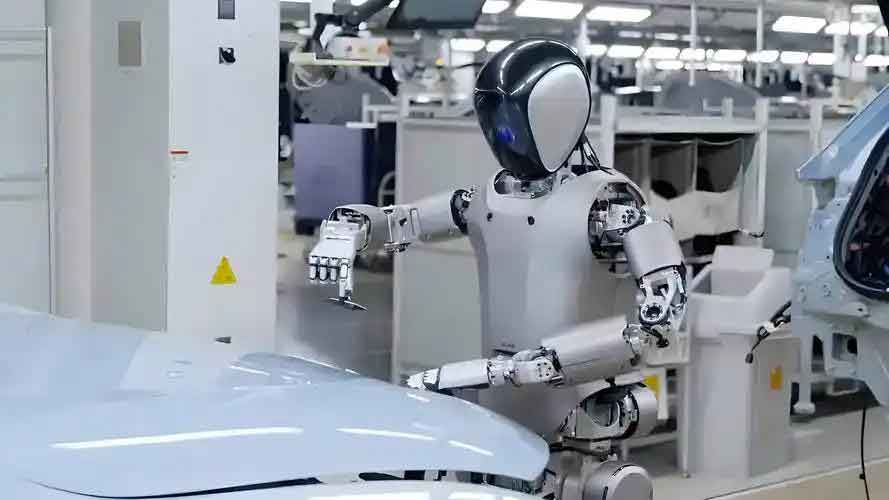
Against this backdrop, the proposal argues that talent cultivation must be reoriented. By 2024, 367 undergraduate institutions in China had established robotics engineering majors. The humanoid robot is technically demanding and widely applicable, and it has therefore become a key focus of policy and industrial investment. Yet the paper observes that university courses related to robot talent cultivation still suffer from outdated content, insufficient cultivation of student innovation capacity, and imperfect evaluation systems. The gap is particularly visible in the mechanical design fundamentals course, which remains central to robotics engineering education but is still often organized around traditional mechanical products rather than humanoid robot product design.
1. Policy and Industry Momentum Make Humanoid Robot Education Urgent
The proposal situates the course reform within a broader national and global race. The humanoid robot is not treated as a single machine but as an integrated product platform that combines mechanics, electronics, control, sensing, software, and human-centered application scenarios. That integrated character makes the humanoid robot a powerful educational carrier. It allows students to see how a complete product is decomposed from application requirements into system architecture, joint performance requirements, component design, simulation, optimization, testing, and evaluation.
The paper states that the humanoid robot has been prioritized because of its high technical difficulty and broad application domain. It cites the policy target of ensuring safe and effective supply of core components by 2025 and forming a secure and reliable humanoid robot industrial chain and supply chain system by 2027. It also cites the future-industry implementation opinion, which identifies the humanoid robot as a landmark product and lists high-torque motors, high-dynamic motion planning and control, bionic perception and cognition, intelligent dexterous hands, and electronic skin as core technologies to be突破. In English terms, these are breakthrough targets, and they indicate that the humanoid robot workforce must be trained across mechanical design, mechatronics, control, and system integration.
The market signal is equally forceful. The proposal reports that Musk has predicted a future humanoid robot market larger than the automobile market, with a scale exceeding one hundred billion. Whether or not such a prediction is realized on a specific timetable, the proposal treats it as evidence that the humanoid robot industry will require a large number of engineers who can design reliable mechanical systems, understand modern design tools, and work within multidisciplinary teams. For mechanical design fundamentals, the implication is clear: the course cannot remain a collection of isolated traditional mechanisms. It must help students understand how mechanical knowledge is used in the humanoid robot product design process.
2. Why the Traditional Mechanical Design Fundamentals Course No Longer Fits Humanoid Robot Development
2.1 Outdated Content and Missing Humanoid Robot Knowledge
The proposal identifies several structural problems in the conventional course. Traditional textbooks organize mechanical design fundamentals into separate technical modules, including structural analysis of planar mechanisms, planar linkage mechanisms, cam mechanisms, intermittent motion mechanisms, threaded connections and screw transmission, belt transmission, chain transmission, gear transmission, worm transmission, gear trains, shaft and hub connections, bearings, couplings, clutches, brakes, balancing of rotating bodies, and machine speed regulation.
Each chapter is relatively independent, with little logical connection between topics. However, humanoid robot design is a systems engineering activity. It requires holistic thinking and a top-down decomposition of design tasks. The course therefore needs a logical thread that connects mechanisms, transmissions, connections, bearings, structures, simulation, and optimization to the actual development of a humanoid robot. The proposal argues that the traditional course also omits content widely used in modern robot design, such as harmonic reducers, cycloidal pinwheel reducers, crossed roller bearings, synchronous belt drives, and parallel mechanisms.
The proposal further notes that modern design methods and tools receive little attention in the traditional course. Many design methods are still taught through analytical methods and drawing methods, which are disconnected from modern engineering practice. A humanoid robot design process relies on three-dimensional modeling, dynamics simulation, structural optimization, electromagnetic simulation, gear design software, and control programming. The reform therefore calls for a top-down theoretical course system in which knowledge points are connected through the humanoid robot product design process, modern design methods and tools are integrated, and missing knowledge required by modern humanoid robot design is added.
2.2 Theory, Laboratory Work, and Course Design Are Disconnected
The paper describes four existing laboratory experiments associated with the theoretical course: cognition experiments on common mechanisms and general components, measurement and analysis of mechanism kinematic diagrams, involute gear tooth profile generation, and structural analysis and disassembly of reducers. In the cognition experiment, students mainly observe teaching aids in the laboratory. The aids show the principles of various mechanisms through motion, but students do not participate in design. In the kinematic diagram experiment, students manually draw planar mechanism diagrams and calculate degrees of freedom, a traditional method that does not use modern design tools.
In the involute gear tooth profile generation experiment, students observe the process by which a rack-type cutter generates an involute gear tooth profile, learn why undercutting occurs, and understand how profile shifting can avoid undercutting. The paper notes that students mainly watch demonstrations. In the reducer structure analysis and disassembly experiment, students disassemble an industrial gearbox and gain some understanding of gearbox structure, gear arrangement, and fastening methods.
The overall laboratory content is limited, and students do not have many opportunities for hands-on operation. Modern design tools are not used, and the connection with course design is insufficient. For humanoid robot education, this is a serious weakness, because the humanoid robot joint is a mechatronic product that requires both mechanical reasoning and simulation-based verification. The proposal therefore calls for an overall consideration of theoretical teaching, laboratory courses, and course design so that they form a coordinated educational chain.
2.3 Innovation Capacity Is Underdeveloped
The proposal argues that the traditional teaching model does not sufficiently cultivate student innovation capacity. Only the first chapter briefly discusses the history of mechanical creation and development, noting that simple textile machines appeared three thousand years ago and that rope wheels, cams, and linkages were used in production two thousand years ago. It also notes that after the Han Dynasty, gear and gear train transmissions were used in south-pointing chariots and distance-recording drums. Other chapters rarely mention mechanical innovation design and mainly explain the principles and applications of traditional machinery.
The traditional course design task is to design a single-stage or two-stage parallel-shaft reducer. This task practices basic course content but does not involve innovation capacity. For engineers who will work on humanoid robot product design, innovation is an essential skill module. The proposal therefore insists that teaching methods must be reformed and that a student innovation capacity system must be built. This is not an optional enrichment activity; it is a response to the humanoid robot industry’s demand for engineers who can generate new concepts, evaluate trade-offs, and apply structured innovation methods.
2.4 The Evaluation System Is Incomplete
The traditional evaluation method generally includes three parts: final theoretical examination, regular learning performance, and regular homework, with proportions of 60 percent, 20 percent, and 20 percent. Regular learning performance includes attendance and classroom participation. Regular homework is usually averaged across multiple assignments. The proposal points out that this system does not assess innovation capacity or practical capacity, both of which are extremely important for humanoid robot design work. A reformed evaluation system must therefore add these dimensions.
3. Rebuilding the Curriculum Around Humanoid Robot Product Design
3.1 A Top-Down Logic for Humanoid Robot Design
The proposal proposes a systematic, top-down reconstruction of the theoretical course system based on the humanoid robot. The design logic begins with application scenario requirements, then moves to the overall humanoid robot design, an initial three-dimensional model, head, arm, and leg configurations, dynamics simulation, determination of joint performance requirements, and detailed joint design.
The paper illustrates this logic through the design processes of large and small humanoid robots. Based on application scenario requirements, an initial humanoid robot system model is designed. This includes preliminary joint design, head configuration design, arm configuration design, and leg configuration design. At this stage, preliminary information on joint dimensions, mass, and performance is provided for whole-machine dynamics simulation. According to the motion requirements of the humanoid robot in its use scenarios, whole-machine dynamics simulation is performed to confirm the performance requirements and motion space requirements of each joint. At this stage, lightweight optimization design of structural parts and motion space optimization of configurations are required.
The course content involved in humanoid robot system design includes planar linkage mechanisms, planar mechanism analysis, belt transmission, chain transmission, screw transmission, and cam transmission. The related modern design tools include Solidworks, ADAMS, Ansys, Webots, and Matlab. Solidworks is used for three-dimensional modeling, ADAMS and Webots for dynamics analysis, Ansys for structural lightweight optimization design, and Matlab for configuration optimization design.
After system design is completed, the performance requirements of large joints are determined, and detailed design is carried out. This includes motors, reducers, controllers, encoders, and control software. The reducer design part includes three transmission forms: harmonic gears, cycloidal pinwheels, and planetary gears. The related course content includes gear transmission, gear trains, shaft and hub connections, bearings, threaded connections, couplings, brakes, and balancing and debugging of rotating bodies. The proposal adds knowledge of crossed roller bearings to the bearing section and adds harmonic gears and cycloidal pinwheels to the gear train section. The modern design tools related to joint design include Solidworks, Maxwell, Kisssoft, Ansys, and Python. Maxwell is used for motor electromagnetic simulation, Kisssoft for gear design, Ansys for gear strength verification, and Python for control software programming.
The design of small humanoid robots follows a similar relationship between curriculum content and design tools, but the joint transmission scheme differs. It mainly adopts parallel-shaft gear trains, face gears, and planetary gears. This comparative structure is valuable for teaching because it shows students that the humanoid robot is not a single fixed architecture. Different scales, loads, cost targets, and application scenarios lead to different mechanical design choices.
3.2 Curriculum Alignment Matrix for Humanoid Robot Product Design
| Humanoid robot design stage | Core mechanical design topics | Modern design tools | Humanoid robot relevance |
|---|---|---|---|
| Application scenario analysis and overall humanoid robot configuration | Planar linkage mechanisms, planar mechanism analysis, belt transmission, chain transmission, screw transmission, cam mechanisms | Solidworks, ADAMS, Webots, Matlab | Connects humanoid robot motion needs to mechanism selection, configuration design, and whole-machine simulation |
| Head, arm, and leg configuration design | Mechanism kinematics, motion space analysis, structural arrangement, lightweight design principles | Solidworks, ADAMS, Ansys, Matlab | Supports humanoid robot balance, reach, manipulation, and human-like motion envelopes |
| Whole-machine dynamics simulation and joint requirement definition | Dynamics fundamentals, transmission efficiency, load analysis, motion planning constraints | ADAMS, Webots, Matlab | Translates humanoid robot task requirements into joint torque, speed, and motion-space targets |
| Large humanoid robot joint design | Gear transmission, gear trains, harmonic gears, cycloidal pinwheels, planetary gears, shafts and hubs, bearings, crossed roller bearings, threaded connections, couplings, brakes, balancing | Solidworks, Maxwell, Kisssoft, Ansys, Python | Integrates motor, reducer, encoder, controller, and control software into a mechatronic humanoid robot joint |
| Small humanoid robot joint design | Parallel-shaft gear trains, face gears, planetary gears, bearing selection, connection design | Solidworks, Kisssoft, Ansys, Python | Demonstrates compact transmission alternatives for small-scale humanoid robot platforms |
4. Integrating Theory, Laboratory Work, Course Design, and Competitions
4.1 Theoretical Teaching
The theoretical teaching content is arranged according to the top-down logic of humanoid robot design. Each part of the course is explained in connection with humanoid robot design. The course also adds content on modern or future components, such as synchronous belts, crossed roller bearings, and harmonic reducers. In addition, it introduces modern design tools used for component design, including ADAMS, Matlab, Ansys, and Kisssoft.
This approach does not discard traditional mechanical design fundamentals. Instead, it repositions them. Linkages, cams, gears, bearings, shafts, and connections remain essential. However, they are no longer taught as isolated modules. They become parts of a humanoid robot design chain. Students see why a humanoid robot arm needs a particular transmission, why a joint requires a crossed roller bearing, why a harmonic reducer is selected, and how a gear train affects joint mass and performance.
4.2 Laboratory Courses
Laboratory courses are arranged in correspondence with the theoretical course. Because class hours are limited, laboratory courses cannot cover everything. The proposal therefore emphasizes that teachers should use modern design tools in laboratory teaching and allow students to participate in hands-on work. The laboratory is not only a place to observe teaching aids. It becomes a place where students use simulation, modeling, and analysis to understand humanoid robot design decisions.
4.3 Course Design
The traditional course design asks students to design a single-stage or two-stage transmission gearbox. Under the humanoid robot-based reform, the design task is changed to the design of a large humanoid robot joint. The joint includes a motor, reducer, encoder, controller, and control software. It is a complex mechatronic product. The task comes directly from modern humanoid robot products, so it has greater value for student training and corresponds to the theoretical teaching content.
This change is important because it moves course design from a generic mechanical component exercise to a product-oriented humanoid robot task. Students must consider how mechanical design interacts with actuation, sensing, control, and packaging. They must also confront the performance requirements defined by the humanoid robot system design stage. The course design thus becomes a bridge between theory and practice rather than an isolated end-of-term exercise.
4.4 Subject Competitions
Student participation in subject competitions is a comprehensive practice and application of classroom knowledge. It stimulates interest in learning. The humanoid robot products taught in the theoretical course have corresponding competitions, and the theoretical course and subject competitions are designed as an integrated chain. Through the humanoid robot product, theoretical courses, laboratory experiments, course design, and subject competitions are connected as a whole, laying a good theoretical foundation for cultivating excellent engineers who can meet the needs of the humanoid robot industry.
5. Building Student Innovation Capacity for Humanoid Robot Engineering
5.1 Teaching the History of Technology and Innovation Tools
The proposal adopts four measures to build student innovation capacity. The first is to teach the history of technological development and innovation tools. Teaching the history of science and technology can increase student interest and help students grasp technology trends, predict development prospects, and improve design foresight. The paper uses the relationship between humanoid robot development history and joint technology as an example, describing the development from rigid joints to elastic joints and quasi-direct-drive joints.
The second element is the teaching of innovation tools. The proposal states that innovation has rules, and TRIZ is an effective innovation tool. TRIZ was created by the former Soviet inventor Genrich S. Altshuler. It reveals the internal laws and principles of creative invention and is a mature and practical innovation methodology. The course introduces five TRIZ innovation thinking methods: the Nine-Screen Method, the Ideal Final Result, the STC Operator Method, the Little People Method, and the Goldfish Method.
5.2 Bringing Research Into the Classroom
Bringing teachers’ research into teaching is an important feature that distinguishes university education from primary and secondary education. The mechanical design fundamentals course team has two teachers who lead National Natural Science Foundation of China General Program projects. The research topics involve line gears and quasi-direct-drive humanoid robot joints. Both are frontiers of technological development. By introducing research content, teachers can inspire students’ innovation capacity and show how humanoid robot joint design continues to evolve.
5.3 Assigning Innovative Design Tasks
After teaching the history of technology, introducing TRIZ innovation thinking methods, and presenting research content, the course assigns innovative design tasks. The design task can be selected by students or proposed by the teacher. Through innovative design assignments, students practice their innovation capacity. This step is important because innovation capacity cannot be cultivated through lectures alone. Students need to frame a problem, generate alternatives, evaluate trade-offs, and present a design solution connected to humanoid robot applications.
5.4 Organizing Students for Subject Competitions
Another effective way to cultivate student innovation capacity is to organize students to participate in subject competitions. Relevant competitions include the China International College Students’ Innovation Competition, the Challenge Cup China College Students’ Entrepreneurship Plan Competition, the National College Students Mechanical Innovation Design Competition, the National College Students Structural Design Competition, and the RAICOM RoboCom Developer Competition. Through these competitions, students connect theory with practice, gain further exposure to real humanoid robot product design, and exercise teamwork capacity.
6. Establishing a Multidimensional Evaluation System
The proposal reforms the traditional evaluation method, which includes only final theoretical examination, regular learning performance, and regular homework. It adds evaluation indicators for innovation capacity and practical capacity, creating a multidimensional evaluation system that better matches the humanoid robot industry’s talent requirements. The proposed weighting is 60 percent for the final theoretical examination and 10 percent each for homework, innovation capacity, practical capacity, and classroom performance.
| Evaluation dimension | Proposed weight | What is assessed | Connection to humanoid robot education |
|---|---|---|---|
| Final theoretical examination | 60 percent | Mechanical design fundamentals, mechanism analysis, transmission, connection, bearing, and system design knowledge | Ensures students have the theoretical base required for humanoid robot mechanical design |
| Regular homework | 10 percent | Exercises, design calculations, analysis assignments, and course-linked tasks | Reinforces humanoid robot design calculations and component selection reasoning |
| Innovation capacity | 10 percent | Two innovative design tasks completed by student innovation groups, with self-selected or teacher-assigned topics | Encourages creative humanoid robot design concepts and structured innovation methods |
| Practical capacity | 10 percent | Participation in subject competitions and related awards | Connects humanoid robot learning to real competition tasks, prototyping, and teamwork |
| Classroom performance | 10 percent | Attendance, participation, discussion, and classroom engagement | Supports continuous learning and active engagement with humanoid robot design cases |
Innovation capacity is evaluated through two innovative design tasks assigned during teaching. Students form innovation groups to complete the design tasks. They may choose their own topics or select topics provided by the teacher. For example, Yangjiang is developing an offshore wind power industry, and students can use the actual needs of that industry as a topic for innovative design. Practical capacity is evaluated through student participation in subject competitions and related awards. Relevant competitions include the China International College Students’ Innovation Competition, the Challenge Cup China College Students’ Entrepreneurship Plan Competition, the National College Students Mechanical Innovation Design Competition, the National College Students Structural Design Competition, the National College Students Robot Competition, the China Robot Competition and RoboCup Robot World Cup China, the RAICOM RoboCom Developer Competition, and the China Robot and Artificial Intelligence Competition.
The RAICOM RoboCom Developer Competition includes the CAIA Digital Culture Creative Track, the CAIP Information Technology Innovation Track, the CAIR Engineering Competition Track, and the CAIM Engineering Maker Track. The CAIR Engineering Competition Track includes sub-tracks such as Future Intelligence, Humanoid Safety, Humanoid Comparison, and Humanoid Virtual Simulation. By participating in subject competitions, students connect theory with practice, gain further contact with actual industrial humanoid robot product design, and exercise teamwork capacity.
7. Implications for Robotics Engineering Education and the Humanoid Robot Workforce
The proposal argues that many university research and teaching activities have become disconnected from industry, especially in fast-developing emerging industries such as offshore wind power and robotics. The humanoid robot is a clear example. Its development requires mechanical engineers who understand system-level design, modern tools, mechatronic integration, and innovation. A mechanical design fundamentals course that remains centered on isolated traditional components cannot fully meet that demand.
The reform is therefore guided by the principle of learning for application. It uses humanoid robot product design as the organizing thread for course content, laboratory work, course design, and subject competitions. It establishes a multidimensional course evaluation system and attempts to build student innovation capacity through technology history, TRIZ methods, research-informed teaching, innovative design assignments, and competitions. The proposal states that this reform and exploration can provide a reference for curriculum reform in other courses within robotics engineering and for talent cultivation in the humanoid robot industry.
For robotics engineering programs, the broader lesson is that the humanoid robot can serve as an integrative educational platform. It connects mechanical design fundamentals to real product requirements. It makes modern design tools meaningful because students see why modeling, dynamics simulation, structural optimization, electromagnetic simulation, gear design, and control programming are needed. It also gives innovation education a concrete object: the humanoid robot joint, the humanoid robot arm, the humanoid robot leg, and the whole humanoid robot system.
The proposal does not claim that a single course reform can solve the entire talent gap. It does, however, show how a foundational mechanical design course can be reorganized around the humanoid robot product design process. The humanoid robot becomes more than an illustration. It becomes the curriculum architecture. The course sequence follows the humanoid robot design sequence. The laboratory work follows the humanoid robot design tasks. The course design becomes a humanoid robot joint design project. The competitions connect students to humanoid robot-related challenges. The evaluation system assesses the knowledge, innovation, and practice needed for humanoid robot engineering.
In this sense, the reform proposal reflects a wider shift in engineering education. The humanoid robot industry needs graduates who can move from requirements to concepts, from concepts to models, from models to simulations, from simulations to detailed design, and from detailed design to testing and evaluation. Mechanical design fundamentals remains foundational, but its content and teaching method must be recontextualized. The humanoid robot provides that context. It gives students a coherent product story and gives teachers a way to connect traditional mechanical knowledge with modern design practice.
The proposal concludes that, with humanoid robot products as the main line, theoretical teaching, laboratory courses, course design, and subject competitions can be integrated into a coordinated educational system. A multidimensional evaluation system can assess theoretical knowledge, learning performance, homework, innovation capacity, and practical capacity. Through these changes, the course aims to support the development of engineers who can contribute to the humanoid robot industry and to provide a reference for further curriculum reform in robotics engineering education.