
The ability to form a robust internal representation of the environment is fundamental for autonomous agents, including animals and robots. Inspired by the concept of a “cognitive map” – an internal neural representation of spatial relationships – and the underlying neurophysiological mechanisms found in the mammalian brain, we present a novel method for environmental mapping. This work proposes a bionic robot navigation framework that computationally models key spatial cells within the hippocampal formation. Unlike traditional SLAM (Simultaneous Localization and Mapping) or previous biomimetic approaches like RatSLAM, which often lack deep biological fidelity, our model is grounded in the functional roles of head direction cells, band cells, grid cells, and place cells. The core innovation lies in a unified attractor network mechanism for path integration driven by band cells, which allows for precise metric encoding. This internal path integrator is continuously corrected by visual loop closure detection using RGB-D images, culminating in the construction of an accurate topological-metric cognitive map for the bionic robot. This map, containing coordinates, visual templates, and topological transitions, provides a foundational representation for goal-directed navigation in complex indoor environments.
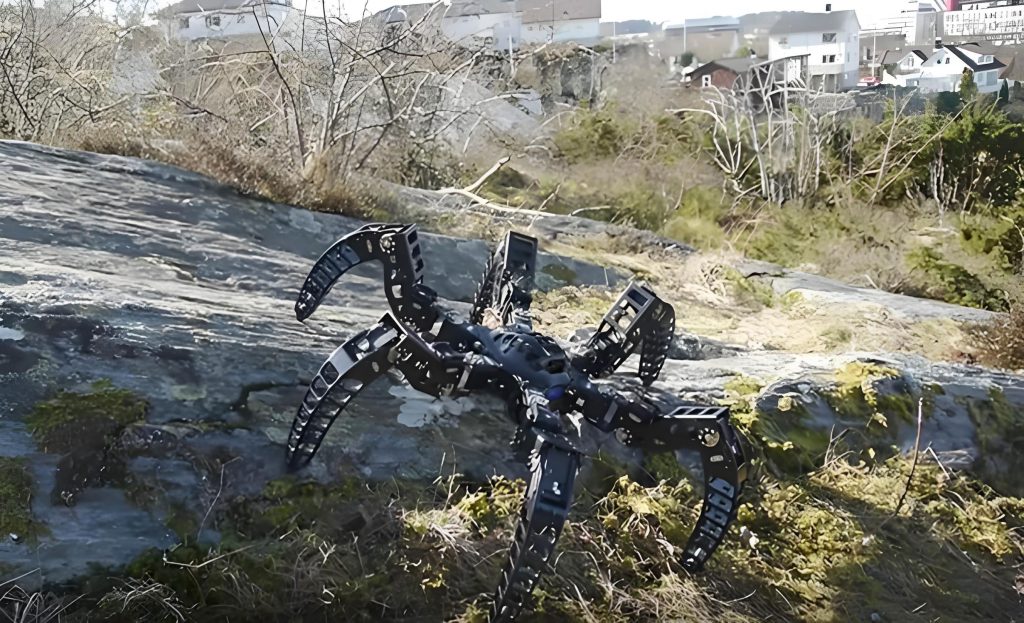
Our approach directly addresses limitations in existing systems. While effective, traditional SLAM methods can be computationally intensive and rely on specific sensor suites. Previous hippocampal models often employed simplified or discrete representations that could not sustain accurate long-term path integration or failed to generate a usable environmental map. Our model bridges this gap by implementing a continuous, neurobiologically plausible path integration system that is both accurate and resilient, specifically designed for a bionic robot platform. The integration of multi-scale spatial coding and visual recalibration mimics the animal’s ability to use both self-motion cues and landmark information, resulting in a robust and scalable mapping solution.
Neurobiological Foundations: The Hippocampal Spatial Circuit
The hippocampal formation is central to spatial cognition and episodic memory. Lesion studies demonstrate that damage to the hippocampus, entorhinal cortex, or parasubiculum severely impairs spatial navigation tasks. Electrophysiological recordings have identified specialized “spatial cells” that form the neural substrate of the cognitive map. The interaction of these cells provides a powerful model for navigation.
| Cell Type | Primary Brain Region | Firing Pattern | Proposed Function |
|---|---|---|---|
| Place Cell | Hippocampus (CA fields) | Fires at a specific location (place field). | Forms a sparse, landmark-based map of the environment. |
| Head Direction (HD) Cell | Postsubiculum, Anterior Thalamic Nuclei | Fires when the head points in a specific allocentric direction. | Provides an internal compass; some are modulated by angular velocity. |
| Grid Cell | Medial Entorhinal Cortex (Layer II) | Fires at multiple vertices of a hexagonal grid covering the environment. | Acts as a metric path integrator, encoding distance and direction via self-motion. |
| Band Cell | Presubiculum, Superficial MEC | Fires in parallel stripes with a specific orientation and spacing. | Provides periodic, directional displacement signals that drive grid cell formation. |
The prevailing theory posits that self-motion cues (velocity, head direction) are integrated by the band/grid cell network to update a continuously changing representation of location. This path-integrated location signal is then transformed into the context-specific, singular firing fields of place cells. External sensory cues (e.g., vision) can reset or correct accumulated errors in this path integration system, especially upon recognizing a familiar landmark. Our computational model for the bionic robot directly implements this functional hierarchy.
Computational Model of Hippocampal Spatial Cells
We construct a unified neural network model where each spatial cell type is modeled using continuous attractor dynamics or competitive learning rules. The system integrates proprioceptive (odometry) and exteroceptive (visual) data from the bionic robot to build the cognitive map.
Head Direction Cell Model
Head direction (HD) cells provide the allocentric directional component for path integration. We model a population of \(m\) HD cells, each with a preferred direction \(\theta_i\) relative to a global reference \(\theta_0\). The population activity at time \(t\) is a vector \(\vec{d}(t)\), modulated by the robot’s current angular velocity. The tuning kernel for the HD cell population is:
$$
\vec{D} = \begin{bmatrix} \cos(\theta_1 + \theta_0) & \cdots & \cos(\theta_m + \theta_0) \\
\sin(\theta_1 + \theta_0) & \cdots & \sin(\theta_m + \theta_0) \end{bmatrix}
$$
The instantaneous HD signal \(\vec{d}(t) = [d_1(t), \dots, d_m(t)]\) is derived from the robot’s angular velocity, providing the directional component needed to project velocity onto specific axes for the band cells.
Band Cell Model: The Driver for Path Integration
Band cells encode periodic displacement along a specific allocentric direction. A band cell population is characterized by its spatial period (wavelength) \(l\), stripe width \(r\), spatial phase \((\Delta x, \Delta y)\), and preferred orientation \(\theta\). We model each population as a one-dimensional ring attractor. The displacement \(d_\theta(t)\) along orientation \(\theta\) is obtained by integrating the velocity component in that direction:
$$
v_\theta(t) = \cos(\theta – \phi(t)) v(t), \quad d_\theta(t) = \int_0^t v_\theta(\tau) d\tau
$$
where \(\phi(t)\) is the robot’s current heading. The periodic drive for a band cell with phase \(\alpha\) is:
$$
s_{\theta\alpha}(t) = (d_\theta(t) – \alpha) \mod l
$$
The firing rate of the band cell is then modeled as a Gaussian function of this periodic drive:
$$
x_{\theta\alpha}(t) = \exp\left( -\frac{(s_{\theta\alpha}(t) – l/2)^2}{b} \right)
$$
Different band cell populations, with various orientations \(\theta\) and periods \(l\), provide the fundamental periodic inputs that drive the two-dimensional grid cell attractor network in our bionic robot‘s navigation system.
Grid Cell Model: A Continuous Attractor for Metric Space
Grid cells are modeled as a two-dimensional continuous attractor network on a torus (a sheet with periodic boundaries), comprising \(N_x \times N_y\) neurons. The dynamics of neuron \(i\) are governed by:
$$
\tau \frac{ds_i}{dt} + s_i = f\left[ \sum_j w^g_{ij} s_j + I^{BC}(t) \right]
$$
Here, \(\tau\) is a time constant, \(f[\cdot]\) is a rectifying linear transfer function, \(s_i\) is the activity of neuron \(i\), and \(I^{BC}(t)\) represents the excitatory feedforward input from band cells. The recurrent synaptic weight \(w^g_{ij}\) from neuron \(j\) to neuron \(i\) has a “Mexican hat” profile (local excitation surrounded by broader inhibition), centered relative to the shift induced by band cell input:
$$
w^g_{ij} = w_0( \vec{x}_i – \vec{x}_j – \Delta\vec{s}(t) ), \quad \text{where } w_0(\vec{x}) = a\left(e^{-\gamma|\vec{x}|^2} – e^{-\beta|\vec{x}|^2}\right)
$$
The shift \(\Delta\vec{s}(t)\) is determined by the band cell inputs, effectively moving the activity bump across the neural sheet. This mechanism performs accurate path integration, and the periodic boundary conditions allow the bump to represent position in a continuous, unbounded metric space. The scale of the grid pattern \(\lambda_{grid}\) is determined by the period \(l\) of the driving band cells and the parameters of the recurrent weights.
From Grid Cells to Place Cells: A Competitive Learning Network
Place cells require a unique, non-periodic representation of location. This is achieved by having a population of place cells learn to respond to specific subsets of grid cell activities. We employ a competitive Hebbian learning rule to form connections \(w^{eh}_{ij}\) from grid cell population \(j\) to place cell \(i\):
$$
\frac{dw^{eh}_{ij}}{dt} = \eta \, p_i (s_j – C_{inh}^g)
$$
where \(\eta\) is the learning rate, \(p_i\) is the activity of place cell \(i\), \(s_j\) is the activity of grid cell population \(j\), and \(C_{inh}^g\) is a threshold based on the average grid cell activity. This rule strengthens connections from grid cells that are co-active with the place cell. The activity of place cell \(i\) is then:
$$
p_i(\vec{r}) = A \cdot f\left[ \sum_{j=1}^{M} w^{eh}_{ij} s_j(\vec{r}) – C_{inh}^p \right]
$$
where \(A\) is a gain, \(M\) is the number of grid cell modules (with different scales and orientations), and \(C_{inh}^p\) is a global inhibition constant that sparsifies the response, helping to form single-peaked place fields. This process allows the bionic robot to distill a unique location code from the periodic grid code.
Place Cell Attractor and Path Integration
The final stage involves a two-dimensional continuous attractor network that represents the robot’s believed location in physical coordinates. The activity bump in this network is primarily driven by the path integration signal derived from the lower-level spatial cells (band → grid → place). The velocity input, transformed through the hierarchical model, causes the bump to shift. The update for the bump’s position \((X,Y)\) in the attractor is given by:
$$
\begin{bmatrix} \delta X_0 \\ \delta Y_0 \end{bmatrix} = \begin{bmatrix} \lfloor k_m \vec{e}_{\theta} \cdot v \cos\phi \rfloor \\ \lfloor k_m \vec{e}_{\theta} \cdot v \sin\phi \rfloor \end{bmatrix}
$$
where \(k_m\) is a path integration gain, \(\vec{e}_{\theta}\) is the unit vector in the integrated direction, and \(\lfloor \cdot \rfloor\) is the floor function. The residual fractional shift \((\delta X_f, \delta Y_f)\) is used to interpolate the activity bump, ensuring smooth movement. This attractor provides a coherent and stable estimate of position that can be directly read out as metric coordinates for the bionic robot‘s cognitive map.
Visual Template Matching and Loop Closure
Pure path integration accumulates error over time. To correct this, the bionic robot uses RGB-D images as visual landmarks. We employ a scanline intensity profile method for efficient loop closure detection. For an RGB or Depth image, the scanline profile \(I\) is a 1D vector created by summing and normalizing pixel intensities down each column.
The match between two image profiles \(I_j\) and \(I_k\) is evaluated by finding the minimum average absolute difference across a range of horizontal shifts \(c\):
$$
g(c, I_j, I_k) = \frac{1}{b – |c|} \sum_{i=1}^{b-|c|} \left| I_j^{i+\max(c,0)} – I_k^{i-\min(c,0)} \right|
$$
where \(b\) is the image width. The best-matching shift \(c_m\) and its associated difference value \(g_{min}\) are found. A combined matching score \(G\) using both RGB and Depth profiles is calculated:
$$
G = \mu_R |g_{min}^R – \bar{g}| + \mu_D |g_{min}^D – \bar{g}|
$$
where \(\mu_R + \mu_D = 1\) are weighting factors. If \(G\) is below a threshold \(c_t\), a loop closure is detected, indicating the robot has returned to a previously visited location. This event triggers a correction in the cognitive map.
Cognitive Map Structure and Update
The cognitive map is a topological-metric graph. Each node \(e_i\) in the graph represents a distinctive location (a “place”) and contains: the associated place cell activity pattern \(p_i\), the visual template \(V_i\), and a metric position estimate \(d_i = (x_i, y_i)\). Edges \(t_{ij}\) between nodes store the experienced transition vector \(\Delta d_{ij}\).
Map Creation: A new node is created when the current place cell activity is sufficiently distinct from all existing nodes (exceeding a novelty threshold \(S_{th}\)), or when a new, stable visual template is stored.
Map Correction at Loop Closure: When a loop closure is detected between the current location and an existing node \(e_i\), the accumulated path integration error becomes apparent. The metric positions of all nodes in the map are gradually adjusted to reconcile the conflict. The correction for a node’s position is proportional to the discrepancy between stored and path-integrated relationships:
$$
\Delta d_i = \vartheta \left[ \sum_{j \in N_f(i)} (d_j – d_i – \Delta d_{ij}) + \sum_{k \in N_t(i)} (d_k – d_i + \Delta d_{ki}) \right]
$$
where \(\vartheta\) is a correction rate (e.g., 0.5), and \(N_f(i)\), \(N_t(i)\) are the sets of nodes connected from and to node \(i\), respectively. This relaxation process distributes the correction throughout the locally connected graph, maintaining the internal consistency of the bionic robot‘s spatial memory.
Experimental Validation and Results
The proposed model was validated through extensive simulation and physical experiments on a Pioneer 3-DX bionic robot equipped with a Kinect RGB-D sensor.
| Parameter | Symbol | Typical Value/Range |
|---|---|---|
| Head Direction Cells | \(m\) | 360 |
| Grid Network Size | \(N_x, N_y\) | 32 × 32 |
| Grid Scale Range | \(\lambda_{net}\) | 12 to 52 cm (sampled) |
| Place Cell Attractor Size | \(n_X, n_Y\) | 32 × 32 |
| Learning Rate (Grid→Place) | \(\eta\) | 0.0005 |
| Visual Matching Threshold | \(c_t\) | 1.0 |
| Map Correction Rate | \(\vartheta\) | 0.5 |
Spatial Cell Model Verification
Simulations confirmed the model’s ability to reproduce core physiological phenomena. Band cell populations exhibited parallel stripe firing patterns with tunable orientation and spacing. Grid cell modules developed stable hexagonal firing grids that tiled the environment. Crucially, the path integration was highly accurate; in simulations over 240m of travel, the error in grid phase was less than half the grid spacing, preventing ambiguity.
The competitive learning from grid to place cells successfully transformed periodic grid patterns into single-peaked place fields. The recurrent competition within the place cell attractor network was essential to suppress multiple peaks and stabilize a single activity bump, as shown in comparative tests.
Cognitive Map Building in Real Environments
The bionic robot was deployed in a 10m × 3m laboratory area. Using odometry for path integration and Kinect images for loop closure, the system successfully built a coherent cognitive map. As shown in the results, while raw odometry accumulated significant drift over time, our model’s loop closure detection and map correction mechanism successfully rectified these errors, producing a map that closely matched the robot’s true trajectory. The moment of loop closure triggered a visible and effective realignment of the cognitive map.
Comparative Analysis
We compared our method against RatSLAM using a public dataset and against a traditional ROS Navigation SLAM module in a corridor environment.
| Method / Test | Environment | Key Result | Notes |
|---|---|---|---|
| Our Model (vs. RatSLAM Dataset) | Office Building (~70m loop) | Built a coherent, low-drift map comparable to RatSLAM’s result. | Demonstrates viability with standard RGB-D data. |
| Our Model (vs. ROS SLAM) | Featureless Corridor (16.8m) | Produced a more geometrically consistent map than ROS SLAM under low-feature conditions. | Highlights robustness of bio-inspired path integration when visual features are scarce. |
| Our Model (vs. ROS SLAM) | Corridor with Added Landmarks | Both methods built accurate maps. | Confirms that visual loop closure is effective when distinctive features are present. |
The comparative experiments underscore a key advantage of our bionic robot navigation approach: its hybrid strategy, combining a robust internal path integrator with opportunistic visual correction, offers resilience in environments where pure vision-based methods might struggle due to perceptual aliasing or lack of features.
Quantitative Analysis of Path Integration Accuracy
A dedicated experiment measured the accuracy of the band-cell-driven path integrator alone. The bionic robot traveled down a 16.8m long corridor. The final position estimated by the pure biological path integrator was (x=16.88m, y=0.58m), while standard wheel odometry gave (x=16.57m, y=0.56m). The true distance was 16.8m. This demonstrates that our model not only integrates motion but also provides a degree of filtering and noise suppression, leading to more accurate dead reckoning than raw odometry, a critical feature for any bionic robot operating in GPS-denied environments.
Discussion and Conclusion
We have presented a comprehensive biomimetic algorithm for cognitive map building, deeply rooted in the neurophysiology of the mammalian hippocampal formation. The model’s strength lies in its unified attractor-based framework that faithfully simulates the interaction of head direction, band, grid, and place cells to perform accurate path integration. The use of band cells as the primary drivers for grid cell dynamics is a particularly biologically grounded feature that contributes to the system’s metric precision.
The bionic robot implementation successfully demonstrates that this neural model can be deployed on real hardware to solve practical navigation problems. The resulting cognitive map is not merely a topological graph but incorporates metric information, making it suitable for both place recognition and vector-based navigation. The system’s performance, competitive with established methods like RatSLAM and traditional SLAM in certain scenarios, validates the utility of brain-inspired approaches for robotics.
Future work will focus on enhancing the visual processing pipeline with more sophisticated feature detection and g2o-based global optimization for loop closure. Furthermore, integrating this mapping system with a goal-directed navigation policy, potentially inspired by hippocampal replay mechanisms, will create a fully autonomous bio-inspired navigation stack for the bionic robot. This research paves the way for a new generation of robust, adaptive, and energy-efficient robotic navigation systems that learn and reason about space in ways fundamentally similar to biological agents.