
The rotary vector reducer, a pivotal component in industrial robots, is renowned for its compact structure, long service life, high transmission ratio, efficiency, and precision. Its widespread application spans robotics, precision mechanical drives, and high-tech instrumentation. Achieving high motion accuracy, high torsional stiffness, and minimal backlash is paramount for robotic applications. This work focuses on analyzing the backlash in rotary vector reducers and proposing effective measures for its reduction. The transmission principle of this reducer is illustrated below, combining an involute planetary gear stage with a cycloidal pin wheel planetary stage and an output mechanism into a closed differential gear train.
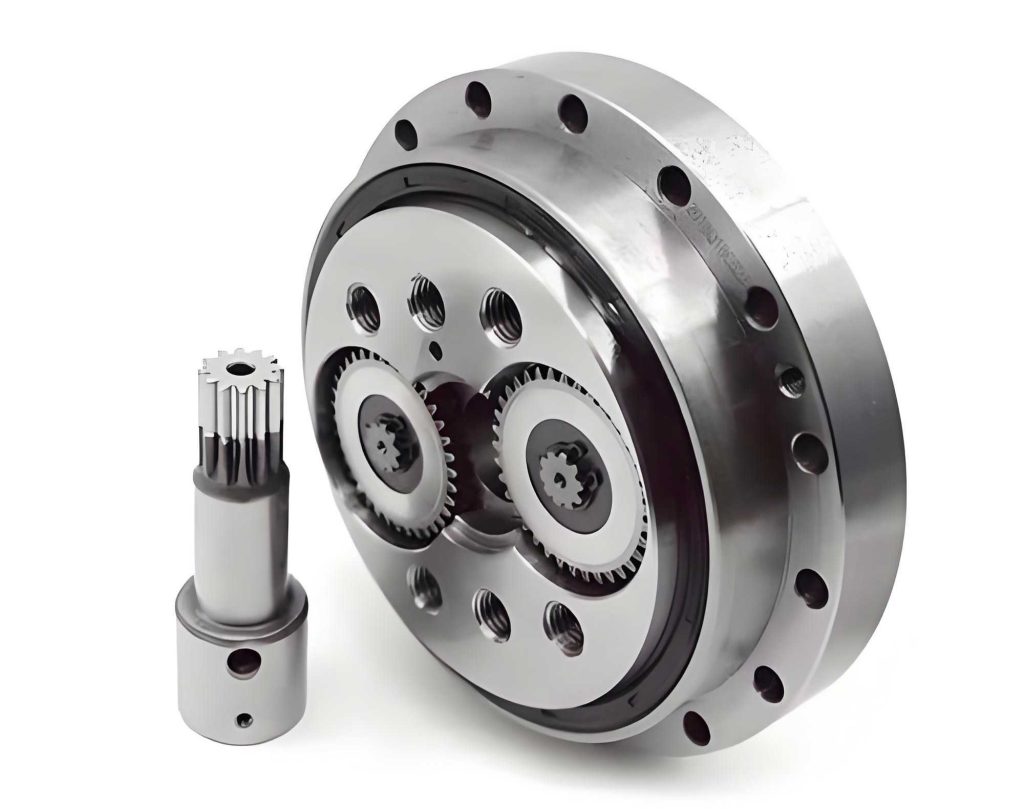
Backlash, defined as the angular lag of the output shaft caused by geometric factors like flank clearances in gear meshes and bearing clearances, is inevitable due to manufacturing tolerances, assembly errors, load, and thermal variations. Its presence disrupts motion transmission during directional changes, introducing non-linearity that adversely affects robotic feedback control systems and dynamic performance. For high-precision rotary vector reducers used in robots, backlash must be strictly confined within (1~1.5) arcminutes depending on size.
Geometric Backlash in Rotary Vector Reducers
The total geometric backlash of a rotary vector reducer, denoted as $\Delta\phi_{\sum}$, is the summation of contributions from its three constituent stages: the first-stage involute planetary transmission ($\Delta\phi_1$), the second-stage cycloidal pin wheel planetary transmission ($\Delta\phi_2$), and the output mechanism ($\Delta\phi_3$).
$$ \Delta\phi_{\sum} = \Delta\phi_1 + \Delta\phi_2 + \Delta\phi_3 $$
Backlash from Involute Planetary Transmission
The backlash from the first stage is derived from the flank clearance calculation for involute gear pairs. The mathematical model is:
$$ \Delta\phi_1 = \frac{j_n \times 180 \times 60}{\pi \times i \times r_1} $$
where $i$ is the total reduction ratio, $r_1$ is the reference circle radius of the sun gear, and $j_n$ is the normal flank clearance. $j_n$ varies between a minimum ($j_{nmin}$) and a maximum ($j_{nmax}$) value, calculated as follows:
$$ j_{nmax} = (Es_{i1} + Es_{i2}) \cos\alpha + 1.44(f_a + 0.72(F_{r1}+F_{r2})) \sin\alpha $$
$$ j_{nmin} = (Es_{s1} + Es_{s2}) \cos\alpha – \Delta + 1.44(f_a – 0.72(F_{r1}+F_{r2})) \sin\alpha $$
The compensation term $\Delta$ accounts for various gear errors:
$$ \Delta = \sqrt{(2f_a \sin\alpha)^2 + 2(F_{\beta})^2 + 2(f_{pb})^2 + (f_x \sin\alpha)^2 + (f_y \cos\alpha)^2} $$
Here, $Es_s$, $Es_i$ are the upper/lower deviations of base tangent length, $f_a$ is center distance error, $F_r$ is radial runout, $f_x$, $f_y$ are axis parallelism errors, $F_{\beta}$ is helix error, and $f_{pb}$ is base pitch deviation.
Backlash from Cycloidal Pin Wheel Transmission
Theoretically, a standard cycloid gear meshes with a pin wheel with zero clearance. In practice, modifications are applied to the cycloid tooth profile to introduce controlled clearance for compensating manufacturing errors, preventing interference, facilitating assembly, and ensuring lubrication. Common modification methods include equidistance modification, shift distance modification, and rotation angle modification. This analysis employs a combined negative equidistance and negative shift distance modification. The backlash model for this stage is:
$$ \Delta\phi_2 = \sum \Delta\phi_{2i} $$
with the contribution from individual error sources given by:
$$ \Delta\phi_{2i} = \frac{180 \times 60}{\pi \times e \times Z_c} \mathbf{A} \boldsymbol{\delta} $$
where $e$ is the eccentricity, $Z_c$ is the number of cycloid gear teeth, $\mathbf{A}$ is a coefficient matrix, and $\boldsymbol{\delta}$ is the error vector containing various manufacturing and modification errors such as pin wheel center radius error ($\delta r_p$), pin position error ($\delta t$), pin hole radius error ($\delta R_{rp}$), pin radius error ($\delta r_{rp}$), cycloid gear pitch error ($f_p$), cycloid gear radial runout ($F_{r1}$), eccentricity error ($\delta e$), and errors in the shift ($\delta \Delta r_p$) and equidistance ($\delta \Delta r_{rp}$) modification amounts.
Backlash from the Output Mechanism
The backlash originating from the output mechanism is primarily due to the radial clearance in the crank arm bearings:
$$ \Delta\phi_3 = \frac{180 \times 60 \times \Delta u_1}{\pi \times a_0} $$
where $\Delta u_1$ is the radial clearance of the crank arm bearing and $a_0$ is the center distance of the involute planetary stage.
Sensitivity Analysis and Key Error Parameters
A sensitivity analysis of the backlash model, particularly focusing on the cycloidal stage due to its significant impact through the high reduction ratio, helps identify the most critical parameters. The relative sensitivity of backlash to various error factors is calculated. Key parameters influencing the geometric backlash of the rotary vector reducer are summarized in the table below, along with their typical error ranges.
| Parameter | Symbol | Relative Sensitivity (S0) | Error Range (mm) |
|---|---|---|---|
| Pin Wheel Center Radius Error | $\delta r_p$ | $\sqrt{1-k_1^2}$ | -0.004 ~ 0.002 |
| Pin Circumferential Position Error | $\delta t$ | $k_1$ | -0.003 ~ 0.001 |
| Pin Hole Radius Error | $\delta R_{rp}$ | 1 | 0.001 ~ 0.004 |
| Pin Radius Error | $\delta r_{rp}$ | -1 | -0.002 ~ 0 |
| Cycloid Gear Cumulative Pitch Error | $f_p$ | $k_1/2$ | -0.007 ~ 0.001 |
| Cycloid Gear Radial Runout | $F_{r1}$ | 0.25 | ±0.001 |
| Equidistance Modification Error | $\delta \Delta r_{rp}$ | 1 | -0.002 ~ 0 |
| Shift Distance Modification Error | $\delta \Delta r_{p}$ | $-\sqrt{1-k_1^2}$ | 0 ~ 0.002 |
| Crank Arm Bearing Radial Clearance | $\Delta u_1$ | $e Z_c / (2 a_0)$ | 0 ~ 0.002 |
Note: $k_1$ is the shortening coefficient. The analysis shows that, except for eccentricity error, improper tolerance allocation for any of these parameters can cause the total backlash to exceed the 1 arcminute limit significantly.
Tooth Profile Modification of the Cycloid Gear in Rotary Vector Reducers
Optimizing the cycloid gear tooth profile by selecting appropriate modification methods and amounts is crucial for controlling backlash in rotary vector reducers. The combined negative equidistance ($\Delta r_{rp} < 0$) and negative shift distance ($\Delta r_p < 0$) modification method is adopted. This approach generates near-conjugate tooth profiles with radial clearance at the tooth tip and root, resulting in minimal flank clearance at the expense of some load capacity.
An optimization model based on normal tooth profile clearance is employed. It ensures multi-tooth contact, uniform load distribution, adequate lubrication, and high rotational accuracy. With the modification angle $\varphi$ as the abscissa and normal clearance as the ordinate, the design variable is defined as $\mathbf{X} = [\Delta r_{rp}, \Delta r_p]^T$. The objective function minimizes the deviation of the actual clearance from a target profile across $n$ sampling points in $\varphi \in [0, \pi]$:
$$ F(\mathbf{x}) = \sum_{i=1}^{n+1} | \Delta(\varphi_i) – l_i | $$
where
$$ \Delta(\varphi_i) = \Delta r_{rp} (1 – \sin \varphi_i) S^{-\frac{1}{2}} – \Delta r_p [1 – \cos(\varphi_i – \varphi_0)] S^{-\frac{1}{2}} – \Delta \delta e Z_c \sin \varphi_i S^{-\frac{1}{2}} $$
and $S = 1 + k_1^2 – 2k_1 \cos(\varphi_i – \varphi_0)$.
The optimization is subject to the following constraints ensuring proper meshing and clearance:
$$ g_1(\mathbf{X}) = \Delta r_{rp} \le 0 $$
$$ g_2(\mathbf{X}) = \Delta r_p \le 0 $$
$$ g_3(\mathbf{X}) = \Delta r_{rp} – \Delta r_p \ge 0 $$
$$ g_4(\mathbf{X}) = \frac{\Delta r_{rp}}{e Z_c} – \frac{\Delta r_p \sqrt{1-k_1^2}}{e Z_c} > 0 $$
$$ g_5(\mathbf{X}) = \Delta\varphi_i = \Delta r_{rp} (1 – \sin \varphi_i) S^{-\frac{1}{2}} – \Delta r_p [1 – \cos(\varphi_i – \varphi_0)] S^{-\frac{1}{2}} \ge 0 $$
Case Study: RV-40E-121 Reducer
The proposed methodology is applied to an RV-40E-121 type rotary vector reducer. Its basic parameters are listed below.
| Parameter | Symbol | Value |
|---|---|---|
| Total Reduction Ratio | $i$ | 121 |
| Pin Wheel Center Radius | $r_p$ | 64 mm |
| Pin Radius | $r_{rp}$ | 3 mm |
| Eccentricity | $e$ | 1.3 mm |
| Number of Cycloid Gear Teeth | $Z_c$ | 39 |
| Shortening Coefficient | $k_1$ | 0.8125 |
Parameter Optimization for the Cycloid-Pin Pair
1. Tooth Profile Optimization: Setting a target radial clearance $\Delta r = \Delta r_{rp} – \Delta r_p = 0.03$ mm, the constrained nonlinear optimization function `fmincon` in MATLAB is used to solve the model. The optimal modification amounts are found to be $\Delta r_{rp}^* = -0.040$ mm and $\Delta r_{p}^* = -0.070$ mm. This yields a minimal backlash contribution of $\Delta\phi_2 = 0.11’$ from the modification itself. The resulting profile is near-conjugate with the necessary clearance.
2. Tolerance Zone Optimization: To compensate for clearances arising from assembly requirements (positive deviation for pin holes, negative for pins) and the negative modification, an error parameter optimization is performed. The design variable is $\mathbf{X} = [\delta r_p; \delta t; \delta R_{rp}; \delta r_{rp}; f_p; F_{r1}; \delta e; \delta\Delta r_p; \delta\Delta r_{rp}]^T$. The objective is to minimize the total backlash contribution $\sum \Delta\phi_{2i}$ subject to initial tolerance bounds. The optimized error values, which minimize backlash, are obtained. Based on these results and sensitivity analysis, practical tolerance bands are allocated as shown in the sensitivity table above.
Backlash Calculation via Monte Carlo Simulation
The Monte Carlo method is employed to simulate the randomness of component dimensions within their tolerance zones and compute the resulting backlash distribution. Error parameters for the involute stage (7-grade gears), cycloid stage (from the optimized tolerances), and output stage ($\Delta u_1 = 0$ to $0.02$ mm) are input. A simulation of 1000 iterations was conducted.
The results indicated that while the contributions from the involute stage ($\Delta\phi_1$) and output stage ($\Delta\phi_3$) were relatively small and stable, the backlash from the cycloid stage ($\Delta\phi_2$) was the dominant and most variable component. The calculated total backlash $\Delta\phi_{\sum}$ for many simulation instances still exceeded the 1 arcminute requirement, highlighting the need for additional compensatory measures beyond tolerance control.
Backlash Reduction via Structural Adjustment: Staggered Assembly
To further reduce backlash, a structural anti-backlash method is proposed. It involves the staggered assembly of the two cycloid gears with a slight angular offset. This creates a preload torque, ensuring that one cycloid gear contacts the pin wheel during forward rotation and the other during reverse rotation. This method compensates for residual clearances and prevents jamming due to assembly errors. The angular offset $\delta’$ can be achieved by: 1) Tangential offset of bearing holes, 2) Rotated machining of the cycloid gear blank, or 3) Introducing a tangential phase error between the two eccentric crank journals.
With this staggered assembly, the effective backlash from the cycloid stage becomes:
$$ \Delta\phi’_2 = \Delta\phi_2 – 4\delta’ $$
When $\Delta\phi’_2 \approx 0$, the cycloid-pin mesh is considered to have zero geometric clearance. The total backlash is then recalculated as:
$$ \Delta\phi_{\sum} = \Delta\phi_1 + \Delta\phi’_2 + \Delta\phi_3 $$
For the RV-40E-121 case, applying a staggered angle of $\delta’ = 0.1’$ successfully reduces the total backlash to under 1 arcminute for all simulated cases, as confirmed by a subsequent Monte Carlo analysis. This meets the stringent requirement for high-precision rotary vector reducers.
Conclusion
This analysis of the rotary vector reducer leads to the following conclusions: First, a comprehensive mathematical model for the geometric backlash was established by identifying and integrating the key error factors from all three transmission stages. Second, the application of combined negative equidistance and negative shift distance modification to the cycloid gear, optimized via a normal clearance model, yields a near-conjugate tooth profile with controlled minimal clearance. Third, the critical parameters affecting backlash were identified through sensitivity analysis, and their tolerance zones were rationally allocated through an optimization process to minimize their collective impact. Finally, a novel and effective structural method involving the staggered angular assembly of the two cycloid gears was proposed and validated. This method provides active compensation for manufacturing and assembly clearances, enabling the rotary vector reducer’s total backlash to be reliably controlled within the 1 arcminute threshold required for high-performance robotic applications. The integrated approach of parameter optimization, tolerance design, and structural adjustment provides a robust methodology for the precision manufacturing of rotary vector reducers.