
The advancement of robotics is inextricably linked to our desire to explore, automate, and augment human capabilities. A particularly fascinating and challenging domain within this field is legged locomotion, inspired by the agility and adaptability of biological organisms. Among legged platforms, the quadrupedal form offers a compelling balance between stability, mechanical complexity, and practical mobility. This article details the design, analysis, and implementation of a compact, electrically actuated bionic robot dog, engineered for versatility and functionality in diverse environments.
The inherent limitations of wheeled and tracked vehicles in unstructured terrains—such as forests, rubble, or steep slopes—have long been recognized. In contrast, legged animals navigate these complex landscapes with remarkable ease. The primary objective of this robot dog project is to capture a fraction of this biological proficiency through mechanical and electronic means. The design philosophy centers on creating a modular, lightweight, and robust platform capable of stable omnidirectional motion, carrying auxiliary payloads, and integrating advanced sensory systems for autonomous behaviors like object following. By emulating the kinematic principles of a canine, the aim is to develop a robot dog that is not merely a research prototype but a step towards practical applications in areas from education and research to remote inspection and assistance.
The core motivation stems from observing the biomechanics of quadrupedal animals. Their movement is governed by coordinated sequences of leg lifts and placements, known as gaits, which ensure static and dynamic stability. Translating this biological symphony into engineering specifications requires a systematic approach: a stable mechanical structure, precise actuator control, intelligent gait planning, and robust sensory feedback. This robot dog is conceived as an integrated system where each subsystem—mechanical, electronic, and computational—is co-designed to achieve harmonious operation. The following sections elaborate on the design considerations, mechanical architecture, control algorithms, and system integration that bring this bionic robot dog to life.
Key Design Considerations and Comparative Analysis
The initial phase of designing the robot dog involves defining performance targets and evaluating technological options. The primary design goals were established as follows:
- Stable Locomotion: The robot dog must maintain balance while walking, trotting, and turning on moderately uneven surfaces.
- Payload Capacity: It should be capable of carrying additional weight, such as sensors (e.g., cameras, LiDAR) or small parcels, without compromising mobility.
- Precise Control: The system must allow for accurate positioning of each limb to execute complex gait patterns.
- Lightweight and Robust Construction: The structure must be strong enough to withstand operational stresses while minimizing mass to improve efficiency and dynamics.
A critical decision point is the selection of the actuation system. The choice of actuator directly influences the robot dog’s torque output, speed, weight, controllability, and cost. The following table summarizes a comparative analysis of common actuator types considered for legged robots like our robot dog.
| Actuator Type | Advantages | Disadvantages | Suitability for Robot Dog |
|---|---|---|---|
| Hydraulic Servo | Very high power/weight ratio, excellent force/torque control, high bandwidth. | Complex system (pump, hoses), potential for leaks, high cost, noisy, requires significant infrastructure. | Excellent for large, high-performance platforms (e.g., Boston Dynamics’ robots) but overkill and impractical for a small, portable robot dog. |
| Brushed/Brushless DC Servo Motor with Gearbox | High continuous torque, mature control technology, good speed-torque characteristics. | Often requires an external motor driver/controller, additional components for position sensing (encoder), more complex mechanical integration. | Highly capable and common in research platforms. Offers great performance but increases design complexity for a compact robot dog. |
| Stepper Motor | Open-loop position control, good holding torque, simple control electronics. | Lower efficiency, can vibrate or lose steps under load, torque drops significantly at higher speeds. | Useful for precise positioning without feedback but dynamic leg motion requires high acceleration, making steppers less ideal for an agile robot dog. |
| Smart Servo (Serial Bus Servo) | Integrated motor, gearbox, driver, and controller. Simple daisy-chain wiring via a single bus (e.g., UART, PWM). Compact, easy to mount, good position control. | Typically lower peak torque compared to high-end DC servos, potential for communication latency in large networks, can overheat under sustained high load. | Optimal for this design. Balances performance, simplicity, cost, and ease of integration perfectly for a small-scale, multi-degree-of-freedom robot dog. |
Based on this analysis, high-torque digital smart servos were selected. They offer a self-contained solution, simplifying the electrical design and mechanical assembly. Their programmable nature allows for precise angular control, which is fundamental for implementing the inverse kinematics necessary for leg movement. For the specific robot dog model, servos with a rated torque of approximately 2 N·m (20 kg·cm) were chosen to provide sufficient force for locomotion and payload carrying.
Mechanical Design and Structural Analysis
The mechanical embodiment of the robot dog is where biological inspiration meets engineering rigor. The design adopts a modular philosophy, separating the chassis/body from the leg assemblies. This approach simplifies manufacturing, maintenance, and potential future upgrades to the robot dog.
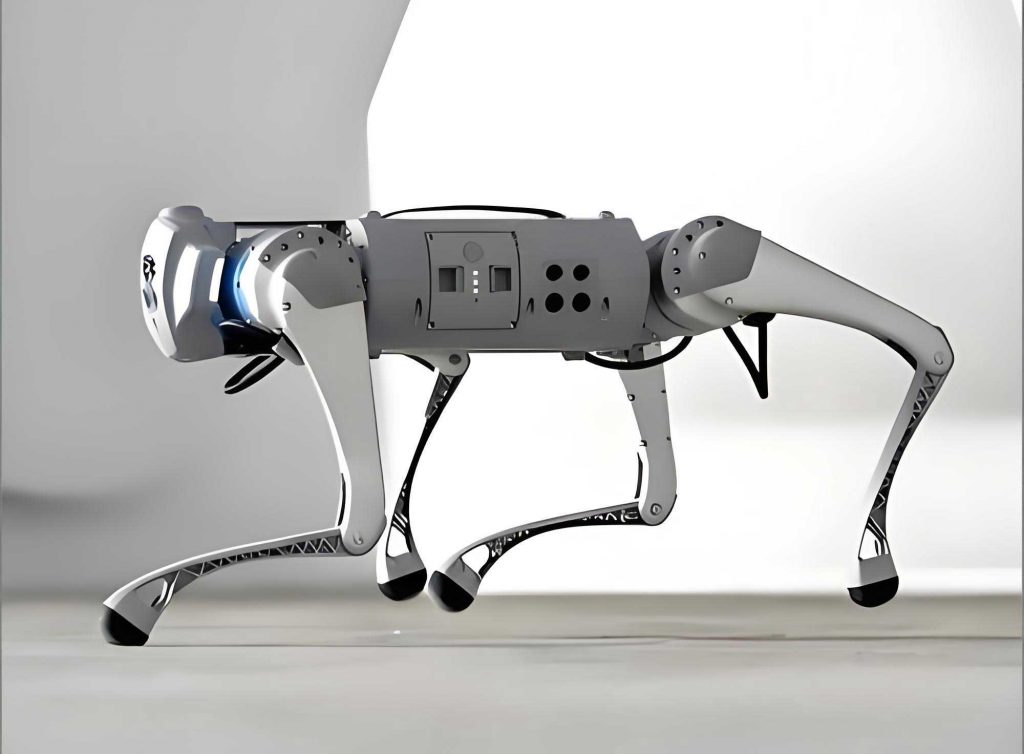
The leg is the primary functional unit. Emulating a biological limb, each leg of the robot dog requires a minimum of three degrees of freedom (DoF) to position its foot arbitrarily within a workspace relative to the body. These three DoFs correspond roughly to the hip abduction/adduction, hip flexion/extension, and knee flexion/extension. The kinematic configuration is shown in the figure above and described below:
- Servo 1 (Hip Yaw): Located at the shoulder/hip joint connecting the leg to the body. It rotates the entire leg assembly forward/backward in the sagittal plane (movement along the robot dog’s longitudinal axis).
- Servo 2 (Hip Pitch): Mounted directly on the output horn of Servo 1. It drives the upper link (thigh) of the leg, primarily controlling the leg’s lift and forward/backward swing.
- Servo 3 (Knee Pitch): This servo is mounted on the thigh link. Its rotation is transmitted to the lower link (shank) via a four-bar linkage mechanism. This arrangement allows the knee angle to be controlled indirectly, keeping the mass of the servo closer to the body (improving dynamics) and providing mechanical advantage.
The four-bar linkage is a critical design element. It converts the rotational motion of Servo 3 into the angular motion of the shank. A thrust ball bearing is incorporated at the linkage joint to minimize friction and ensure smooth motion under load. The primary structural material is 3mm carbon fiber plate, chosen for its exceptional strength-to-weight ratio. Joints are reinforced with 3D-printed components using tough resin, and metal spacers with lubricant are used at interfacing surfaces to reduce wear. The foot is capped with a rubber pad (Shore A ~55 hardness) to provide shock absorption, vibration damping, and increased traction on various surfaces for the robot dog.
Static Load Analysis and Payload Estimation
To estimate the payload capacity of the robot dog, a static force analysis is performed on a single leg under maximum load conditions, assuming the robot dog is standing still. The analysis focuses on the most stressed joint, which is typically the knee actuator (Servo 3) due to the lever arm of the shank.
Let’s define the key parameters for a rear leg (analysis is symmetric):
- $M_2$: Output torque of the knee servo (Servo 3), max = 2 N·m.
- $L_{thigh}$: Length of thigh link = 0.13 m.
- $L_{shank}$: Length of shank link = 0.133 m.
- $F_{ground}$: Vertical ground reaction force on one foot when fully loaded.
We analyze the four-bar linkage that connects Servo 3 to the shank. The servo torque $M_2$ acts on a crank of length $L_c = 0.024$ m. Through the geometry of the linkage (with specific angles $\alpha = 43^\circ$, $\beta = 44^\circ$ between links and force directions), the torque is transmitted to the shank. The relationship between the servo torque and the force $F_{knee}$ generated at the “knee” joint (connecting shank and thigh) to counteract the ground force can be derived. A simplified model, ignoring the small angles of other joints for this worst-case static estimate, yields that the force at the knee joint is proportional to the servo torque divided by the shank length.
The ground reaction force $F_{ground}$ creates a moment about the knee joint equal to $F_{ground} \cdot L_{shank} \cdot \cos(\theta)$, where $\theta$ is the shank angle from vertical. For a conservative estimate at near-vertical stance ($\cos(\theta) \approx 1$), this moment must be balanced by the knee mechanism’s output moment. The mechanism provides a moment $M_{knee} = \eta \cdot M_2$, where $\eta$ is a mechanical gain from the linkage (calculated from geometry to be ~2.33 in this design).
Therefore, the balance equation is:
$$ \eta \cdot M_2 = F_{ground} \cdot L_{shank} $$
Solving for the force on one leg:
$$ F_{ground} = \frac{\eta \cdot M_2}{L_{shank}} = \frac{2.33 \times 2.0\text{ N·m}}{0.133\text{ m}} \approx 35.0\text{ N} $$
This is the force one leg can support. For a static, four-legged stance, the total maximum weight $W_{max}$ the robot dog can hold is:
$$ W_{max} = 4 \times F_{ground} = 4 \times 35.0\text{ N} = 140\text{ N} $$
This corresponds to a mass of approximately:
$$ m_{payload+robot} = \frac{W_{max}}{g} = \frac{140}{9.81} \approx 14.3\text{ kg} $$
Subtracting the robot dog’s own mass (~3-4 kg), the estimated net payload capacity is about 10-11 kg. This confirms the design’s ability to carry additional equipment like sensors or small items.
Motion Control Algorithms and Gait Generation
The soul of the robot dog lies in its control software, which translates high-level commands into precise, coordinated servo movements. The process involves gait generation, inverse kinematics, and real-time pose adjustment.
Gait Patterns
A gait defines the sequence and timing of leg lift (swing phase) and placement (stance phase). Different gaits offer trade-offs between speed, stability, and energy efficiency. For this robot dog, we implement two primary gaits:
- Walk Gait: A statically stable gait where three legs are always on the ground. The leg sequence is typically: Left Front → Right Rear → Right Front → Left Rear. The duty factor (percentage of cycle a leg is on the ground) is greater than 0.75. This gait provides maximum stability for the robot dog at low speeds.
- Trot Gait: A dynamic, diagonally-symmetric gait where diagonal leg pairs (Left Front & Right Rear, Right Front & Left Rear) move in unison. Each pair alternates between swing and stance phase. This introduces periods of dynamic imbalance where only two legs support the robot dog, requiring momentum control. It is significantly faster than the walk.
The timing and foot trajectory during the swing phase are governed by parametric curves. A common method uses a composite sinusoidal or cycloidal trajectory for the foot’s vertical lift and forward motion, ensuring smooth acceleration and deceleration to minimize impact forces on the robot dog.
Inverse Kinematics (IK)
IK is the mathematical core that calculates the required joint angles ($\theta_1, \theta_2, \theta_3$) to place the foot at a desired coordinate $(x, y, z)$ relative to the shoulder joint. For our 3-DoF leg in a planar configuration (simplifying by combining hip yaw separately), the geometry is defined by the thigh length $L_1$ and shank length $L_2$.
Given a target foot position in the leg’s sagittal plane $(x, z)$:
$$ r = \sqrt{x^2 + z^2} $$
The law of cosines gives the knee angle $\theta_3$:
$$ \theta_3 = \pi – \arccos\left(\frac{L_1^2 + L_2^2 – r^2}{2 L_1 L_2}\right) $$
The angle of the leg triangle $\beta$ is:
$$ \beta = \arccos\left(\frac{r^2 + L_1^2 – L_2^2}{2 r L_1}\right) $$
Finally, the hip pitch angle $\theta_2$ and the resulting ankle angle are:
$$ \theta_2 = \arctan2(z, x) + \beta $$
$$ \theta_{ankle} = \theta_2 + \theta_3 – \pi $$
These calculations are performed in real-time by the microcontroller for each leg of the robot dog to generate smooth foot paths.
Attitude Control and Stability
To maintain balance, especially during dynamic gaits or on slopes, the robot dog uses an attitude sensor (an IMU – Inertial Measurement Unit) containing accelerometers and gyroscopes. Sensor fusion algorithms (like a complementary filter or Kalman filter) estimate the robot’s orientation (roll $\phi$ and pitch $\theta$ angles).
This orientation feedback is used in a closed-loop control scheme. If the robot dog starts to tilt, the controller adjusts the foot placement or body posture to counteract the tilt. A simple but effective method is to modify the default “home” height of the body based on the pitch and roll angles. For example, if pitching forward ($\theta > \text{threshold}$), the algorithm can lower the front legs and raise the rear legs slightly, effectively shifting the center of gravity backward. This is implemented by adding corrective offsets to the target foot positions calculated by the IK solver.
The control code snippet below illustrates how IMU data is read and used to apply corrective offsets to the servo angles for maintaining the robot dog’s level posture:
// Pseudocode for attitude compensation
void attitudeCompensation() {
    float pitch, roll, yaw;
    getIMUData(&pitch, &roll, &yaw); // Get filtered orientation

    float pitch_correction = P_GAIN * pitch; // Simple proportional gain
    float roll_correction = P_GAIN * roll;

    // Apply corrections to all legs' shoulder servo targets (example for one hip pitch servo)
    // This shifts the body posture opposite to the tilt.
    servo_target_angle[FRONT_LEFT_HIP] += pitch_correction - roll_correction;
    servo_target_angle[FRONT_RIGHT_HIP] += pitch_correction + roll_correction;
    servo_target_angle[REAR_LEFT_HIP] -= pitch_correction - roll_correction;
    servo_target_angle[REAR_RIGHT_HIP] -= pitch_correction + roll_correction;
}
Communication and Control System Architecture
The electronic nervous system of the robot dog is hierarchical. At the top sits a main microcontroller unit (MCU), such as an STM32 or ESP32. This MCU runs the high-level control loops, gait scheduler, IK calculations, and processes input from remote control or autonomous sensors.
The MCU does not drive the 12+ servos directly. Instead, it communicates with dedicated servo driver boards via a fast serial bus (e.g., I²C or UART). A common choice is the PCA9685 driver, which can generate 16 independent PWM signals from I²C commands. Using two such boards provides control for up to 32 servos, far exceeding the needs of the robot dog. This architecture offloads the precise timing-critical PWM generation from the main MCU, freeing its resources for computation.
User input is provided via a wireless PlayStation 2 (PS2) style controller. A receiver module connected to the MCU decodes button presses and joystick movements over SPI. Commands like “move forward,” “turn left,” “change gait,” or “stand up” are translated into parameter sets for the gait engine.
For autonomous operation, the robot dog can be equipped with a vision system. A Raspberry Pi or similar single-board computer (SBC) with a camera can be mounted on the head. The SBC runs computer vision algorithms (using OpenCV or neural networks) for tasks like object detection, color tracking, or face recognition. Detected target coordinates are then sent to the main MCU via a serial link (UART), which in turn generates the appropriate walking commands to follow the target, making the robot dog an interactive companion or tool.
The power system is based on a high-capacity Lithium Polymer (LiPo) battery (e.g., 12V, 3000mAh). A switching DC-DC buck converter steps the voltage down to a stable 5V rail to power the servos and logic circuits, ensuring clean power delivery and preventing brownouts during high-current maneuvers of the robot dog.
Applications and Future Directions
The developed bionic robot dog platform opens doors to a multitude of applications across various sectors. Its combination of mobility, payload capacity, and programmability makes it a versatile tool.
- Research and Education: It serves as an excellent platform for studying legged locomotion, robotics, control theory, and machine learning. Its modular design allows students and researchers to experiment with gait algorithms, sensor fusion, and autonomous navigation.
- Remote Inspection and Surveillance: In hazardous or inaccessible environments like industrial plants, disaster zones, or contaminated areas, the robot dog can be deployed to carry cameras and sensors (thermal, gas) to provide real-time data without risking human lives.
- Assistance and Logistics: In controlled environments like warehouses, hospitals, or homes, a robot dog could follow a person to carry items or assist individuals with mobility challenges. Its stable gait allows it to navigate door thresholds, carpets, and mild obstacles better than many wheeled robots.
- Public Safety and Security: Equipped with night vision and LIDAR, the robot dog could patrol perimeters, inspect suspicious packages, or assist in search-and-rescue operations by exploring unstable rubble.
- Entertainment and Companionship: With expressive movements and interactive behaviors programmed via its vision system, the robot dog can function as a highly advanced, dynamic pet or entertainment robot.
Future enhancements for this robot dog design are vast. Integrating more sophisticated sensors like 3D depth cameras (Intel RealSense) or solid-state LiDAR would enable full 3D environment mapping and autonomous path planning. Implementing torque sensing at the joints (using current sensing in servos or dedicated sensors) would allow for advanced force control, enabling the robot dog to walk on extremely uneven terrain, climb stairs, or even push objects. Furthermore, leveraging machine learning for terrain adaptation and gait optimization could lead to more efficient and robust locomotion, where the robot dog learns the best way to move through trial and error in simulation or the real world.
Conclusion
The design and implementation of a bionic quadruped robot dog is a multidisciplinary endeavor that synthesizes mechanical engineering, electronics, control systems, and computer science. This article has detailed a practical approach to creating such a platform, from the initial actuator selection and mechanical design with force analysis to the implementation of core control algorithms for stable locomotion. By adopting a modular architecture and leveraging commercially available smart servos and microcontrollers, a capable and functional robot dog can be realized without the extreme complexity of hydraulic or custom motor drive systems. The resulting platform is not only a testament to the principles of biomimetic design but also a robust foundation for future research and application development. As sensor technology and artificial intelligence continue to advance, the capabilities of such robot dogs will expand, bringing us closer to having versatile, legged machines as commonplace tools in both industrial and domestic settings.