
As I delve into the fascinating world of robotics, I am continually amazed by the innovations inspired by nature. The field of bionic robots has seen remarkable progress, with designs that mimic the efficient and adaptive mechanisms of various organisms. In this article, I will explore several key developments in bionic robots, highlighting their principles, applications, and the underlying science. The concept of a bionic robot revolves around emulating biological systems to create machines that can perform complex tasks in challenging environments. From crawling and jumping to navigating tight spaces, these bionic robots showcase the power of biomimicry. I will use tables and formulas to summarize critical aspects, ensuring a detailed understanding of these technological marvels.
The inspiration for bionic robots often comes from creatures like snakes, insects, and caterpillars, which exhibit exceptional mobility and resilience. For instance, one notable bionic robot is designed to crawl like a snake, utilizing artificial scales for movement. This bionic robot consists of an elastic tube that expands and contracts, with plastic scales attached to its surface. These scales, inspired by snake skin, deform and grip the ground as the tube inflates and deflates, enabling locomotion. The motion can be modeled using principles of fluid dynamics and elasticity. Consider the pressure change within the tube, which drives the expansion. The force generated by the scales can be expressed as:
$$ F_s = \mu N \cdot f(\theta) $$
where \( F_s \) is the frictional force from the scales, \( \mu \) is the coefficient of friction, \( N \) is the normal force, and \( f(\theta) \) represents the angle-dependent deformation of the scales. The overall displacement \( \Delta x \) per cycle of inflation-deflation is given by:
$$ \Delta x = \int_{0}^{T} v(t) \, dt $$
with \( v(t) \) being the velocity profile derived from the pressure dynamics. This bionic robot exemplifies how simple mechanisms can lead to effective mobility, making it suitable for search and rescue or medical applications. The table below summarizes key parameters of this snake-inspired bionic robot.
| Parameter | Description | Typical Value |
|---|---|---|
| Scale Material | Plastic with laser-cut incisions | Polyethylene |
| Tube Elasticity | Young’s modulus of elastic tube | 2.5 MPa |
| Operating Pressure | Pressure range for inflation | 10-50 kPa |
| Locomotion Speed | Average crawling speed | 5 cm/s |
| Applications | Search, rescue, medical delivery | N/A |
Another groundbreaking bionic robot is inspired by cockroaches, known for their agility and durability. This centimeter-scale bionic robot can move rapidly, jump, climb, and withstand falls from significant heights. The design leverages compliant mechanisms and lightweight materials to replicate the insect’s exoskeleton and leg dynamics. The jumping motion, for example, involves storing energy in elastic elements and releasing it suddenly. The energy storage can be described by Hooke’s law:
$$ E = \frac{1}{2} k x^2 $$
where \( E \) is the stored elastic energy, \( k \) is the spring constant, and \( x \) is the displacement. Upon release, this energy converts to kinetic energy, propelling the bionic robot upward. The trajectory follows projectile motion equations:
$$ h = \frac{v_0^2 \sin^2(\theta)}{2g} $$
with \( h \) as the maximum height, \( v_0 \) the initial velocity, \( \theta \) the launch angle, and \( g \) the gravitational acceleration. Such capabilities make this bionic robot ideal for infrastructure inspection or disaster response. Below is a table comparing this bionic robot to its biological counterpart.
| Aspect | Cockroach-inspired Bionic Robot | Natural Cockroach |
|---|---|---|
| Size | Centimeter-scale (approx. 3 cm) | 2-5 cm |
| Speed | Up to 20 body lengths per second | Up to 50 body lengths per second |
| Durability | Survives falls from 10x its height | Survives high impacts |
| Power Source | Micro-batteries or wireless power | Metabolic energy |
| Key Features | Jumping, climbing, adaptive control | Rapid escape, omnidirectional movement |
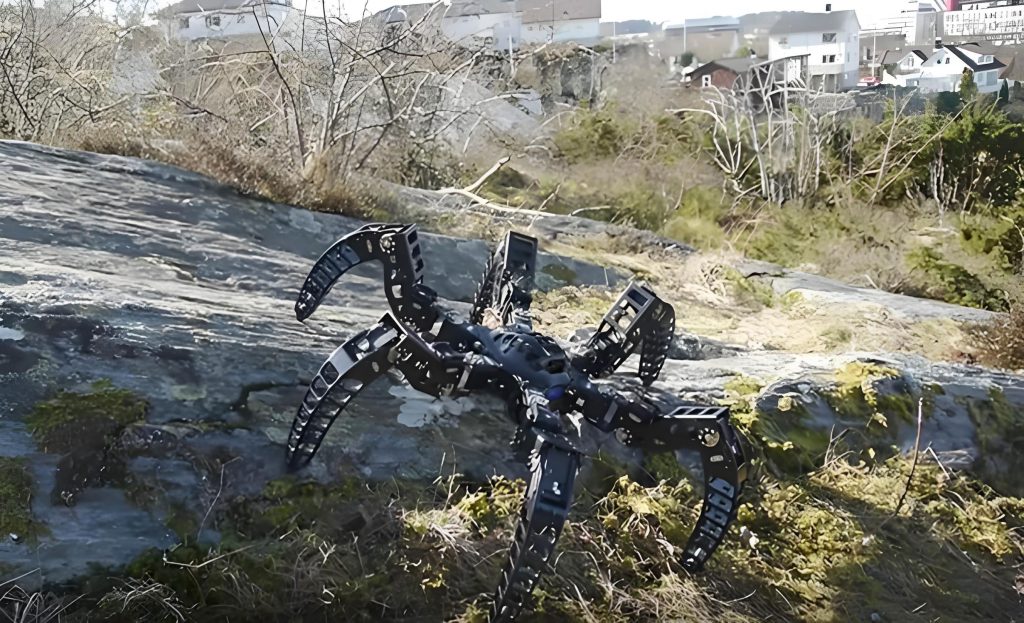
Moving to smaller scales, millimeter-level bionic robots have been developed, inspired by soft-bodied larvae and caterpillars. These minimalist bionic robots can perform diverse motions such as crawling through tunnels, jumping, and exiting water. Their flexibility allows them to navigate confined spaces, making them promising for medical applications like drug delivery or non-invasive surgery. The locomotion of such a bionic robot often relies on wave-like deformations, modeled using continuum mechanics. For a soft body moving in a viscous environment, the Reynolds number is low, and Stokes flow equations apply:
$$ \mu \nabla^2 \mathbf{u} – \nabla p = 0 $$
where \( \mu \) is the dynamic viscosity, \( \mathbf{u} \) is the velocity field, and \( p \) is the pressure. The body deformation can be controlled via external stimuli like magnetic fields or temperature changes. For instance, a common actuation method uses shape-memory alloys, where the strain \( \epsilon \) is a function of temperature \( T \):
$$ \epsilon = \alpha (T – T_0) $$
with \( \alpha \) as the thermal expansion coefficient and \( T_0 \) the reference temperature. This bionic robot’s ability to operate in liquid environments aligns with biomedical needs. The table summarizes the characteristics of this millimeter-scale bionic robot.
| Feature | Details |
|---|---|
| Size | Approximately 2-5 mm (grain-sized) |
| Material | Soft polymers (e.g., PDMS) with embedded actuators |
| Actuation Methods | Magnetic, thermal, pneumatic |
| Locomotion Modes | Crawling, jumping, swimming, in-tunnel navigation |
| Potential Applications | Targeted drug delivery, minimally invasive surgery, environmental monitoring |
In addition to these biologically inspired designs, bionic robots have found practical applications in everyday technology. For example, smart cleaning robots utilize adaptive algorithms to navigate home environments. While not directly mimicking a specific organism, these robots incorporate bionic principles such as sensor fusion and path planning, akin to insect navigation. The adaptive algorithm can be formulated as an optimization problem:
$$ \min_{\mathbf{p}} \sum_{i=1}^{n} d(\mathbf{p}_i, \mathbf{o}_i) + \lambda \cdot t(\mathbf{p}) $$
where \( \mathbf{p} \) is the path vector, \( d \) is the distance to obstacles \( \mathbf{o}_i \), \( t \) is the time function, and \( \lambda \) is a weighting factor. Sensors like lidar and infrared provide data for real-time decision-making, enabling behaviors like wall-following and obstacle avoidance. This bionic robot exemplifies how biomimicry extends beyond physical form to cognitive processes. The integration of multiple sensors enhances robustness, as shown in the sensor data table.
| Sensor Type | Function | Data Output |
|---|---|---|
| Bump Sensor | Detects physical contact | Binary (contact/no contact) |
| Infrared Sensor | Measures distance to objects | Continuous range (0-5 m) |
| Wheel Encoder | Tracks rotation and displacement | Pulse count per revolution |
| Gyroscope | Measures orientation and angular velocity | Degrees per second |
| Camera | Visual recognition of environments | Image matrices (RGB pixels) |
The evolution of bionic robots is driven by advances in materials science, control theory, and bioengineering. As I reflect on these developments, it becomes clear that the synergy between biology and robotics holds immense potential. For instance, the design of a bionic robot often involves trade-offs between size, speed, and energy efficiency. These can be analyzed using scaling laws. In fluid dynamics, the drag force \( F_d \) on a small bionic robot moving in air or water is given by:
$$ F_d = \frac{1}{2} C_d \rho A v^2 $$
where \( C_d \) is the drag coefficient, \( \rho \) is the fluid density, \( A \) is the cross-sectional area, and \( v \) is the velocity. For miniature bionic robots, surface forces dominate over inertial forces, influencing locomotion strategies. Moreover, energy consumption is a critical factor, especially for autonomous operation. The power requirement \( P \) for a bionic robot can be estimated as:
$$ P = F \cdot v + P_{\text{electronics}} $$
with \( F \) as the net force for movement and \( P_{\text{electronics}} \) as the power for sensing and computation. Optimizing these parameters is key to enhancing the performance of bionic robots. To illustrate, consider a comparative analysis of different bionic robot types based on their operational metrics.
| Bionic Robot Type | Scale | Primary Locomotion | Energy Source | Typical Application |
|---|---|---|---|---|
| Snake-inspired | Decimeter-scale | Crawling via inflation/deflation | Pneumatic or hydraulic | Search and rescue in rubble |
| Cockroach-inspired | Centimeter-scale | Running, jumping, climbing | Battery or capacitive storage | Infrastructure inspection |
| Caterpillar-inspired | Millimeter-scale | Soft-bodied deformation | Wireless (e.g., magnetic induction) | Medical interventions |
| Smart Cleaning Robot | Meter-scale (household) | Wheeled navigation with algorithms | Rechargeable batteries | Autonomous cleaning |
Looking ahead, the future of bionic robots is bright, with ongoing research focused on enhancing autonomy, adaptability, and integration with human environments. One promising direction is swarm robotics, where multiple bionic robots collaborate like insect colonies. The collective behavior can be modeled using agent-based simulations, with each bionic robot following simple rules. For example, the alignment rule in flocking algorithms is:
$$ \mathbf{v}_i(t+1) = \mathbf{v}_i(t) + \alpha \sum_{j \in N_i} (\mathbf{v}_j(t) – \mathbf{v}_i(t)) $$
where \( \mathbf{v}_i \) is the velocity of robot \( i \), \( N_i \) is its neighborhood, and \( \alpha \) is a gain factor. Such swarms of bionic robots could revolutionize areas like agriculture, disaster response, and environmental monitoring. Additionally, advances in soft robotics are enabling bionic robots to interact safely with humans, opening doors to assistive technologies.
In conclusion, the development of bionic robots represents a convergence of inspiration from nature and cutting-edge engineering. From crawling and jumping to navigating complex terrains, these machines demonstrate remarkable capabilities. As I explore this field, I am convinced that bionic robots will play an increasingly vital role in addressing global challenges. Whether in healthcare, exploration, or daily chores, the impact of bionic robots is set to grow, driven by continuous innovation and a deeper understanding of biological systems. The journey of creating ever more sophisticated bionic robots is just beginning, and I eagerly anticipate the breakthroughs to come.