
As a rapidly evolving field, the development of humanoid robots represents a convergence of cutting-edge technologies such as chips, sensors, software, artificial intelligence, communication, mechanics, and materials. According to data from the International Federation of Robotics in 2024, the market for humanoid robots is expanding at an average annual growth rate of 20%, with the total value expected to reach hundreds of billions of dollars in the coming years. These machines are becoming a new high ground for technological competition and a promising track for future industries, offering immense market potential and opportunities. In this article, I will explore the value, historical evolution, and global comparisons of the humanoid robot industry, with a focus on China’s current status, using tables and formulas to summarize key insights.
The core value of humanoid robots lies in three aspects. First, they are better adapted to human production and living environments. Unlike wheeled, tracked, or crawling robots, humanoid robots mimic the bipedal upright walking form of humans, allowing them to navigate obstacles like thresholds, slopes, narrow paths, and stairs. Second, humanoid robots can more naturally use tools invented by humans. With high degrees of freedom in mechanical arms and legs, their hands and feet are highly flexible and versatile, enabling adaptation to various scenarios such as firefighting, logistics, manufacturing, and agricultural work without special design. Third, the human-like morphology, especially in thought processes, allows humanoid robots to understand, accompany, and assist humans, achieving true human-machine collaboration and enhancing work efficiency and social value. This adaptability can be expressed through a performance metric: $$ \text{Adaptability Score} = \sum_{i=1}^{n} w_i \cdot f_i(\text{Environment}_i, \text{Tool}_i) $$ where \( w_i \) represents weights for different scenarios, and \( f_i \) denotes functionality in environment \( i \) or tool usage \( i \).
The development of humanoid robots has progressed through four distinct stages. The first stage (1969–1995) was marked by the pioneering work at Waseda University in Japan, which developed an early humanoid robot capable of slow static walking, symbolizing a groundbreaking achievement. The second stage (1996–2015) saw Japan maintain its lead, with Honda’s ASIMO robot demonstrating a shift from static to continuous dynamic walking. The third stage (2016–2023) focused on achieving high-dynamic motion performance, exemplified by Boston Dynamics’ ATLAS robot performing complex movements. Currently, the industry is entering the fourth stage—the initial commercialization phase—where humanoid robots are being applied in manufacturing, education, and commercial settings, with manufacturing being the most mature area, driving continuous innovation and iteration. This evolution can be modeled as: $$ \text{Technological Maturity}(t) = M_0 \cdot e^{kt} $$ where \( M_0 \) is initial maturity, \( k \) is the growth rate, and \( t \) is time in years.
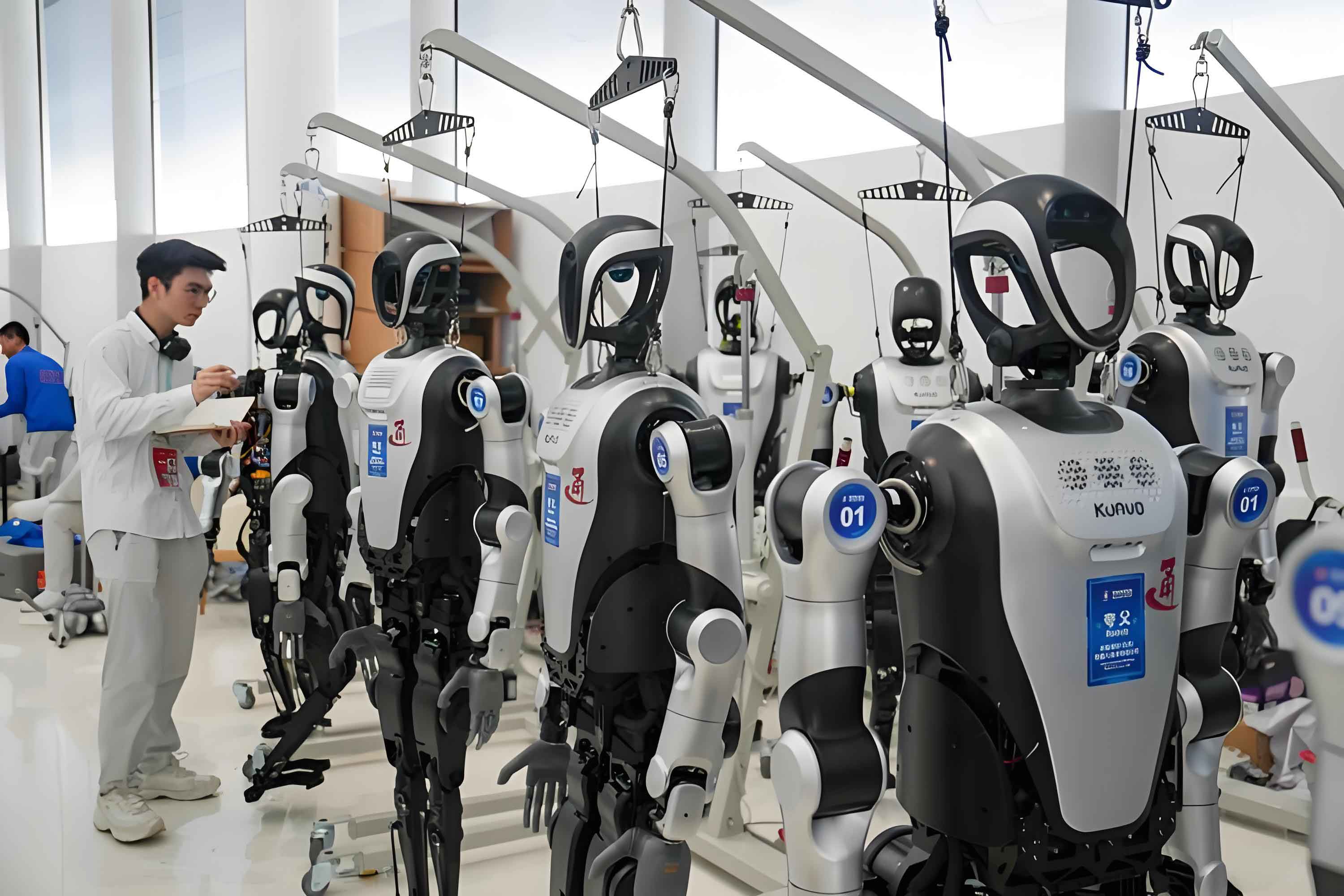
In terms of global comparisons, humanoid robot development is concentrated in regions like Japan, the United States, Europe, and China, with many products still in prototype or proof-of-concept stages, yet to achieve mass production or widespread commercial application. I will analyze this through policy, patents, products, and national trends.
Starting with industrial policies, major economies have enacted various plans to support humanoid robot innovation. The table below summarizes key policies from the United States, Japan, the European Union, and China, highlighting their strategic focuses and timelines.
| Economy | Release Time | Major Policy/Plan | Main Content |
|---|---|---|---|
| United States | 2011 | National Robotics Initiative 1.0 | Emphasized human-robot collaboration to accelerate industry development and application. |
| United States | 2013 | U.S. Robotics Roadmap: From Internet to Robotics | Highlighted the role of robotics in manufacturing and healthcare. |
| United States | 2017 | National Robotics Initiative 2.0 | Focused on foundational research, technology, and integrated systems for assistive robots. |
| United States | 2021 | National Robotics Initiative 3.0 | Aimed to integrate robotic systems based on previous projects. |
| United States | 2024 | CDAO AI Services and Governance Assessment | Identified public-private partnerships as key to advancing general AI. |
| Japan | 2014 | Robotics White Paper | Summarized technologies and application scenarios for robotics R&D. |
| Japan | 2015 | New Robot Strategy | Set goals for innovation hubs, medical applications, and global leadership in robotics. |
| Japan | 2021 | 2021 Science and Technology Innovation White Paper | Envisioned robots with autonomous learning and human-like actions by 2050. |
| Japan | 2024 | Strategic Investment in Semiconductors and AI | Approved a ¥21.9 trillion stimulus for semiconductor and AI fields. |
| European Union | 2014 | Civilian Robotics Project | Largest civilian robotics R&D plan, investing €28 billion by 2020 to boost industrial competitiveness. |
| European Union | 2016 | Horizon 2020 Robotics Projects | Funded 21 projects in industrial and service robotics with €100 million over 2–5 years. |
| European Union | 2018 | EU AI Strategy | Focused on investment, data access, talent development, and trust for AI advancement. |
| European Union | 2024 | EU AI Act | Regulated AI R&D and manufacturing to align with human-centric needs. |
| China | 2021 | 14th Five-Year Plan for Robot Industry Development | Aimed to make China a global hub for innovation, high-end manufacturing, and application by 2025. |
| China | 2022 | National Key R&D Program—Smart Robotics | Provided $43.5 million in support funds. |
| China | 2023 | Guiding Opinions on Humanoid Robot Innovation and Development | Targeted world-leading整机 by 2025 and comprehensive global leadership by 2027. |
Turning to patent applications, the landscape reveals technological strengths and gaps. The table below lists the top ten countries by cumulative patent filings for humanoid robots, indicating China’s high volume but lower proportion of core patents.
| Rank | Country | Cumulative Patent Applications (units) | Valid Invention Patents (units) |
|---|---|---|---|
| 1 | China | 6618 | 1699 |
| 2 | Japan | 6058 | 1743 |
| 3 | South Korea | 1279 | 674 |
| 4 | France | 766 | 245 |
| 5 | United States | 685 | 358 |
| 6 | Germany | 135 | 60 |
| 7 | United Kingdom | 66 | 14 |
| 8 | Canada | 39 | 6 |
| 9 | Italy | 33 | 12 |
| 10 | India | 29 | 6 |
Moreover, the distribution of patent applicants varies significantly. In Japan, the United States, and South Korea, enterprises dominate, whereas in China, both enterprises and academic institutions play major roles, with universities and research institutes contributing substantially to core patents. This can be expressed as: $$ \text{Enterprise Share} = \frac{\text{Enterprise Patents}}{\text{Total Patents}} \times 100\% $$ For China, this share is 56.3%, compared to 93.3% for Japan and 89.9% for the U.S., as shown in the following table.
| Applicant Type | China | Japan | United States | South Korea |
|---|---|---|---|---|
| Enterprises | 56.3% | 93.3% | 89.9% | 72.4% |
| Universities/Research Institutes | 38.1% | 4.0% | 5.9% | 22.9% |
| Others | 5.7% | 2.7% | 4.3% | 4.8% |
Regarding product development, several companies worldwide have unveiled prototypes or commercial models. The table below compares key humanoid robots, detailing their degrees of freedom, industrialization levels, application scenarios, technical solutions, release times, and costs. This highlights the diversity in approaches, from hydraulic drives to electric actuators, and the ongoing efforts to reduce costs for broader adoption.
| Brand | Country | Degrees of Freedom | Industrialization Level | Application Scenarios | Technical Solution | Release Time | Price (USD) and Cost |
|---|---|---|---|---|---|---|---|
| Honda ASIMO | Japan | 58 | Not industrialized, discontinued | Exhibitions | Rotary motors: servo motor + harmonic reducer | 2000 | Not sold; cost ~$2.5 million |
| Boston Dynamics Atlas | United States | 28 | Not commercialized | Exploration, rescue | Hydraulic drive | 2013 | $2 million; shifting to electric, cost target $20k–30k |
| Agility Robotics Digit | United States | 20 | Initial commercialization | Logistics, warehousing | Servo motor + harmonic/cycloidal reducer | 2019 | $250,000 |
| UBTech Walker X | China | 41 | Initial commercialization | Education, logistics, healthcare | Rotary motors: servo motor + harmonic reducer | 2021 | Average sale price $840,000; cost reduced to ~$100,000 by 2023 |
| Xiaomi CyberOne | China | 21 | First-gen prototype | Manufacturing, logistics, services | Servo motor + harmonic/cycloidal reducer | 2022 | Cost ~$85,000–$100,000; price not set |
| Tesla Optimus | United States | 50 | Second-gen prototype | Manufacturing, logistics, services | Rotary actuator: motor + harmonic reducer; linear actuator: motor + ball screw | 2022 | Target price under $20,000; cost ~$10,000 |
| Unitree H1 | China | 19 | Initial commercialization | Entertainment, research, home | High-energy-density joint motor, harmonic reducer and motor module | 2023 | $14,000; high cost-performance |
| Unitree G1 | China | 23–43 | Initial commercialization | Home, education, healthcare | Similar to H1 | 2024 | $14,000; hardware cost over $11,000 |
| Google Mobile ALOHA | United States | 16 | Initial commercialization | Home, hospitality, medical aid | ACT algorithm application | 2024 | System cost ~$32,000 |
| Kepler | China | 52 | Initial commercialization | General-purpose | Embodied AI system, high-performance hardware, proprietary algorithms | 2024 | Estimated price $20,000–$30,000 |
| Zhiyuan | China | 40 | Initial commercialization | General-purpose | Action large model, high自由度, Power Flow joint motor | 2023 | Target manufacturing cost under $28,000 |
The evolution of humanoid robot costs can be modeled with a learning curve: $$ C(t) = C_0 \cdot N(t)^{-b} $$ where \( C(t) \) is cost at time \( t \), \( C_0 \) is initial cost, \( N(t) \) is cumulative production, and \( b \) is the learning rate. This shows how mass production can drive down prices, crucial for commercialization.
Analyzing national trends, the United States, Japan, and China exhibit distinct trajectories in humanoid robot development. In the United States, advancement is characterized by progress in motion and language capabilities, driven by corporate efforts. For instance, Tesla’s Optimus showcases improved limb coordination with a 30% faster walking speed, while Figure AI demonstrates fluent human-robot dialogue, and NVIDIA’s Project GR00T aims to enable natural language understanding and action imitation through observation. Companies like Boston Dynamics and Tesla are pushing applications in industrial and domestic spheres. However, challenges include lagging industrial deployment, high costs for maintenance, and ethical dilemmas such as weaponization and job displacement. The innovation rate here can be approximated by: $$ \text{Innovation Index} = \alpha \cdot \text{R&D Investment} + \beta \cdot \text{Corporate Activity} $$ where \( \alpha \) and \( \beta \) are coefficients.
Japan emphasizes highly human-like design, balance, lightweight construction, and high-performance materials. Robots like HRP-4C from Toyota can traverse complex terrains and perform repetitive tasks, while SoftBank’s Pepper offers services like navigation and translation. The focus on仿人 design enables applications in hazardous fields like rescue operations. However, Japanese humanoid robots remain distant from mass production due to technical complexity and high costs—for example, ASIMO’s development spanned decades with a cost around $2.5 million, and it was never sold. The balance performance can be quantified as: $$ \text{Balance Stability} = \frac{\text{Torque Control Accuracy}}{\text{Mass} \times \text{Height}} $$ indicating how lightweight materials enhance stability.
China stands out for its strong supply chain integration and multi-domain applications. The country accounts for about 38% of the global humanoid robot supply chain, with the Greater Bay Area contributing approximately 57%, reflecting robust manufacturing and整合 capabilities. Humanoid robots in China target both consumer (C-end) uses like home care, companionship, basic chores, and entertainment, and business (B-end) applications in research and manufacturing, particularly in automotive where commercialization is advancing rapidly. Yet, challenges persist: gaps in AI software innovation (e.g., in generative video technology), insufficient product maturity leading to issues like misjudgments or collisions, and market pressures from price wars and product homogenization that squeeze profit margins. The supply chain advantage can be expressed as: $$ \text{Supply Chain Score} = \sum_{i} \text{Localization Rate}_i \cdot \text{Criticality}_i $$ where \( i \) indexes components. To catch up in software, China needs to boost R&D, modeled as: $$ \text{Software Gap Closure} = \int_{0}^{T} (\text{Foreign Innovation Rate} – \text{Domestic Innovation Rate}) \, dt $$ where \( T \) is the time horizon.
In conclusion, as a vital component of future industries, the humanoid robot sector garners significant attention from governments and tech firms globally. Through this analysis, I have compared industrial policies, patent landscapes, product offerings, and national trends. China’s humanoid robot industry is developing rapidly, leveraging innovation, supply chain strengths, and diverse applications. However, it faces hurdles in software innovation, technical maturity, competitive homogeneity, and scenario expansion. Addressing these will require sustained investment in core technologies, enhanced collaboration between academia and industry, and strategic policy support to foster a robust ecosystem for humanoid robots. The future growth can be projected using: $$ \text{Market Size} = S_0 \cdot (1 + r)^t $$ where \( S_0 \) is the initial market size, \( r \) is the annual growth rate (e.g., 20%), and \( t \) is time in years. As humanoid robots evolve, they promise to reshape industries and daily life, making this field a critical area for global technological leadership.