
In the realm of robotics, I have always been fascinated by the intersection of biology and engineering, leading to the emergence of bionic robots. Simply put, a bionic robot is a system where researchers draw inspiration from natural organisms, using bionic techniques to mimic their external structures or functions, thereby creating robots that combine biological features with functional capabilities. Essentially, bionic robots represent an organic integration of advanced technologies from bionics and robotics, constructed from inorganic components like mechanisms, electronics, hydraulics, optics, and organic functional bodies. These bionic robots exhibit morphological characteristics of advanced life in aspects such as motion mechanisms and behavioral patterns, perception modes and information processing, control coordination and computational reasoning, and energy metabolism and material structures. They are designed to perform complex tasks accurately, flexibly, reliably, and efficiently in unknown, unstructured environments. As a rapidly evolving branch of robotics, bionic robots have become a hot topic for researchers worldwide. Compared to other robots, bionic robots often have more complex structures and control processes, but their superior flexibility and adaptability allow them to undertake complex, hazardous, and specific missions. In recent years, with the rapid advancement of bionic technology, the application of bionics in robotics has expanded significantly, making bionic robots increasingly intelligent and enabling them to move from fixed-point operations to more challenging fields like aerospace, military reconnaissance, resource exploration, underwater detection, disease inspection, and disaster relief. Undoubtedly, bionic robots will play an indispensable role in national welfare and people’s livelihoods in the future.
From my perspective, the classification of bionic robots is complex due to the multidisciplinary nature involved, including life sciences, information science, brain and cognitive science, engineering, mathematics, mechanics, and systems science. Bionic robots primarily utilize bionic principles, encompassing technologies like structural bionics, perceptual bionics, control bionics, intelligent bionics, and material bionics. Based on different criteria, bionic robots can be categorized in various ways. For instance, according to the operating environment, they can be divided into underwater bionic robots, terrestrial bionic robots, and aerial bionic robots. Based on locomotion methods, they include jumping bionic robots, wheeled bionic robots, legged bionic robots, and crawling bionic robots. In this article, I will focus on attribute-based classification, which I summarize in Table 1 below.
| Classification Criteria | Types of Bionic Robots | Key Features |
|---|---|---|
| Operating Environment | Underwater Bionic Robots | Designed for aquatic environments, mimicking fish or marine creatures. |
| Operating Environment | Terrestrial Bionic Robots | Operate on land, imitating animals like spiders or humans. |
| Operating Environment | Aerial Bionic Robots | Fly in the air, inspired by birds or insects. |
| Locomotion Method | Jumping Bionic Robots | Utilize jumping motions, similar to frogs or kangaroos. |
| Locomotion Method | Wheeled Bionic Robots | Use wheels for movement, often combined with bionic designs. |
| Locomotion Method | Legged Bionic Robots | Employ legs for walking, mimicking multi-legged or bipedal organisms. |
| Locomotion Method | Crawling Bionic Robots | Move by crawling, inspired by snakes or worms. |
| Bionic Technology | Structural Bionics | Focus on mimicking biological shapes and mechanisms. |
| Bionic Technology | Perceptual Bionics | Imitate sensory systems like vision or touch. |
| Bionic Technology | Control Bionics | Adopt biological control strategies, such as neural networks. |
| Bionic Technology | Intelligent Bionics | Incorporate AI to emulate cognitive functions. |
| Bionic Technology | Material Bionics | Use biomimetic materials for flexibility or durability. |
Reflecting on the development journey of bionic robots, I see it as a progressive evolution from primitive exploration to advanced integration. Bionic robots are designed by researchers based on bionic principles, imitating biological structures and movement characteristics to create robot systems with specific functions. They have shown promising applications in civilian fields like resource exploration and disease inspection, as well as military domains such as counter-terrorism and aerospace. Throughout history, bionic robots have undergone several stages: the primitive exploration stage, the macro-imitation and motion bionics stage, the partial integration of electromechanical systems and biological performance stage, and now, they are moving towards a life-like system stage with hybrid rigid-soft structures, integration of bionic structures, materials, and drives, neuron-level fine control, and efficient energy conversion. This current phase emphasizes the integration of structure and biological characteristics, making bionic robots more akin to living systems. The historical milestones can be summarized in Table 2.
| Development Stage | Time Period | Key Characteristics | Examples |
|---|---|---|---|
| Primitive Exploration | Ancient to Early 20th Century | Basic imitation of biological prototypes, human-driven models. | Early mechanical animals and flying machines. |
| Macro-Imitation and Motion Bionics | Mid-20th Century Onwards | Use of electromechanical systems,实现 walking, jumping, flying functions with human control. | Early robotic walkers and fliers. |
| Partial Integration | Early 21st Century | Combination of traditional structures with bionic materials, advancement in驱动 technologies. | Quadruped robots and avian-inspired drones. |
| Life-Like System Stage | Present and Future | Integration of structure and biology, self-perception, control, and adaptive learning. | Soft robotics and neuro-controlled systems. |
To quantify the motion dynamics in bionic robots, I often refer to kinematic and dynamic models. For example, the locomotion of a legged bionic robot can be described using the following formula for joint angles and forces:
$$ \tau = M(q)\ddot{q} + C(q, \dot{q})\dot{q} + G(q) $$
where \( \tau \) is the joint torque vector, \( q \) is the joint position vector, \( M(q) \) is the inertia matrix, \( C(q, \dot{q}) \) represents Coriolis and centrifugal forces, and \( G(q) \) is the gravitational force vector. This equation highlights the complexity in controlling bionic robots, as it mimics the dynamic balance found in biological organisms.
In my analysis of current research, bionic robots have diversified significantly, with numerous types and functions. For clarity, I will discuss the research status from three perspectives: terrestrial bionic robots, underwater bionic robots, and aerial bionic robots. Each category showcases the innovative applications of bionic principles in robotics.
Starting with terrestrial bionic robots, these systems mimic land-based organisms to perform tasks like ground reconnaissance, detection, and hazardous operations. For instance, inspired by desert spiders, a recent bionic spider robot was developed with eight legs that allow both walking and rolling motions. In walking mode, it uses a tripod gait where three legs are grounded while three move forward, enabling stable progression. In rolling mode, it folds its legs to form a wheel-like structure, achieving faster movement. This bionic robot demonstrates high terrain adaptability and bionic authenticity, making it suitable for agriculture, exploration, and battlefield surveillance. Another notable example is a humanoid bionic robot capable of human-like actions such as standing on one leg, doing push-ups, and manipulating objects with dexterous fingers. It features autonomous learning abilities for navigation in confined spaces, with potential applications in rescue operations and space missions. These terrestrial bionic robots exemplify how bionic design enhances functionality in challenging environments.
Moving to underwater bionic robots, the aquatic environment poses unique design challenges, requiring advanced technologies for propulsion, sensing, and control. These bionic robots are highly integrated systems with broad prospects in civilian and military fields. A prominent example is a manta-ray-inspired bionic robot fish, which uses flexible PVC fins driven by electric motors to swim agilely at speeds up to 0.7 m/s. It can carry sensors for underwater reconnaissance, marine resource exploration, and mapping. Another innovative bionic robot is a soft robotic fish that mimics real fish in size and behavior, controlled via a waterproof手柄 to observe marine life minimally invasively. Its tail摆动 propulsion, with a driving frequency range of 0.9 Hz to 1.4 Hz, allows efficient movement. Additionally, a tuna-like bionic underwater robot has been tested, featuring biomorphic shapes for minimal ecological impact. It is fully autonomous with modular sensors for monitoring and parameter recording in aquatic spaces. These underwater bionic robots leverage bionic principles to achieve enhanced maneuverability and stealth.
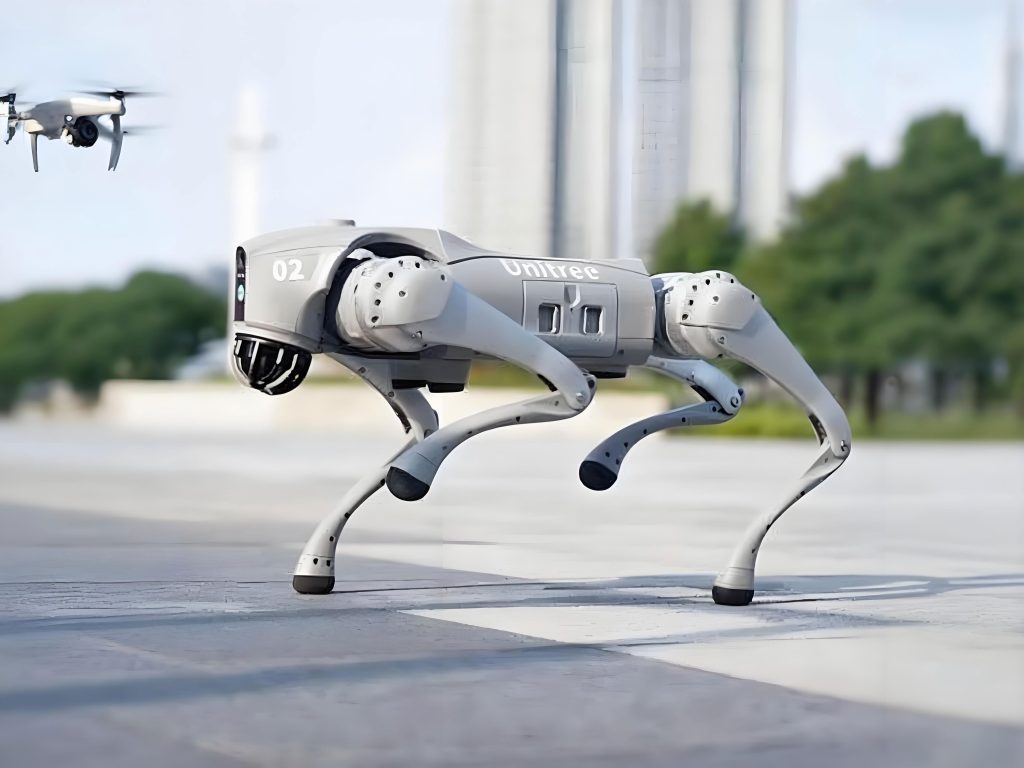
In aerial bionic robots, the focus is on mimicking flying organisms for applications in military reconnaissance, disaster response, and anti-terrorism. Due to their small size,灵活运动, and unrestricted airspace, aerial bionic robots are gaining increasing attention. A striking example is a bionic flying fox drone, inspired by bat wings, with a lightweight carbon fiber frame and elastic fabric membrane. It can autonomously plan flight paths and learn from each mission to improve performance. Another development is a wireless robotic fly, powered by laser beams and equipped with a micro-controller to control wing flapping for takeoff and landing. This bionic robot is cost-effective and ideal for surveillance in inaccessible areas, such as defense探测 or gas leak detection. The agility and仿形 of these aerial bionic robots enable them to blend into environments seamlessly, much like their biological counterparts.
To further illustrate the performance metrics of bionic robots, I often use formulas to model their efficiency. For instance, the energy consumption of a bionic robot can be expressed as:
$$ E = \int P(t) dt = \int \left( \sum_{i} F_i v_i + \sum_{j} \tau_j \omega_j \right) dt $$
where \( E \) is the total energy, \( P(t) \) is the power function, \( F_i \) and \( v_i \) are forces and velocities at contact points, and \( \tau_j \) and \( \omega_j \) are torques and angular velocities at joints. This emphasizes the need for efficient energy conversion in bionic robots, mirroring biological metabolism.
As bionic robots transition to more demanding scenarios, I observe several emerging trends aimed at enhancing their仿生性能 for harsh and variable environments. First, miniaturization is critical, driven by tasks in precise, narrow, and complex settings. The key lies in微型化 electromechanical systems by integrating驱动, transmission, sensors, controllers, and power sources. This trend allows bionic robots to operate in confined spaces, such as medical applications or微型侦察. Second, intelligence is advancing rapidly with AI technologies, shifting bionic robots from purely mechanical to smart systems. Intelligent bionic robots exhibit diverse task execution, human-like动作, and precise control, enabling better imitation of biological functions. This can be modeled using machine learning algorithms, such as:
$$ \min_{\theta} \sum_{t} L(y_t, f(x_t; \theta)) $$
where \( \theta \) represents learned parameters, \( L \) is a loss function, \( y_t \) is the desired output, and \( f(x_t; \theta) \) is the robot’s policy based on inputs \( x_t \). Third,仿形化, or morphological similarity to生物, is becoming essential for隐蔽性 in军事 operations. Bionic robots that closely resemble organisms can evade detection more effectively. Fourth,多功能化 is emerging as任务场景 diversify, leading to various forms like蠕动机器人,蛇形机器人, and爬壁机器人. Each design caters to specific environmental challenges, expanding the capabilities of bionic robots.
In summary, as a researcher in this field, I believe bionic robots hold immense potential for tasks like unknown environment exploration, military reconnaissance, counter-terrorism, and disaster救援. They are vital members of the robotics family, capable of undertaking dangerous or humanly impossible missions. However, despite significant progress, bionic robots still face limitations, such as structural imperfections and control complexities. To overcome these, we must deepen our学习 of biological forms and features, drawing inspiration from nature’s diversity. By combining AI, mechanical manufacturing, and information science, we can achieve breakthroughs in模仿, replication, and再造 of生物, leading to qualitative leaps in the functionality and technology of bionic robots. The future of bionic robots lies in continuous innovation, making them more life-like and adaptable for the benefit of society.
To encapsulate the evolution of bionic robots, I propose a conceptual framework based on bio-inspiration levels, as shown in Table 3 below. This table highlights how bionic robots are advancing towards更高的 integration with biological systems.
| Inspiration Level | Description | Example Bionic Robot Features | Mathematical Representation |
|---|---|---|---|
| Structural Imitation | Mimicking external shapes and mechanisms. | Legged locomotion, wing designs. | $$ q = f(\theta) $$ where \( q \) is position, \( \theta \) is joint angle. |
| Functional Emulation | Replicating biological functions like sensing or movement. | Autonomous navigation, adaptive control. | $$ \dot{x} = g(x, u) $$ with state \( x \) and control input \( u \). |
| Cognitive Integration | Incorporating learning and decision-making akin to生物 brains. | Neural network controllers, self-learning. | $$ \pi(a|s) = \text{softmax}(Q(s,a)) $$ for policy \( \pi \). |
| Holistic Biomimicry | Full integration of structure, function, and intelligence. | Life-like soft robots, energy-autonomous systems. | $$ \frac{dE}{dt} = \eta P_{\text{in}} – P_{\text{loss}} $$ for energy dynamics. |
In conclusion, the journey of bionic robots from simple模仿 to sophisticated life-like systems reflects our growing understanding of biology and engineering. As I delve deeper into this field, I am optimistic that bionic robots will revolutionize various sectors, driven by trends like miniaturization, intelligence, morphological fidelity, and multifunctionality. By embracing interdisciplinary approaches, we can unlock the full potential of bionic robots, making them indispensable tools for future challenges.