
In contemporary society, young adults navigate an environment saturated with relentless competition and pervasive consumerism. This constant pressure often leads to a profound sense of disillusionment, where individuals feel detached from their goals and devoid of vitality in their work and personal lives. This state, characterized by emotional exhaustion, cynicism, and a reduced sense of personal accomplishment, is widely recognized as burnout. As a designer, I am compelled to explore how intelligent product design, specifically the development of domestic companion robots, can offer a therapeutic intervention. This article delves into designing a smart, home-based companion robot aimed at mitigating burnout symptoms, reigniting passion, and providing stable emotional support for young adults through intelligent companionship.
Understanding the Etiology and Manifestations of Burnout
Burnout is not merely fatigue; it is a syndrome conceptualized from prolonged exposure to chronic interpersonal stressors. For young adults, its roots often lie in a sociocultural paradigm that encourages self-exploitation—the internalized pressure to constantly optimize performance and productivity until it leads to psychological collapse. This cycle is exacerbated in high-intensity, repetitive work-life patterns where individuals feel a loss of autonomy and struggle to manage arising challenges. The core emotional experience shifts from engagement to persistent weariness and detachment.
The behavioral manifestations of burnout are distinct and inform the design requirements. Key characteristics observed in affected youth include:
- Social Withdrawal and “Social Fear”: A preference for isolation, avoiding social interactions and new commitments, often stemming from emotional overload.
- Anhedonia and Loss of Drive: A diminished interest or pleasure in most activities, leading to a passive, routine-driven existence.
- Compensatory Consumption (“精致穷”): Engaging in excessive spending on luxury or lifestyle items as a fleeting emotional reward mechanism, often disregarding financial sustainability, which ultimately deepens feelings of emptiness.
- Aversion to Future Planning: A pervasive anxiety about the future, leading to avoidance of significant life steps such as committed relationships or family planning.
At its core, the fundamental need arising from this state is not just for distraction, but for empathic companionship and a safe, non-judgmental outlet for emotional expression. While pet ownership is a common and effective solution for many, it is often impractical due to demanding work schedules, living constraints, or lifestyle mobility. This gap presents a critical opportunity for a technological solution.
Design Directions from Existing Emotional and Companion Products
Analysis of contemporary designs aimed at emotional regulation and companionship reveals several convergent strategies. Successful products often engage multiple sensory modalities to create a calming, interactive experience. Common approaches include:
- Auditory-Visual Translation: Products that transform intangible elements like sound or breath into visualized, calming patterns, providing a tangible focus point for mindfulness.
- Tangible Confidants: Objects designed with clear, metaphorical forms (e.g., a “tree hole”) that serve as a physical repository for secrets and verbalized thoughts, facilitating emotional catharsis.
- Guided Somatic Interaction: Devices that use gentle lighting, haptic feedback, or guided breathing prompts to anchor the user’s attention and regulate the autonomic nervous system during moments of anxiety.
- Integrated Utility: Combining companionship features with practical domestic functions (e.g., cleaning) to enhance contextual relevance and adoption within the home ecosystem.
These cases underscore a principle crucial for our companion robot design: effective intervention works across the sensory—visual, auditory, haptic—and behavioral levels to foster emotional connection and stability.
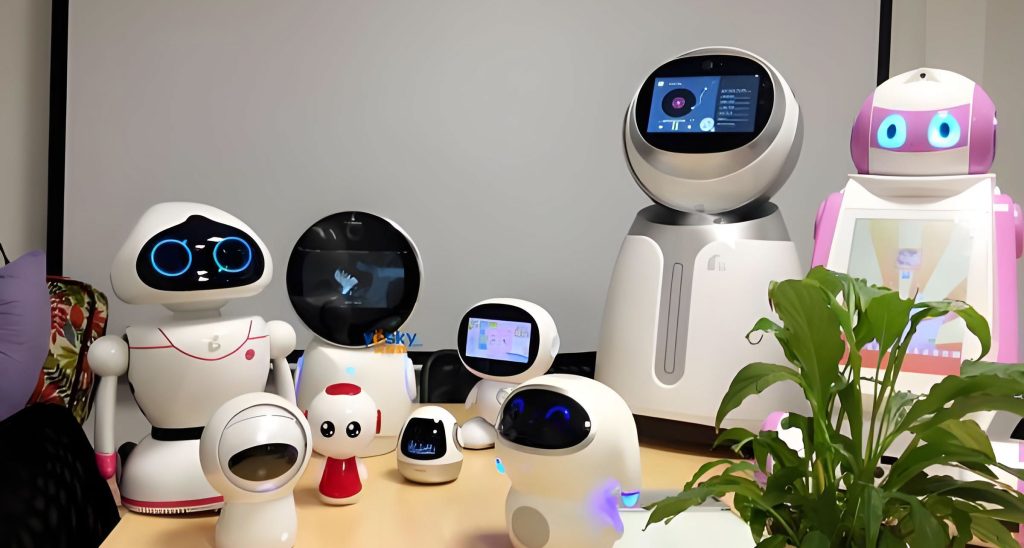
Design Practice for an Intelligent Home Companion Robot
The design of a companion robot for youth burnout must be a holistic integration of empathetic interaction, contextual awareness, and seamless domestic integration. The following framework outlines the key pillars of this design practice.
1. User Scenario and Core Functional Architecture
The primary user is a young adult experiencing burnout symptoms, within their home environment. The robot should also possess limited portability for use in personal spaces like a study or balcony. Its core functions are built around two pillars: Intelligent Interaction and Centralized Orchestration.
| Functional Pillar | Components | Description |
|---|---|---|
| Intelligent Interaction | Voice Dialogue | Context-aware conversations for emotional venting, casual talk, and providing non-clinical support using NLP and empathetic AI. |
| Behavioral & Visual Sensing | Using cameras and sensors to interpret user posture, activity levels, and facial cues to infer emotional state. | |
| Haptic Feedback | Responsive touch surfaces (e.g., warm lighting, gentle vibrations) to provide comforting physical feedback. | |
| Centralized Orchestration | Smart Home Integration Hub | Serves as a command center, analyzing user state and coordinating other smart devices (lighting, speakers, climate) to create a cohesive, mood-supportive environment. |
2. From “Smart” to “Wise”: The Application of Intelligence
The robot’s intelligence transcends simple command response. It embodies a “wise” system that learns, anticipates, and acts proactively to support emotional well-being. This is achieved through a layered intelligence model:
Perception Layer: Aggregates multi-modal input data (voice tone, speech content, facial expression, motion patterns).
$$ D_{input}(t) = \{ V(t), L(t), E_f(t), M(t) \} $$
where $V(t)$ is vocal data, $L(t)$ is linguistic content, $E_f(t)$ is facial expression score, and $M(t)$ is movement data at time $t$.
Analysis & Learning Layer: Employs machine learning models to assess emotional state $E_s(t)$ and identify patterns indicative of burnout cycles.
$$ E_s(t) = f(D_{input}(t), H_{historical}) $$
Here, $f$ is the analysis model and $H_{historical}$ is the user’s historical interaction data, allowing the system to recognize individual baselines and deviations.
Orchestration Layer: Determines the optimal multi-device response $R_{opt}$.
$$ R_{opt} = \arg \max_{R} [ \alpha \cdot U_{user}(R, E_s) + \beta \cdot C_{cohesion}(R) ] $$
This formula seeks to maximize a weighted function of user benefit $U_{user}$ (based on current state $E_s$) and environmental cohesion $C_{cohesion}$, where $\alpha$ and $\beta$ are tuning parameters.
3. Product Ecosystem: Robot and Mobile App Integration
The physical companion robot is the primary interactive node, but its utility is extended through a dedicated mobile application. This creates a continuous feedback loop for self-awareness and control.
| Component | Primary Role | Key Features |
|---|---|---|
| Robot Endpoint | Real-time interaction, data collection, environmental action. | Voice/visual interface, ambient lighting, smart home control execution, sensor hub. |
| Mobile Application | Insights, customization, and community. | Emotional state dashboard & trends, interaction history, robot behavior customization, anonymous community sharing for peer support. |
The data flow can be summarized as: Robot senses → Cloud processes/learns → App visualizes insights → User adjusts preferences via App → Robot adapts behavior.
4. Form, Interaction, and Modular Expression
The physical design must counteract the coldness of technology with warmth and approachability. The principles guiding this are:
- Unconscious Design: The form should intuitively suggest its function and mode of interaction, minimizing cognitive load. Rounded, organic geometries and soft, matte textures invite touch and proximity.
- Neutral yet Warm Aesthetics: A base palette of whites, grays, and warm woods, accented with low-saturation, calming colors (e.g., sage green, soft blue) that can adapt to any home decor.
- Expressive yet Simple Face: A minimal display capable of rendering basic, empathetic expressions (through light patterns or simple abstract shapes) rather than complex, potentially uncanny human-like faces.
- Modular Mobility: A core base unit for stationary home use, with optional add-ons:
- Mobile Platform: Enables “follow-me” companionship around the home.
- Portable Pod: A smaller, detachable unit for personal space use or short trips.
- Task-Specific Modules: E.g., a projector module for shared media viewing or a light therapy module for seasonal affective disorder (SAD) support.
5. Specific Intervention Strategies for Burnout
The ultimate value of this companion robot lies in its daily, contextual interventions. Its actions are designed to be proactive, subtle, and integrated into the rhythm of life.
| Burnout Symptom | Robot’s Intervention Strategy |
|---|---|
| Emotional Exhaustion & Withdrawal | Initiates low-demand check-ins via gentle light pulses or short, open-ended questions. Offers passive companionship by maintaining a quiet presence nearby. Plays user-curated ambient soundscapes to reduce cognitive load. |
| Cynicism & Detachment | Uses positive reinforcement based on observed micro-achievements (e.g., “I noticed you prepared a meal today, that’s great!”). Shares neutral or uplifting news/curiosities to gently reconnect the user with the outside world. |
| Loss of Routine & Self-Care | Provides gentle, non-judgmental reminders for hydration, breaks, or bedtime based on learned schedules. Can guide through short, 2-minute breathing or stretching exercises when it detects prolonged inactivity or agitation. |
| Compensatory Urges | Suggests alternative, low-cost rewarding activities it has learned the user enjoys (e.g., “Would you like me to play that relaxing playlist?” or “It’s a nice evening for a short walk.”). |
The robot’s dialogue system avoids therapeutic claims but is built on principles of motivational interviewing and active listening. Its emotional analysis model, $E_s(t)$, triggers different response protocols $R_{opt}$. For example, a low $E_s(t)$ score (indicating fatigue/depression) might trigger a protocol that slowly increases ambient light warmth and suggests a favorite calming activity, while a high-agitation score might trigger a protocol for guided breathing.
A critical behavioral analysis metric the robot can compute is the User Engagement Variability Index ($UEVI$):
$$ UEVI = \sigma( B_{a,1}, B_{a,2}, …, B_{a,n} ) $$
where $B_{a}$ represents a quantified daily activity metric (e.g., verbal interaction length, movement patterns) over $n$ days. A low $UEVI$ suggests a stagnant, repetitive routine—a key burnout indicator—prompting the robot to cautiously introduce gentle novelty.
Conclusion
The design exploration for a companion robot targeting youth burnout is a multidimensional challenge sitting at the intersection of affective computing, human-centered design, and domestic robotics. It moves beyond mere task automation towards creating an empathetic entity capable of fostering emotional resilience. By synthesizing multi-sensory interaction, proactive environmental orchestration, and continuous, adaptive learning, such a robot can transition from being a smart device to a meaningful companion. It offers a consistent, non-judgmental presence that helps de-escalate negative emotional spirals, reinforces positive micro-behaviors, and ultimately supports the user in rebuilding a sense of agency and engagement with life. While challenges regarding acceptance, personalization depth, and ethical data handling remain, the potential for technology to serve as a stabilizing, therapeutic force in the intimate context of the home is profound. The goal is not to provide a final solution, but to design a sophisticated tool for companionship that empowers young adults to navigate burnout and rediscover their vitality, one day at a time.