
The market for companion robots designed for children presents a unique paradox. On one hand, the potential for these intelligent devices to support development, provide engagement, and offer educational value is immense. On the other, many products suffer from a pronounced lack of differentiation, leading to market saturation with homogeneous offerings that fail to deeply resonate with their young users and their families. This often results in subpar interactive experiences and low user satisfaction. The core issue frequently lies not in the technology itself, but in a fundamental misalignment between product features and the nuanced, varied needs of the target audience. Traditional user segmentation based on basic demographic data, while clear-cut, provides only a superficial view. To create truly effective and engaging companion robots, we must delve deeper into the psychographic and behavioral layers of the user—specifically, their attitudes, expectations, and perceived satisfaction with the product’s interactive capabilities. This article, from my perspective as a researcher in interaction design, argues for and demonstrates a methodological approach to user segmentation based on Factor and Cluster Analysis. This data-driven process moves beyond demographics to uncover distinct user archetypes based on their functional priorities, thereby providing a concrete foundation for targeted design and strategic market positioning.
The interaction between a child and a companion robot is a complex, cyclical system of information exchange. The quality of this interaction, and thus the overall user experience, is shaped by a confluence of factors: the physical hardware, the software interface, and the cognitive and social characteristics of the child user. To systematically understand this, I constructed an interaction model tailored for children aged 7-12, synthesizing principles from established human-computer interaction frameworks and Norman’s action cycle. This model posits that a successful interaction must satisfy four key dimensions: interaction with the physical artifact, interaction with the digital interface, alignment with the child’s own developmental characteristics, and facilitation of social interaction with others.
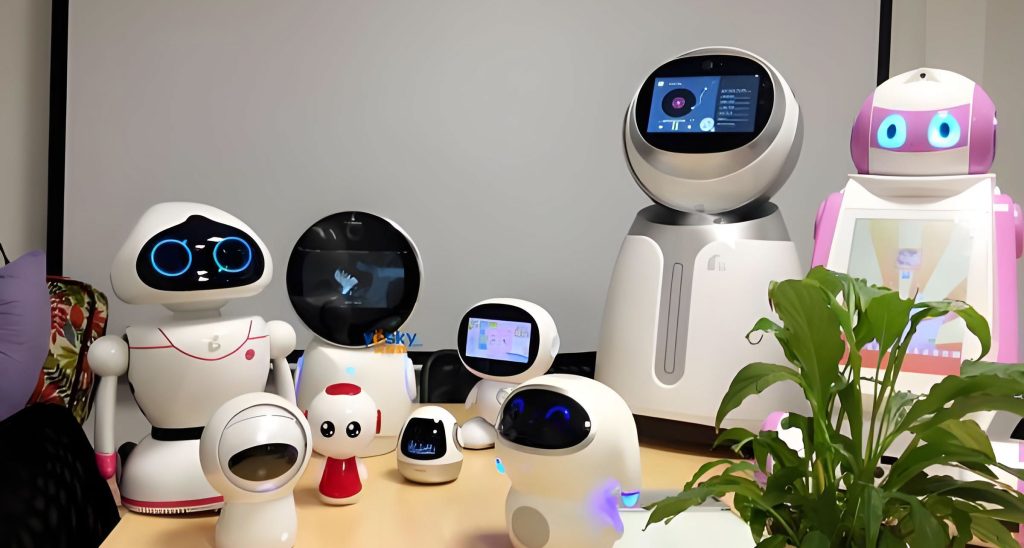
The first dimension, Interaction with the Physical Artifact, concerns the tangible hardware. Many current companion robots share remarkably similar, often minimalist, forms—rounded heads on trapezoidal bodies with little detailing and a cold color palette. To improve this, the design must balance aesthetic friendliness with strict adherence to safety standards, ergonomic sizing for children, and durable material choices. From this, I derived four key metrics: Safety, Durability/Robustness, Friendly Appearance/Form, and Ergonomic Sizing.
The second dimension, Interaction with the Digital Interface, is guided by known principles of child-computer interaction. Children are drawn to colorful, multimodal interfaces rich with imagery, sound, and animation connected to their real-world experiences. They have lower literacy, prefer graphical navigation over text, struggle with deep hierarchical menus, and possess a limited ability to filter out persuasive elements like ads. Based on this, ten interface metrics were established: Interface Consistency & Coherence, Visual Appeal/Imagery, Content Extensibility, Information Relevance to Real Life, Multi-channel Feedback, Error Prevention & Reduction, Limitation of Irrelevant Information, User Control & Autonomy, Operational Simplicity, and Minimal Information Architecture Depth.
The third dimension, Alignment with Child-Specific Characteristics, recognizes the unique developmental stage of children aged 7-12 (Piaget’s Concrete Operational stage). These children are developing logical thought, learning through structured play and instruction, improving social and language skills, and beginning to form a sense of self-discipline and competency. Metrics reflecting this include: Story-based/Scenario Learning, Phased & Tiered Teaching, Child Agency/Initiative, Language Interactivity, Game-based Learning, Gender-based Differentiation, Quality/Character Development, Personalized/Customizable Service, and Reward & Encouragement Systems.
The fourth and crucial dimension, Facilitation of Social Interaction with Others, acknowledges that a companion robot does not exist in a vacuum. Its role in mediating or encouraging interactions with parents, peers, and even virtual characters within its ecosystem is vital for holistic child development. This led to five social metrics: Parental Companionship, Parental Monitoring/Oversight, Facilitation of Social Connections, Peer Interaction/Communication, and Interaction with a Virtual Protagonist/Character. From these four dimensions, a comprehensive set of 28 functional interaction metrics was initially compiled as the basis for evaluating user satisfaction with a companion robot.
To refine these metrics and create a robust assessment tool, I employed a structured, qualitative approach. I conducted a series of workshops using a modified, or “Limited,” KJ Method with 24 parent-child pairs (children meeting the age criteria and having over one year of experience with a companion robot). The goal was to validate and consolidate the 28 functional phrases. In the first stage, participants grouped the 28 cards based on perceived affinity, resulting in six higher-order categories: “Product Hardware Performance,” “Child-Centric Perception Characteristics,” “Interface Information Configuration,” “Interface Interaction & Operation,” “Other Stakeholders,” and “Other.” The second stage involved merging these groups further based on cross-category affinities. This process distilled the original 28 items into a finalized, hierarchical set of 26 key interaction function indicators, as summarized in Table 1.
| Product Hardware Performance | Child-Centric Perception | Interface Information Config. | Interface Interaction & Operation | Other Stakeholders | Miscellaneous |
|---|---|---|---|---|---|
| 1. Safety | 3. Friendly Appearance | 5. Interface Consistency | 10. Error Rate Reduction | 20. Character Development | 25. Peer Interaction |
| 2. Material Durability | 4. Ergonomic Sizing | 6. Visual Appeal/Imagery | 11. Irrelevant Info. Limitation | 22. Reward & Encouragement | 26. Virtual Protagonist |
| 15. Phased/Tiered Teaching | 7. Content Extensibility | 12. User Control & Autonomy | 23. Parental Supervision | ||
| 16. Child Agency | 8. Real-life Info. Relevance | 13. Operational Simplicity | 24. Social Connection Facilitation | ||
| 18. Game-based Learning | 9. Multi-channel Feedback | 17. Language Interactivity | |||
| 19. Gender Differentiation | 14. Story-based Learning | ||||
| 21. Personalized Service |
These 26 indicators were then used to construct a 5-point Likert scale questionnaire (1=Very Dissatisfied to 5=Very Satisfied) to measure user attitudes. An initial pilot test (n=71) confirmed high reliability (Cronbach’s Alpha = 0.91) and suitability for factor analysis (KMO = 0.816). The main study deployed 240 questionnaires, with 222 valid responses collected. The dataset exhibited excellent properties for multivariate analysis (KMO = 0.896, Alpha = 0.91).
The methodological core of this user segmentation lies in the combined application of Factor Analysis and K-means Clustering. Factor Analysis is a powerful dimensionality reduction technique that simplifies complex, correlated variable structures by identifying underlying “latent” factors. The fundamental model can be expressed as follows. For each observed, standardized variable \(X_i\) (where \(i = 1, 2, …, p\), with \(p=26\) in our case), it is a linear combination of \(m\) common factors \(F_j\) plus a unique factor \(\epsilon_i\):
$$X_i = a_{i1}F_1 + a_{i2}F_2 + \dots + a_{im}F_m + \epsilon_i$$
Here, \(a_{ij}\) represents the factor loading—the correlation between variable \(X_i\) and common factor \(F_j\). In matrix form, the model is:
$$X = AF + E$$
where \(X\) is the vector of observed variables, \(F\) is the vector of \(m\) common factors (\(m \le p\)), \(A\) is the factor loading matrix, and \(E\) is the vector of unique factors. The analysis extracts these common factors, which condense the information from the original 26 variables into a smaller set of composite dimensions. Subsequently, a factor score can be calculated for each respondent on each factor, representing their standing on that underlying dimension.
Applying Principal Component Analysis with Varimax rotation to the satisfaction data, I extracted factors with eigenvalues greater than 0.59. The scree plot indicated a clear break after 14 factors, confirming this as an appropriate solution. These 14 factors collectively explained 81.57% of the total variance in the original data. The rotated factor loadings, showing which original variables cluster onto which factor, are presented in Table 2. The factors were interpreted and labeled based on their highest-loading variables, such as “Cognitive Factor” (emphasizing structured learning), “Affinity Factor” (emphasizing friendly interface and appearance), “Hardware Factor,” “Control Factor,” and so on.
| Factor & Interpretation | Key Variables (Loading >0.55) | Eigenvalue | Cumulative % Variance |
|---|---|---|---|
| F1: Cognitive Factor | Phased/Tiered Teaching (0.79), Content Extensibility (0.71), Language Interactivity (0.56) | 8.525 | 32.79% |
| F2: Affinity Factor | Operational Simplicity (0.71), Multi-channel Feedback (0.68), Friendly Appearance (0.53), Irrelevant Info. Limitation (0.47) | 1.844 | 39.88% |
| F3: Information Factor | Interface Consistency (0.83), Real-life Info. Relevance (0.67) | 1.374 | 45.17% |
| F4: Hardware Factor | Material Durability (0.76), Ergonomic Sizing (0.71) | 1.186 | 49.73% |
| F5: Control Factor | User Control & Autonomy (0.80), Error Rate Reduction (0.58), Safety (0.44) | 1.111 | 54.00% |
| … (Factors F6-F14) | … | … | … |
| F14: Supervision Factor | Parental Supervision (0.95) | 0.596 | 81.57% |
The resulting 14 factor scores for each of the 222 respondents became the new input variables for the segmentation phase. I applied the K-means clustering algorithm, specifying a 4-cluster solution to generate distinct and actionable user segments. The algorithm iteratively assigns respondents to the nearest cluster center (mean) based on their factor score profiles. The final cluster centers, which represent the average factor score profile for each segment, are shown in Table 3. A positive value indicates the segment values that factor above the overall mean, while a negative value indicates below-average importance.
| Factor | Cluster 1 (n=49) | Cluster 2 (n=54) | Cluster 3 (n=35) | Cluster 4 (n=84) |
|---|---|---|---|---|
| Cognitive Factor | 0.135 (High) | -0.018 (Low) | -0.092 (Low) | -0.029 (Low) |
| Affinity Factor | 0.032 (Low) | -0.270 (Low) | -0.910 (Low) | 0.534 (High) |
| Hardware Factor | 0.416 (High) | 0.213 (Low) | -1.048 (Low) | 0.057 (Low) |
| Control Factor | -0.723 (Low) | 0.217 (Low) | -0.259 (Low) | |
| Supervision Factor | -0.191 (Low) | -0.531 (Low) | 0.046 (Low) | |
| Peer Factor | -0.727 (Low) | 0.615 (High) | -0.461 (Low) | 0.221 (Low) |
| Gender Factor | -0.386 (Low) | 0.409 (High) | 0.358 (Low) | -0.187 (Low) |
Analyzing these cluster profiles allows for a rich interpretation of four distinct companion robot user segments, whose priority for product development can be inferred from their sample size: Cluster 4 > Cluster 2 > Cluster 1 > Cluster 3.
Cluster 4: The Affinity & Supervision-Seeking Majority (n=84). This is the largest segment, representing a core market perspective likely driven by parental priorities. They place exceptionally high importance on the Affinity Factor (friendly, simple, multi-modal interaction), the Supervision Factor (parental oversight features), and the Control Factor (safety, autonomy, error prevention). For this group, the companion robot’s primary role is that of a safe, approachable, and parent-approved companion. Design strategies must prioritize warm, intuitive industrial and interface design, robust parental control dashboards, and features that ensure a secure and mistake-forgiving interactive environment. The emotional connection and trustworthiness of the robot are paramount.
Cluster 2: The Social & Personalized Learners (n=54). This segment highlights an emerging and sophisticated set of needs. They show high scores on the Peer Interaction Factor and the Gender Differentiation Factor, indicating a desire for the companion robot to facilitate social connections and acknowledge the child’s individual identity. They also value factors related to personalized, scenario-based learning. This suggests a market ready for companion robots that move beyond solitary play towards being social mediators or platforms for personalized, identity-aware education. Design implications include features for safe, moderated peer-to-peer interaction within the ecosystem, customizable avatars or narratives that reflect gender and personal interests, and adaptive learning paths.
Cluster 1: The Hardware-Centric Pragmatists (n=49). This group’s attitude is defined by a strong focus on the Hardware Factor (durability, ergonomics) and a notable emphasis on the Cognitive Factor (structured, language-based learning). They are less concerned with social features or strict parental supervision. For them, the companion robot is primarily a robust educational tool. The design strategy here should emphasize physical quality, resilience to rough handling, excellent sound quality for language learning, and a content-rich, curriculum-aligned educational software suite. The product is viewed as an investment in learning, so its tangible quality and pedagogical substance are key selling points.
Cluster 3: The Niche Character Developers (n=35). The smallest segment is characterized by a very high valuation of qualities related to character and moral development (a factor loading highly on “Quality Cultivation”). Their profile is otherwise neutral or low on other factors. This represents a niche but dedicated market interested in companion robots as explicit tools for nurturing virtues, empathy, and social ethics. Design would need to focus on narrative content, role-playing scenarios, and feedback mechanisms that reward prosocial behavior, cooperation, and emotional intelligence.
In conclusion, applying Factor and Cluster Analysis to user satisfaction data for companion robots provides a powerful, data-driven framework for moving beyond generic design. This method successfully segments the heterogeneous market into distinct archetypes—the Safety-Conscious Family, the Social Connector, the Educational Pragmatist, and the Character-Focused Niche. Each segment reveals a different priority hierarchy for the 26 interaction functions, offering clear strategic guidance for product development, feature roadmaps, and targeted marketing. For designers and product managers, this approach translates vague notions of “user-centricity” into concrete, actionable insights. It demonstrates that the path to improving user experience and achieving market success for the next generation of companion robots lies in strategically choosing which cluster’s needs to serve most prominently, thereby transforming a generic gadget into a purpose-built companion that truly resonates with its intended users. Future work should aim to validate these segments with larger, more geographically diverse samples and explore how other constraints like cost and manufacturability interact with these user-driven design priorities.