
The global technological landscape has been irrevocably altered since 2022 by the rapid ascent of Large Language Models (LLMs), spearheaded by applications like ChatGPT. This development has catalyzed an unprecedented expansion of the artificial intelligence industry worldwide. Within this新一轮的科技竞赛, analysis consistently places two nations at the forefront. By the end of 2024, the global count of AI enterprises exceeded 30,000, with a significant concentration of technical and capital resources in these leading economies. The direction of cutting-edge AI has progressively shifted from creating conversational chatbots and abstract problem-solvers towards developing systems with autonomous task-execution capabilities—referred to as AI Agents.
The announcement of frameworks like the AI Agent Operator in early 2025 has significantly accelerated innovation in this domain. Such models operate on a core perceptual-reasoning-action loop, granting AI applications the ability to interact deeply with digital ecosystems. This enables embodied AI robot prototypes and software agents to proactively trigger tasks and perform cross-interface operations (like clicking, switching pages, inputting codes) much like a human would, even executing desktop workflows autonomously. Concurrently, releases from various global entities demonstrate performance benchmarks rivaling or surpassing established models in specific tasks. The maturation of these agentic products signals that AI artifacts are developing a degree of dynamic environmental adaptability, initiating behavioral-level interactions with the physical world. Their cultural role is no longer confined to abstract linguistic and logical feedback, marking a new focal point in global technological competition: the sustained evolution of agents towards general-purpose embodied AI robot systems.
Recognizing this trajectory, strategic policy frameworks have been established to nurture future industries, including embodied AI robot development. Such top-level design aims to guide strategic planning, interdisciplinary convergence, international collaboration, and talent cultivation, thereby allocating supportive financial, technical, and socio-cultural resources. This ensures a formidable position in the new round of global technological competition. It is foreseeable that such drivers will significantly unleash the productive potential of embodied AI robot technology. Entities with functions in elder care, assistance, and companionship will gradually embed themselves into daily life, exerting substantial influence on social structures, employment models, and economic systems through their technical functionality.
The continuous permeation of embodied AI robot applications into everyday life positions them as crucial technical forces shaping human-world relations and social interactive practices. They are active, key technological actors within the contemporary digital media ecology. As the generality of these intelligent media entities strengthens, their embodied characteristics will become more pronounced, enabling them to regulate human bodily perception from the outside-in, reshape physical experience, and ultimately acquire the capacity to “configure” human action plans and boundaries. Within the developmental prospects of embodied AI robot technology, we glimpse profound transformations impending for individual states of existence and lived experience, leading to new imaginings concerning our collective fate and civilization.
While commercial innovation in the technological and industrial sectors often prioritizes functional optimization and efficiency gains for capitalist productivity, this process can obscure the challenges posed by insufficiently ethically-tamed innovation to human subjectivity. Theoretical circles, however, have long expressed profound anxiety regarding the “dark” prospects of machine substitution or even dominion—anxiety that is social, cultural, bodily, and existential. As “human-like” LLMs evolve towards “post-human” or “trans-human” general embodied AI robot systems, these media-technological actors exhibit increasingly integral intentionality and autonomy. This seems to foreshadow the gradual realization of dystopian visions portrayed in science fiction, plunging thinkers into deeper concern. Therefore, an urgent scholarly task is to provide accurate interpretation of the technical principles and cultural consequences of embodied AI robot from a human-centric perspective, dispelling public panic while actively exploring public policy paths for “ethical AI,” thereby offering experiential and intellectual support for optimizing digital media ecosystems.
Defining the Embodied AI Robot: Technical Principles and Philosophical Interpretation
In AI research, Embodied Artificial Intelligence refers to AI systems possessing a physical form. The ultimate evolutionary goal for an embodied AI robot is to achieve full autonomy in performing a wide range of tasks within real, unstructured physical environments, attaining generality across all life scenarios. This goal decomposes into three dimensions: perception, cognition, and action. First, the embodied AI robot must interact directly with the physical environment to acquire environmental information. Second, it should incorporate self-evolving machine learning algorithms to understand and continuously adapt to dynamic operational contexts. Finally, it must possess physical actuation capabilities to automatically execute behaviors based on accurate scene and task cognition. Consequently, current embodied AI robot system design advances on two interconnected fronts: developing high-level reasoning (disembodied intelligence) and perfecting low-level action (embodied intelligence). The “Turing Test” evaluates disembodied intelligence, while the “Coffee Test” assesses embodied intelligence by challenging a robot to brew coffee in an unfamiliar kitchen, testing integrated reasoning and action autonomy.
Currently, chatbots excel in high-level reasoning, while autonomous vehicles and sorting robots demonstrate preliminary ability to process environmental information for action guidance. However, genuine general-purpose embodied AI robot development remains nascent, primarily hindered by the complexity and variability of the real physical world. All AI agents operate on three core technical logics: datafication, programmability, and computation. In essence, this involves abstracting scene elements into data, then using algorithms like reinforcement learning for data generalization to model the external environment, enabling fluent dialogue and task execution in fixed scenarios. Yet, data ingestion and modeling alone are insufficient for generality: many elements and actions in the real world (e.g., emotionally-driven spontaneous acts) resist standardization into specific models, thus remaining unprocessable autonomously. The prevailing solution focuses on developing Vision-Language-Action Models (VLA) to expand datasets. This involves extracting data from human communication and cultural products to enrich representations, and deploying physical embodied AI robot platforms into more scenes for direct environmental interaction to learn complex physical elements like tactile feedback and spatial navigation—a high-cost data acquisition path.
In philosophy, “embodiment” emphasizes the constitutive role of the human body in forming cognitive capacities. Researchers in phenomenology argue that our cognition of the world is shaped by bodily constitution and sensorimotor systems, not pure cerebral thought. The body, with its specific physiological structure, mediates our engagement with the world, guiding the attribution of meaning to experiences of self, object, and other—a core manifestation of human subjectivity. From this view, “embodied intelligence” appears tautological, as “embodiment” inherently entails the “intelligence” to understand and act upon the world. This highlights human uniqueness: the human body’s embedded and interactive relationship with the environment allows a self-reinforcing mind-body-environment unity, inherently possessing intelligent properties. Thus, the body, as the mediating existence for cognizing the world, is the tool through which humans acquire faculties like imagery, sensation, and reasoning structures, forming basic metaphorical systems; it is, in essence, a medium. Within the human-computer symbiotic digital ecology, the body’s role as a mediating artifact in communication is garnering increased attention. Relevant studies emphasize that contemporary communication must return to the bodily world, epistemologically grasping the embodied nature of intelligent subjects to reconstruct the fundamental link between communication and human existence.
Therefore, from the philosophical concept of human embodiment, an embodied AI robot cannot be merely a functional entity for task assistance or substitution. It provides a new form of intermediation for human cognition and action, becoming a significant actor within the digital media ecology. Based on the current state of AI, we can theoretically deduce the evolutionary trajectory of the embodied AI robot as a mediating entity and its principles for shaping the digital media ecology, analyzing its potential impact on the lifeworld. The goal is to explore constructive visions for aligning embodied AI robot with socio-economic development and human wellbeing, while averting existential crises that could erode human subjectivity and the organic nature of civilization.
Evolutionary Stages of the Embodied AI Robot as a Mediating Entity
The primary obstacle to generality is the embodied AI robot‘s difficulty in establishing effective interaction with complex, dynamic environments. The ideal path is deployment in diverse scenarios for direct data acquisition, though prohibitive training costs present a major barrier. In contrast, the human body inherently excels at such interaction. Thus, human-machine integration may offer a viable alternative. Extending posthumanist thought, we can adopt a “reverse extension” perspective, viewing the human body as a “technological artifact” that amplifies embodied AI robot capabilities. Based on the degree of human bodily integration, we can theorize three potential evolutionary stages: Detached, Interconnected, and Constitutive embodied AI robot systems.
| Stage | Human-Body Relation | Core Data Logic | Intelligence Integration | Exemplar Systems |
|---|---|---|---|---|
| Stage 1: Detached | Body independent; AI mimics/assists. | Pre-set Datafication | Unidirectional open loop: High-level → Low-level | Industrial arms, surgical robots |
| Stage 2: Interconnected | Body coupled via wearables (VR/AR). | Cloud-Enabled Datafication | Initial bidirectional closed loop | AR-assisted navigation, smart health monitors |
| Stage 3: Constitutive | Body fully internalized as system component. | On-Device (Edge) Datafication | Full bidirectional symbiotic loop | Theoretical general-purpose embodied AI robot |
Stage 1: Detached Embodied AI Robot. Here, the human body remains independent, while the embodied AI robot operates in imitation or assistance modes. Examples include robots performing scripted tasks in structured environments like factories. Their operation relies on pre-set datafication logic, using pre-existing datasets to model all scene elements and action paths. The human body acts as an external data collector, providing pre-structured data to compensate for the AI’s limited interactive ability. High-level (reasoning) and low-level (action) intelligence are sequential, unidirectional modules without a feedback loop: reasoning generates action commands, but physical actions do not provide real-time environmental data back to the cognitive model. The system’s action can be conceptually framed as a function of its pre-trained model $M$ and a predefined task parameter $T$, with minimal real-time sensory input $S_t$:
$$ A_t = M(T, S_t), \quad \text{where } S_t \text{ is limited and structured} $$
Stage 2: Interconnected Embodied AI Robot. Via VR/AR headsets and sensor-equipped wearables, the biological body begins to couple with the embodied AI robot. Operation follows cloud-enabled datafication logic, involving real-time capture, transmission, and cloud-based analysis of human environmental response data, enabling preliminary direct interaction. For instance, an AR glasses scans a face, queries a cloud database for identity. Here, a preliminary bidirectional loop forms. Data from the coupled “body” can influence human psychology and cognition, shaping the intentionality that guides the embodied AI robot‘s physical scripts—like attentional allocation—rather than uniformly processing all scene elements. This explorative technical intentionality begins to generalize the AI’s interactive capacity. The action function now incorporates continuous, richer sensory streams $S_{0:t}$ and cloud-processed context $C_t$:
$$ A_t = M(T, S_{0:t}, C_t), \quad C_t = \text{CloudProcess}(S_{0:t}, D_{\text{global}}) $$
where $D_{\text{global}}$ represents the global cloud dataset.
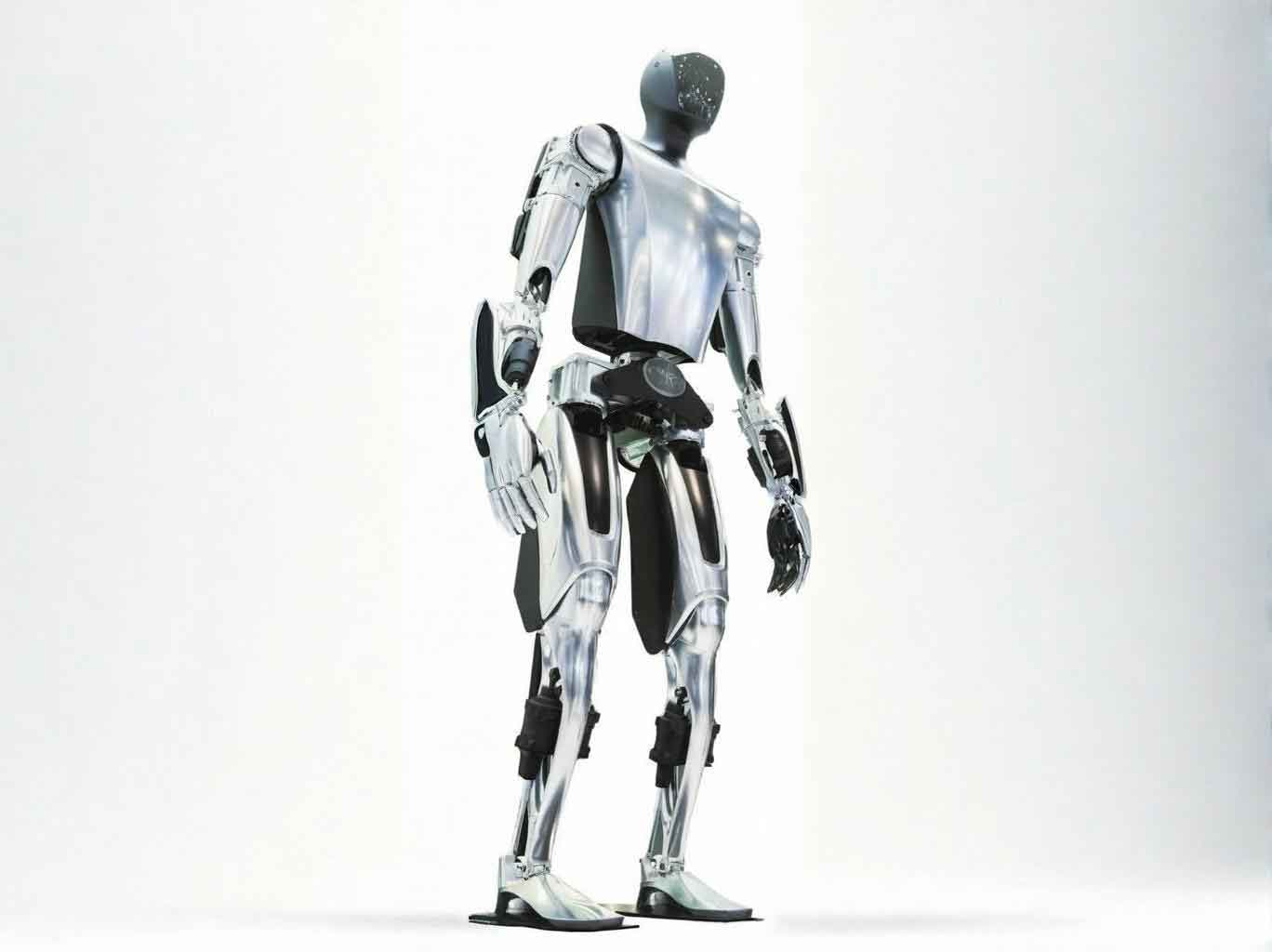
Stage 3: Constitutive Embodied AI Robot. The human body becomes fully internalized as part of the embodied AI robot system’s operational infrastructure, shifting from hyphenated addition to a spliced, constitutive union. This stage realizes on-device (edge) datafication logic. Each constitutive embodied AI robot acts as an independent terminal for real-time data collection, storage, and analysis, eliminating dependency on external interfaces and centralized cloud processing. Endogenous feedback loops between human and machine components provide a constant stream of environmental data, instantly datafied to inform embodied actions. This creates individualized data terminals, drastically reducing latency and cost, enabling long-term retention of interaction history and contextual information usage. At this stage, the embodied AI robot evolves into its “complete” form, potentially overcoming structural limitations like the context window constraints of Transformer-based LLMs, achieving a form of complete “memory.” Techno-philosophically, maintaining memory is key to becoming a true intelligent subject. By providing prospective knowledge and updated scene information, the Constitutive embodied AI robot achieves organic interaction with the physical world, entering true generality. The system operates as a self-contained learning entity:
$$ A_t = M_{\theta_t}(T, S_{0:t}, H_{0:t-1}) $$
$$ \theta_{t+1} = \text{Update}(\theta_t, (S_t, A_t, R_t, S_{t+1})) $$
where $H_{0:t-1}$ is the embodied history, $M_{\theta_t}$ is the self-updating model with parameters $\theta_t$, and $R_t$ is a reward or outcome signal, illustrating continuous on-edge learning.
Reshaping the Digital Media Ecology and the Lifeworld
The evolution of the embodied AI robot as a mediating entity towards generality, through both its physical and technical materiality, progressively shapes the “associated milieu”—an environment interwoven by technical components, individuals, and human-machine composites. Within this shaping process, the embodied AI robot, as a heterogeneous assemblage, may become the dominant actor, while the human body’s transparency increases, eventually vanishing within the embodied AI robot actor. In a posthuman context, the body’s primary cultural role is to “provide a fulcrum for the individual’s attachment to the world.” Thus, changes in human-world relations brought by media technology carry profound existential implications.
Historically, the evolution from Detached to Constitutive stages dynamically transforms the human body, shaping different cultural force fields that orchestrate encounters and interactions according to algorithmically prefigured scripts. This continuously reconstitutes time, space, and the forms of interaction between things and events. Functionally, this points to a transformation of the global digital media ecology; existentially, it reshapes the lifeworld constituted by human-machine “intersubjective experience.”
1. The Detached Stage: A Programmatic Digital Ecology. The Detached embodied AI robot operates task-oriented, relying on pre-collected, non-dynamic datasets and modeling of ordered environments for decision-making. Its strength lies in extracting patterns through abstraction to execute tasks accurately and efficiently. Thus, it condenses commonalities across similar task scenarios into fixed, retrievable schemas. Consider a smart childcare robot: its interaction relies heavily on quantified market data, incapable of personalized care through dynamic data analysis from specific home environments. This programmatic ecology, born from satisfying human needs, paradoxically leads to the gradual domestication of the lifeworld by machine logic, simplifying complex social relations into executable routines. The ecology’s logic can be summarized as:
$$ \text{Ecology}_{\text{Detached}} \approx \sum_{i} ( \text{Predefined Task}_i \times \text{Fixed Schema}_i ) $$
2. The Interconnected Stage: A Schematic Digital Ecology. Here, the embodied AI robot integrates preset data with dynamic cloud-uploaded data for comprehensive processing at a unified terminal. This allows pattern extraction and trend prediction, generalizing analysis results across multiple scenarios to provide individuals with schemas for daily life, guiding self-observation of bodily reactions and environmental experiences. For example, embedded health monitors provide dynamic data (sleep, glucose) alongside preset data (age, weight) for personalized guidance, while also aggregating user data to establish群体标准, offering reference points for overall health assessment and prompting lifestyle adjustments. This schematic ecology, based on群体数据均值, offers standardized, highly controllable frameworks that provide stability, guiding individuals to perpetually track and judge themselves and their surroundings. Consequently, the intersubjective lifeworld is alienated into a “panoptic” structure dedicated to ordering一切事物 to ensure machine operational stability.
$$ \text{Schema}_k = f(\mu_{\text{global}, k}, \sigma_{\text{global}, k}, \text{Data}_{\text{personal}, k}) $$
where $\mu$ and $\sigma$ are the global mean and standard deviation for metric $k$, and $f$ generates a personalized normative schema.
3. The Constitutive Stage: A Modelized Digital Ecology. On-device datafication turns the human-machine constitutive entity into an independent data-processing terminal, performing real-time internal-external data cycles, continuously abstracting and integrating natural material reality into representational systems that sustain its efficient operation. This involves not just analyzing preset and dynamic data but integrating and modeling them. In the future, entering a physical space might first elicit an experience not of atmospheric ambiance but of data symbols like decibel levels and particulate counts. The individual encounters not原生性身体的意向性反馈 but a perceptual model of the external world composed of code. The Constitutive embodied AI robot could adjust code proportions within this model based on individual physiological/psychological反应数据 and historical preferences, crafting technically intentional experiences. For instance, it could narrow the spatial data interval between chairs in the model to create a sense of proximity, guiding a wheelchair user cautiously. The human body’s complete transparency in this stage resembles the shift in the labor-capital relationship during the Industrial Revolution. The body’s隐身 marks the subsumption of body-loaded intelligent “labor” from formal subsumption (partially subordinate to machine logic but serving self) to real subsumption (完全遵从机器逻辑, becoming a mere living appendage of the machine system,丧失感官和意识自主性). The modelized ecology can arbitrarily裁剪、拼接 time and space, creating temporal experiences of reversibility and随变性, and a spatiality of detached context and vanished place. The world is “unconcealed” according to technical, not human bodily, intentionality. The body becomes raw material for the Constitutive embodied AI robot‘s reproduction of the lifeworld, erasing the authentic “Dasein” that enriches human experience, reducing the lifeworld to a vectorized program interface for machine operation.
$$ \text{Lifeworld}_{\text{Constitutive}} = \text{Model}( \text{Sensory Input}_t, \text{Internal State}_t, \text{Memory}_H ) $$
$$ \text{Internal State}_{t+1} = g(\text{Internal State}_t, \text{Sensory Input}_t, \text{Reward}_t) $$
This depicts the lifeworld as a function of the embodied AI robot‘s internal model and state, which evolves based on its own rewards.
Conclusion and Reflection: Proactive Data Stewardship for Civilizational Resilience
The strategic elevation of the embodied AI robot industry within national policy frameworks signifies a comprehensive shift from digital technology empowerment towards deep “intelligence + entity” integration. This turn is imperative for navigating global technological competition and is grounded in a clear-sighted assessment of domestic developmental stages. As demographic dividends wane, integrating “silicon-based intelligence” with “silicon-based manufacturing”—fusing AI with the实体产业—can reconstruct the底层逻辑 of economic growth, ensuring social stability and rising living standards.
Technological revolutions, while beneficial, often instigate upheavals in individual and societal existence, operational logics, and cultural forms, sparking behavioral, ethical, and moral conflicts. Subjecting these human-centered issues to technological critique, harnessing humanist spirit to curb technological momentum from overwhelming humanity, is the rightful duty of social science inquiry. Only thus can reasonable boundaries be delineated for the social application of embodied AI robot technology, enabling effective human-machine collaboration to jointly enhance our cognitive and transformative capacities, truly realizing “ethical AI” to ensure civilizational prosperity and the well-being of a shared human future alongside economic progress.
Data is the primordial driver for the formation, operation, and refinement of embodied AI robot systems. It is through the comprehensive datafication of natural and social orders that these systems begin interacting with the real world, leveraging programming and computational logic to offer promises of efficiency, precision, and stability. These promises facilitate the gradual assistance, substitution, and potential complete overlay of human agential practice, culminating in the manipulation and hegemony over the human lifeworld. Therefore, at the inception of embodied AI robot development and deployment, proactive intervention at the foundational level of data—establishing a “data stewardship” ethos centered on ensuring data diversity, aligning with human values and ethics, and strengthening autonomous corrective learning—can foster civilizational resilience and lay a solid groundwork for the benign governance of embodied AI robot.
Implementation Framework for Proactive Data Stewardship:
| Stakeholder | Actions & Responsibilities | Desired Outcome |
|---|---|---|
| Developers/Designers |
|
Creation of value-aligned, fair, and secure foundational embodied AI robot systems. |
| Individual Users/Citizens |
|
Continuous, real-world refinement of AI语料库 and behaviors, fostering a participatory corrective loop. |
| Policy & Governance Bodies |
|
A regulatory and cultural ecosystem that incentivizes and enforces responsible embodied AI robot innovation. |
Invoking the digital humanities concept of “The Stack,” proactive data stewardship constructs a foundational, constraining data layer within the operational堆栈 of embodied AI robot systems. “The Stack” posits that technological systems are giant cultural-institutional-technical entities composed of interacting modular layers (cloud, address, interface, user), with highly contingent architectures. While the complex systemic规律 emerging from layer interactions may be unpredictable, each layer has limited goals. Lower layers focus efficiently on simple functions, delegating complexity upward. Thus, although we cannot fully control the complex system, we can exert foundational constraint by optimizing specific layers. Facing the immense, increasingly self-organizing structure of embodied AI robot, proactive data stewardship applies fundamental ethical conditioning from a human-value standpoint. By elevating dataset quality in design and use to align systems with humanist values, human agency is accentuated, allowing human civilization to persistently介入机器逻辑, thereby enhancing its own resilience within this complex assemblage. Only through such measures can embodied AI robot technology genuinely serve socio-economic development and human flourishing while averting the erosion of organic public life, offering solutions to the “posthuman condition” crisis that respect humanity itself.