
In modern industrial applications, particularly in robotics, the RV reducer stands as a critical component due to its high precision and load-bearing capacity. As one of the three core technologies in robotics, the reliability and stability of the RV reducer directly impact the safety and performance of robotic systems. However, the complex structure of the RV reducer, comprising multiple interacting parts such as input shafts, planetary gears, crank shafts, cycloid gears, and needle rollers, often leads to significant noise interference during operation. This noise complicates fault diagnosis, as vibration signals are contaminated with irrelevant components, masking the characteristic frequencies associated with faults like those in needle rollers or gears. Traditional methods, such as wavelet transform or empirical mode decomposition, struggle with modal aliasing or parameter sensitivity, limiting their effectiveness in extracting weak fault features under heavy noise. Therefore, developing advanced signal processing techniques for accurate fault diagnosis of the RV reducer is imperative to prevent system failures and economic losses.
To address these challenges, I propose a novel fault diagnosis method that integrates Particle Swarm Optimization (PSO) with Variational Mode Decomposition (VMD) and Maximum Correlation Kurtosis Deconvolution (MCKD). This approach, termed PSO-VMD-MCKD, aims to enhance fault feature extraction by optimizing key parameters and suppressing noise. VMD adaptively decomposes signals into intrinsic mode functions (IMFs) with specific bandwidths, but its performance hinges on the decomposition level c and penalty factor α. Similarly, MCKD amplifies periodic fault impacts but requires careful selection of filter length L and shift parameter M. By employing PSO to optimize these parameters based on multi-scale permutation entropy (PME) as a fitness function, I ensure optimal decomposition and deconvolution. The process involves decomposing noisy vibration signals, selecting relevant IMFs using kurtosis criteria, applying MCKD to highlight fault impulses, and performing Hilbert envelope demodulation for frequency analysis. Through experimental validation on a faulty RV reducer, I demonstrate that this method effectively isolates fault characteristics, even under -5 dB Gaussian white noise, outperforming conventional techniques. This article details the methodology, experimental setup, and comparative analyses, providing a robust framework for RV reducer maintenance and diagnostics.
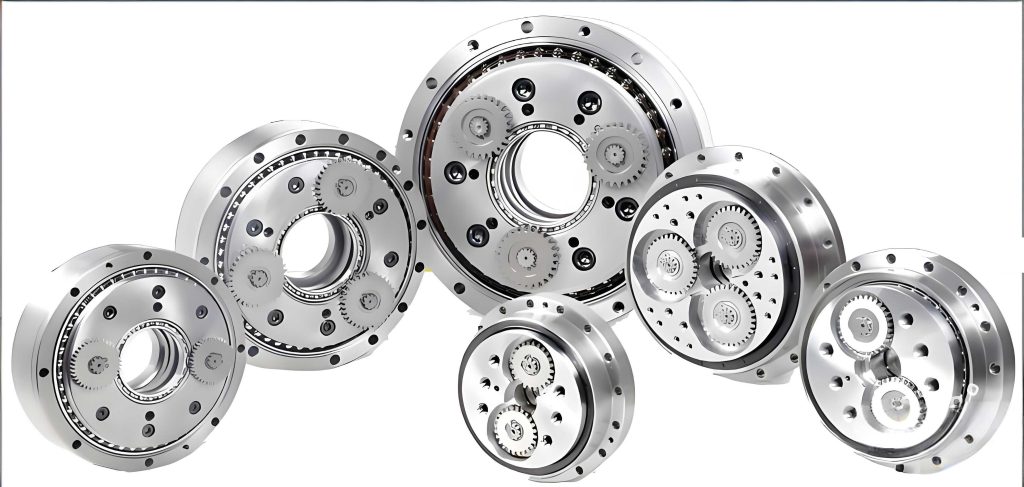
The RV reducer operates through a two-stage reduction mechanism. The first stage involves the input shaft driving planetary gears, while the second stage comprises cycloid gears engaging with needle rollers to produce output via a planetary carrier. This intricate design, while efficient, introduces multiple vibration sources that can obscure fault signals. For instance, a fault in the needle rollers generates characteristic frequencies calculable from the reducer’s geometry and operating conditions. Given an input speed n1, the input shaft frequency f1 is:
$$ f1 = \frac{n1}{60} $$
For a needle roller fault, the base frequency f2 depends on the gear teeth counts: z1 for the input shaft, z2 for the planetary gear, z3 for the cycloid gear, and z4 for the needle roller. The formula is:
$$ f2 = -\frac{(z4 – z3) z1}{z2 z4} f1 $$
In typical RV reducers, such as the one tested with a reduction ratio of 1:121 and output speed of 18 rpm, this yields a needle roller fault frequency around 30 Hz. However, in practice, vibration signals are often dominated by noise, making direct frequency analysis ineffective. The need for advanced denoising and feature enhancement techniques is clear, prompting the development of the PSO-VMD-MCKD method.
Variational Mode Decomposition (VMD) is a non-recursive signal processing technique that decomposes a signal f(t) into c discrete IMFs uc(t), each with a specific center frequency ωc. The goal is to minimize the sum of bandwidths for all modes, formulated as a constrained optimization problem:
$$ \min_{\{u_c\},\{\omega_c\}} \left\{ \sum_{c=1}^C \left\| \partial_t \left[ \left( \delta(t) + \frac{j}{\pi t} \right) * u_c(t) \right] e^{-j\omega_c t} \right\|_2^2 \right\} $$
subject to:
$$ \sum_{c=1}^C u_c(t) = f(t) $$
Here, ∂t denotes the partial derivative with respect to time, δ(t) is the Dirac delta function, j is the imaginary unit, and * represents convolution. VMD effectively separates signal components without modal aliasing, but its success relies on appropriate choices for c and α. An overly high c may lead to over-decomposition, while a low c might miss fault information. Similarly, α controls the bandwidth of each IMF; improper selection can blur fault features. To automate this, I use Particle Swarm Optimization (PSO), a metaheuristic algorithm inspired by bird flocking behavior. PSO searches for optimal parameters by iteratively updating particle positions based on personal and global best solutions. The position update for each particle i in dimension d is:
$$ v_{id}^{t+1} = \omega v_{id}^t + c_1 r_1 (p_{id} – x_{id}^t) + c_2 r_2 (g_d – x_{id}^t) $$
$$ x_{id}^{t+1} = x_{id}^t + v_{id}^{t+1} $$
where v is velocity, x is position, ω is inertia weight, c1 and c2 are acceleration coefficients, r1 and r2 are random numbers, p is the personal best, and g is the global best. For VMD parameter optimization, I define the search space for c as [2, 20] and α as [100, 4000], with PME as the fitness function to minimize, ensuring an optimal balance between mode separation and noise rejection.
After VMD decomposition, the signal is split into IMFs, among which the most relevant to faults must be selected. Kurtosis, a statistical measure of peakiness, serves as a criterion for this selection. For a signal x, kurtosis K is defined as:
$$ K = \frac{E[(x – \mu)^4]}{\sigma^4} $$
where E is the expectation, μ is the mean, and σ is the standard deviation. Higher kurtosis values indicate more pronounced impulses, typical of fault impacts. I compute kurtosis for each IMF and choose the one with the maximum value for further processing. This step ensures that the subsequent deconvolution focuses on the component richest in fault information.
Maximum Correlation Kurtosis Deconvolution (MCKD) enhances periodic fault impulses by designing a finite impulse response (FIR) filter that maximizes the correlation kurtosis of the output signal. Given an input signal y(n), MCKD seeks a filter f(l) of length L to produce an output x(n):
$$ x(n) = \sum_{l=1}^L f(l) y(n-l+1) $$
The correlation kurtosis CK_M is defined for a period T and shift M:
$$ CK_M = \frac{\sum_{n=1}^N \left( \prod_{m=0}^M x(n – mT) \right)^2}{\left( \sum_{n=1}^N x(n)^2 \right)^{M+1}} $$
MCKD optimizes f(l) to maximize CK_M, thereby accentuating periodic impacts. However, the filter length L and shift parameter M significantly influence performance. To determine optimal values, I again employ PSO, with L in [100, 500] and M in [1, 8], using PME as the fitness function. This optimization tailors MCKD to the specific fault characteristics of the RV reducer, improving deconvolution accuracy.
The integrated PSO-VMD-MCKD method follows a systematic workflow. First, PSO optimizes VMD parameters [c, α] based on the noisy vibration signal. Next, VMD decomposes the signal into IMFs, and the IMF with highest kurtosis is selected. Then, PSO optimizes MCKD parameters [L, M] for this IMF. MCKD is applied to enhance fault impulses, followed by Hilbert transform for envelope demodulation and spectral analysis. This pipeline robustly extracts fault features even under severe noise, as demonstrated in the following experimental validation.
For experimental testing, I used a specialized test rig for RV reducers, incorporating a servo motor, couplings, and vibration sensors. The RV reducer had a needle roller fault, with parameters summarized in Table 1. Vibration data were collected along the X-axis at a sampling frequency fs of 25.6 kHz, with 100,000 data points. To simulate realistic noise conditions, I added -5 dB Gaussian white noise to the signals, challenging the diagnostic method.
| Component | Number of Teeth |
|---|---|
| Input Shaft | 12 |
| Planetary Gear | 36 |
| Cycloid Gear | 39 |
| Needle Roller | 40 |
The theoretical needle roller fault frequency f2 was calculated as 30 Hz based on the formulas above. Initial time-domain and frequency-domain analyses of the noisy signal showed no clear fault indicators, highlighting the need for advanced processing. Applying PSO-VMD, I obtained optimal parameters [c=10, α=1533]. VMD decomposition yielded 10 IMFs, with kurtosis values listed in Table 2. IMF2 had the highest kurtosis (3.844), indicating it contained the most significant fault information.
| IMF Component | Kurtosis Value |
|---|---|
| IMF1 | 2.873 |
| IMF2 | 3.844 |
| IMF3 | 2.818 |
| IMF4 | 2.519 |
| IMF5 | 2.347 |
| IMF6 | 2.163 |
| IMF7 | 1.964 |
| IMF8 | 1.756 |
| IMF9 | 1.258 |
| IMF10 | 1.097 |
Frequency analysis of IMF2 revealed a peak near 30 Hz, but with interference at harmonics, limiting diagnostic confidence. Subsequently, PSO optimized MCKD parameters to [L=432, M=7]. Applying MCKD to IMF2 produced a time-domain signal with clear periodic impulses. Envelope spectrum analysis then showed distinct peaks at 30.2077 Hz, 60.4154 Hz, and 89.5991 Hz, corresponding to the fault base frequency and its harmonics. These results align closely with theoretical predictions, confirming the RV reducer’s needle roller fault and demonstrating the method’s efficacy in noise suppression.
To validate superiority, I conducted a comparative experiment using PSO-optimized MCKD alone (without VMD). With parameters [L=458, M=7], the envelope spectrum only displayed peaks at 30.2077 Hz and 60.4154 Hz, with the third harmonic obscured by noise. This contrast underscores the advantage of combining VMD for denoising with MCKD for feature enhancement, as the integrated approach extracts more complete fault information. The PSO-VMD-MCKD method consistently outperforms standalone techniques in handling noisy RV reducer signals.
The effectiveness of this method stems from several factors. First, PSO automates parameter selection, overcoming the trial-and-error pitfalls of manual tuning. Second, VMD adaptively decomposes signals, preserving fault features while reducing noise. Third, MCKD amplifies periodic impacts, making faults more detectable. The use of kurtosis for IMF selection further refines the process. For RV reducers operating in variable conditions, such as changing speeds or loads, this method can be extended by incorporating order tracking or adaptive thresholds. Future work may explore deep learning integrations for real-time monitoring of RV reducer health.
In conclusion, the PSO-VMD-MCKD method offers a robust solution for fault diagnosis in RV reducers, particularly under noisy environments. By optimizing VMD and MCKD parameters via PSO, it enhances fault feature extraction and improves diagnostic accuracy. Experimental results confirm its ability to identify needle roller faults with clear harmonic patterns, surpassing conventional methods. This approach contributes to the reliability and maintenance of robotic systems, ensuring the RV reducer’s critical role in industrial automation is supported by advanced diagnostics. As the demand for precision robotics grows, such techniques will become increasingly vital for predictive maintenance and fault prevention.