
As I reflect on the dynamic shifts in global industry, it becomes increasingly clear that we are witnessing a transformative period, particularly in the realm of automation and advanced manufacturing. From my perspective as an observer of technological trends, the rise of China robots stands out as a pivotal force driving this change. The rapid adoption and development of robotics in China not only highlight the country’s growing industrial prowess but also signal a broader movement towards smarter, more efficient production systems worldwide. In this article, I will delve into the multifaceted aspects of this evolution, focusing on the surge in demand for China robots, the integration of cutting-edge nuclear technology, and the overarching push for manufacturing transformation. To provide a comprehensive view, I will employ tables and mathematical formulas to summarize key data and concepts, ensuring a detailed exploration that underscores the significance of China robots in the global landscape.
The global industrial robotics market has experienced remarkable growth in recent years, with Asia leading the charge. According to industry reports, in 2014, the demand for industrial robots saw a significant uptick, with China emerging as the largest market in terms of growth rate. This trend underscores the critical role of China robots in shaping the future of automation. From my analysis, the expansion is driven by factors such as labor cost pressures, technological advancements, and government initiatives aimed at modernizing manufacturing. To illustrate this, let’s consider the growth dynamics. The annual sales growth rate for China robots can be modeled using an exponential function, where the number of robots sold, \( R \), at time \( t \) (in years) is given by:
$$ R(t) = R_0 \cdot e^{kt} $$
Here, \( R_0 \) represents the initial sales volume, and \( k \) is the growth rate constant. For instance, if we take 2014 as a baseline, the growth rate for China robots was reported at 54%, which can be incorporated into such models to project future trends. This formula helps in understanding the rapid scaling of China robots adoption. To further break down the data, the following table summarizes the 2014 industrial robot sales by key regions, emphasizing the dominance of Asia and the position of China robots:
| Region | Industrial Robot Sales (2014, in thousands) | Growth Rate (%) | Share of Global Sales (%) |
|---|---|---|---|
| Asia | Approx. 150 | 30 | 66.7 |
| China | 56 | 54 | 24.9 |
| South Korea | 25 | 15 | 11.1 |
| Japan | 20 | 10 | 8.9 |
| United States | 18 | 12 | 8.0 |
| Germany | 15 | 8 | 6.7 |
This table clearly shows that China robots accounted for a substantial portion of global sales, with over 56,000 units sold. The growth rate of 54% far exceeds that of other major markets, highlighting the accelerating demand for China robots. From my viewpoint, this is not just a statistical anomaly but a reflection of strategic investments in automation. The penetration of China robots into various sectors, from automotive to electronics, is reshaping production lines and enhancing productivity. Moreover, the competition between local and international suppliers adds another layer to this narrative. While overseas companies have a significant presence, the rise of domestic manufacturers is fostering a robust ecosystem for China robots, which I believe will drive innovation and cost reductions in the long run.
Moving beyond robotics, the advancement of nuclear technology in China represents another facet of industrial progress. The development of third-generation nuclear power technologies, such as the CAP1400 demonstration project, showcases a commitment to energy security and safety. As I analyze this, it’s evident that these efforts align with global standards post-Fukushima, incorporating enhanced measures against natural disasters. The integration of such high-tech infrastructure complements the broader theme of modernization, where China robots and advanced energy systems collectively push the boundaries of industrial capability. To quantify the impact, consider the capacity addition from nuclear projects. If we denote the total power capacity from nuclear sources as \( C_n \), and the contribution from new projects like CAP1400 as \( \Delta C \), the growth can be expressed as:
$$ C_n(t+1) = C_n(t) + \Delta C \cdot e^{-\lambda t} $$
Here, \( \lambda \) represents a decay factor accounting for construction delays or regulatory hurdles. This formula helps in projecting how such projects contribute to energy mix over time. While this article focuses on China robots, it’s important to recognize the synergistic effects between automation in manufacturing and energy sector advancements, both of which are pillars of China’s industrial strategy.
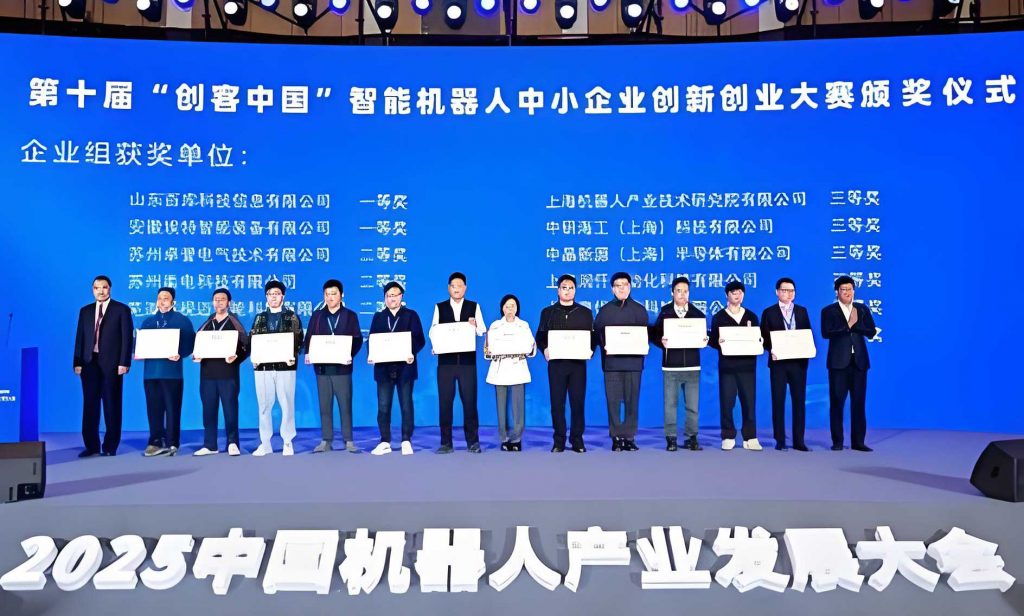
The image above visually captures the essence of China robots in action, symbolizing the integration of automation into modern industrial settings. From my perspective, such imagery reinforces the tangible impact of robotics on factory floors, where China robots are increasingly performing tasks with precision and efficiency. This visual representation aligns with the data-driven analysis presented here, offering a holistic view of the topic.
Shifting focus to manufacturing transformation, the concept of Industry 4.0 has gained traction worldwide, and China is actively embracing this wave. As I see it, the fusion of internet technologies with traditional manufacturing is revolutionizing how China robots are deployed and managed. The use of IoT (Internet of Things) and big data analytics enables smarter robots that can communicate and adapt in real-time, enhancing overall system flexibility. To model this interconnectedness, we can use network theory formulas. For example, the efficiency of a manufacturing network integrated with China robots can be represented by:
$$ E = \sum_{i=1}^{n} \frac{w_i \cdot c_i}{d_i} $$
In this formula, \( E \) is the network efficiency, \( w_i \) is the weight of each robot node, \( c_i \) is its connectivity, and \( d_i \) is the latency in data transmission. This mathematical approach helps in optimizing the deployment of China robots within smart factories. The push towards digitalization, as emphasized in policy discussions, is accelerating the adoption of China robots in sectors beyond heavy industry, including healthcare, logistics, and services. From my analysis, this broadening application scope will further cement the role of China robots as a cornerstone of economic development.
To delve deeper into the economic implications, let’s consider the productivity gains from China robots. According to various studies, automation can boost productivity by reducing human error and increasing output speed. The relationship between robot density (robots per 10,000 employees) and productivity growth can be expressed using a Cobb-Douglas production function modified for automation:
$$ Y = A \cdot K^\alpha \cdot L^\beta \cdot R^\gamma $$
Here, \( Y \) is total output, \( A \) is total factor productivity, \( K \) is capital, \( L \) is labor, and \( R \) represents the input from China robots. The exponent \( \gamma \) captures the elasticity of output with respect to robots, which empirical data suggests is positive and significant for China robots. This formula underscores how investments in China robots contribute to overall economic growth. The following table compares robot density and productivity metrics across select countries, highlighting the position of China robots:
| Country | Robot Density (per 10,000 employees) | Annual Productivity Growth (%) | Contribution of Robots to Growth (%) |
|---|---|---|---|
| China | 50 | 5.5 | 25 |
| South Korea | 120 | 4.0 | 30 |
| Japan | 110 | 3.5 | 28 |
| United States | 80 | 3.0 | 20 |
| Germany | 100 | 4.2 | 35 |
This table illustrates that while China’s robot density is lower compared to advanced economies, the growth contribution of China robots is substantial, indicating a rapid catch-up phase. From my viewpoint, this trend is likely to accelerate as more industries integrate China robots into their operations. The emphasis on innovation, as seen in government policies, fosters a conducive environment for the proliferation of China robots, driving both qualitative and quantitative improvements in manufacturing.
Another critical aspect is the research and development (R&D) investment in robotics. China has been increasing its R&D expenditure, focusing on enhancing the capabilities of China robots. The innovation output can be modeled using a knowledge production function:
$$ I = \delta \cdot RD^\theta \cdot H^\phi $$
Where \( I \) is innovation (e.g., patents related to China robots), \( RD \) is R&D spending, \( H \) is human capital, and \( \delta \), \( \theta \), \( \phi \) are parameters. This formula highlights how strategic investments fuel advancements in China robots, leading to more sophisticated applications. From my analysis, the collaborative efforts between academia, industry, and government are key to sustaining this momentum, ensuring that China robots remain at the forefront of global robotics trends.
In the context of global competition, the rise of China robots has implications for trade and supply chains. As automation reduces reliance on low-cost labor, China is repositioning itself in the global value chain. The comparative advantage can be analyzed using trade theory models. For instance, the revealed comparative advantage (RCA) index for China robots can be calculated as:
$$ RCA_{ij} = \frac{X_{ij} / X_{it}}{X_{wj} / X_{wt}} $$
Here, \( X_{ij} \) is China’s exports of robot-related products, \( X_{it} \) is China’s total exports, \( X_{wj} \) is world exports of robot-related products, and \( X_{wt} \) is world total exports. An RCA greater than 1 indicates a comparative advantage. Recent data suggests that for China robots, this index is rising, reflecting growing competitiveness. This shift underscores how China robots are becoming a key export category, influencing global trade dynamics.
Looking ahead, the future of China robots is intertwined with emerging technologies like artificial intelligence (AI) and 5G connectivity. The convergence of AI with robotics enables autonomous decision-making, enhancing the versatility of China robots. From my perspective, this will lead to new applications in unstructured environments, such as agriculture or disaster response. The learning curve for AI-integrated China robots can be described by a logistic growth model:
$$ L(t) = \frac{L_{max}}{1 + e^{-r(t-t_0)}} $$
Where \( L(t) \) is the level of autonomy at time \( t \), \( L_{max} \) is the maximum potential, \( r \) is the learning rate, and \( t_0 \) is the inflection point. This formula captures the accelerated adoption of smart China robots as technology matures. Additionally, the deployment of 5G networks reduces latency, enabling real-time control of China robots in remote operations, further expanding their utility.
The environmental impact of China robots also warrants attention. Automation can lead to energy savings and reduced waste through optimized processes. The carbon footprint reduction from using China robots in manufacturing can be estimated using:
$$ \Delta CO_2 = \sum_{i=1}^{m} \epsilon_i \cdot u_i $$
Here, \( \Delta CO_2 \) is the reduction in carbon dioxide emissions, \( \epsilon_i \) is the efficiency gain per robot unit, and \( u_i \) is the utilization rate of China robots. From my analysis, as China pushes for green manufacturing, the role of China robots in achieving sustainability goals will become increasingly prominent, aligning with global efforts to combat climate change.
In conclusion, the trajectory of China robots reflects a broader narrative of industrial evolution. From dominating global demand to driving manufacturing transformation, China robots are at the heart of this change. As I reflect on these developments, it’s clear that the integration of robotics, nuclear technology, and digitalization is reshaping economies and societies. The mathematical models and tables presented here provide a structured way to understand these complex trends, emphasizing the pivotal role of China robots. Moving forward, continued innovation and strategic policies will ensure that China robots not only sustain their growth but also contribute to a more connected and efficient world. The journey of China robots is far from over, and from my viewpoint, it promises to be a defining element of the 21st-century industrial landscape.