
FOSHAN, September 2, 2026 — The 2026 AI + Future Industry Innovation Conference (Shunde Sub-venue) and the Shunde Intelligent Robot Application Conference opened at the Tanzhou International Convention and Exhibition Center, bringing together a panoramic display of robots, core components, software systems, and application scenarios. The exhibition did not present robotics as a collection of isolated machines. Instead, it placed reducers, servo motors, sensors, dexterous hands, robot dogs, humanoid robot platforms, automated guided vehicles, and service robots into one connected industrial landscape. The result was a clear view of how the humanoid robot is moving from a compelling exhibition concept into a practical node within a broader robotics supply chain.
Inside the exhibition hall, a wheeled humanoid robot moved through a demonstration area, turning, avoiding obstacles, and stopping smoothly. Its motions were fluid and controlled, drawing attention from visitors who stopped to watch how the machine negotiated the space around it. Nearby, a coffee robot booth attracted a long queue. A mechanical arm precisely grasped a handle, extracted coffee, steamed milk, and created latte art. In about two minutes, a cup of latte with a tulip pattern was handed to a visitor. The scene captured the dual character of the current robotics wave: the humanoid robot represents the ambitious frontier of embodied intelligence, while the coffee workstation shows how robotic manipulation can already deliver a visible, repeatable service experience.
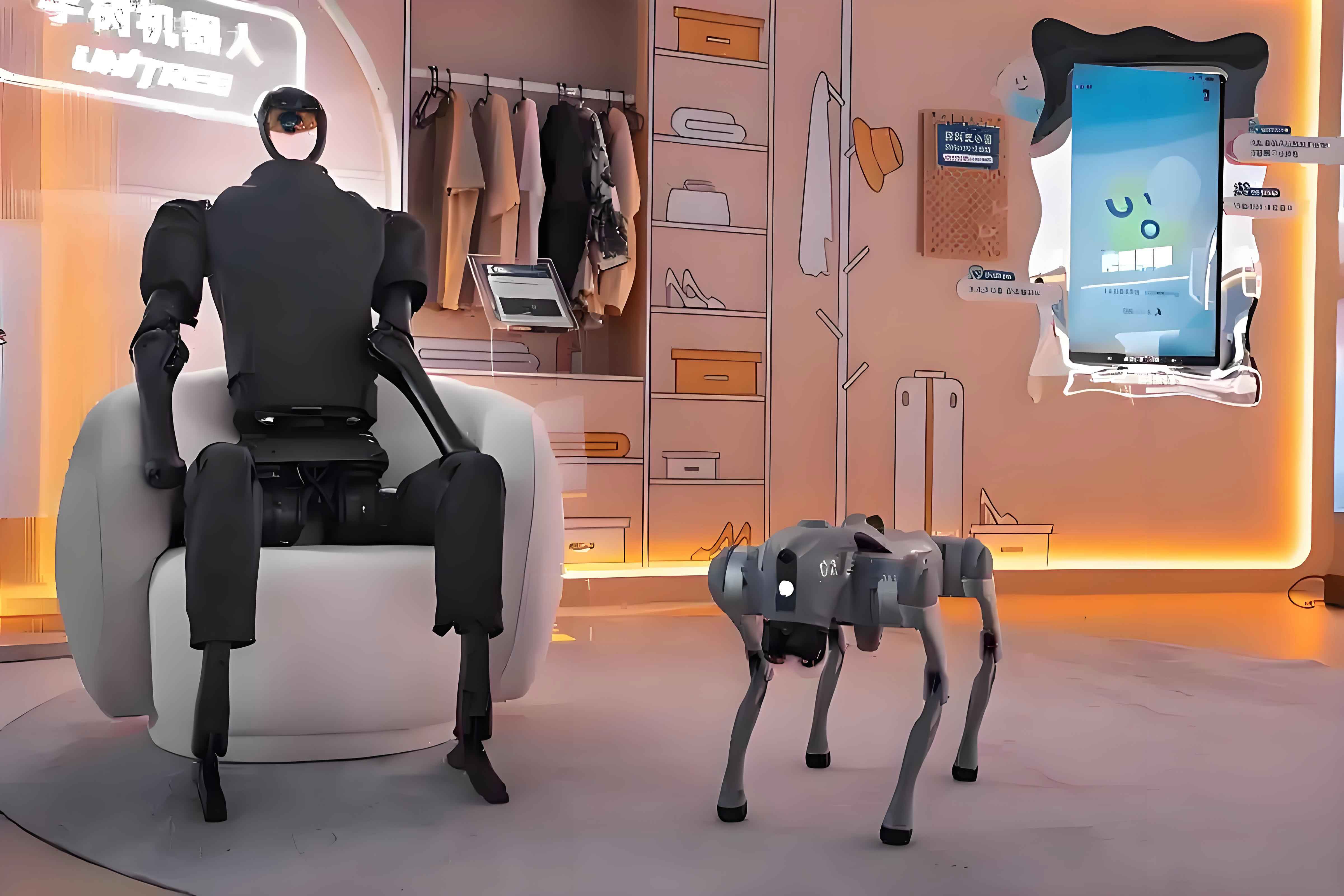
The significance of the exhibition came from its range. From core parts to complete machines, from industrial handling to public-facing services, the display showed a robot industry chain that is becoming deeper and more integrated. The humanoid robot was not treated as a standalone spectacle. It appeared as one part of a larger system that includes mobility platforms, sensing, motion control, precision transmission, heavy-load transport, and application engineering. That integrated view is important because the humanoid robot depends on advances across many layers at once: the humanoid robot needs reliable joints, efficient actuators, stable power, robust perception, and intelligent planning, and it also needs real application scenarios in which those capabilities can be tested and refined.
- From Components to Complete Machines: A Full-Chain View
The exhibition presented a chain that begins with reducers, servo motors, and sensors and extends to dexterous hands, robot dogs, humanoid robot platforms, and complete application systems. This structure matters for the humanoid robot sector because it shows that the humanoid robot is not only a design challenge. It is also a manufacturing challenge, a supply chain challenge, and an application challenge. A humanoid robot can only become reliable when its core components are stable, its motion control is precise, and its software can adapt to real environments. The presence of component makers alongside complete-machine developers suggests that the humanoid robot industry in Foshan is being built on industrial foundations rather than on presentation alone.
For visitors, the full-chain layout made the humanoid robot easier to understand. A humanoid robot may appear to be a single product, but behind it are multiple technology layers. The transmission system determines joint strength and precision. Servo motors influence responsiveness and control. Sensors provide the data that allow the humanoid robot to perceive its surroundings. Dexterous hands expand what the humanoid robot can manipulate. Mobility platforms determine where the humanoid robot can go. Application systems determine what the humanoid robot can actually do in a factory, a port, a hospital, or a commercial building. The exhibition connected these layers in a way that made the humanoid robot feel less like a distant prototype and more like the visible tip of an emerging industrial system.
The display also showed that the humanoid robot agenda is not developing in isolation from other robot forms. Robot dogs, wheeled platforms, mechanical arms, and automated guided vehicles all contribute technologies that can feed into humanoid robot development. A quadruped robot may share actuators, sensors, and control logic with a humanoid robot. A wheeled chassis may provide a stable mobility base for a humanoid robot designed for indoor service. A mechanical arm used in a coffee workstation may contribute manipulation experience that later informs humanoid robot hands and arms. In this sense, the humanoid robot is both a product category and an integration point for a wider robotics ecosystem.
Table: Full-Chain Robot Display and Its Relevance to Humanoid Robot Development
| Layer | What Was Shown | Reported Capability or Role | Relevance to the Humanoid Robot Ecosystem |
|---|---|---|---|
| Core components | Reducers, servo motors, sensors | Foundational parts for robot motion, control, and perception | Provide the mechanical and sensing base on which a humanoid robot depends |
| Manipulation hardware | Dexterous hands and mechanical arms | Precision grasping and programmed motion | Support humanoid robot manipulation and service tasks |
| Mobility platforms | Wheeled humanoid robot chassis, robot dogs, tracked vehicles | Turning, obstacle avoidance, emergency stopping, rough-terrain movement | Expand where a humanoid robot or embodied system can operate |
| Complete machines | Humanoid robot platforms, robot dogs, coffee workstations, loading robots | Application-oriented systems for factories, ports, buildings, and containers | Create real scenarios for humanoid robot testing and iteration |
| Application integration | Industrial handling, port transfer, beverage service, container loading | Deployment in repetitive, heavy, hot, or service-intensive work | Demonstrate how humanoid robot technology can be commercialized through focused use cases |
The table reflects a key insight from the exhibition: the humanoid robot is not simply a machine that looks like a person. It is an integration of mobility, manipulation, perception, and decision-making. Each layer shown at the event contributes to that integration. The presence of core components and application systems in the same exhibition space made the humanoid robot value chain visible and demonstrated that progress in one layer can accelerate progress in another.
- Jaten Robot and the Mobility Foundation for Humanoid Robot Platforms
At the Jaten Robot exhibition area, Chen Hongbo, vice president of the company, pointed to a running embodied intelligent chassis and described a long-standing focus. He said the company has spent more than 20 years doing one thing: using robots to carry materials for people around the world. That focus was visible in the company’s new humanoid robot general embodied intelligent chassis. The platform uses four omnidirectional wheels, and its movement trajectory has removed what the company described as the concept of direction. The result is a mobility base that can move flexibly and precisely in confined or dynamic environments.
The significance of this chassis for the humanoid robot field is practical. Many humanoid robot designs face a trade-off between stability, payload, endurance, and agility. A wheeled humanoid robot may not need to walk on two legs for every task. In indoor factories, warehouses, hospitals, and commercial spaces, a stable wheeled base can provide efficient movement while allowing the upper body to focus on manipulation and interaction. The Jaten platform shows how a humanoid robot can benefit from a mobility foundation that is already engineered for smooth turning, obstacle avoidance, and precise stopping. For a humanoid robot intended for repetitive industrial or service tasks, such a base can improve reliability and reduce the complexity of whole-body control.
Jaten also presented a 70-ton unmanned transport vehicle that has completed a real-world pilot at Rongqi Port. Chen Hongbo described the vehicle with three points: it has no cab, it has no driver, and its steering is more flexible than that of a human-driven vehicle. The machine relies on 5G-A communication and GNSS multi-sensor fusion positioning. It has multiple driving modes, including full figure-eight and diagonal movement, and it provides a domestic solution for unmanned container transfer in smart ports. Although this vehicle is not itself a humanoid robot, its technology demonstrates the same industrial direction that supports humanoid robot development: perception, localization, motion planning, and robust control in complex environments.
The connection between port automation and humanoid robot development may not be obvious at first, but it is substantial. A 70-ton unmanned transport vehicle must perceive its position, plan safe routes, and operate continuously in a busy industrial environment. A humanoid robot working in a factory or a logistics center must solve related problems at a smaller scale. Both require reliable sensing, real-time decision-making, and safe interaction with infrastructure and people. The port pilot therefore adds credibility to the local robotics ecosystem and shows that companies are testing autonomy in demanding real-world conditions, not only in laboratory demonstrations.
Table: Jaten Robot Exhibits and Reported Capabilities
| Exhibit | Reported Specification | Reported Application Direction | Link to Humanoid Robot Development |
|---|---|---|---|
| Humanoid robot general embodied intelligent chassis | Four omnidirectional wheels; flexible and precise trajectory control | General embodied intelligence platform | Provides a stable mobility base for a wheeled humanoid robot |
| 70-ton unmanned transport vehicle | No cab; no driver; steering described as more flexible than human driving; 5G-A communication; GNSS multi-sensor fusion positioning; full figure-eight and diagonal driving modes | Smart port container transfer; completed real-world pilot at Rongqi Port | Demonstrates autonomous navigation and control technologies relevant to humanoid robot mobility |
| Company focus | More than 20 years in robotic material handling | Using robots to carry materials for global users | Shows long-term industrial experience that can support humanoid robot commercialization |
The Jaten display illustrated a central theme of the event: the humanoid robot does not emerge from a single breakthrough. It emerges from the accumulation of many engineering capabilities. A humanoid robot needs a mobility system that can operate safely, a control system that can respond in real time, and an application layer that can deliver value. Jaten’s embodied intelligent chassis and its heavy-load port vehicle represent two ends of that capability spectrum. One points toward flexible indoor humanoid robot mobility, and the other demonstrates autonomous heavy transport in a complex outdoor environment.
- Kepler Robot’s Humanoid Robot “Bumblebee” Enters Real Production Lines
Kepler Robot brought a humanoid robot named “Bumblebee” that attracted many representatives from manufacturing enterprises. The humanoid robot has a dual-arm payload of 30 kilograms and can work for eight hours after one hour of charging. These specifications position it as an industrial humanoid robot rather than a demonstration-only platform. According to the exhibition information, the humanoid robot has already been deployed on real production lines in multiple factories, where it handles transport and assembly tasks. That deployment is significant because it moves the humanoid robot conversation from potential to practice.
The event also marked the first high-profile appearance of the humanoid robot after Kepler Robot’s national production, manufacturing, and industry development center landed in Shunde. Song Hua, CEO of Kepler Robot, said that the company’s manufacturing base in Beijiao has started operation and is planned to produce between 1,000 and 5,000 units per year. For the humanoid robot sector, this production plan is an important signal. It suggests that the humanoid robot is being approached as a manufactured product with a supply chain, a production process, and a capacity plan, not merely as a research prototype.
The Bumblebee humanoid robot’s reported payload and endurance are relevant to industrial use cases. A dual-arm payload of 30 kilograms allows the humanoid robot to handle a range of components and materials in factory settings. An eight-hour working period after a one-hour charge aligns with the rhythm of many industrial shifts. These are not abstract performance figures. They describe how a humanoid robot might be scheduled, recharged, and integrated into production planning. When a humanoid robot can work for a full shift and carry meaningful loads, it becomes easier for manufacturers to evaluate where the humanoid robot can complement existing automation.
The deployment of the Bumblebee humanoid robot in multiple factories also highlights the role of real production lines in humanoid robot development. Factories provide controlled but demanding environments. They have defined tasks, measurable cycle times, safety requirements, and repetitive workflows. A humanoid robot operating in such an environment can generate data that improves grasping, path planning, and task execution. The humanoid robot does not need to solve every problem at once. It can start with transport and assembly tasks and gradually expand its capabilities as reliability improves. This step-by-step approach is often more practical than trying to create a universal humanoid robot from the beginning.
Table: Kepler Robot’s Humanoid Robot “Bumblebee” and Reported Specifications
| Item | Reported Detail | Industrial Meaning | Humanoid Robot Significance |
|---|---|---|---|
| Product | Humanoid robot named “Bumblebee” | Industrial humanoid robot platform | Places the humanoid robot in real manufacturing discussions |
| Payload | Dual-arm payload of 30 kilograms | Supports handling of substantial components and materials | Expands the humanoid robot’s potential tasks in factories |
| Endurance | One hour of charging supports eight hours of work | Matches a typical industrial shift pattern | Improves the humanoid robot’s usability in continuous production |
| Deployment | Already working on real production lines in multiple factories | Transport and assembly tasks | Provides real-world data for humanoid robot iteration |
| Production plan | Manufacturing base in Beijiao has started operation; planned annual output of 1,000 to 5,000 units | Signals movement toward manufactured scale | Supports the humanoid robot’s transition from prototype to product |
The Bumblebee humanoid robot also demonstrates why the humanoid robot form factor matters in industrial settings. Factories are often built around human workflows, tools, and spaces. A humanoid robot can, in principle, use existing tools and move through environments designed for people. That flexibility is valuable where fixed automation is difficult to justify or where product lines change frequently. The humanoid robot does not replace all dedicated machines. Instead, it can fill gaps that require mobility, manipulation, and adaptability. The reported deployment of the Bumblebee humanoid robot on real production lines is a practical test of that proposition.
- Qilin Quadruped Robot and the Shared Hardware Logic of Embodied Systems
In addition to the Bumblebee humanoid robot, Kepler Robot presented the Qilin heavy-load flatbed quadruped robot, described as the world’s first quadruped robot with a hybrid architecture. The Qilin platform uses self-developed planetary roller screw core hardware across its product line, a design choice intended to ensure industrial-grade reliability and heavy-load capability from the hardware level. The quadruped robot can walk continuously for eight hours after one charge and has an IP67 protection rating. These capabilities allow it to operate in all-weather security inspection, outdoor heavy material transfer, and other complex conditions.
Although the Qilin is a quadruped robot rather than a humanoid robot, its technology is closely related to humanoid robot development. Both a quadruped robot and a humanoid robot require efficient actuators, robust joints, reliable power systems, and intelligent control. The planetary roller screw hardware mentioned by Kepler Robot is an example of a core component that can influence the performance of legged machines. For the humanoid robot, leg joints and arm joints must handle repeated loads while maintaining precision. Advances in transmission hardware therefore have direct implications for humanoid robot durability and payload capacity.
The Qilin quadruped robot’s eight-hour endurance and IP67 protection also show how embodied systems are being designed for real working conditions. A humanoid robot intended for outdoor or industrial use will face similar requirements. It may need to operate in dust, rain, heat, or uneven terrain. It may need to work for a full shift and then recharge quickly. The fact that these requirements are already being addressed in quadruped robot platforms suggests that the component base for humanoid robot development is maturing. The humanoid robot can benefit from hardware and control technologies proven in other legged robot forms.
Table: Qilin Quadruped Robot and Reported Capabilities
| Feature | Reported Detail | Application Relevance | Connection to Humanoid Robot Technology |
|---|---|---|---|
| Platform type | Quadruped robot with hybrid architecture; heavy-load flatbed version | Industrial and outdoor embodied mobility | Shares legged locomotion and actuator challenges with the humanoid robot |
| Core hardware | Self-developed planetary roller screw core hardware | Industrial-grade reliability and heavy-load capability | Relevant to humanoid robot joint durability and precision |
| Endurance | Eight hours of continuous walking after one charge | Long-duration inspection and transfer tasks | Supports the humanoid robot requirement for full-shift operation |
| Protection | IP67 rating | All-weather security inspection and outdoor heavy material transfer | Indicates hardware readiness for demanding humanoid robot environments |
The Qilin quadruped robot adds another dimension to the event’s humanoid robot narrative. It shows that the same industrial ecosystem is developing multiple forms of embodied intelligence. A humanoid robot may be the most visible expression of that trend, but quadruped robots, wheeled platforms, and mechanical arms all contribute to the same technology pool. The humanoid robot is therefore part of a broader wave of machines that combine mobility, perception, and task execution. This broader wave is likely to produce shared suppliers, shared software tools, and shared engineering talent, all of which can accelerate humanoid robot progress.
- Xinbao Electric and Service Robotics: Manipulation Moves Into Everyday Spaces
On another side of the exhibition area, Xinbao Electric, a leading home appliance company, presented a self-developed mechanical arm coffee workstation. The system uses self-produced core modules in the ice maker, coffee machine, and milk frother. Engineers studied the hand movements of a barista and encoded the latte art motion into a program. The company has applied for seven related patents. Li Xia, director of the first research office at the Xinbao Electric Research Institute, said the mechanical arm coffee workstation can easily go upstairs and be placed in office buildings, hospitals, and government parks.
This exhibit is relevant to the humanoid robot field because it demonstrates the commercialization of manipulation in a service context. A humanoid robot intended for service work will need to perform precise hand movements, interact with machines, and operate in spaces designed for people. The coffee workstation shows that robotic manipulation can be packaged into a compact, mobile, and user-friendly system. It also shows the value of programming by imitating human motion. The engineers did not simply automate a coffee machine. They translated a barista’s hand trajectory into robotic motion, which is a form of skill capture that could be useful for humanoid robot training.
The ability to move the workstation upstairs and place it in office buildings, hospitals, and government parks is also significant. Service robots must often operate in existing buildings with stairs, elevators, corridors, and limited space. A humanoid robot may face similar constraints. Mobility, footprint, and ease of installation become as important as processing power. The Xinbao Electric coffee workstation suggests that service robotics is moving toward practical deployment in everyday environments. For the humanoid robot, this trend creates both a market and a set of expectations: the humanoid robot must be useful, safe, and easy to integrate into existing spaces.
Table: Xinbao Electric Coffee Workstation and Reported Details
| Item | Reported Detail | Service Robotics Significance | Link to Humanoid Robot Development |
|---|---|---|---|
| System | Self-developed mechanical arm coffee workstation | Automated beverage service | Demonstrates robotic manipulation in public-facing settings |
| Core modules | Ice maker, coffee machine, and milk frother use self-produced core modules | Vertical integration of key subsystems | Shows how component control can improve humanoid robot reliability |
| Motion programming | Barista hand trajectory encoded into a program; latte art demonstrated | Captures skilled human motion for robotic execution | Provides a model for humanoid robot skill learning and repetition |
| Patents | Seven related patents applied for | Indicates investment in proprietary service robot technology | Strengthens the intellectual property base around manipulation |
| Deployment | Can easily go upstairs and be placed in office buildings, hospitals, and government parks | Designed for everyday indoor environments | Highlights mobility and integration requirements for service humanoid robots |
The coffee workstation also illustrates why the humanoid robot should not be viewed only as a factory tool. Factories are important early markets because they offer structured tasks and measurable value, but service environments offer a different kind of demand. In offices, hospitals, and public facilities, robots must interact with people, handle unpredictable conditions, and maintain a friendly presence. The humanoid robot is often discussed as a natural fit for these environments because its form can support human-like interaction. The Xinbao Electric exhibit shows that the underlying manipulation technology is already entering service spaces, even if the full humanoid robot form is still developing.
- Longshen Robot and the Hard Last Mile of Container Loading
Longshen Robot focused on the last mile of export cargo handling: container loading and unloading. On a large screen in the exhibition area, a composite crawler AGV equipped with 3D vision and AI algorithms operated as an intelligent loading and unloading embodied robot. The system autonomously navigated into a container, identified cargo, planned a stacking path, and placed items precisely, all without human intervention. The scenario addressed a difficult industrial problem. According to the company, temperatures inside a container can reach 65 degrees Celsius, and workers must rotate every two hours. The robot was designed specifically for this pain point.
Su Xin, general manager of the company, said the system has been iterated to its fourth generation and that precision has improved from the centimeter level to the millimeter level. That progression is important for the humanoid robot field because it shows how embodied intelligence improves through repeated deployment. A humanoid robot working in a factory or logistics environment will also need to identify objects, plan movement, and place materials with high precision. The Longshen Robot system demonstrates the same core capabilities in a focused industrial context: perception, navigation, planning, and manipulation.
The container loading application is also a reminder that robotics adoption is often driven by harsh working conditions. High temperatures, repetitive lifting, and physically demanding tasks create clear demand for automation. A humanoid robot may eventually take on some of these tasks, but the immediate opportunity may belong to specialized embodied robots designed for a specific environment. This does not weaken the humanoid robot case. Instead, it strengthens the broader ecosystem by proving that embodied intelligence can deliver value in difficult industrial scenarios. The humanoid robot can learn from these deployments and inherit hardware and software advances developed for specialized machines.
Table: Longshen Robot Container Loading System and Reported Capabilities
| Feature | Reported Detail | Industrial Challenge | Relevance to Humanoid Robot Development |
|---|---|---|---|
| System | Composite crawler AGV with 3D vision and AI algorithms; intelligent loading and unloading embodied robot | Autonomous container operation | Combines perception, navigation, and manipulation in one embodied system |
| Workflow | Navigates into container, identifies cargo, plans stacking path, and places items precisely | Requires real-time planning in confined spaces | Provides a model for humanoid robot task planning and object handling |
| Environment | Container temperature can reach 65 degrees Celsius; workers rotate every two hours | Heat and repetitive physical work | Highlights the value of humanoid robot deployment in dangerous or exhausting tasks |
| Precision | System has reached its fourth generation; precision improved from centimeter level to millimeter level | Requires accurate placement and stacking | Shows iterative improvement of embodied manipulation accuracy |
The Longshen Robot exhibit also showed how application-specific robots can push the boundaries of embodied intelligence. The system must operate in a narrow container, identify different types of cargo, and plan a stable stack. These are not simple tasks. They require a combination of vision, reasoning, and motion control. A humanoid robot designed for general-purpose work will face similar challenges but with greater variability. The container loading system therefore provides a useful benchmark: it shows what reliable embodied intelligence looks like when it is focused on a well-defined industrial problem.
- Humanoid Robot Commercialization Signals Across the Exhibition
The event revealed several signals about the direction of humanoid robot commercialization. The first signal is that the humanoid robot is being supported by a maturing component ecosystem. Reducers, servo motors, sensors, dexterous hands, and mobility platforms were all present in the exhibition. A humanoid robot cannot be produced at scale without these inputs. The fact that they are being displayed alongside complete machines suggests that the local supply chain is preparing for broader humanoid robot production.
The second signal is that the humanoid robot is entering real deployment environments. The Bumblebee humanoid robot has been used on production lines for transport and assembly. This is a critical step. Laboratory demonstrations can show what a humanoid robot is capable of under controlled conditions. Real production lines show whether the humanoid robot can operate reliably, safely, and economically over time. The reported deployment of the Bumblebee humanoid robot in multiple factories indicates that companies are willing to test the humanoid robot in value-creating tasks.
The third signal is that the humanoid robot is part of a wider shift toward embodied intelligence. The exhibition included a wheeled humanoid robot, a quadruped robot, a coffee workstation, a container loading robot, and a 70-ton unmanned transport vehicle. These machines differ in form and function, but they share a common direction: moving intelligence from software into physical systems that perceive, plan, and act. The humanoid robot is the most visible expression of this shift, but it is not the only one. The broader ecosystem gives the humanoid robot more opportunities to borrow technology, share suppliers, and learn from adjacent applications.
The fourth signal is that application diversity is expanding. The humanoid robot is often associated with factories, but the exhibition also showed service robotics, port automation, and logistics handling. A humanoid robot may eventually move between these domains, but early commercialization is likely to be task-specific. A humanoid robot that handles transport in a factory is different from a humanoid robot that serves coffee in a hospital. The industry is therefore likely to see multiple humanoid robot configurations and business models rather than a single universal machine.
- Why Foshan’s Manufacturing Base Matters for the Humanoid Robot
Foshan’s manufacturing base provides a practical advantage for humanoid robot development. The region has long experience in appliances, machinery, automation, and electronics. These industries create both the demand for robots and the supply capabilities needed to build them. A humanoid robot requires precision parts, reliable electronics, efficient assembly, and rigorous testing. Manufacturing clusters can provide these elements at close range, reducing development cycles and improving coordination between component makers and complete-machine developers.
The presence of companies such as Jaten Robot, Kepler Robot, Xinbao Electric, and Longshen Robot illustrates the breadth of the local ecosystem. Jaten contributes mobility and heavy-load automation. Kepler Robot contributes humanoid robot and quadruped robot platforms. Xinbao Electric contributes service robotics and appliance manufacturing expertise. Longshen Robot contributes embodied intelligence for logistics and container handling. Together, these capabilities form a network that can support the humanoid robot value chain in different ways. The humanoid robot does not need every company to build a complete humanoid robot. It needs a strong network of specialized suppliers and application developers.
The exhibition also showed how manufacturing know-how can accelerate humanoid robot reliability. A humanoid robot must survive repeated use, maintain precision, and operate safely. These are familiar challenges in industrial manufacturing. Companies that have spent years building robots for factories and ports understand how to test for durability, how to design for maintenance, and how to integrate machines into existing workflows. That experience is valuable for the humanoid robot sector, where reliability is often a greater challenge than demonstration capability.
Another important factor is the availability of real scenarios. A humanoid robot can only improve if it is exposed to real tasks. Factories, ports, office buildings, hospitals, and logistics centers provide diverse environments for testing. The exhibition demonstrated that such scenarios are already being used for robotics development in the region. The humanoid robot can therefore benefit from an environment in which application partners are accessible and willing to test new systems.
- Public Experience and the Humanoid Robot’s Visible Progress
The public experience at the exhibition was notable because it made advanced robotics tangible. Visitors watched a wheeled humanoid robot turn and stop smoothly. They queued for coffee made by a mechanical arm. They observed a quadruped robot designed for heavy loads and a loading system designed for extreme container temperatures. These experiences matter because they build familiarity. The humanoid robot is often portrayed as a future technology, but public demonstrations help people understand what the humanoid robot can do today and what remains under development.
The coffee robot line was particularly effective as a communication tool. A visitor could see the entire process from order to finished drink. The mechanical arm’s movements were precise and repeatable, and the latte art provided a visible sign of dexterity. For the humanoid robot field, this kind of demonstration is valuable because it shows manipulation in a context that people understand. The humanoid robot will need to perform many tasks that are ordinary to humans but difficult for machines. Coffee preparation is one example. Others include material handling, assembly, inspection, and delivery.
The wheeled humanoid robot demonstration served a different purpose. It showed mobility and control in a dynamic space. The humanoid robot moved around obstacles and stopped safely, which are essential capabilities for any humanoid robot expected to work near people. The combination of the wheeled humanoid robot and the coffee workstation illustrated two key requirements for service humanoid robots: the ability to move through human spaces and the ability to manipulate objects with precision.
- Consolidated Snapshot of Reported Performance Data
The following table consolidates performance data and specifications reported at the exhibition. It is intended to provide a clear reference for how different systems address the requirements that also matter to humanoid robot development.
Table: Reported Performance Data Across Featured Robotic Systems
| System | Reported Metric | Reported Capability | Humanoid Robot Relevance |
|---|---|---|---|
| Wheeled humanoid robot demonstration | Four omnidirectional wheels on the Jaten humanoid robot general embodied intelligent chassis | Flexible turning, obstacle avoidance, smooth emergency stopping | Shows a practical mobility base for a wheeled humanoid robot |
| Jaten 70-ton unmanned transport vehicle | 70-ton class; 5G-A communication; GNSS multi-sensor fusion positioning | No cab, no driver, full figure-eight and diagonal driving modes; pilot at Rongqi Port | Demonstrates autonomous heavy transport technology relevant to humanoid robot navigation |
| Kepler Bumblebee humanoid robot | Dual-arm payload of 30 kilograms; one hour charging for eight hours of work | Transport and assembly tasks on real production lines | Provides industrial performance benchmarks for a humanoid robot |
| Kepler Qilin quadruped robot | Eight hours of continuous walking after one charge; IP67 protection | All-weather security inspection and outdoor heavy material transfer | Shares actuator, endurance, and protection requirements with the humanoid robot |
| Xinbao Electric coffee workstation | About two minutes per latte; seven related patents | Mechanical arm prepares coffee and latte art; can be placed in office buildings, hospitals, and government parks | Demonstrates service-oriented manipulation for future humanoid robot applications |
| Longshen Robot container loading system | Fourth-generation system; precision improved from centimeter level to millimeter level | Autonomous navigation, cargo identification, stacking path planning, and precise placement in containers up to 65 degrees Celsius | Shows embodied intelligence in harsh, confined industrial environments relevant to humanoid robot deployment |
The data points in the table are not isolated claims. They represent different parts of the same industrial progression. The humanoid robot needs mobility, payload, endurance, protection, manipulation, and planning. Each featured system addresses one or more of these requirements. By placing them together, the exhibition showed how the humanoid robot can be assembled from a broader set of proven capabilities rather than invented from scratch.
- From Single-Point Breakthroughs to Cluster Formation
The exhibition reflected a transition in the robotics industry. The sector is moving from single-point breakthroughs toward cluster formation. A single company may develop an impressive robot, but a cluster can supply components, test applications, train talent, and share knowledge. The humanoid robot is a complex product that benefits greatly from cluster formation. It requires mechanical engineering, electronics, software, artificial intelligence, manufacturing, and application expertise. No single company can easily master every layer. A cluster allows specialized firms to collaborate and compete, driving down costs and improving quality.
The display of multiple robot types also showed that the cluster is not limited to one product category. Industrial robots, service robots, quadruped robots, humanoid robots, and autonomous transport vehicles are developing together. This diversity creates cross-pollination. A component developed for a quadruped robot may improve a humanoid robot joint. A vision system developed for container loading may help a humanoid robot identify objects. A coffee workstation may generate insights into human-robot interaction. The humanoid robot is therefore part of a broader innovation system, and its progress depends on the health of that system.
The event’s overall message was that the robotics industry in Foshan is moving from an industrial robot base toward an embodied intelligence hub. The humanoid robot is a central part of that ambition, but it is not the only part. The combination of humanoid robot platforms, quadruped robots, wheeled chassis, service robots, and heavy-load autonomous vehicles shows a comprehensive approach. The humanoid robot can draw on all of these developments, and the broader industry can benefit from the attention that the humanoid robot brings to embodied intelligence.
- What Comes Next for the Humanoid Robot Ecosystem
The next stage for the humanoid robot ecosystem will likely involve deeper integration between components and applications. A humanoid robot cannot succeed simply because it has impressive hardware. It must be integrated into workflows, trained for specific tasks, and supported by maintenance and safety systems. The exhibition showed that companies are already working on these layers. Jaten’s mobility platform, Kepler’s production line deployment, Xinbao’s service manipulation, and Longshen’s container loading system all represent different forms of integration. The humanoid robot will benefit as these integration models mature.
Another likely trend is the continued convergence of humanoid robot and non-humanoid robot technologies. The line between a humanoid robot and other embodied systems is not always sharp. A wheeled humanoid robot may use the same chassis technology as an autonomous mobile robot. A quadruped robot may use the same actuators as a humanoid robot. A mechanical arm may use the same grasping algorithms as a humanoid robot hand. This convergence can accelerate development because progress in one area can be transferred to another. It can also create economies of scale in component production, which is important for reducing humanoid robot costs.
The humanoid robot will also need to demonstrate measurable value in specific tasks. The Bumblebee humanoid robot’s deployment in transport and assembly is an example of this. The humanoid robot does not need to be universally capable to be useful. It needs to be reliable and efficient in the tasks it performs. As more humanoid robot deployments generate data, companies can refine their systems and expand into adjacent tasks. This incremental approach is likely to be more successful than waiting for a fully general humanoid robot to emerge at once.
Finally, the humanoid robot ecosystem will depend on talent and collaboration. The exhibition brought together component makers, complete-machine developers, application companies, and research institutions. This kind of interaction is essential for solving multidisciplinary problems. A humanoid robot requires expertise in mechanics, electronics, control, perception, artificial intelligence, and human factors. Building a cluster of talent around these disciplines will be as important as building a supply chain. The event demonstrated that the region is developing both.
- Conclusion: The Humanoid Robot as the Visible Edge of a Broader Transformation
The 2026 AI + Future Industry Innovation Conference and the Shunde Intelligent Robot Application Conference presented a robotics landscape that is broader and more integrated than a simple product showcase. The wheeled humanoid robot moving through the exhibition hall, the coffee robot preparing a latte, the Bumblebee humanoid robot deployed on production lines, the Qilin quadruped robot designed for heavy loads, and the container loading robot working in extreme heat all pointed to the same direction: intelligence is moving into physical systems that can perceive, decide, and act.
The humanoid robot is the most visible expression of this transformation. It captures public imagination and attracts investment, talent, and media attention. But the humanoid robot is also deeply dependent on the less visible layers of the industry: reducers, servo motors, sensors, dexterous hands, mobility platforms, control software, and application engineering. The exhibition made these layers visible and showed how they connect. It demonstrated that the humanoid robot is not a single invention but an integration of many capabilities.
For Foshan, the significance is strategic. The region is using its manufacturing strength to build a robotics cluster that spans core components, complete machines, and application scenarios. The humanoid robot is a central part of that cluster, but it is supported by industrial robots, service robots, quadruped robots, and autonomous transport systems. This breadth gives the humanoid robot a stronger foundation. It can borrow technology, share suppliers, and learn from adjacent applications. It can also benefit from real-world testing grounds in factories, ports, offices, hospitals, and logistics centers.
The exhibition did not claim that the humanoid robot has reached full maturity. It showed something more practical: the humanoid robot is being developed through real deployments, component innovation, and application-focused engineering. The Bumblebee humanoid robot’s production line work, the Jaten humanoid robot chassis, the Qilin quadruped robot’s hardware, the Xinbao coffee workstation, and the Longshen container loading system all contribute to that process. Each represents a step toward a more capable, more reliable, and more commercially viable humanoid robot ecosystem.
As the robotics industry moves from single-point breakthroughs to cluster formation, the humanoid robot will remain a key measure of progress. It combines the most demanding requirements of mobility, manipulation, perception, endurance, and human interaction. The event showed that those requirements are being addressed from multiple directions at once. The humanoid robot is no longer only a vision of the future. It is becoming a product of a full supply chain, a test of real application scenarios, and a visible edge of a broader transformation in embodied intelligence.