
At the recent Second World Humanoid Robot Games in Beijing, the Ice Ribbon became more than a sports venue. It became a live laboratory for the humanoid robot. The event was not a simple showcase in which a humanoid robot ran a short distance or performed a rehearsed dance. It brought together 51 events and 1,301 matches, with 666 teams from 16 countries and 2,056 robots competing on the same stage. The number of teams was nearly 1.5 times greater than in the previous edition, while the number of robots quadrupled. Inside the arena, the humanoid robot moved from the ability to walk toward the ability to run, fight, balance, aim, dance, and collaborate. Outside the arena, a robot chef in a robot restaurant skillfully cut a decorative cucumber dish, and the first Robot Hi FUN Bazaar offered human-robot interaction experiences. In this setting, the humanoid robot was no longer a high-tech exhibit behind glass. It was a competitor, a conversational partner, a performer, and a life companion with growing sensing and decision-making abilities.
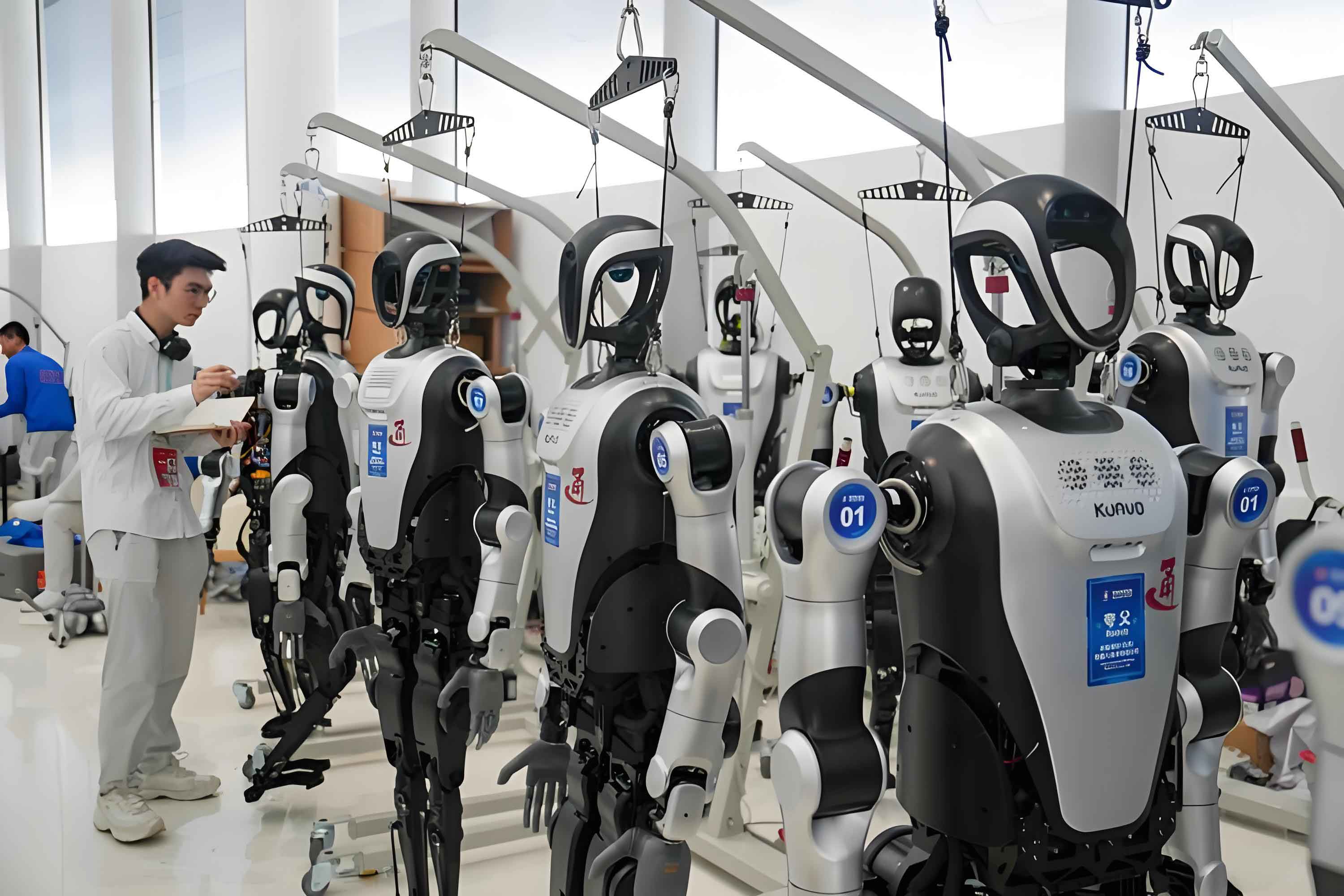
The significance of the Second World Humanoid Robot Games lies in its breadth. A humanoid robot was tested not only for speed but also for cultural expression, precision, stability, and cooperation with human operators. The event showed that the humanoid robot is becoming a general-purpose platform. Its body, brain, cerebellum, joints, hands, sensors, and control algorithms are being pushed together. The humanoid robot is moving from separate demonstrations toward integrated capability. That shift matters because a humanoid robot that can only walk is a prototype. A humanoid robot that can move accurately, respond to targets, recover balance, follow cultural choreography, and hand over a task under time pressure is closer to a real tool for real environments.
- Scale and Scope: A Humanoid Robot Event That Moved Beyond Display
The scale of the Second World Humanoid Robot Games made the humanoid robot visible as a broad technology category rather than a single product. The 51 events and 1,301 matches created many chances for failure and success. Each match became a stress test for the humanoid robot. The 16 participating countries and 666 teams brought different approaches to mechanics, perception, control, and artificial intelligence. The 2,056 robots represented many body types and design philosophies. Some humanoid robot platforms were well known, such as Unitree robots. Others attracted public attention through nicknames and distinctive appearances, such as the popular robot called Little Milk Bottle. The variety itself was important. It showed that the humanoid robot field is not converging on one single form or one single method. Instead, teams are exploring multiple paths toward embodied intelligence.
| Metric | Figure |
|---|---|
| Edition | Second World Humanoid Robot Games |
| Venue | Beijing Ice Ribbon |
| Events | 51 |
| Matches | 1,301 |
| Countries represented | 16 |
| Teams | 666 |
| Robots | 2,056 |
| Team growth compared with previous edition | Nearly 1.5 times greater |
| Robot growth compared with previous edition | Quadrupled |
For the humanoid robot, the event was a public examination. The audience could see the machine fall, recover, adjust, aim, run, and interact. The humanoid robot was not protected by edited video or a staged environment. It had to perform under lights, noise, timing pressure, and human expectations. That is why the games matter for the humanoid robot industry. A humanoid robot that performs well in a laboratory may still fail in a crowded, unpredictable setting. A humanoid robot that performs well in a competition gains data that can be used to improve reliability. The competition therefore becomes a bridge between research and deployment.
- Traditional Culture and the Humanoid Robot as Digital Inheritor
One of the most distinctive features of the Second World Humanoid Robot Games was the inclusion of traditional culture as a competitive category. Tai Chi was one of them. It moved from a performance event in the previous edition to an official competition in this edition. The humanoid robot athletes gave their full effort in what became a large training exercise. Each humanoid robot had a different body shape and posture. Some were familiar Unitree robots, and some were popular robots such as Little Milk Bottle. When they entered the field, they wore traditional Tai Chi practice uniforms. From the opening posture to the complete autonomous performance of martial arts movements, the humanoid robot achieved a high degree of human likeness and even carried a small sense of ritual.
At the competition site, the humanoid robot could complete classic Tai Chi movements such as the fist salute and White Crane Spreads Wings. It also attempted difficult movements such as the tiger jump and the aerial outward swing. Participating teams could even create their own difficulty levels so that the humanoid robot could display a unique skill. This was not merely entertainment. The judges said the Tai Chi event tested the humanoid robot’s body balance, multi-joint coordination, motion control, and autonomous decision-making. Each flowing martial arts movement represented the result of a research and development team continually challenging the boundaries of embodied intelligence and motion capability. The humanoid robot was changing from a machine that can move toward a machine that moves accurately and stably.
This cultural dimension is important for the humanoid robot. A humanoid robot that can perform Tai Chi is not only demonstrating motor control. It is also demonstrating the ability to learn and reproduce structured human movement. The humanoid robot must coordinate many joints while keeping its center of mass stable. It must sequence movements in time. It must decide when to shift weight, when to extend a limb, and when to hold a posture. These abilities are directly relevant to real-world tasks. A humanoid robot that can balance during a slow martial arts form may also be better prepared to balance while carrying an object, stepping over an obstacle, or working near a person. The Tai Chi event therefore turns cultural heritage into a demanding test of the humanoid robot’s physical intelligence.
- Precision and Ritual: Pitch-Pot and Cheerleading
The pitch-pot event offered another view of the humanoid robot. In this competition, the humanoid robot athlete grabbed an arrow, stood behind a throwing line 1.5 meters from the pot, aimed, swung its arm, and sent the arrow toward the opening. The arrow went in. The whole process took no more than 3 minutes. An engineer competing alongside the robot clenched a fist, waved an arm, and cheered. The perfect throw meant that the research and development team had also passed an assessment in this event.
According to Zhang Hua, deputy director of the organizing committee, the pitch-pot event tested the humanoid robot’s target judgment, motion precision, and force control. In other words, the humanoid robot athlete needed hand-eye coordination, visual target recognition, upper-limb trajectory planning, stable grasping with a dexterous hand, and precise control of throwing force and angle. The event concentrated on testing the fine operation ability of the dexterous hand. At the same time, the humanoid robot also needed good static standing balance. A humanoid robot that can throw an arrow into a pot must integrate perception, planning, and action in a very short time. It cannot rely on a single repeated motion. It must see the target, estimate the distance, choose the force, and release the arrow at the right moment. These are core skills for a humanoid robot that will one day work with tools, handle objects, or assist humans in everyday tasks.
If Tai Chi and pitch-pot represent the activation and use of traditional sports, the cheerleading competition offered a cross-time dance between traditional culture and frontier technology. Bronze statue robots with distinctive shapes performed in the cheerleading arena. They held yellow pom-poms and danced to the competition music. They looked like steel dancers wearing Sanxingdui bronze masks, happily dancing on the field. According to their research and development team, the appearance of this model drew on elements such as the vertical eyes of bronze masks unearthed at Sanxingdui. The design combined those elements with a modern reshaping of the robot body. The team hoped to use the humanoid robot as a carrier and a symbol of cultural output from Sanxingdui.
This cheerleading performance showed that the humanoid robot can be more than a functional machine. It can also become a cultural messenger. The humanoid robot can carry visual identity, movement style, and emotional expression. It can engage an audience. It can make technology feel less distant. For the humanoid robot industry, public engagement is not a secondary concern. If a humanoid robot is going to enter homes, hospitals, schools, and public spaces, people must become comfortable with it. A humanoid robot that can dance, perform, and express cultural references may help build that comfort. The humanoid robot becomes familiar rather than threatening.
- Running on the Blue Track: Humanoid Robot Speed and Coordination
On the blue running track, the starting gun sounded, and figures sped forward. The mechanical creaking sounds mixed with cheers from the audience. One world record after another was broken at the Second World Humanoid Robot Games. A female student watching on site smiled and said that the most striking thing was the humanoid robot running. She said it allowed her to see with her own eyes the rapid changes in the country’s science and technology.
Liu Xingliang, a specially appointed researcher at the Digital China Research Institute of the University of Chinese Academy of Social Sciences, said that robot racing appears to test the coordination of two legs, but in fact it tests the coordination of the brain, the cerebellum, and the body. The brain is the decision-making center. The cerebellum is the motion control center. The body is the physical platform. Compared with the previous year, algorithms, robot joint bodies, and control systems have all been upgraded. This means the humanoid robot is not improving in only one dimension. Its perception, planning, actuation, and stability are advancing together.
From the straight and curve switching of the 400-meter event to the speed and intensity of the 100-meter event, the audience saw what appeared to be a humanoid robot fighting alone. In reality, the event required close collaboration between the humanoid robot and its operator. Although the humanoid robot can already run autonomously, starting and stopping still require operator control. This means that a 4×100-meter event requires 4 robot starts and 4 robot stops. That is a significant challenge for both the humanoid robot athlete and the team. It tests whether the humanoid robot can autonomously perceive when to accelerate, when to maintain a constant speed, and when to decelerate. It also tests whether the operator can predict the state of the humanoid robot and avoid early or late actions that could cause collisions or errors.
The running events revealed the dual nature of the humanoid robot. On one hand, the humanoid robot is becoming more autonomous. On the other hand, the humanoid robot still needs human supervision and coordination in complex, high-speed, or high-risk situations. This balance between autonomy and human control is central to the future of the humanoid robot. A humanoid robot that can run is impressive. A humanoid robot that can run safely, stop reliably, and coordinate with people is useful. The competition on the blue track therefore tested not only speed but also the relationship between the humanoid robot and its human team.
- Relay Without a Baton: Humanoid Robot Handover Tests Timing and Stability
The relay event added another layer of difficulty. The competition did not use a physical relay baton. According to Chen Bin, the track and field event director, there were two criteria for judging a successful handover by the humanoid robot. The first was that the handover had to take place within the designated handover area. The second was that the two humanoid robots had to overlap physically. Position overlap was enough. Fingers could overlap. A hand and a foot could overlap. A hand and a body could overlap.
In an ideal state, the handover between two legs of the relay should be completed while the humanoid robots are in motion. This requires high-precision timing. It also tests the stability and anti-interference ability of the humanoid robot. The humanoid robot must improve its stable performance at high speed through continuous training. A humanoid robot that loses balance during a handover can ruin the race. A humanoid robot that does not coordinate well with its teammate can miss the overlap zone. The relay therefore becomes a test of teamwork between machines and between machines and humans.
This relay format is revealing for future applications. In warehouses, factories, hospitals, and homes, a humanoid robot will often need to hand over objects or tasks to another robot or to a person. The handover may occur while both parties are moving. It may require precise timing and spatial awareness. The humanoid robot must know where the other agent is, when to extend its arm, and when to release or receive. The relay event turns that future challenge into a visible competition. The humanoid robot is not only learning to run. It is learning to cooperate.
- From Arena to Life: Humanoid Robot Capabilities as Future Professions
A parent who watched the competition shared a thoughtful perspective. The parent said that coming to watch was intended to help the child understand intelligence better, because this is an inevitable trend. The country is developing new quality productive forces, and more exposure to these technologies is good for children. By watching the Second World Humanoid Robot Games, parents and children felt both the visual impact of advanced technology and the real scenes of future life. The event was not only an experience ground for the public to feel technology. It was also a comprehensive test of the humanoid robot. Every capability on the field corresponds to a possible future profession.
Liu Xingliang said that the purpose of the competition is changing. It is verifying whether the humanoid robot can truly work. He said that the robot games are more important because they break down the technical threshold that separates the humanoid robot from the real world. Today, teams compete for gold medals on the field. In the future, they will compete for orders in the market. This statement captures the transition now underway. The humanoid robot is moving from demonstration to deployment. The skills tested in the games are not abstract. Balance, perception, manipulation, timing, and collaboration are exactly the abilities needed for the humanoid robot to perform useful work.
A co-founder of Lingxin Qiaoshou Co., Ltd. offered another insight. The co-founder said that every road the humanoid robot walks is not walked in vain, and every fall is not taken in vain. These data have already been recorded. Even failure is valuable. This view is important because the humanoid robot will not become reliable without encountering edge cases. A fall can reveal a weakness in balance control. A missed grasp can reveal a problem in visual recognition or hand design. A failed handover can reveal a timing error. Each failure becomes a data point for improvement. The humanoid robot learns through real-world testing.
Every action on the competition field is a real test. For the humanoid robot, mastering skills and solving problems is what matters most. Each small improvement is laying a realistic step for a future of human-robot symbiosis. The humanoid robot does not need to be perfect on the first attempt. It needs to improve through iteration. The games provide a structured environment for that iteration. They create pressure, feedback, and public accountability. They also create hope. When a humanoid robot completes a Tai Chi form, throws an arrow into a pot, dances in a bronze-inspired costume, or finishes a relay, it shows that the distance between laboratory and life is shrinking.
- Event Capability Matrix: What the Humanoid Robot Was Tested For
| Event | Key capabilities tested in the humanoid robot | Notable details |
|---|---|---|
| Tai Chi | Body balance, multi-joint coordination, motion control, autonomous decision-making | Official competition, traditional practice uniforms, fist salute, White Crane Spreads Wings, tiger jump, aerial outward swing, team-created difficulty |
| Pitch-pot | Target judgment, motion precision, force control, hand-eye coordination, visual target recognition, upper-limb trajectory planning, dexterous hand grasping, static standing balance | Arrow thrown from 1.5 meters behind the line, successful pot entry, process completed within 3 minutes |
| Cheerleading | Dance coordination, cultural expression, visual identity, public engagement | Bronze statue robots, yellow pom-poms, Sanxingdui bronze mask elements, modern reshaping, cultural output symbol |
| Running | Leg coordination, decision-making, motion control, acceleration, constant speed, deceleration | Blue track, starting gun, mechanical sounds, world records broken, operator collaboration for start and stop |
| 4×100-meter relay | High-precision timing, stability, anti-interference, robot-to-robot coordination, operator prediction | No physical baton, handover within designated area, physical overlap required, 4 starts and 4 stops |
The capability matrix shows why the Second World Humanoid Robot Games were more than a public spectacle. The humanoid robot was tested across a wide range of skills that map directly to real-world tasks. A humanoid robot that can balance in Tai Chi may be better at standing safely while working. A humanoid robot that can throw an arrow into a pot may be better at placing a tool or handing over an object. A humanoid robot that can dance in a cheerleading routine may be better at interacting with people in a friendly way. A humanoid robot that can run and stop may be better at moving through dynamic spaces. A humanoid robot that can complete a relay handover may be better at cooperating with other robots and humans.
- Analysis: Why the Humanoid Robot Agenda Is Broadening
The broadening agenda of the humanoid robot is visible in the structure of the event. The humanoid robot is no longer judged only by walking speed or the number of joints. It is judged by how well it integrates perception, planning, control, and action. The humanoid robot must see, decide, move, and adapt. It must handle uncertainty. It must recover from mistakes. It must work with humans. These requirements are driving advances in algorithms, actuators, sensors, materials, and human-machine interfaces.
The humanoid robot also faces a social challenge. It must be accepted. A humanoid robot that looks human-like can create expectations. People may expect it to understand language, follow social norms, and behave safely. The games help calibrate those expectations. The public can see what the humanoid robot can do today and what it still cannot do. The public can also see the humanoid robot as a work in progress rather than a finished product. That transparency is healthy for the industry. It reduces hype and encourages realistic development.
The humanoid robot is also becoming a platform for cultural expression. The Tai Chi event and the Sanxingdui-inspired cheerleading robots show that the humanoid robot can carry meaning beyond utility. It can perform heritage. It can represent identity. It can tell a story. This cultural layer may help the humanoid robot enter daily life more smoothly. A humanoid robot that can participate in cultural events is more than a machine. It becomes part of the social fabric.
- Safety, Reliability, and Operator Collaboration
The relay and running events highlighted safety and reliability. The humanoid robot can run autonomously, but it still needs operators for start and stop. This is a reminder that autonomy is not an all-or-nothing state. The humanoid robot may be autonomous in one function and dependent on a human in another. The operator must understand the humanoid robot’s state. The operator must predict what the humanoid robot will do next. The humanoid robot must also communicate its state clearly enough for the operator to act correctly. This human-robot collaboration is a critical area for future deployment.
In a factory or warehouse, a humanoid robot may work alongside people. It must stop when a person enters its path. It must slow down when carrying a heavy load. It must avoid collisions. It must recover balance if bumped. The games do not simulate every industrial scenario, but they do create controlled stress. A humanoid robot that can manage a high-speed relay handover is developing the timing and stability needed for safer real-world operation. A humanoid robot that can stand steadily during a precise throw is developing the balance needed for safe manipulation.
Reliability also depends on data. The co-founder of Lingxin Qiaoshou noted that every fall is recorded. This data-driven approach is essential. The humanoid robot cannot improve only through simulation. It must experience real physics, real friction, real delays, and real failures. The competition provides a rich source of such data. Teams can analyze why a humanoid robot fell, why it missed a target, or why it failed to hand over in time. Those insights can then feed back into design and control. The humanoid robot becomes more robust with each iteration.
- Public Engagement and the Humanoid Robot as a Life Partner
The Second World Humanoid Robot Games also reached the public in ways that a technical conference cannot. A robot restaurant featured a robot chef skillfully cutting a decorative cucumber dish. The first Robot Hi FUN Bazaar offered human-robot interaction experiences. Families watched competitions. Children saw robots run, dance, and perform. Parents discussed the future of intelligence. The humanoid robot became a topic of everyday conversation. It became a life partner in the imagination of the audience.
That phrase, life partner, may sound ambitious. But the direction is clear. The humanoid robot is being designed to operate in human environments. It will use human tools. It will climb human stairs. It will sit at human tables. It will speak in human languages. It will need to understand human intentions. The more the humanoid robot can do, the more it can assist. The more it can assist, the more it must be trusted. Trust is built through repeated positive interactions. Public events like the games help create those interactions at scale.
The humanoid robot is not yet a common household appliance. It is still expensive, complex, and limited. But the arc of development is pointing toward broader use. The games show that the humanoid robot is moving from a single-task machine toward a multi-task platform. The humanoid robot of the future may not look exactly like any robot at the event. It may combine the balance of a Tai Chi performer, the precision of a pitch-pot athlete, the expression of a cheerleading dancer, the speed of a runner, and the cooperation of a relay team. That combination is the real goal.
- Conclusion: Humanoid Robot Progress Builds Steps for Human-Robot Symbiosis
The Second World Humanoid Robot Games demonstrated that the humanoid robot is advancing on many fronts at once. The humanoid robot can now run, balance, aim, dance, and collaborate. It can wear cultural clothing and perform traditional movements. It can throw an arrow into a pot. It can inspire a child to marvel at technology. It can fail, fall, and try again. Each of these abilities is a step toward practical use. Each failure is a data point. Each success is a proof of concept.
For the humanoid robot industry, the message is clear. The humanoid robot must be tested in public, under pressure, and in diverse tasks. The humanoid robot must integrate mind and body. The humanoid robot must work with people, not only alongside them. The humanoid robot must be reliable, safe, and understandable. The humanoid robot must also be accepted by society. The games provide one venue for that acceptance to grow.
The humanoid robot is still in its early competitive era. The records set today may be broken tomorrow. The skills demonstrated today may become basic requirements tomorrow. The teams competing today may become suppliers, employers, and innovators tomorrow. What matters is that the humanoid robot is no longer confined to the laboratory. The humanoid robot is on the track, in the arena, in the restaurant, and in the public imagination. The humanoid robot is learning to move through the human world. Every step, every fall, and every handover is recorded. Those records are building the foundation for a future in which the humanoid robot and people can work, live, and grow together.