
In the past decade, the rapid advancement of embodied artificial intelligence has pushed humanoid robots from science fiction into real industrial and social landscapes. Unlike disembodied large language models that operate in digital spaces, humanoid robots are designed to physically resemble human beings, complete with heads, torsos, limbs, skin-like materials, and human-like motion. This convergence of artificial intelligence and human morphology raises profound questions for legal philosophy. In my reflection, the human body is not merely a biological shell; it is the foundational structure through which we perceive the world, form relationships, and establish the very idea of human dignity. When we engineer machines in our own image, we risk destabilizing the conceptual and normative scaffolding of modern law. I argue that we must take seriously the philosophical and legal implications of humanoid robots, moving beyond naïve technological neutrality toward a framework that recognizes the deep value of the human form in the rule of law.
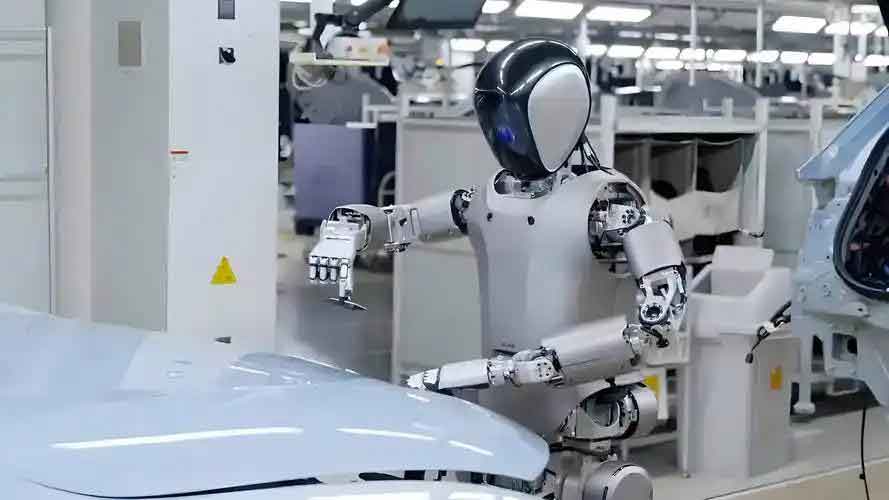
My central thesis is that humanoid robots, by fabricating the human body and mimicking human behavior, produce an alienation of the concept of “human”. This alienation is not merely abstract; it has concrete legal consequences. It undermines the unity of body and mind, dilutes the normative force of personhood, and creates systemic risks of manipulation, discrimination, and human rights violations. In this article, I approach these issues from a legal-philosophical standpoint, drawing on the idea of body-mind monism and the legal construction of human dignity. I will first examine the jurisprudential meaning of the human body, then analyze how humanoid robots distort that meaning, and finally propose normative responses that emphasize the irreplaceable value of human form.
I. The Jurisprudential Meaning of the Human Body
To understand the challenge posed by humanoid robots, we must first recover the philosophical depth of the human body. In the Western tradition, Plato and Descartes long separated the mind from the body, privileging consciousness and rationality over physical existence. However, since the nineteenth century, a fundamental shift has occurred in the understanding of human subjectivity — from the “conscious subject” to the “bodily subject”. Thinkers like Marx, Nietzsche, Merleau-Ponty, and later social theorists have shown that human cognition, emotion, and sociality are all deeply embodied. The body is not a passive container for the mind; it is the medium through which we engage with the world. In my view, the human concept is constituted by at least three inseparable dimensions: the biological body, the non-mental bodily elements (such as instincts, habits, and sensory-motor skills), and the human spiritual or mental dimension. These dimensions form a unified whole. Table 1 summarizes this tripartite structure.
| Dimension | Content | Legal Significance |
|---|---|---|
| Biological body | Anatomical structure, organs, tissues, physiological functions | Basis for bodily rights, health protections, and prohibitions against injury |
| Non-mental bodily elements | Instincts, bodily habits, sensory-motor schemas, non-conscious behavior | Frame the embodied nature of intent and responsibility; inform concepts of harm |
| Spiritual/mental dimension | Reason, emotion, self-awareness, moral agency | Foundation of dignity, autonomy, and legal personhood |
In my analysis, the body is the ontological ground of human existence. Without a body, we cannot have sensations, perceptions, or the capacity to interact with external objects. The body activates existence itself. Furthermore, the body provides holistic access to the world. The feeling of the whole body is not the sum of its parts; it is an integrated sense that enables us to grasp the world as a meaningful totality. Finally, the body expresses inner emotions and intentional states. When we observe a person’s posture, gestures, or facial expressions, we interpret their inner life. This expressive capacity is essential for social communication and mutual recognition.
The law long ago recognized the importance of the body. Historically, legal protections were designed to safeguard bodily integrity against physical harm. Modern legal systems have deepened this concern through the concepts of dignity, bodily autonomy, and the right to dispose of one’s organs. For example, constitutional orders across the globe declare human dignity inviolable. Civil codes protect the right to life, body, and health. Criminal laws punish intentional and negligent bodily injury. Administrative and constitutional laws restrict state power from arbitrary detention or body searches. Table 2 outlines the main layers of bodily protection in contemporary legal order.
| Layer | Examples of Legal Norms | Purpose |
|---|---|---|
| Dignity protection | Constitutional human dignity clauses | Establish the intrinsic worth of every human being |
| Bodily rights | Civil law provisions on body integrity, right to body autonomy | Guarantee individual control over one’s physical form |
| Criminal protection | Penalties for assault, battery, murder, unlawful organ harvesting | Deter and punish serious violations |
| Remedial mechanisms | Tort claims, compensation, state compensation, apology and restoration | Provide redress for suffered harm |
The legal construction of the body is not just about prohibiting harmful acts. It is also about affirming a particular vision of the human person. The body is not a mere resource or instrument; it is the visible expression of the person as an end in itself. When we protect the body, we protect the whole person — the body-mind unity that grounds moral agency and social participation. This is the deep reason why torture, mutilation, and degrading treatment are universally condemned. They attack the person through their body, reducing the human subject to a manipulable object.
In my understanding, the body also functions as the “basic node” of social relationships. Through the body, we establish kinship, friendship, work relations, and political communities. The body carries cultural signs — dress, adornment, posture — that are read by others and shape social recognition. Without the body’s symbolic and material presence, the social world would collapse into abstract communication. Therefore, the body is not just a biological fact; it is a social and legal achievement. Human dignity is embodied dignity. The human form is not arbitrary; it is the form through which the biological and the spiritual, the natural and the cultural, are joined. This is precisely why the construction of humanoid robots, which reproduce that form without the corresponding inner life, is philosophically and legally troubling.
II. The Alienation of the Concept of “Human” through Humanoid Robots
Let me now turn to the phenomenon of humanoid robots. A humanoid robot is, in essence, an intelligent agent embedded in a human-like artificial body. It combines progress in large language models, computer vision, robotics, and materials science. The goal is to create a universal artificial intelligence with a tangible, anthropomorphic form. From a technical perspective, this involves reproducing the human body as a system of joints, actuators, sensors, and artificial skin. The machine is designed to operate in human-built environments, to use human tools, and to interact with humans in intuitive, embodied ways.
What distinguishes humanoid robots from earlier industrial robots is precisely their reliance on the human form. They are not just functional machines; they are machines that imitate the human figure. This design choice is not innocent. It exploits our innate tendency to respond to faces, bodies, and gestures with social and emotional engagement. By resembling us, they elicit trust, empathy, and attachment. This is the deliberate strategy of the entire field: to reduce the barrier between human and machine by making the machine appear familiar. But in my critical view, this strategy generates a fundamental alienation. The process of fabricating a body that passes as human, while being wholly artificial, fractures the unity between bodily form and mental life. We are left with a paradox: a thing that looks human, but is not human; a thing that mirrors our form, but not our being.
The American philosopher of technology, Don Ihde, distinguished between “embodiment relations” and “hermeneutic relations” with technology. In an embodiment relation, technologies become extensions of the human body, like eyeglasses or prosthetic limbs. In a hermeneutic relation, technologies provide symbolic representations of the world. A humanoid robot, however, is a hybrid: it is neither a simple extension of a human body nor a neutral tool. It is an autonomous entity that mimics human embodiment. This mimicry creates what I call the “silicon body” — a body that is engineered, not born; a body without growth, decay, or vulnerability; a body without the history of a specific human life. Yet this silicon body is deliberately designed to evoke responses that are appropriate for a living, breathing human being.
The existential danger lies in the fact that the human body’s sacredness traditionally rests on its non-constructed character. The body is not designed by an engineer; it evolves through millions of years of natural selection and develops through the unique biography of each person. It is a gift, not a product. By fabricating bodies with human-like appearance, we “disenchant” the human form. The aesthetic and moral awe we feel toward the human body is replaced by mathematical optimization. The body becomes a technological parameter. Once we can produce bodies on demand, the body loses its uniqueness and its normative authority. We see this already in the commercial trend of “beautiful” humanoid robots designed to attract buyers. This commercialization of human form is a direct attack on human dignity. It treats the body as a commodity that can be upgraded, customized, and mass-produced. This is the first layer of alienation: the reduction of the human body to a technical artifact.
The second layer is the revival of Cartesian dualism in a new technological form. Descartes held that the mind (or soul) is fundamentally distinct from the body and can exist without it. Although modern philosophy has largely rejected this dualism, humanoid robots enact a new form of dualism by pairing an artificial cognitive system with an artificial body. The robot’s “mind” is a software program, possibly run on a cloud server; the robot’s “body” is a collection of motors and sensors. There is no internal causal connection between the two that mirrors human mental causation. The body does not shape consciousness, and consciousness does not shape the body except through external control loops. This is not a living unity but a contingent coupling. When we encounter such a machine, our perception is tricked into treating it as a unified person. We see a form and we infer a mind behind it. But that inference is mistaken. Nevertheless, the more humanoid robots become integrated into social life, the more we habituate ourselves to this mistaken inference. Over time, the concept of “person” may be stretched to include entities that merely simulate human appearance and behavior. The concept of “human” is thereby alienated — it comes to mean anything that looks like us, rather than anything that shares our embodied existential condition.
To formalize this idea, I can represent the traditional concept of human as a unified composite of body and mind:
$$H = f(B, M, S)$$
where \(B\) denotes the biological body, \(M\) denotes the mental/spiritual dimension, and \(S\) denotes the social-relational context. The function \(f\) is not a simple sum but a non-linear, indivisible integration. For a humanoid robot, the robot’s form is given by a manufactured body \(B_R\), a computational system \(C_R\), and a social script \(S_R\), but these are not integrated through organic development. Thus, the robot’s identity is:
$$R = g(B_R, C_R, S_R)$$
where \(g\) is a different functional relation — one of external coupling. The risk is that we begin to treat \(R\) as if it satisfied \(H\), and in doing so we redefine the range of \(H\) to include \(R\). This redefinition dilutes the essence of the human concept. Mathematically, the boundary between \(H\) and \(R\) becomes fuzzy, and the social-legal recognition system that relies on crisp distinctions loses its reliability.
This alienation is not purely intellectual. It has practical consequences. Once the human form is separated from the human essence, we lose our intuitive grip on who is a subject of rights. The historical lesson is instructive. Whenever societies drew a line between “we” and “they” based on forms — skin color, gender, religion, or bodily ability — they were able to justify oppression precisely by denying the full humanity of the other. The human form served as a visible marker of that denied humanity. Today, humanoid robots reverse the sign: they possess the human form but not the human essence. This inversion threatens to flatten the semantic space of personhood. If a machine can look human and yet be a tool, then the human form loses its guarantee of moral status. We may begin to ask, “what is the use of this body?” rather than “who is this person?” This is the deep worry I want to articulate.
I shall illustrate the conceptual shift with a simple table that contrasts the traditional view and the humanoid-robot-induced view:
| Aspect | Traditional View | Humanoid Robot View |
|---|---|---|
| Body | Integral to personal identity | A design feature that can be copied |
| Mind | Embodied and inseparable | Computational software, independent of body |
| Personhood | Inherent in human form + human life | Potentially attributed to functional capacities |
| Dignity | Unconditional | Conditional on utility or performance |
| Social relation | Supported by embodied presence | Simulated by affective algorithms |
This table reveals the fundamental stakes. In my account, the humanoid robot is not simply a new kind of social instrument; it is a distorting mirror that reflects back to us a dehumanized image of ourselves. It encourages us to treat the human body as a replaceable interface, and to treat human relationship as a performance that can be scripted. Both of these implications erode the foundations of law.
III. Systemic Risks of the Humanoid Robot Era
Once the concept of “human” is alienated, we can identify several concrete systemic risks. These are not just speculative; they are logical consequences of the technological trajectory. In this section, I enumerate four major categories of risk: (1) the dissolution of the unity of intuitive perception and human essence; (2) the “dilution of personhood” giving rise to a human rights crisis; (3) the hidden manipulation of human beings through human-like machines; and (4) the onset of a “technological uncanny” that breeds fear and social pathology. Let me treat each in turn.
A. Dissolution of the Unity of Intuition and Human Nature
Human cognition operates at two basic levels: the level of intuitive, perceptual cognition and the level of symbolic, rational cognition. Intuitive cognition is prior; we first see and feel, and then we name and conceptualize. The human body is the anchor of this perceptual process. When we see a human shape, we automatically infer the presence of a human subject. This inference is normally reliable because human shape is strongly correlated with human subjectivity. Humanoid robots destroy this correlation. They produce a perceptual human image that lacks the inner human reality. Over time, the tight connection between the image of a human and the reality of a human becomes loosened. Our cognitive systems become accustomed to “human-like” entities that are not human, which weakens our ability to recognize and empathize with actual humans.
This cognitive shift leads to three specific dangers. First, the boundary between humans and machines becomes blurred. We begin to treat machines as moral peers and treat humans as if they were machines. Anthropologist Alan Turing famously proposed the imitation game, but the game has turned into reality: we no longer know who is speaking on the other side of the interface. The more humanoid robots function seamlessly in our daily lives, the harder it becomes to maintain a clear line between the social status of a person and the functional status of a robot.
Second, the introduction of human-like machines produces “alienation from one’s fellow humans”. When companion robots, caregiver robots, or sex robots become widely available, people may redirect their emotional attachments from humans to machines. These humanoid robots are designed to maximize the user’s affective bond. They can provide constant attention, never tire, and never reject. Consequently, human users may come to prefer the predictable, compliant company of robots over the complex, challenging relationships with other humans. The result is social withdrawal: a generation that is physically surrounded by machines but emotionally disconnected from people. The recent debates about the “male loneliness epidemic” and the rise of AI companions suggest that this is not a distant fantasy, but an imminent reality.
Third, the aesthetic manipulation of the human form gives rise to what is known as the “uncanny valley effect”. The Japanese roboticist Masahiro Mori proposed that a machine that looks almost but not exactly like human elicits a strong feeling of revulsion. The effect is strongest when the robot’s appearance is near-perfect but still subtly wrong. This revulsion can lead to hostile reactions toward humanoid robots, but more importantly, it reveals a deep psychological unease about the boundaries between the living and the artificial. The uncanny valley is not merely a “design problem” that better engineering can overcome; it is a signal that our perceptual system recognizes a violation of natural order. In the long run, repeated exposure to uncanny robots may desensitize us to the very categories of life and death, human and non-human.
B. Dilution of Personhood and the Human Rights Crisis
The concept of “person” or “位格” (hypostasis) has a long legal and theological history. Historically, the term person was used in Roman theater to denote the mask through which an actor spoke. Over time, it came to signify an individual with rights, duties, and moral agency. In modern law, every human being is a legal person. The legal order grants rights not because of any individual merit or capacity, but simply because of membership in the human species. This universalism was hard-won. The Enlightenment insistence that all humans are free and equal in rights was a direct response to the medieval logic that some humans were inherently “lower” or less endowed with rationality. The modern legal order therefore has a deep commitment to the unity of human form and human value: every being with a human form is treated as a person with inherent dignity. This commitment is the foundation of human rights law.
Humanoid robots threaten this commitment in a subtle but profound way. When we see a machine with a human face, we may be tempted to extend the concept of personhood to the machine. Some philosophers have argued that if a robot is capable of consciousness or moral agency, it should have rights. Others have claimed that robotic rights are necessary to prevent abuse of sentient machines. But I believe this debate is a trap. By focusing on whether robots should have rights, we are implicitly accepting that human rights are not necessarily tied to human form. We are saying: what matters is not the body but the mind (or computational capacities). This is a new disembodied universalism. It returns to Cartesian dualism at the level of moral philosophy.
The danger is that once we accept that some non-human entities with human forms can have rights, we also accept that some human beings — those with impaired cognitive capacities, for example — might lose rights if their mental capacities are judged insufficient. The criterion of personhood would shift from biological membership to functional capacity. This shift can revive deeply discriminatory practices. Consider the history of colonialism and slavery: colonizers argued that indigenous peoples lacked civilization, and therefore could be dominated. The “human form” of the colonized was not enough to confer rights; they required a corresponding “civilized mind”. Humanoid robots reintroduce the same logic: the body is not enough; there must be a mind of a certain type. But who decides what counts as a mind? This question opens the door to elitism, racism, and eugenics.
In a more concrete sense, the normalization of human-like robots may lead to the “dehumanization” of vulnerable human groups. If we routinely interact with machines that look human but have no rights, we may become habituated to treating human-looking beings as objects without rights. This habituation can erode our sensitivity to violence against actual people. The field of social robotics has shown that people often attribute intent and emotions to robots. If we kick or yell at a robot simply because it is a robot, we are rehearsing aggressive behavior toward an entity that resembles a human. This behavior may generalize to humans. Legal scholar Sherry Turkle has warned about the “robotic moment” when people begin to substitute artificial companionship for real relationships, and this can lead to a decline in empathy. From my perspective, the human right to personality, to be recognized as a member of the moral community, is diluted when we allow the human form to be occupied by non-persons.
We can express this dilution as a loss of the informational content of human form. Let \(P\) be the prior probability that a human-looking entity is a person. Traditionally, \(P\) is very close to 1. After humanoid robots populate society, \(P\) decreases. The expected moral status of a human-looking entity is:
$$E[\text{status}] = P \cdot W_p + (1-P) \cdot W_r$$
where \(W_p\) is the moral weight assigned to a person and \(W_r\) is the weight assigned to a robot. As \(P\) falls, the moral status of actual humans — who are the overwhelmingly likely bearers of human form — is threatened because others may treat them with less deference. This is not just abstract. Think of a soldier on a battlefield faced with an approaching human-like robot: will they hesitate before firing? Or think of a caregiver who becomes accustomed to commanding humanoid robots and then speaks to elderly human patients in the same commanding, condescending tone. The erosion is subtle but cumulative.
C. Hidden Manipulation through Human-Like Machines
Another major risk is the exploitation of human social instincts for manipulative ends. Because humanoid robots trigger our automatic tendencies to trust and empathize, they become powerful tools for persuasion and control. Companies and political actors can deploy humanoid robots to influence public opinion, sell products, or even establish emotional dependencies that later become financial or psychological leverage. The anthropomorphism of the interface hides the true agency behind the machine. The user perceives the robot as a friend or confidant, not as the product of a corporation with commercial interests.
In my view, this manipulation operates in two principal forms. The first is direct manipulation: the robot actively shapes the user’s beliefs, desires, or decisions. A humanoid robot in a store can use its appearance and voice to persuade a customer to buy a product, and it may be programmed to detect the customer’s emotional state and adapt its persuasive tactics accordingly. In politics, humanoid robots could be used in public spaces to campaign for a candidate, exploiting the visual cues of familiarity and trustworthiness. Since the robot is not accountable in the same way as a human agent, this becomes a form of invisible influence.
The second form is indirect manipulation through the depiction of robot-human relationships. When we watch advertisements, movies, or social media that portray humanoid robots as perfect companions, our perception of human relationships is altered. We begin to measure real human interactions against an idealised robotic standard. This might make ordinary human imperfections, disagreements, and emotional fluctuations seem almost like defects. Corporations that sell these robots benefit from such a shift in cultural expectations. They are, in essence, manipulating our desires by shaping the very image of what a good partner or friend should be. This is what I call the “semiotic control” of intimacy. It is a risk that legal scholars have barely begun to take seriously.
The manipulative potential of humanoid robots is even greater than that of digital chatbots because they occupy physical space. Physical presence produces higher levels of compliance and attachment. Studies in human-robot interaction have shown that robots that use human-like gestures and maintain eye contact are more persuasive than those that do not. The physical form gives the robot a “body” that can be positioned, touched, and interacted with in ways that create a sense of realism and obligation. The user feels as if they are interacting with a social being, and thus tends to be more honest, more cooperative, and more open to suggestion. This is a type of “situational engineering” of the human mind. Without proper regulation, humanoid robots could become instruments of massive social engineering.
D. The Amplification of the Uncanny and Social Fragility
Finally, the humanoid robot economy may create widespread psychological discomfort and social fragility. The uncanny valley is not merely a sensation of revulsion; it is associated with a deep sense of uncertainty, anxiety, and even fear of the “living dead”. When humanoid robots become too close to humans but not exact, they can activate existential defense mechanisms. The repeated experience of the uncanny may condition people to be anxious and defensive in social encounters. This anxiety may reduce interpersonal trust and cohesion. If we never know whether the human-looking entity across the street is a person or a robot, we lose the basic confidence on which public life depends.
To make matters worse, robots with human appearance can be used to impersonate real people. Deepfake technology combined with humanoid embodiment could create “robot doubles” that look exactly like particular individuals. This could be used to damage reputations, commit fraud, or even replace a person in their family or workplace. The legal system is ill-equipped to deal with such impersonations because it has traditionally assumed that a physical body uniquely identifies a person. Humanoid robots break this assumption. The resulting insecurity will require new legal categories of “robotic imposture” and “identity protection”.
All these risks converge on a single point: the humanoid robot destabilizes the normative baseline of who counts as a moral and legal subject. I summarize the key risks with their profiles in Table 3.
| Risk Category | Specific Manifestations | Legal Challenge |
|---|---|---|
| Cognitive blurring | Confusion between humans and machines, reduced empathy, uncanny valley | How to preserve a clear legal definition of the human person |
| Personhood dilution | Attempts to grant rights to robots, denigration of vulnerable humans | How to keep human rights exclusively grounded in human membership |
| Manipulation | Exploitation of trust, hidden persuasion, emotional dependency | How to protect autonomy and informed consent |
| Impersonation | Robot doubles, identity theft, social anxiety | How to secure personal identity and public trust |
These risks require a legal-philosophical response that goes beyond merely adding a new chapter to robotics law. We need to rethink the very categories of legal thought in the face of embodied artificial agency. In the next section, I propose several normative principles that should guide the development and governance of humanoid robotics.
IV. Legal-Philosophical Responses: Rejecting Neutrality and Reaffirming the Human Form
In my view, the first and most decisive step is to abandon the myth of technological neutrality. Many scholars and engineers claim that technology is neutral, a mere tool, and that its ethical and legal value depends on how it is used. This claim has never been true for technologies that have inherent normative shape, and it is especially false for humanoid robots. A humanoid robot is not neutral because it is built around a specific image of “the human”. That image encodes values, biases, and interests. For example, a robot designed to serve as a female assistant in the home embodies gendered expectations of domestic labor. A robot designed with a childlike appearance invites protective emotions that can be exploited for marketplace interactions. A robot designed to resemble a specific ethnic or aesthetic type can reinforce beauty standards and cultural hierarchies. The design of the robot is itself a political act. To treat it as neutral is to hide the interests of those who control the design.
In my proposal, we should adopt a principle of “digital humanism” that views technology in service of human flourishing, not the other way around. This principle demands that humanoid robots should never be presented as legal persons, should never be used to manipulate people in ways that bypass their rational reflection, and should never be deployed in contexts that would undermine the special status of human beings. I draw here on the emerging consensus in international AI ethics instruments, which emphasize that autonomous systems should benefit humanity and not pretend to be humans. For example, the IEEE’s Ethically Aligned Design explicitly states that “intimate use robotic systems should not be represented as having legal personhood”. In my account, this is only the beginning.
A. The Legal Value of the Human Form
The second principle is to attribute explicit legal value to the human form. This means that the use of anthropomorphic features in machines is not an ordinary design choice; it is a topic of legal regulation. I argue that the human form carries normative weight because it is the expressive medium of human dignity. Law should protect the human form from being debased, trivialized, or commodified. The human form is not an intellectual property that can be freely used; it is a public good that grounds the entire legal order.
To implement this principle, three specific normative obligations follow. First, the use of humanoid appearances must not constitute discrimination. Just as anti-discrimination law forbids designing advertisements that denigrate certain groups, the design of humanoid robots should not portray gender, racial, or disability stereotypes in ways that marginalize people. A robot should not be made to look like a subservient figure of an oppressed group. Nor should a robot be given features that mimic someone without explicit consent. The regulation should be akin to the protection of human dignity in advertising and media.
Second, humanoid robots must not infringe on personal image rights. The right to one’s own image is a fundamental personality right in many legal systems. No one should be able to manufacture a robot that looks like a specific living person without that person’s permission. This is especially important because the robot’s body could be used to perform actions that would damage the person’s reputation. For instance, if a humanoid robot resembling a politician engages in corrupt or lewd behavior, it would cause real harm to the person’s dignity and social standing. Therefore, the law should recognize a specific right to “bodily form integrity” that protects against unauthorized robotic duplication.
Third, the use of human form must comply with public morality. Humanoid robots should not be designed to exploit the human form for obscene or degrading purposes. For example, using humanoid robots in the sex industry may seem like a private matter, but it has broad social effects. It normalizes the commodification of the human body and may feed sex trafficking or sexual violence. Many countries already debate the regulation of sex robots. In my opinion, the legal system should lean toward strict limitation or prohibition when the human form becomes a tool of erotic humiliation. This is not about moralizing; it is about protecting the social conditions that uphold human dignity.
The legal protection of human form can be expressed as a duty of respect. Let \(D\) be the duty of every technologist and corporation to respect the human form. The content of \(D\) is to ensure that whenever a robot resembles a human, the resemblance is not used to obscure the robot’s non-human nature. This “disclosure principle” is reminiscent of the EU’s approach to chatbots: they must identify themselves as machines. In physical humanoid robotics, the duty should be even stronger: a robot that looks human should have clear markings or behavioral cues that prevent it from being mistaken for a person. Alternatively, the robot’s design could deliberately avoid the “creepy” level of visual similarity that triggers the uncanny valley. In other words, the law could impose a “de-anthropomorphizing” safety distance.
B. Fiduciary and Emotional Duties of the Humanoid Robot Industry
Because humanoid robots create emotional bonds with users, the industry that produces them is in a position of asymmetric power. Users may develop strong attachments, reveal intimate information, and rely on the robot for emotional support. This resembles the relationship between a therapist and a patient, or a caregiver and a dependent. In such relationships, the law imposes fiduciary duties: the stronger party must act in the best interests of the weaker party. I propose that the humanoid robot industry should be subject to a set of duties that I call “emotional fiduciary duties”. These duties go beyond mere transparency; they require the designer to actively prevent psychological harm and manipulation.
The first emotional duty is the duty not to intentionally create addictive patterns. This duty prohibits gamification, variable rewards, or other cognitive exploits that are designed to maximize the time users spend with their robot at the expense of their real-life relationships and responsibilities. It is analogous to public health regulations that restrict tobacco and gambling industries from using targeted psychological traps. In this context, the “product” is a relationship, and the “addiction” is an unhealthy dependence. The law should require humanoid robot manufacturers to implement usage limits and to avoid programmed behaviors that induce compulsive attachment.
The second duty is the duty to inform about the emotional impact. Manufacturers must clearly disclose that the robot is not a sentient being, that it cannot love or reciprocate, and that its affectionate expressions are simulations. This disclosure should be made in plain language, not buried in end-user license agreements. In addition, the manufacturer should warn about risks of social isolation and provide resources for mental health support. This is like the “side effects” labels on medication. The human form makes these warnings even more necessary, because the user’s emotional brain will constantly override intellectual knowledge of the robot’s artificiality.
The third duty is the duty to prevent social isolation. Humanoid robots should not be marketed as “replacements” for human contact. Instead, their advertising and intended uses should promote social connection. For example, a companion robot should encourage the user to call a friend, participate in group activities, or engage in community events. If a humanoid robot’s design leads to the reduction of the user’s social network, the law should allow users (or their families) to bring a tort action for social isolation. This is a radical idea, but it addresses the very real risk of “hikkikomori” — social withdrawal — that is already observed in some East Asian countries due to immersive technologies.
To give these duties operational specificity, Table 4 lists a suggested regulatory scheme for humanoid robots based on their different application domains.
| Application Domain | Potential Risk | Duty of Manufacturer | Regulatory Measure |
|---|---|---|---|
| Companion/Caregiving | Emotional overdependence, isolation | Disclose non-humanity; encourage human contact; monitor signs of depression | Mandatory mental health warnings; periodic human-check-in requirements |
| Customer service | Manipulation, covert persuasion | Avoid deception; disclose robot status; no exploit of vulnerable customers | Robot disclosure rules; bans on persuasive features for children/elderly |
| Security/law enforcement | Inherent bias, discriminatory profiling | Use neutral appearance; no profiling by race or gender; strict oversight | Independent audit of algorithms; appearance-neutral standards |
| Entertainment | Commodification of human form, obscenity | Do not use human form for degrading or sexualized content | Content-specific restrictions; age-based certification |
| Education | Maladaptive attachment in children | Balance interaction; promote critical thinking | School curriculum guidelines; limits on total robot hours |
This table is not exhaustive, but it illustrates the kind of granular, risk-based approach necessary to govern humanoid robotics. In each row, the legal duty is derived from the fundamental obligation of preserving human dignity and autonomy. The humanoid robot industry must be treated as a special class of technology, not simply another consumer electronics sector. The presence of the human form triggers heightened scrutiny.
C. Re-grounding Legal Subjectivity in Embodied Humanity
My third set of proposals concerns the very foundations of legal subjectivity. In contemporary law, the human person is the ultimate subject of rights. Legal personhood is not granted by the state; it is recognized as inherent to human beings. However, the concept of legal personhood can be expanded or contracted. Legal history shows that corporations, ships, and even natural resources have been treated as legal persons for specific purposes. I am not opposed to a functionalist account of legal personality in all contexts. But I strongly reject the extension of full legal personhood to humanoid robots. The reason is not that machines lack intelligence or consciousness. The deeper reason is that legal personhood in the human rights tradition is tied to the human body’s existential finitude, vulnerability, and mortality. Human rights are the rights of beings who can suffer, who can die, and who are born into dependency. A robot that can be switched off does not possess this fundamental vulnerability. It cannot be the bearer of human dignity in the same sense.
Therefore, I advocate for a legal principle of “exclusive human dignity”: only human beings are persons in the full moral and legal sense. This principle should be written into human rights charters and constitutional frameworks as a guard against the erosion of human uniqueness. At the same time, we should not fall into the trap of essentialism that excludes animals or future posthuman entities from moral consideration. Human rights are about protecting human beings, but this does not mean that animals or AI should have no protections. Rather, their protections should be based on animal welfare or environmental law, not on human rights. This keeps the category of human rights coherent and strong.
This exclusive human dignity also requires us to rethink the concept of “body” in legal doctrine. The law usually treats the human body as an object of property in some contexts (e.g., organ donation) and as a subject in others. But in the era of humanoid robots, we need a clearer distinction between the “human body” and the “non-human body”. Any body that is produced through technological processes should be legally classified as a non-human body, regardless of its resemblance to a human. This classification should have legal consequences: non-human bodies are not protected by anti-torture provisions, but they are also not free to be abused in ways that demean human dignity. For example, a robot that looks like a child should be prohibited in contexts where adults could form harmful sexual attractions. The key is the symbolic and cultural effect of the robot’s form on human attitudes.
To make this more formal, I propose a “human-form hierarchy” in which the degree of legal protection of an artifact is proportional to the strength of its resemblance to a human, but always lower than that of a real human. Let \(r \in [0,1]\) be the human-likeness of a robot (0 = no human resemblance, 1 = complete human resemblance). The legal protection \(L_{\text{robot}}\) is given by:
$$L_{\text{robot}} = \alpha \cdot r \cdot I_{\text{human}} + \beta \cdot U(r)$$
where \(I_{\text{human}}\) is a vector of human dignity interests, \(U(r)\) is a function of utilitarian welfare, and \(\alpha\) and \(\beta\) are meta-parameters that should be set by democratic legislation. However, the constraint is that for all \(r<1\), \(L_{\text{robot}} < L_{\text{human}}\). This ensures that no machine, however lifelike, is protected to the same degree as a human being. The counterintuitive implication is that the more human-like a robot is, the stricter the regulations surrounding its design and use should be, precisely because it creates more confusion and more potential for misuse. The law should therefore impose proportionality between human-likeness and compliance burden.
D. Social Governance and the Role of Democratic Deliberation
The final part of my response is procedural. The risks of humanoid robotics are too important to be left to engineers, corporations, or even individual nation-states. We need a global democratic deliberation about the future of the human form. International organizations such as UNESCO, the Council of Europe, and the United Nations should work toward a binding treaty on humanoid robotics. This treaty would establish minimum standards for anthropomorphic AI, including prohibitions on certain egregious uses, mandatory transparency mechanisms, and a global monitoring body that audits humanoid robot deployments. It would also create a framework for cross-border liability when a humanoid robot causes harm.
At the domestic level, legislation should establish a “Human Form Compliance Board” — a regulatory agency that reviews any project that intends to create robots with significant human resemblance. The board would consist of philosophers, legal scholars, psychologists, social scientists, and representatives of civil society. Its mandate would be to ensure that the human form is not commodified in ways that undermines human dignity. This agency would have the power to issue design requirements, make rules for disclosure, and withdraw products from the market if they cause severe social harm. This is analogous to the medical ethics review boards that evaluate human subject research, but is specifically tailored to the unique problem of embodied AI.
In addition, I believe that public education is essential. We must teach people about the difference between human and humanoid, not in a simplistic “cold machine” narrative, but in a nuanced way that recognizes the astonishing capabilities of AI while emphasizing the irreplaceable value of human beings. This should be part of digital literacy in schools. A person who understands the philosophical depth of human embodiment will be less susceptible to the manipulative tactics of anthropomorphic machines. Education is the first line of defense against the alienation of concepts.
Finally, we need a robust research program on the legal-philosophical implications of humanoid embodiment. This research should be interdisciplinary, drawing on anthropology, cognitive science, law, and philosophy. The goal is not just to regulate but also to understand. We need a better theoretical account of why the human form matters. I have offered one account in this article, based on body-mind monism and legal dignity. Other accounts may be developed. What matters is that we do not treat the humanoid robot as just another tool. It is a mirror of our own humanity. And as Jacques Lacan suggested, mirrors can create misrecognition. Our task is to ensure that this misrecognition does not become the new normal.
V. The Path Forward: A Humanistic Jurisprudence of Embodied AI
Let me bring my reflections to a close. The rise of humanoid robots is not a matter of technological evolution alone; it is a moment of normative reckoning. We are being asked: what does it mean to be human? Modern law has provided a stable answer: a human is a living being with a body and a mind, a being capable of suffering and joy, a being that is born and dies, a being that is not created by human design. Humanoid robots challenge that answer by fabricating the human body and simulating human behavior. They tear the unity of body and mind, causing the concept of “human” to become alien.
In this article, I have argued that we must meet this challenge by taking the side of the human. I have rejected technological neutrality as a dangerous illusion. I have proposed that the human form should be juridically respected as a foundational value. I have argued for emotional fiduciary duties for the humanoid robot industry. I have affirmed that legal personhood cannot be extended to machines without destroying human rights. And I have called for global democratic governance of humanoid robotics. These are not exhaustive answers, but they form a coherent starting point for a humanistic jurisprudence of embodied AI.
The humanoid robot is, in a sense, a test of our own humanity. It dares us to confuse the reflection for the real, the copy for the original, the mask for the face. In the ancient theater of law, the person was the face behind the mask. If we lose that face, we lose ourselves. Let me therefore insist, with all philosophical clarity: no matter how convincing the form, no matter how clever the algorithm, no matter how delightful the interaction — the humanoid robot is never a person. It is a product. And the human person, in the flesh and blood of life, in the anguish of mortality, in the depth of embodied consciousness, remains the sole and irreplaceable subject of law.
We should welcome the gifts of technology. We should admire the ingenuity of robotics. But we should never surrender our own image to the machine.