
A mechanical hand closes around the cap of a bottled water. The fingertips draw together, rotate, and slowly twist the cap open. For a person, the motion is ordinary. For humanoid robots, it remains a hard test in dexterous manipulation and a threshold that must be crossed before humanoid robots can leave the laboratory and enter production and daily life.
At the 2026 World Robot Conference and the Second World Humanoid Robot Games, held one after another in Beijing, humanoid robots ran faster and moved with better coordination. In exhibition halls, the industrial chain presented core components and complete applications. Yet the competition among humanoid robots is changing. Running, jumping, and interacting are no longer the only attractions. Whether humanoid robots can reliably grasp, assemble, and operate tools is becoming a new standard of capability.
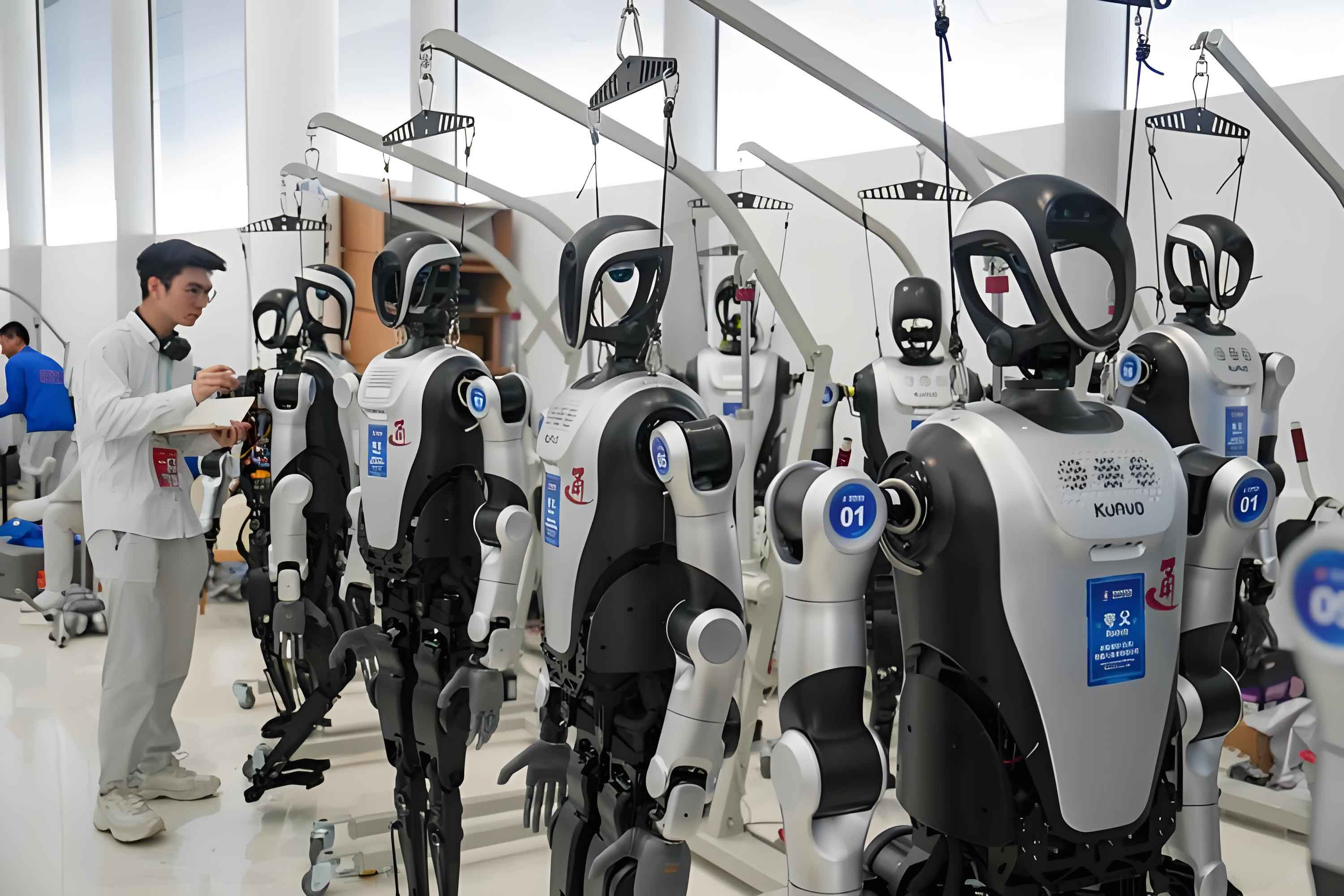
1. From Motion Capability to Operation Capability
In June 2026, the Ministry of Industry and Information Technology and the State-owned Assets Supervision and Administration Commission jointly launched the 2026 Special Action for Real-World Training of Humanoid Robots and Embodied Intelligence. The action calls for key products to complete application validation and normalized deployment in representative scenarios, opening an operation mode for humanoid robots. The shift from motion capability to operation capability means dexterous hands are becoming a critical link as embodied intelligence moves from the show stage to the use stage.
A recently released 2026 Humanoid Robot Industry Development Report shows that in the first half of 2026, shipments of humanoid robots in China exceeded 40,000 units, and the global share rose to 97 percent. As complete humanoid robots move toward larger-scale deployment, the ability of a pair of hands to steadily convert model capability into real operations becomes increasingly important.
Traditional industrial robots already have hands. In welding, painting, loading and unloading materials, and other processes, fixed grippers with dedicated tooling can efficiently complete large amounts of repetitive work. But this model has a precondition: the object, position, and action are largely fixed. Once humanoid robots face flexible materials that deform, small parts that slip, tangled cables, or an unfamiliar object whose position has shifted slightly, the originally efficient robotic arm may find itself unable to start.
The real world is full of uncertainty. Objects differ in hardness and shape, and operation involves friction, sliding, and collision. For humanoid robots to move from closed workstations into more open production and living spaces, they must have stronger general manipulation capability.
Human upright walking freed the hands, and only then did humans develop rich survival skills. In a sense, the hand is the starting point of human civilization, said Zuo Jiaping, co-founder of Lingxin Qiaoshou (Beijing) Technology Co., Ltd. The comment points to the industrial position of dexterous hands: they are not merely end components of a complete humanoid robot, but also the direct interface through which intelligence acts on the physical world.
The physical world imposes stricter requirements on manipulation precision and fault tolerance. Zhong Xinlong, director of the Artificial Intelligence Research Office at the Future Industry Research Center of the CCID Research Institute under the Ministry of Industry and Information Technology, offered an example. In the digital world, if artificial intelligence writes a piece of code incorrectly, it can revise the code repeatedly. In the physical world, if a hand applies one unit too much force, it may damage an object, halt equipment, or even injure a person. Whether a part can be installed and whether a tool will slip from the hand test whether perception, decision-making, and execution can form a closed loop.
The value of dexterous hands also extends to data collection. At the physical exhibition stand of Critical Point, a dexterous hand company based in Shanghai, several mechanical hands continually moved their joints. A reporter put on a data-sensing glove, made a fist, pinched with a twist, and made a virtual pinch. The mechanical hands replicated the gestures in sync, and the amount of force was also captured by the device. Han Xiaoxuan, marketing director of Critical Point, said the glove can be used for teleoperation, for collecting real-machine operation data, and also independently of the robot body to directly collect data on human operation skills.
Whether a grasp slips and where an assembly process meets resistance are process details that can be collected as new operation data. Zhong Xinlong believes that dexterous hands sit at the value realization end of the embodied intelligence industrial chain and are also the starting point for real operation data to flow back. They simultaneously perform execution, perception, and data collection.
2. From Degrees of Freedom to System-Level Capability
For a period, the industry was keen to compare degrees of freedom and to stage biomimetic performances that imitated human gestures. Zhang Tianyi, chief executive officer of Zhongke Guiji (Nanjing) Robotics Co., Ltd., recalled that during the research stage, the team purchased foreign products, and some dexterous hands reached the million-yuan level, with long maintenance cycles. In his view, once the products enter practical application, lifespan, payload, and continuous working capability are more decisive indicators of product quality.
Zhang Tianyi divides the industry into two stages. The 1.0 stage is can move, can demonstrate, cool. The 2.0 stage is can use, easy to use, durable to use. In the early stage, the industry needs diverse exploration and different strengths. After entering the scale stage, companies face the same constraint: how to balance performance, reliability, and cost. This places higher demands on the system-level capability of dexterous hands.
Xiong Kun, chief technology officer of Critical Point, observed that this year’s industry progress is first reflected in hardware maturity. Product completeness has improved noticeably compared with the previous year, and process capabilities such as connectors and assembly have improved at the same time. Mass production capability has also increased. At the same time, more complex manipulation demonstrations continue to appear, and software algorithms are iterating rapidly.
Perception has become an important focus for the technological upgrade of dexterous hands. At the stand of Paxini Artificial Intelligence Technology at the 2026 World Robot Conference, a reporter pressed a tactile sensor on a dexterous hand with a finger, and the force value and force distribution on the screen changed accordingly. Such pressure produces corresponding mechanical changes, which the sensor converts into physical signals that a robot can understand and use for decisions. A new generation of tactile sensors can simultaneously obtain more than 15 types of human-like tactile information, including distributed force, resultant force, and torque.
If only vision is relied upon and force touch is lacking, the force-control capability for fine manipulation has a shortcoming, said Xu Jincheng, founder and chief executive officer of Paxini. Force tactile sensing is not only about improving experience. It is also the underlying support that ensures stable operation of complex tasks, and related sensing components are increasingly being equipped on various dexterous hand products.
As the gap in hardware parameters continues to narrow, the focus of industrial competition is shifting further toward software-hardware collaboration. Drivers, reducers, motors, and sensors iterate very quickly. The gap in pure hardware parameters is narrowing. The difficulty lies in enabling software and algorithms to form a stable partnership with the body, Zhang Tianyi said. What customers purchase is not an isolated mechanical hand, but a complete operation solution for completing a specific task. Competition in dexterous hands has escalated from a contest over individual hardware parameters to a contest over the comprehensive capability of an entire system.
3. Real-World Scorecards: Cost, Reliability, and Uptime
When entering a real operation site, the assessment indicators for dexterous hands are no longer simply whether the action can be produced. They become a series of practical metrics: task success rate, continuous operation duration, frequency of manual intervention, maintenance cost, and investment return period.
Zhong Xinlong’s suggestion is to calculate the accounts first, then select the model. Companies should calculate process pain points, labor costs, operation frequency, environmental changes, allowed error rate, and investment payback period one by one, and then decide how many fingers, how many degrees of freedom, and what drive method are needed, avoiding over-design.
Real scenarios are also shaping products. Zhongke Guiji is advancing cooperation with industrial customers such as JD.com in logistics sorting, handling, loading and unloading, and quality control testing. Product development is also beginning to shift from take a product to find a scenario to deriving performance boundaries from specific processes.
However, demand for dexterous hands differs greatly across scenarios. In the short term, it is difficult for one type of dexterous hand to cover all scenarios, Zuo Jiaping said frankly. If every new scenario requires new data collection, model training, and hardware debugging, application costs will be difficult to reduce.
She proposed a vision of depositing a large number of mature operation skills in the cloud, to be called upon like downloading an application when needed. Her team built the LinkerSkillNet dexterous operation skill library, relying on hardware and real operation data accumulation, striving to make mechanical hands smarter the more they are used.
4. Standards, Evaluation, and Industrial Coordination
Standard construction is keeping pace with the industry. In June 2026, the Ministry of Industry and Information Technology issued the 2026 third batch of industry standard revision project plans. The document Humanoid Robots and Embodied Intelligence End Effector Interface Technical Specification Part 1: Dexterous Hands was included in the plan. In August 2026, the National Humanoid Robot Industry Standard System Construction Guide (2026 Edition) was made public for comments.
Industry participants said standardization does not require different products to converge into the same form. Instead, it establishes the necessary common language to clarify interfaces, data records, and performance test evaluation rules, reduce repeated adaptation costs between complete humanoid robot manufacturers and component suppliers, and consolidate the institutional foundation for industrial compatibility and comparability while encouraging exploration of multiple technical routes.
The evaluation system is also being reformed in parallel. The 2026 Special Action for Real-World Training of Humanoid Robots and Embodied Intelligence proposes scientifically evaluating indicators such as the real operation success rate, efficiency improvement rate, safety and reliability, and economic feasibility of complete humanoid robot solutions, and promoting normalized deployment for solutions that pass validation.
A small dexterous hand carries a major breakthrough in the industrialization of embodied intelligence. From biomimetic display to real-world delivery, from single-point technological breakthroughs to full-chain system upgrades, dexterous hands still need to withstand testing in real scenarios. In the future, with deep coordination among the embodied intelligence brain, body, and terminal hand, dexterous hands will continue to activate productivity in physical scenarios and become an important force for intelligent manufacturing to empower the real economy.
5. A Structured View of the Transition
| Dimension | Earlier Focus for Humanoid Robots | Emerging Benchmark for Humanoid Robots | Implication for Humanoid Robots |
|---|---|---|---|
| Movement | Running, jumping, coordination, and interaction | Stable grasping, assembly, and tool operation | Humanoid robots must demonstrate useful work, not only performance |
| Hand Hardware | Degrees of freedom and biomimetic gestures | Lifespan, payload, continuous operation, and cost balance | Reliability becomes decisive when humanoid robots scale |
| Sensing | Vision-heavy perception | Force touch, distributed force, resultant force, and torque | Humanoid robots need closed-loop physical interaction |
| Competition | Single hardware parameters | Software-hardware integration and task-level solutions | Humanoid robots compete as complete systems |
| Deployment | Demonstrations and showcases | Real-world training and normalized deployment | Humanoid robots are measured by success rate, uptime, and return |
| Standards | Fragmented interfaces and repeated adaptation | Common interfaces, data records, and performance rules | Standards reduce integration costs across humanoid robots |
6. Why Humanoid Robots Need Hands That Can Work
The bottle-cap example captures a broader truth about humanoid robots. A humanoid robot may have a sophisticated brain, a stable body, and a powerful model, but if its hands cannot interact with objects in a controlled way, its intelligence remains disconnected from the physical world. The dexterous hand is where perception, decision-making, and execution meet. For humanoid robots, manipulation is not an accessory to intelligence. It is a condition for intelligence to produce value.
This is why the focus on humanoid robots is moving from mobility to work. Running and jumping show that a humanoid robot can control its body dynamically. Grasping and assembly show that a humanoid robot can change the world around it. The first capability is impressive. The second capability is economically meaningful. In factories, warehouses, laboratories, and service environments, humanoid robots will be judged by whether they can complete tasks, how often they need human help, how long they can operate, and whether their cost can be recovered.
The industrial chain is responding. Component suppliers are improving connectors, assembly processes, and mass production. Sensor companies are adding force touch and tactile perception. Software teams are building algorithms that allow humanoid robots to adapt to friction, sliding, and collision. Complete humanoid robot makers are moving from finding a scenario for a product to deriving performance boundaries from a process. These are all signs that humanoid robots are entering a stage in which system integration matters more than isolated novelty.
Data is another reason dexterous hands matter for humanoid robots. Every grasp, slip, assembly success, and assembly failure can become a data point. When humanoid robots operate in real environments, their hands are not only actuators. They are also sensors and recorders. A glove can capture human operation skills. A mechanical hand can replay and refine those skills. A cloud skill library can store mature operations and distribute them when needed. For humanoid robots, this creates a flywheel: more operation generates more data, more data improves models, better models improve operation, and better operation enables more deployment.
Yet the challenges remain significant. Different objects have different hardness, shape, surface friction, and weight distribution. Different tasks require different force, speed, and precision. A hand that is strong enough to lift a heavy part may be too coarse for a small connector. A hand that is sensitive enough for fine assembly may be too delicate for rough handling. A hand that works in a structured factory may fail in a messy warehouse. Humanoid robots therefore cannot rely on a single universal hand design for every use case. They need a portfolio of hands, or modular hands, or hands that can be adapted through software and tool changes.
This is also why the industry is discussing calculate the accounts first, then select the model. The right hand for humanoid robots is not the one with the highest number of degrees of freedom. It is the one that matches the task, the environment, the allowed error rate, and the payback period. Over-design can increase cost without improving outcomes. Under-design can cause failures and manual intervention. The balance is an engineering and economic problem, not only a technical one.
7. From Components to Complete Operation Solutions
The competition in dexterous hands is increasingly a competition in complete operation solutions. Customers do not simply buy a mechanical hand. They buy the ability to sort packages, load machines, test products, assemble parts, or handle materials. That ability depends on the hand, the arm, the sensors, the control algorithms, the software platform, and the integration with the surrounding environment. For humanoid robots, the dexterous hand is therefore a gateway component. It connects the robot’s intelligence to the task and the task’s data back to the robot’s intelligence.
Hardware maturity is necessary but not sufficient. Drivers, reducers, motors, and sensors are improving quickly. Connectors and assembly processes are getting better. Mass production is becoming more feasible. But the hardest part is stable coordination between software, algorithms, and the body. A humanoid robot may have excellent components and still fail at a task if the perception system misreads the object, the planning system chooses the wrong grasp, or the control system applies the wrong force. System-level capability is the ability to make all these parts work together reliably.
Perception is central to that capability. Vision can identify an object and estimate its position, but vision alone may not reveal how much force is needed, whether the object is slipping, or whether a tool is securely held. Force tactile sensing provides information that vision cannot easily provide. Distributed force, resultant force, and torque allow humanoid robots to adjust their grip and motion in real time. More than 15 types of human-like tactile information are now available in new-generation sensors, according to the industry development report. This kind of sensing is not a luxury for humanoid robots. It is a foundation for stable complex operations.
Data collection closes the loop. When a human operator wears a data-sensing glove, the glove can capture gestures and force. When a mechanical hand performs a task, it can capture slip and resistance. These process details become training data. Over time, humanoid robots can learn from both human skills and their own experience. A cloud skill library can make mature skills available across different robots and different sites. This approach could reduce the cost of entering new scenarios, because not every new task would require starting from zero.
8. Deployment Metrics for Humanoid Robots
Once humanoid robots enter real operation sites, the scorecard changes. The question is not whether the action can be demonstrated once. The question is whether the task can be completed repeatedly, reliably, and economically. Task success rate measures how often the robot completes the operation without failure. Continuous operation duration measures how long it can work before maintenance or recharge. Manual intervention frequency measures how often a human must step in. Maintenance cost measures the burden of repairs and replacement parts. Investment return period measures whether the deployment makes financial sense.
These metrics are especially important for humanoid robots because they are general-purpose platforms. A general-purpose humanoid robot may be expected to perform many tasks in many environments. That flexibility can be valuable, but it can also create complexity. If each task requires a different hand, different software, and different training, the cost of flexibility may be too high. The industry is therefore exploring modularity, skill libraries, and standardized interfaces. The goal is to preserve flexibility while reducing integration and deployment costs.
The 2026 special action reflects this direction. It calls for application validation and normalized deployment in representative scenarios. It also calls for scientific evaluation of real operation success rate, efficiency improvement rate, safety and reliability, and economic feasibility. Solutions that pass validation can be promoted for normalized deployment. This is a shift from demonstration to delivery. For humanoid robots, it means that the value of a dexterous hand will be measured in the field, not on a stage.
9. Standardization and the Common Language of Humanoid Robots
Standardization is following the growth of the industry. The inclusion of dexterous hand interface specifications in the 2026 third batch of industry standard revision plans is a signal. The public comment process for the National Humanoid Robot Industry Standard System Construction Guide (2026 Edition) is another. These efforts are not intended to force all humanoid robots or all dexterous hands into one design. Instead, they aim to create a common language for interfaces, data records, and performance testing.
A common language matters because the humanoid robot supply chain is complex. Complete humanoid robot manufacturers need to integrate hands, arms, sensors, controllers, and software from different suppliers. Component suppliers need to know what interfaces and performance requirements to meet. Testing organizations need consistent rules to evaluate products. Without common standards, every integration can become a custom project, increasing cost and slowing deployment. With common standards, humanoid robots can benefit from reusable components, comparable performance data, and faster system integration.
Standards can also support multiple technical routes. The industry is exploring different drive methods, different sensor designs, different degrees of freedom, and different control strategies. Standardization does not have to choose one winner. It can define the common boundaries within which different approaches can compete. For humanoid robots, this balance between diversity and compatibility is essential. It encourages innovation while making it easier for the industry to scale.
10. The Road Ahead for Humanoid Robots and Dexterous Hands
The road ahead for humanoid robots will be shaped by the interaction of brain, body, and hand. The brain refers to the models, algorithms, and decision-making systems. The body refers to the arms, legs, torso, and mobility systems. The hand refers to the end effector that directly touches the world. Deep coordination among these three elements is necessary for humanoid robots to perform useful work. A powerful brain without a capable body cannot act. A capable body without a dexterous hand cannot manipulate. A dexterous hand without perception and control cannot adapt.
Dexterous hands will continue to improve in hardware. Their lifespan, payload, and continuous operation capability will increase. Their cost will need to decrease. Their sensors will become richer and more integrated. Their software will become more adaptive. Their skill libraries will grow. Their interfaces will become more standardized. These improvements will not happen overnight. They will be tested in real scenarios, where success rate, uptime, manual intervention, maintenance, and return on investment are the final judges.
For humanoid robots, the ability to grasp, assemble, and operate tools is not the end of the journey. It is the beginning of practical value. When humanoid robots can reliably perform tasks in factories, warehouses, laboratories, and service environments, they can become a new kind of productivity tool. They can take on repetitive, dangerous, or labor-intensive work. They can work alongside people. They can collect data and improve over time. The dexterous hand is a small component, but it carries a large part of the promise of embodied intelligence industrialization.
The bottle-cap task remains a useful symbol. It is small, ordinary, and difficult. It requires perception, planning, force control, and adaptation. When humanoid robots can open a bottle cap reliably, they are demonstrating a capability that extends far beyond the cap itself. They are showing that they can interact with the physical world in a controlled and useful way. That capability is the foundation for the next stage of humanoid robots. It is also why dexterous hands have become a new measure of real-world ability for humanoid robots.
From the 2026 World Robot Conference to the Second World Humanoid Robot Games, from real-world training actions to industry standards, the direction is clear. Humanoid robots are moving from movement to manipulation, from demonstration to deployment, and from single components to complete systems. The dexterous hand is at the center of this transition. For humanoid robots, the future will not be won only by running faster or jumping higher. It will be won by hands that can work steadily, reliably, and economically in the real world.
11. Manufacturing and Logistics as Early Testing Grounds
Manufacturing and logistics appear repeatedly in the discussion of humanoid robots and dexterous hands. The source material notes cooperation in logistics sorting, handling, loading and unloading, and quality control testing. These environments are structured enough to allow deployment but variable enough to test manipulation. Packages vary in size and weight. Parts may be flexible or small. Positions may shift. A humanoid robot that can sort, handle, and inspect objects in these settings must combine mobility, perception, and dexterous manipulation. For humanoid robots, logistics and manufacturing are not just markets. They are training grounds where operation data can be collected and systems can be refined.
In manufacturing, humanoid robots may eventually work alongside fixed automation. Fixed automation is efficient when the product and process are stable. Humanoid robots may add value when the product changes, when the process requires flexible handling, or when the environment is unstructured. A dexterous hand allows humanoid robots to use tools, pick varied objects, and adapt to small changes. That adaptability is difficult to achieve with fixed grippers. It is also why humanoid robots are being discussed as a complement to traditional industrial robots rather than only a replacement.
In logistics, the challenge is volume and variability. Humanoid robots may need to pick many different items, place them accurately, and work at a steady pace. A single slip can cause a failed order or a damaged product. A single missed grasp can require human intervention. The economics of humanoid robots in logistics therefore depend on reliability and uptime. These are exactly the areas where dexterous hands, force tactile sensing, and system-level control matter. For humanoid robots, logistics is a practical test of whether dexterous manipulation can be both flexible and dependable.
12. Safety, Reliability, and Human Interaction
Safety and reliability become more important when humanoid robots work near people. A humanoid robot with a powerful arm and a dexterous hand can apply significant force. If it misjudges an object or a person, the consequences can be serious. The source material notes that applying too much force in the physical world can damage objects, stop equipment, or injure people. This is why force control and tactile sensing are not optional for humanoid robots that operate in shared spaces.
Reliability also affects trust. If humanoid robots frequently drop objects, miss grasps, or require human intervention, workers and managers will hesitate to deploy them. If humanoid robots can operate for long periods with predictable performance, they can become accepted as part of the workflow. The industry is therefore focusing on continuous operation duration, maintenance cost, and manual intervention frequency. These metrics are not only technical. They are social and economic signals that determine whether humanoid robots can be integrated into real workplaces.
Standardization can help improve safety and reliability by defining performance test rules and data records. If different dexterous hands are evaluated under common rules, buyers can compare products more easily. If interfaces are standardized, complete humanoid robot makers can integrate components more quickly. If data records are consistent, failures can be analyzed and improvements can be shared. For humanoid robots, standards are a way to build trust across the supply chain and with end users.
13. The Economic Case for Dexterous Hands
The economic case for dexterous hands follows the economic case for humanoid robots. A humanoid robot must perform useful work at a cost that makes sense. If the robot is too expensive, too slow, or too unreliable, it will not be deployed at scale. Dexterous hands are a key part of that equation. A hand that is too expensive may make the whole humanoid robot unaffordable. A hand that is unreliable may increase maintenance and intervention costs. A hand that is too limited may force humanoid robots into a narrow set of tasks.
The source material suggests calculating process pain points, labor costs, operation frequency, environmental changes, allowed error rate, and investment payback period before choosing a hand. This is a practical approach. It recognizes that different tasks have different economics. A task that is dangerous or difficult to staff may justify a higher-cost humanoid robot. A task that is simple and highly repetitive may require a very low-cost solution. The right dexterous hand for humanoid robots depends on the task and the business case.
Cost reduction can also come from software and data. If a mature operation skill can be stored in a cloud library and reused, the cost of training humanoid robots for a new task may fall. If a dexterous hand can be adapted through software rather than replaced with new hardware, the cost of changing tasks may fall. If real operation data can improve models over time, the performance of humanoid robots may rise without a proportional increase in hardware cost. These are the economic reasons behind skill libraries, data collection, and software-hardware integration.
14. Data, Cloud Skills, and Continuous Learning
Data is becoming a strategic resource for humanoid robots. Every operation in the physical world can generate information about objects, forces, failures, and successes. A dexterous hand is a rich source of that information because it directly contacts the environment. It can sense force, detect slip, and record the details of an assembly. When this information is collected and organized, it can be used to train models, improve control, and expand the range of tasks that humanoid robots can perform.
The idea of a cloud skill library reflects this logic. Mature operation skills can be stored and called upon when needed. Instead of programming every humanoid robot for every task from scratch, a skill can be downloaded and adapted. The LinkerSkillNet effort described in the source material aims to accumulate hardware and real operation data so that mechanical hands can become smarter the more they are used. For humanoid robots, this is a path toward continuous learning and faster deployment.
Continuous learning also raises questions about data quality, data sharing, and standardization. If different humanoid robots collect data in different formats, it may be difficult to combine and reuse that data. If interfaces and data records are standardized, the value of data can increase. Standardization can therefore support the data flywheel for humanoid robots. It can help the industry move from isolated demonstrations to shared learning while still allowing different companies to compete on algorithms, hardware, and applications.
15. Conclusion: The Hand as the Interface of Embodied Intelligence
The dexterous hand is a small part of a humanoid robot, but it is a decisive interface. It is where intelligence meets matter. It is where perception becomes action. It is where data is generated and where value is delivered. For humanoid robots, the hand is not just a tool. It is a test of whether the entire system can work in the real world. The bottle-cap task, the assembly task, the logistics pick, and the quality control test all depend on the same fundamental capability: controlled interaction with physical objects.
The 2026 World Robot Conference and the Second World Humanoid Robot Games showed that humanoid robots are becoming more capable in motion. The next stage will be judged by operation. Humanoid robots will need to grasp, assemble, and use tools reliably. They will need to balance performance, reliability, and cost. They will need to collect data, learn from experience, and adapt to new tasks. They will need standards that reduce integration costs and evaluation systems that measure real-world success.
Dexterous hands are central to this transition. They are the endpoint of the robot and the starting point of data. They are the component that turns models into actions and actions into value. As humanoid robots move from laboratories to factories, warehouses, and service environments, the ability to work with hands will determine how far they can go. The future of humanoid robots will not be defined only by how well they move. It will be defined by how well they handle the ordinary, difficult, and essential tasks of the physical world.