
As an industrial designer deeply immersed in the field of child-centric technology, I have witnessed firsthand the transformative potential of companion robots. These devices are no longer mere toys; they are evolving into sophisticated partners that foster development, education, and emotional bonding. In this exploration, I will delve into the design philosophy, technological integration, and pedagogical impact of modern companion robots, drawing from extensive research and development experiences. The core thesis is that a well-designed companion robot can significantly enhance cognitive and behavioral growth in children aged 3 to 12, serving as a constant, interactive ally.
The fundamental design principle for any companion robot revolves around creating a safe, engaging, and durable entity that children can perceive as a living partner. Compactness and robustness are paramount, as young users often carry these robots around, exposing them to various physical stresses. The emotional connection is cultivated through intuitive interfaces—such as touch-sensitive areas and expressive displays—that convey a range of emotions, thereby animating the machine with a sense of life. This lifelike interaction is crucial for sustaining a child’s interest and fostering habitual use.
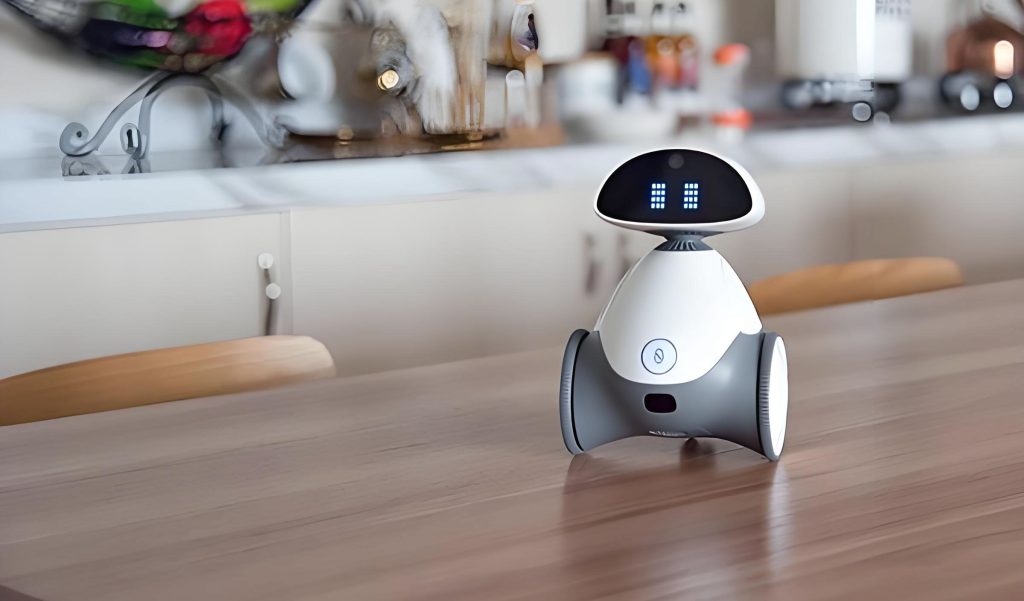
From a technological standpoint, advanced AI algorithms are the backbone of modern companion robots. These systems enable functionalities like real-time image recognition for reading physical books and interactive language tutoring. For instance, when a child places a picture book in front of the robot, AI-driven image processing swiftly identifies the content and generates an auditory narrative. This process can be modeled using a recognition accuracy formula, where the probability of correct identification depends on image clarity and algorithmic training. Let us consider the recognition accuracy \( A \) as a function of image quality \( Q \) and training data volume \( D \):
$$ A(Q, D) = \beta_0 + \beta_1 \cdot \ln(Q) + \beta_2 \cdot \sqrt{D} $$
Here, \( \beta_0, \beta_1, \beta_2 \) are coefficients derived from machine learning models. Such formulas underscore the precision required for a companion robot to perform seamlessly in educational contexts. Moreover, natural language processing algorithms allow the robot to engage in dialogues, correct pronunciations, and even adapt lessons based on the child’s progress. The adaptive learning mechanism can be represented by a reinforcement learning model, where the robot adjusts its responses to maximize engagement and learning outcomes. The reward function \( R \) in such a model might be:
$$ R(s, a) = \alpha \cdot E(s) + (1-\alpha) \cdot C(a) $$
where \( s \) is the child’s state (e.g., attention level), \( a \) is the robot’s action (e.g., asking a question), \( E \) measures educational gain, and \( C \) measures companionship satisfaction, with \( \alpha \) balancing the two objectives.
The educational applications of a companion robot are vast and tailored to developmental stages. For younger children (3-6 years), the focus is on habit formation and basic cognitive skills, such as reading aloud together. The robot acts as a patient reading buddy, encouraging daily practice. For older children (7-12 years), the companion robot can introduce more complex subjects like foreign languages through game-based tutorials. These tutorials often integrate listening, speaking, writing, and reading exercises, creating a holistic learning environment. To illustrate the progression, consider the following table summarizing key functionalities across age groups:
| Age Group | Primary Function of Companion Robot | Key Skills Developed | Typical Interaction Frequency |
|---|---|---|---|
| 3-5 years | Reading companionship and habit formation | Basic literacy, listening comprehension | Daily, 15-30 minutes |
| 6-8 years | Interactive language learning (e.g., English) | Pronunciation, vocabulary, simple grammar | Daily, 30-45 minutes |
| 9-12 years | Advanced cognitive games and remote parental communication | Critical thinking, problem-solving, emotional expression |
This table highlights how a single companion robot can evolve with the child, offering age-appropriate challenges. The interaction frequency is derived from observational studies showing that consistent, short sessions yield optimal retention rates. Furthermore, the companion robot serves as a bridge for remote parenting, allowing guardians to monitor activities and communicate through the device. This feature addresses modern familial needs where parents may be physically absent but still wish to remain involved in their child’s daily routine.
The emotional intelligence embedded in a companion robot is perhaps its most innovative aspect. Through colored LED screens and tactile feedback, the robot expresses emotions like happiness, curiosity, or encouragement, mirroring human-like responses. This emotional mimicry is not merely cosmetic; it fosters empathy and social skills in children. Research indicates that children who interact with emotionally responsive companion robots show improved emotional regulation. The relationship can be quantified using an attachment metric \( M_a \), defined as:
$$ M_a = \frac{1}{T} \sum_{t=1}^{T} I_e(t) \cdot \gamma^{t} $$
where \( T \) is the total interaction time, \( I_e(t) \) is the emotional intensity of interaction at time \( t \), and \( \gamma \) is a decay factor accounting for novelty wear-off. This formula helps designers optimize emotional engagement over long periods.
From a safety and ethical perspective, designing a companion robot involves stringent considerations. Data privacy is paramount, as these devices often collect audio and visual inputs. Robust encryption and anonymization protocols must be in place to protect children’s information. Additionally, the robot should avoid over-dependence, encouraging balanced interactions with humans and the real world. The design philosophy always prioritizes supplementing, not replacing, human care. To evaluate safety parameters, we can use a risk assessment matrix, as shown below:
| Risk Category | Potential Issue | Mitigation Strategy in Companion Robot | Severity Score (1-10) |
|---|---|---|---|
| Data Security | Unauthorized access to child’s data | End-to-end encryption, local processing where possible | 9 |
| Physical Safety | Choking hazards or sharp edges | Rounded designs, non-toxic materials, durability testing | 8 |
| Psychological Impact | Over-attachment or social isolation | Time-limit features, prompts for human interaction | 7 |
| Educational Accuracy | Incorrect information or pronunciation | Regular AI updates, curated content databases | 8 |
This table underscores the multifaceted approach needed to ensure that a companion robot is both effective and safe. Each mitigation strategy is integrated into the design process from inception, reflecting a commitment to holistic child development.
The economic and market dynamics of companion robots are also worth examining. The demand for such devices is rising, driven by increased awareness of early childhood education and technological adoption. Production costs involve factors like sensor quality, AI software development, and safety certifications. A simplified cost model \( C_{total} \) for manufacturing a companion robot can be expressed as:
$$ C_{total} = C_{hardware} + C_{software} + C_{compliance} $$
where \( C_{hardware} \) includes components like processors and displays, \( C_{software} \) covers algorithm licensing and updates, and \( C_{compliance} \) accounts for safety and regulatory testing. As scale increases, economies of drive down these costs, making companion robots more accessible. Market penetration can be modeled using logistic growth, where the adoption rate \( P(t) \) follows:
$$ P(t) = \frac{K}{1 + e^{-r(t-t_0)}} $$
Here, \( K \) is the market saturation level, \( r \) is the growth rate, and \( t_0 \) is the inflection point. This model predicts rapid expansion in the coming years, especially in regions emphasizing STEM education.
Looking ahead, the future of companion robots lies in enhanced personalization through deeper AI integration. Imagine a robot that not only reads stories but also crafts unique narratives based on a child’s interests, or one that detects emotional cues from voice tone and adjusts its behavior accordingly. Such advancements will require interdisciplinary collaboration between designers, educators, and computer scientists. The ultimate goal is to create a companion robot that grows alongside the child, adapting to their evolving needs and becoming a trusted lifelong learning partner.
In conclusion, the journey of developing and refining companion robots is a testament to the synergy between technology and human-centric design. These devices are reshaping how children learn, play, and connect, offering a blend of education and companionship that was once the realm of science fiction. As I continue to innovate in this space, I am constantly inspired by the potential to positively impact young minds. The companion robot, in its ideal form, is more than a tool—it is a catalyst for curiosity, a guardian of development, and a friend in the digital age.