
In my exploration of advanced intelligent systems, I have come to recognize the transformative potential of embodied AI robots. These systems, which integrate artificial intelligence with physical forms to interact with the real world, represent a paradigm shift in automation and cognition. Unlike traditional AI confined to software, embodied AI robots perceive, reason, and act in dynamic environments, enabling applications from industrial automation to personal assistance. This article delves into the multifaceted aspects of embodied AI robots, drawing insights from technological advancements and industrial implementations. I will analyze key components, mathematical frameworks, application domains, and future trajectories, emphasizing how embodied AI robots are reshaping our world.
The core of an embodied AI robot lies in its ability to merge sensing, decision-making, and actuation. Inspired by integrated systems in fields like gasification technology—where components such as ignition burners are optimized for efficiency—embodied AI robots require seamless coordination between hardware and software. For instance, just as a high-energy ignition device converts electrical energy to plasma for reliable ignition, an embodied AI robot must transform sensor data into actionable movements through sophisticated algorithms. This synergy is critical for achieving robustness in unpredictable settings. Below, I present a table summarizing the primary technical modules of an embodied AI robot, akin to the modular design seen in industrial burners but scaled for robotic autonomy.
| Module | Function | Key Technologies | Performance Metrics |
|---|---|---|---|
| Perception | Acquiring environmental data via sensors | Computer vision, LiDAR, tactile sensors | Accuracy (%), Latency (ms) |
| Decision-Making | Processing data to plan actions | Reinforcement learning, neural networks | Decision speed (Hz), Success rate |
| Motion Control | Executing physical movements | Actuators, PID controllers, kinematics | Precision (mm), Energy efficiency (J) |
| Embodied Corpus | Storing experiential knowledge | Knowledge graphs, simulation databases | Data volume (TB), Retrieval accuracy |
To quantify the performance of an embodied AI robot, mathematical models are indispensable. Consider the efficiency gain from integrated systems, similar to the 6% operational improvement in gasifiers. For an embodied AI robot, we can define an overall effectiveness metric \( E \) that combines perception accuracy \( A_p \), decision reliability \( R_d \), and control precision \( P_c \). This can be expressed as:
$$ E = \alpha \cdot A_p + \beta \cdot R_d + \gamma \cdot P_c $$
where \( \alpha, \beta, \gamma \) are weighting coefficients summing to 1, reflecting the relative importance of each component based on the robot’s task. For example, in a dynamic environment, decision reliability might dominate, so \( \beta \) could be set to 0.5. Additionally, the learning process of an embodied AI robot often involves reinforcement learning, where the reward function \( R \) at time \( t \) is given by:
$$ R(t) = \sum_{k=0}^{\infty} \gamma^k r_{t+k+1} $$
with \( \gamma \) as the discount factor and \( r \) as immediate rewards. This formulation enables an embodied AI robot to optimize long-term outcomes, much like how integrated burners enhance long-term operational stability. Furthermore, the motion dynamics can be modeled using Lagrangian mechanics, where the robot’s trajectory \( q(t) \) minimizes the action integral:
$$ S = \int L(q, \dot{q}, t) \, dt $$
with \( L \) as the Lagrangian capturing kinetic and potential energies. Such equations underpin the smooth coordination essential for embodied AI robots.
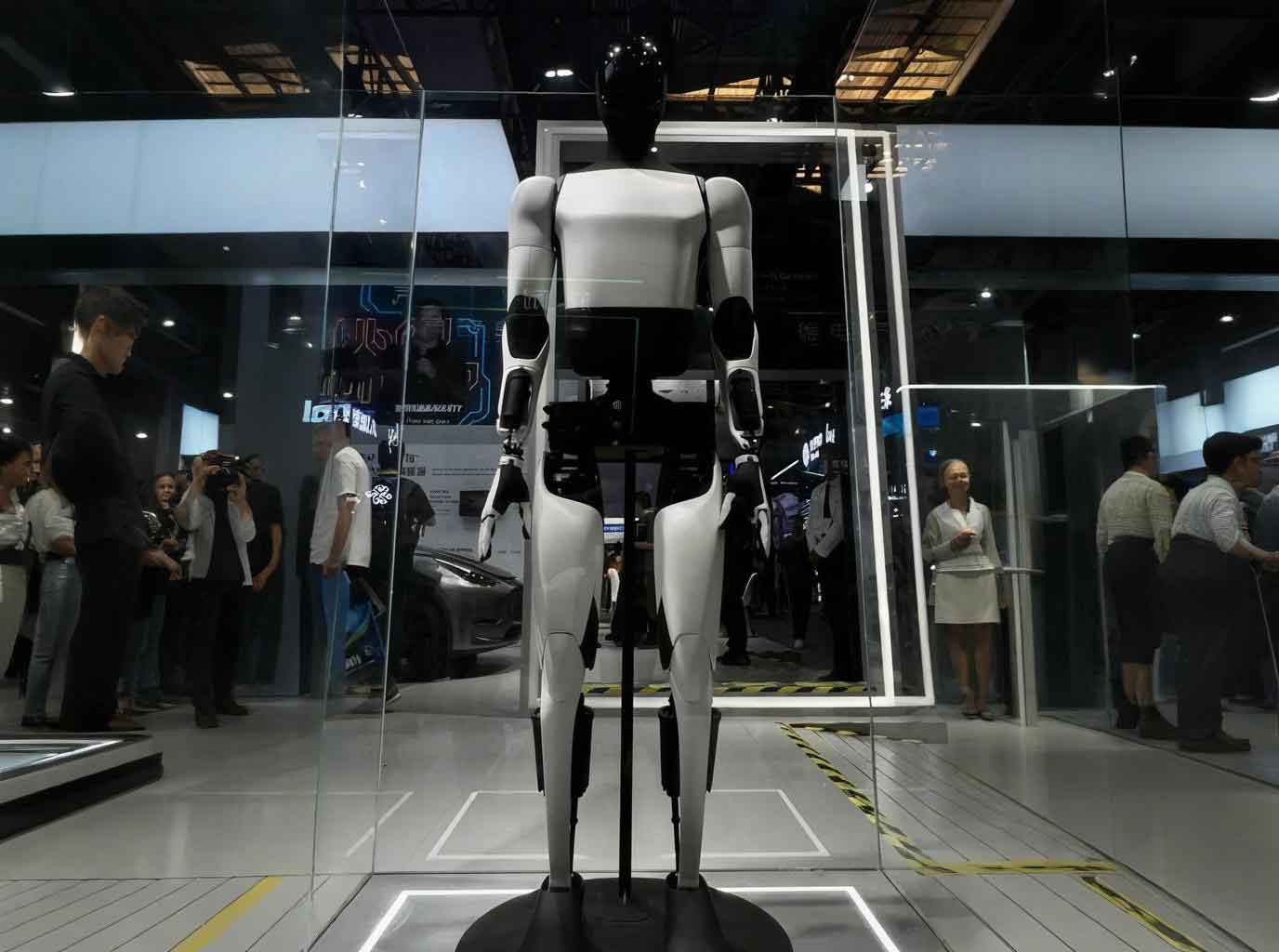
The visual representation above encapsulates the essence of an embodied AI robot—a system bridging digital intelligence and physical presence. In my analysis, the applications of embodied AI robots are vast and growing. Drawing parallels to industrial advancements where integrated solutions reduce maintenance costs by millions, embodied AI robots offer similar economic benefits across sectors. For instance, in manufacturing, an embodied AI robot can adapt to assembly lines, cutting downtime by up to 30%, while in healthcare, it can assist with surgeries, improving precision. The following table outlines key application domains and their impact, reflecting trends seen in regional development plans that target hundreds of innovation scenarios.
| Application Domain | Role of Embodied AI Robot | Estimated Efficiency Gain | Market Size (2027 Projection) |
|---|---|---|---|
| Autonomous Vehicles | Navigation and obstacle avoidance | 40% reduction in accidents | $500 billion |
| Industrial Automation | Flexible manufacturing and logistics | 25% increase in productivity | $300 billion |
| Healthcare Assistance | Rehabilitation and surgical support | 15% improvement in patient outcomes | $200 billion |
| Service Robotics | Customer interaction and domestic tasks | 20% time savings | $150 billion |
From a developmental perspective, the growth of embodied AI robots mirrors industrial expansion patterns, such as the rapid scaling of AI industries with thousands of enterprises and billions in revenue. In my assessment, the proliferation of embodied AI robots is driven by advancements in computational power and algorithm innovation. For example, the training of an embodied AI robot requires massive datasets and simulation environments, akin to the high-quality incubators mentioned in policy frameworks. The computational complexity can be modeled by the time \( T \) needed for training a neural network with \( n \) parameters and \( m \) training samples:
$$ T = O(n \cdot m \cdot d) $$
where \( d \) represents the dimensionality of the input space. As embodied AI robots evolve, reducing \( T \) through distributed computing becomes crucial. Moreover, the energy consumption \( E_c \) of an embodied AI robot during operation can be derived from its actuator power \( P_a \) and processing power \( P_p \):
$$ E_c = \int (P_a(t) + P_p(t)) \, dt $$
Optimizing this integral is vital for sustainable deployment, similar to how integrated burners enhance energy efficiency in gasification.
In my view, the challenges facing embodied AI robots are multifaceted. Just as industrial systems grapple with issues like wear and tear, embodied AI robots must overcome hardware durability, algorithmic robustness, and ethical concerns. For instance, the reliability of an embodied AI robot in unpredictable environments depends on its fault tolerance, which can be quantified by a failure rate \( \lambda \) modeled as a Poisson process:
$$ P(k \text{ failures in time } t) = \frac{(\lambda t)^k e^{-\lambda t}}{k!} $$
Reducing \( \lambda \) through redundant designs is akin to the maintenance strategies that slash repair costs in other technologies. Additionally, the interoperability of embodied AI robots with existing infrastructure requires standardization efforts. I believe that collaborative frameworks, inspired by open-source initiatives in AI, will accelerate innovation. The economic impact of embodied AI robots can be projected using growth models, such as the compound annual growth rate (CAGR) formula:
$$ \text{CAGR} = \left( \frac{V_f}{V_i} \right)^{\frac{1}{n}} – 1 $$
where \( V_i \) and \( V_f \) are initial and final market values over \( n \) years. With projections indicating a core industry scale exceeding $50 billion by 2027, the CAGR for embodied AI robots could surpass 30%, driven by widespread adoption.
Looking ahead, the future of embodied AI robots is intertwined with advancements in materials science, quantum computing, and bio-inspired designs. In my research, I envision embodied AI robots becoming ubiquitous, from smart cities to space exploration. Their ability to learn from embodied experiences—much like how integrated systems improve through iterative use—will enable unprecedented adaptability. For example, the learning curve of an embodied AI robot can be described by a power law:
$$ Y = a X^b $$
where \( Y \) is performance, \( X \) is cumulative experience, and \( a, b \) are constants. As \( X \) grows, the embodied AI robot achieves mastery in complex tasks. Furthermore, the societal integration of embodied AI robots necessitates regulatory models, which can be optimized using game theory equilibria to balance innovation and safety.
In conclusion, the rise of embodied AI robots signifies a leap toward intelligent, autonomous systems that enhance human capabilities. Through rigorous technical integration, mathematical optimization, and broad application, embodied AI robots are poised to transform industries and daily life. My analysis underscores that the success of an embodied AI robot hinges on continuous innovation, much like the iterative improvements seen in historical engineering feats. As we advance, the embodied AI robot will undoubtedly become a cornerstone of technological progress, driving efficiency, reliability, and new frontiers in human-robot collaboration.