
The quest to create a machine that moves with the grace, efficiency, and adaptability of a human is one of the most compelling challenges in robotics. The potential for such humanoid robots to operate seamlessly in environments built for humans—from factories and homes to disaster sites—is immense. However, a significant gap remains between human locomotion capabilities and the current performance of even the most advanced humanoid robots. This gap is not solely a matter of control algorithms; it is fundamentally constrained by mechanical design, particularly the architecture of the legs. The leg configuration of a humanoid robot is a primary determinant of its dynamic balance, payload capacity, impact resilience, and overall energy efficiency. It dictates the mass distribution, centroid height, and inertia properties, which are critical for stable and agile motion. This article provides a first-person perspective on the historical progression, current technological landscape, and future directions of humanoid robot leg configuration, emphasizing the pivotal interplay between mechanism design, actuator technology, and control paradigms.
The human leg, a product of millennia of evolution, serves as the ultimate biological inspiration. From a kinematic standpoint, the lower limb can be simplified into a 6-degree-of-freedom (DOF) chain: a 3-DOF spherical joint (RRR) at the hip (flexion/extension, abduction/adduction, rotation), a 1-DOF revolute joint (R) at the knee (flexion/extension), and a 2-DOF universal joint (RR) at the ankle (plantar/dorsiflexion, inversion/eversion). Mechanically, Hill’s muscle model provides a foundational understanding of the biological actuator, comprising Contractile Elements (CE), Series Elastic Elements (SE), and Parallel Elastic Elements (PE). Emulating this combination of strength, compliance, and energy storage has been a guiding principle in the development of robotic actuators, which fundamentally fall into rotary or linear types, each with sub-categories like Traditional Stiffness (TSA), Series Elastic (SEA), and Quasi-Direct Drive (QDD) actuators.
The history of humanoid robot leg design spans over five decades, marked by pivotal conceptual shifts. The journey began in 1969 with Waseda University’s WL-3, which used hydraulic actuation. A landmark moment arrived in 1983 with the WL-10R, which established the rotary actuator-based serial leg configuration as a standard. The paradigm began to shift in 2006 with the LOLA robot from TUM, which introduced a parallel ankle mechanism, pioneering the series-parallel leg configuration. Further innovation came in 2014 with Virginia Tech’s THOR, showcasing a leg employing entirely linear actuators in a series-parallel arrangement. More recently, in 2021, UBTECH’s Walker demonstrated a modern series-parallel configuration utilizing QDD actuators for full-body torque control. This evolution reflects a continuous search for better performance metrics dictated by simplified control models like the Linear Inverted Pendulum (LIP). The LIP model highlights that for dynamic walking, a high center of mass (CoM) and low leg inertia are desirable properties—goals that directly drive leg configuration innovation.
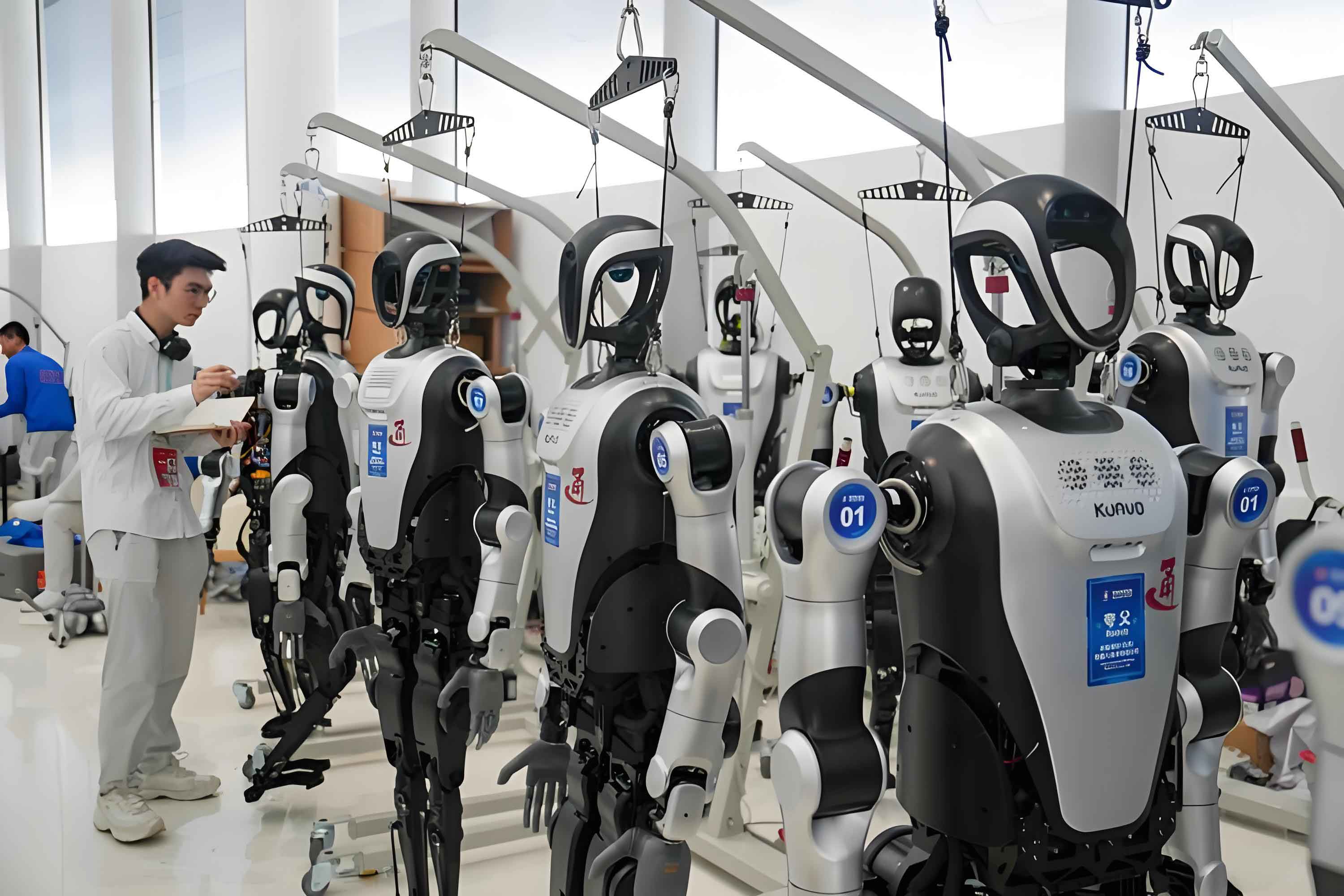
The serial leg configuration, where joints are connected in an open kinematic chain, was the dominant early design due to its simplicity and large workspace. In its purest form, all actuators are mounted directly at their respective joint axes (e.g., early Waseda robots, Sony’s QRIO). However, this leads to high inertial loads on proximal joints (hip and knee) and a low CoM. To mitigate this, designers began relocating actuator mass. A common strategy is using belt drives or linkages to place ankle actuators near the knee (e.g., HUBO, HRP-4) or knee actuators near the hip (e.g., TORO, COMAN). While this improves mass distribution compared to the pure serial form, the gains in reducing proximal inertia and raising the CoM are often limited. The kinematics remain straightforward, with the end-effector (foot) position \(\mathbf{x}\) derived from joint angles \(\mathbf{q}\) through a forward kinematics function \(\mathbf{f}\):
$$\mathbf{x} = \mathbf{f}(\mathbf{q})$$
The inverse kinematics, while more complex, is generally tractable. However, the inherent low stiffness due to cumulative gear backlash and structural deflection in long kinematic chains remains a performance bottleneck for highly dynamic tasks.
The limitations of serial chains spurred interest in parallel mechanisms, known for their high stiffness, high payload-to-weight ratio, and low moving mass. The most common initial application was at the ankle joint. Here, two or three actuators (linear or rotary) are mounted on the shank and connected to the foot via a parallel linkage (e.g., 2-UPS/U, 2-PUS/U). This creates a compact, stiff ankle while allowing the heavy actuators to be positioned higher on the leg. Robots like Valkyrie, CogIMon, and TALOS employ such parallel ankle designs. When combined with serial hip and knee joints, this forms a series-parallel hybrid leg configuration. The kinematics of a parallel ankle involve solving a more complex closure constraint. For a generic parallel mechanism, the relationship between actuator displacements \(\mathbf{l}\) and the foot pose \(\mathbf{x}\) is governed by:
$$g(\mathbf{x}, \mathbf{l}) = 0$$
The velocity Jacobian \(\mathbf{J}\), which relates joint velocities \(\dot{\mathbf{l}}\) to foot twist \(\boldsymbol{\nu}\), is crucial for force control:
$$\boldsymbol{\nu} = \mathbf{J} \dot{\mathbf{l}}$$
$$\boldsymbol{\tau} = \mathbf{J}^T \mathbf{F}$$
where \(\boldsymbol{\tau}\) is the actuator force/torque and \(\mathbf{F}\) is the wrench at the foot.
The logical progression was to extend the use of parallel mechanisms to the knee and even the hip, creating more integrated series-parallel leg configurations. The goal is to concentrate the majority of the leg’s mass—the actuators—into the torso or upper thigh, dramatically reducing the inertia of the thigh and shank links. This approach takes many forms. Some designs use rotary actuators with complex linkages. For instance, a four-bar linkage (1-RRRR) can transmit motion from a hip-mounted motor to the knee joint (e.g., WALK-MAN, ASIMO, UBTECH Walker). Similarly, a spatial linkage can drive the ankle from a motor near the knee. More radical designs place almost all leg actuators in the hip, using multi-DOF parallel manipulators to control the foot pose. Examples include Disney’s research robot, MIT’s minimal leg design, and the OmniLeg concept, which use mechanisms like 3-RRR or other parallel structures to achieve 3 or 6-DOF leg control with all drives proximal.
An alternative path employs linear actuators, often mimicking the “piston-like” action of muscles. Robots like LOLA, THOR, and BHR-T use electric linear actuators (e.g., ball-screw drives) arranged in series-parallel patterns. Tesla’s Optimus robot also proposes a leg with linear hip and knee actuators and a 2-SPRR+1U parallel ankle. Linear actuators can offer high force density and a natural impedance characteristic. Their integration often leads to slender, more anthropomorphic leg shapes, as the actuator can be aligned with the limb segment. The force-velocity relationship of a linear actuator is central to its dynamics:
$$F = F_{\text{max}} \left(1 – \frac{v}{v_{\text{max}}}\right)$$
where \(F\) is the output force, \(v\) is the velocity, and \(F_{\text{max}}\) and \(v_{\text{max}}\) are the stall force and no-load speed, respectively. This relationship must be carefully matched to the required joint torque-speed profile through the mechanism’s leverage.
The choice of actuator type is deeply intertwined with the leg configuration. Traditional high-gear-ratio actuators (TSA) provide high torque but are non-backdrivable and have high reflected inertia. SEA introduces deliberate compliance for force control and energy storage but adds complexity. QDD actuators, with low gear ratios, offer high fidelity torque control and natural compliance, making them ideal for dynamic, force-controlled walking but requiring larger motors for the same peak torque. The configuration must accommodate the physical size, weight, and thermal management needs of the chosen actuator. A series-parallel leg using QDD actuators, for example, might prioritize compact linkage design to manage the larger motor volumes while maximizing inertia reduction.
A comparative analysis of the three fundamental leg configuration types reveals their distinct trade-offs, crucial for designing a humanoid robot for a specific performance regime.
| Configuration Type | Stiffness & Payload | Mass Distribution & Inertia | Workspace & Dexterity | Kinematic Complexity | Dynamic Performance Potential |
|---|---|---|---|---|---|
| Serial | Low (cumulative errors) | Low CoM, High Limb Inertia | Large, Simple | Low (Direct) | Limited |
| Parallel (Full Leg) | Very High | Very High CoM, Very Low Limb Inertia | Limited, Complex | Very High (Closure Constraints) | Very High |
| Series-Parallel Hybrid | High (at parallel joints) | High CoM, Low Limb Inertia | Moderate/Large | High (Mixed) | High |
The progression in research is clear when examining representative platforms. Early robots used serial configurations almost exclusively. The 2000s saw the introduction of parallel ankles. The last decade has been defined by the exploration of increasingly integrated series-parallel hybrid leg configurations, moving drives proximally to optimize dynamic metrics.
| Representative Robot (Year) | Hip Parallel DOF | Knee Parallel DOF | Ankle Parallel DOF | Total Leg Parallel DOF | Actuator Trend |
|---|---|---|---|---|---|
| LOLA (2006) | 0 | 1 | 2 | 3 | Linear TSA |
| THOR (2014) | 3 | 1 | 2 | 6 | Linear SEA |
| TALOS (2017) | 0 | 0 | 2 | 2 | Rotary TSA |
| Disney Robot (2018) | 3 | 1 | 1 | 5 | Rotary TSA |
| UBTECH Walker (2021) | 1 | 1 | 2 | 4 | Rotary QDD |
| MIT Humanoid (2021) | 1 | 1 | 1* | 3 | Rotary QDD |
| Optimus (2022) | 2 | 1 | 2 | 5 | Linear (Proposed) |
*Ankle roll fixed for simplicity.
The library of viable parallel mechanisms for humanoid robot legs is extensive. Their selection and combination define the design space. Common candidates include 3-UPU or 3-RRR for a fully parallel hip, 1-RRRR or 1-RRPR for a parallel knee, and 2-SPU+1U or 2-SPRR+1U for a parallel ankle. The combinatorial possibilities for a series-parallel hybrid leg are numerous.
| Body Segment | Candidate Parallel Mechanisms |
|---|---|
| Hip (3-DOF) | 3-UPU, 3-PSP, 3-RRR, 3-R[2-SS] |
| Knee (1-DOF) | 1-RRRR, 1-RRPR |
| Ankle (2-DOF) | 2-SPU+1U, 2-PUS+1U, 2-SPRR+1U, 2-SU[1-RRPR]+1U |
Despite promising advancements, significant challenges persist in humanoid robot leg configuration design. A primary challenge is kinematic and dynamic model compatibility. Complex series-parallel legs have non-trivial, often non-linear, kinematics and dynamics. Traditional ZMP-based walking controllers rely on simplified models (like LIP) that assume a point-mass and massless legs. Reconciling the complex leg dynamics with these real-time control models is non-trivial. The control equation for a floating-base humanoid robot with complex legs is:
$$\mathbf{M}(\mathbf{q})\ddot{\mathbf{q}} + \mathbf{C}(\mathbf{q}, \dot{\mathbf{q}}) + \mathbf{G}(\mathbf{q}) = \mathbf{S}^T \boldsymbol{\tau} + \mathbf{J}_c^T \mathbf{F}_c$$
where \(\mathbf{M}\) is the inertia matrix, \(\mathbf{C}\) Coriolis/centrifugal terms, \(\mathbf{G}\) gravity, \(\mathbf{S}\) the selection matrix for actuated joints, \(\boldsymbol{\tau}\) joint torques, and \(\mathbf{J}_c^T \mathbf{F}_c\) contact wrenches. For a series-parallel leg, the mapping from actuator torques \(\boldsymbol{\tau}_a\) to joint torques \(\boldsymbol{\tau}\) involves the mechanism’s Jacobian, adding a layer of complexity: \(\boldsymbol{\tau} = \mathbf{J}_m^T \boldsymbol{\tau}_a\).
Other critical challenges include structural design optimization: creating stiff yet lightweight linkages for parallel mechanisms that can withstand high dynamic loads; actuator integration: packaging motors, gearboxes, and sensors within compact linkages while managing heat dissipation; and unified design synthesis: co-optimizing the leg configuration, actuator parameters (e.g., gear ratio, motor constant), and structural topology for a target performance profile (e.g., running speed, jump height, efficiency). This is often framed as a constrained optimization problem:
$$\min_{\mathbf{p}} \Phi(\mathbf{p}) = w_1 \cdot J_{\text{inertia}} + w_2 \cdot m_{\text{total}} + w_3 \cdot E_{\text{consumption}}$$
$$\text{subject to: } g_i(\mathbf{p}) \geq 0 \quad \text{(e.g., stiffness, workspace, stress)}$$
where \(\mathbf{p}\) is the vector of design parameters (link lengths, motor selection, etc.) and \(w_i\) are weighting factors.
Current research hotspots are actively addressing these challenges. Advanced Series-Parallel Topologies are a dominant theme, with new multi-loop linkages being explored to better approximate the human leg’s muscle coordination, offering optimal force polytopes and variable impedance. Actuator-Configuration Co-Design is crucial, as the rise of QDD and compact linear actuators enables new, previously impractical, mechanism designs. The shift from pure position control to Whole-Body Torque Control (WBTC) is perhaps the most significant trend. WBTC leverages the full dynamics model and directly optimizes joint torques, making it more compatible with the complex dynamics of series-parallel legs. The core QP problem in WBTC is:
$$\min_{\boldsymbol{\tau}, \mathbf{F}_c} \|\mathbf{A} \boldsymbol{\tau} + \mathbf{B} \mathbf{F}_c – \mathbf{b}\|^2$$
$$\text{s.t. } \mathbf{C} \boldsymbol{\tau} + \mathbf{D} \mathbf{F}_c \leq \mathbf{e}, \quad \text{Friction Cone Constraints}$$
This approach allows the robot to exploit its mechanical intelligence, making complex leg designs more manageable. Furthermore, the advent of Machine Learning and AI, particularly deep reinforcement learning (DRL), is transforming the field. DRL can learn effective control policies directly from simulation, bypassing the need for explicit, accurate analytical models of complex legs. The policy \(\pi\) maps states \(\mathbf{s}\) to actions \(\mathbf{a}\) (e.g., joint torques):
$$\mathbf{a}_t = \pi_\theta(\mathbf{s}_t)$$
The parameters \(\theta\) are optimized to maximize expected reward \(R\), which can encode walking stability, speed, and efficiency. This paradigm reduces the burden of kinematic complexity, as the network can learn the inverse kinematics and dynamics implicitly.
Looking forward, the trends in humanoid robot leg configuration point toward greater integration, intelligence, and performance. The shift from pure serial to sophisticated series-parallel hybrid configurations will continue, as the benefits for dynamic performance are undeniable. Actuator technology will evolve alongside, with a clear trend toward QDD and advanced linear actuators that enable more biomimetic force control and energy regeneration. The control paradigm is firmly moving toward force/torque-based control and hybrid force-position control, facilitated by both model-based optimization and data-driven learning. We anticipate deeper holistic optimization, where leg mechanism geometry, composite material structure, and actuator characteristics are optimized as a single system using multi-disciplinary tools. Finally, the application of large-scale AI models for motion planning and control will likely abstract away much of the traditional complexity associated with novel leg configurations, allowing designers to focus on mechanical optimization for raw performance—strength, speed, and efficiency—while the AI learns to master the machine’s unique kinematics. The future of the humanoid robot leg lies not in simply mimicking the human form, but in synthesizing the principles of biology with the strengths of engineering to create legs that can ultimately surpass human locomotion in specific, demanding environments.