
BEIJING — On September 8, XPeng Robotics officially activated its robot production line. At the center of the milestone, XPeng’s first high-order general-purpose humanoid robot completed automated final assembly and autonomously walked off the production line. The development marks a key leap for XPeng Robotics from research and development trial production to production-line manufacturing, and it represents an important step toward mass production of humanoid robots.
The milestone places XPeng among companies seeking to move humanoid robots beyond limited, semi-manual assembly. For years, humanoid robots have largely remained in small-batch production and semi-handmade assembly. Scaling humanoid robots has been a widely recognized challenge across the industry. XPeng Group independently designed and developed the world’s first automated production line for high-order humanoid robots. The company combined the mature quality system of the automotive industry with the precision manufacturing requirements of humanoid robots, applying vehicle-grade consistency standards to build a mass-production quality system for high-order humanoid robots.
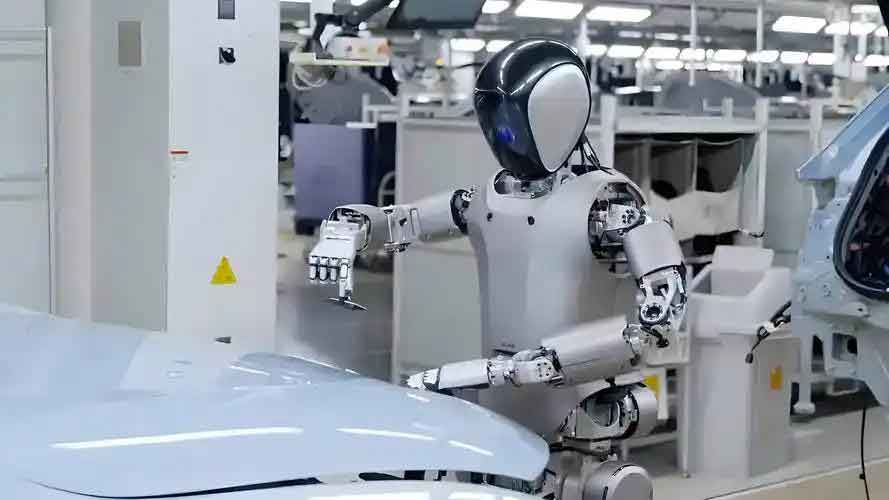
The production line was developed from the outset with mass production of humanoid robots as its objective. Its core process automation rate exceeds 80 percent. The line establishes a high-precision, high-flexibility, and intelligent manufacturing system. It helps ensure that key processes remain stable and consistent, and it lays a foundation for subsequent scaled production and rapid capacity expansion of humanoid robots.
1. A production milestone for humanoid robots
The activation of the XPeng Robotics production line is significant because it directly addresses a persistent bottleneck in the humanoid robots sector. In many previous efforts, humanoid robots were built in small quantities, often with semi-manual assembly methods that limited consistency, speed, and scalability. XPeng Robotics has now moved its first high-order general-purpose humanoid robot through automated final assembly and allowed it to walk off the line autonomously. That action is not merely a demonstration of robot mobility. It is also a signal that humanoid robots can be integrated into a structured manufacturing process designed for repeatability and scale.
XPeng Group’s approach is rooted in the idea that humanoid robots require a manufacturing discipline similar to that of modern vehicles. The company has therefore applied vehicle-grade consistency standards to its robot production. For humanoid robots, consistency is critical because every joint, sensor, actuator, and computing module must work together reliably. A production line that supports stable and consistent key processes can help humanoid robots move from experimental prototypes to dependable products.
The first high-order general-purpose humanoid robot from XPeng is described as a high-order general-purpose machine. Its completion through automated final assembly and its autonomous walk-off highlight two dimensions of progress: manufacturing maturity and autonomous capability. As humanoid robots advance, both dimensions must develop together. A robot that can walk but cannot be manufactured at scale remains a prototype. A production line that can assemble but cannot deliver autonomous behavior remains incomplete. XPeng Robotics is presenting the combination of both.
| Milestone element | Detail |
|---|---|
| Event | XPeng Robotics production line officially activated |
| Date | September 8 |
| First robot | XPeng’s first high-order general-purpose humanoid robot |
| Key action | Completed automated final assembly and autonomously walked off the production line |
| Strategic meaning | A key leap from research and development trial production to production-line manufacturing |
| Industry challenge | Humanoid robots had long remained in small-batch, semi-manual assembly |
| Production line | World’s first automated production line for high-order humanoid robots, independently designed and developed by XPeng Group |
| Quality approach | Integration of the automotive industry’s mature quality system with precision manufacturing for humanoid robots |
| Standard | Vehicle-grade consistency standards |
| Core process automation rate | Over 80 percent |
| Manufacturing system | High-precision, high-flexibility, intelligent |
| Production target | Mass production of humanoid robots |
| Future target | Faster production takt and larger-scale robot manufacturing capability |
| Commercialization plan | Mass production by the end of this year; commercial scenarios from XPeng stores and campuses; official launch and delivery in China and overseas markets in 2027 |
| Financing | First equity financing round completed on August 24; over USD 900 million raised; post-money valuation over USD 6.3 billion |
| Record | New record for a single-round private equity financing in China’s embodied intelligence industry |
| Robot positioning | Ultimate anthropomorphic, AI-driven, highest standard safety quality, high-order humanoid robot |
| Platform goal | Next-generation general-purpose humanoid robot platform |
| Body specifications | Full body 76 degrees of freedom; single hand 21 degrees of freedom; first full-coverage flexible lattice |
| Intelligence specifications | 3 Turing AI chips; effective compute 2,250 TOPS; on-device deployment of XPeng Physical AI large model; no teleoperation required; autonomous completion of complex work tasks; low-latency inference and data security |
| Growth curves | Automotive, robots, globalization |
| Physical AI strategy | Important carrier; from one Physical AI model to different intelligent bodies to scale manufacturing |
| Complete chain | Model foundation, product research and development, industrialization landing |
2. Why scale manufacturing matters for humanoid robots
Scale manufacturing is one of the defining tests for humanoid robots. Humanoid robots are complex systems that combine mechanical structure, actuation, sensing, computing, power, and software intelligence. Each subsystem must meet demanding requirements. When humanoid robots are assembled in small batches or semi-manual settings, variations can accumulate. These variations can affect performance, reliability, safety, and cost. For humanoid robots to serve broad scenarios, production must become more consistent and more efficient.
XPeng Group’s decision to develop its production line with mass production as the target reflects this reality. The line is not simply a modified assembly area. It is a manufacturing system designed around the needs of humanoid robots. The core process automation rate exceeds 80 percent, which indicates a high degree of automated control in critical stages. Automation can improve repeatability, reduce variability, and support higher output. For humanoid robots, this is essential because each unit must perform reliably across many tasks and environments.
The company states that the production line creates a high-precision, high-flexibility, and intelligent manufacturing system. Precision matters because humanoid robots depend on coordinated motion across many joints. Flexibility matters because humanoid robots may be produced in different configurations or updated over time. Intelligence matters because modern manufacturing uses data, monitoring, and adaptive control to maintain quality. Together, these characteristics support the stable and consistent execution of key processes. They also prepare the way for larger-scale production of humanoid robots and rapid expansion when demand increases.
The challenge is not only technical. It is also organizational and industrial. Building humanoid robots at scale requires supply chain coordination, quality management, process engineering, and testing. XPeng Group’s experience in the automotive sector provides a relevant foundation. Automotive manufacturing has mature systems for quality assurance, consistency, and safety. By integrating those systems with the precision needs of humanoid robots, XPeng seeks to create a new manufacturing model. This model is intended to support humanoid robots as they move from limited production to broader commercialization.
3. The production line and its automation strategy
XPeng Robotics describes its production line as a purpose-built facility for humanoid robots. It was developed forward from the goal of mass production rather than being adapted from an existing line. This distinction matters because humanoid robots have unique assembly requirements. Their joints, limbs, hands, sensors, and computing units must be integrated with precision. Their software and hardware must be calibrated together. Their safety systems must be validated across many conditions. A production line designed for humanoid robots can address these requirements from the beginning.
The line’s core process automation rate exceeds 80 percent. This indicates that a majority of critical manufacturing steps are automated. Automation supports consistency, but it also requires careful engineering. Each automated step must be defined, controlled, and monitored. The result is a manufacturing system that can maintain stable and consistent key processes. For humanoid robots, this stability is a prerequisite for reliable performance. It also helps reduce the risk of defects and improves the ability to scale production.
The production line is described as high-precision, high-flexibility, and intelligent. High precision supports the mechanical and electronic integration required by humanoid robots. High flexibility allows the line to accommodate changes in design, configuration, or production volume. Intelligence enables data-driven monitoring and control. These attributes are not separate goals. They work together to create a manufacturing environment where humanoid robots can be produced with quality and efficiency.
The line also lays a foundation for subsequent scaled production and rapid capacity expansion. This forward-looking design is important because the humanoid robots market is expected to evolve. Demand may emerge in different sectors at different times. A production line that can expand and adapt can help a company respond to changing needs. For XPeng Robotics, the activation of the line is therefore not the end of a project. It is the beginning of a manufacturing capability that can support future growth in humanoid robots.
4. Leadership perspective on building a new production category
He Xiaopeng, Chairman and CEO of XPeng Group, stated that the robot production line was created from zero and had no precedent to follow. He said XPeng is creating an entirely new category of production line. This perspective highlights the novelty of the challenge. Humanoid robots are not simply another consumer electronic product or another automobile. They combine mobility, manipulation, perception, and intelligence in a single embodied system. Manufacturing them at scale requires new thinking.
He Xiaopeng also said that XPeng will continue to explore faster production takt and larger-scale robot manufacturing capability. The company aims to explore a new path for robot manufacturing that can be leading in China and globally. This statement connects the production line to a broader ambition. The goal is not only to build humanoid robots, but also to build the industrial capability to produce humanoid robots efficiently and at scale.
Faster production takt is important because it affects cost and availability. Larger-scale manufacturing capability is important because it determines how many humanoid robots can be delivered to customers and deployed in real scenarios. By focusing on these areas, XPeng Robotics is addressing the industrial side of humanoid robots. The company is treating manufacturing as a core part of its robot strategy, not as a secondary concern.
The leadership message also reinforces the idea that humanoid robots require a long-term commitment. Creating a new production category involves developing processes, training teams, building supplier relationships, and learning from each production cycle. XPeng Group’s decision to independently design and develop the world’s first automated production line for high-order humanoid robots demonstrates a willingness to invest in this foundational work. For the humanoid robots sector, such investment can help accelerate the transition from prototypes to products.
5. Physical AI strategy and the role of humanoid robots
XPeng Robotics is an important carrier of XPeng Group’s Physical AI strategy. The company positions its robot as an ultimate anthropomorphic, AI-driven, high-order humanoid robot with the highest standard of safety quality. The goal is for the robot to become a next-generation general-purpose humanoid robot platform. Such a platform would support a wide range of applications and enable self-reinforcement in the real world.
The term Physical AI reflects the idea that artificial intelligence must operate in the physical world, not only in digital environments. Humanoid robots are a natural embodiment of Physical AI because they can perceive, move, manipulate, and interact in human-centered spaces. For humanoid robots to be useful, they must understand their surroundings and act safely. They must also learn from real-world experience. XPeng’s strategy connects a Physical AI model with different intelligent bodies and with scale manufacturing.
This connection is significant for humanoid robots. A single Physical AI model can potentially support multiple embodiments, from humanoid robots to other intelligent machines. At the same time, humanoid robots provide a demanding testbed for Physical AI because they operate in complex, unstructured environments. The ability to deploy a Physical AI large model on the device side allows humanoid robots to process information locally. This can support low-latency inference and data security, which are important for real-world applications.
XPeng’s objective is to build humanoid robots that can support broad scenarios and improve through real-world use. That vision requires more than advanced algorithms. It requires reliable hardware, safe operation, and scalable manufacturing. The activation of the production line and the autonomous walk-off of the first high-order general-purpose humanoid robot are therefore steps in a larger strategy. They show how Physical AI, humanoid robots, and manufacturing are being connected within XPeng Group.
6. Body design and anthropomorphic capability
In terms of body design, XPeng states that its humanoid robots have an industry-leading anthropomorphic physique and form. The robot features a first-of-its-kind full-coverage flexible lattice. This design choice is intended to support the robot’s physical structure and interaction capabilities. For humanoid robots, anthropomorphic design can help them operate in environments built for humans. It can also make interaction more natural and intuitive.
The robot has 76 degrees of freedom in the full body and 21 degrees of freedom in a single hand. Both figures are described as industry-leading. Degrees of freedom are important because they determine how flexibly a robot can move and manipulate objects. A high number of degrees of freedom can support complex tasks, but it also increases the difficulty of control and manufacturing. XPeng’s ability to integrate such a system into a production process is part of what makes the milestone notable for humanoid robots.
The full-coverage flexible lattice is another distinctive feature. It suggests an emphasis on structural design that can support the robot’s body while allowing flexibility and protection. For humanoid robots to operate safely around people, physical design must consider both capability and safety. The robot’s anthropomorphic form and high degrees of freedom are intended to make it suitable for a wide range of tasks. These tasks may include scenarios in stores, campuses, and other environments where humanoid robots can provide assistance.
The body design also has implications for manufacturing. A robot with many degrees of freedom requires precise assembly and calibration. Each joint and actuator must be aligned and tested. The production line’s high-precision and high-flexibility characteristics are therefore closely tied to the robot’s physical complexity. As XPeng scales production of humanoid robots, the ability to manufacture these complex bodies consistently will be a key factor.
7. Intelligence, computing, and autonomous operation
In terms of intelligence, XPeng IRON is equipped with 3 Turing AI chips. The effective compute reaches 2,250 TOPS. XPeng describes this as the industry’s largest compute for its robot. The company states that its Physical AI large model has been successfully deployed on the device side. This allows the humanoid robot to autonomously complete complex work tasks without teleoperation. It also supports low-latency inference and data security.
On-device intelligence is important for humanoid robots because real-world tasks often require immediate responses. If a humanoid robot must send all data to remote servers, latency and connectivity can become limiting factors. On-device deployment allows the robot to process information locally and act quickly. It can also help protect data by reducing the need to transmit sensitive information. For humanoid robots operating in daily environments, these advantages are significant.
The ability to complete complex work tasks without teleoperation is another major step. Teleoperation can be useful for development and testing, but it is not a scalable solution for general-purpose humanoid robots. If humanoid robots are to become useful in stores, campuses, and other commercial settings, they must be able to operate autonomously. They must perceive their environment, plan actions, and execute tasks safely. XPeng’s statement that its robot can autonomously complete complex work tasks reflects progress toward that goal.
The combination of 3 Turing AI chips and 2,250 TOPS of effective compute provides the computational foundation for Physical AI. However, compute alone is not enough. The software model must be efficient and reliable. It must be integrated with sensors, actuators, and safety systems. The production line must build robots that can support this integration consistently. For humanoid robots, intelligence and manufacturing are connected. A capable robot must also be a well-made robot.
8. Commercialization timeline for humanoid robots
XPeng Robotics plans to enter the mass production stage by the end of this year. The company intends to begin commercial scenario applications from XPeng stores and campuses. In 2027, it plans to officially launch and deliver its humanoid robots in China and overseas markets. This timeline provides a clear path from production line activation to commercial deployment.
Starting with XPeng stores and campuses is a practical approach for humanoid robots. These environments are controlled and familiar, which can help the company test and refine its robots. Stores and campuses also offer opportunities for interaction with people, allowing the robot to gather experience and support real tasks. As humanoid robots become more capable, they can expand to broader scenarios. The initial commercial deployment can provide valuable feedback for future development.
The plan to launch and deliver in China and overseas markets in 2027 indicates a global ambition. XPeng Group is pursuing globalization as one of its growth directions. Humanoid robots could become part of that international strategy. For humanoid robots to succeed globally, they must meet different requirements and operate in different environments. A scalable production line and a general-purpose platform can help support that expansion.
The commercialization timeline also places pressure on manufacturing. Mass production by the end of this year requires the production line to be ready, the supply chain to be coordinated, and quality systems to be effective. The fact that the first high-order general-purpose humanoid robot has already completed automated final assembly and walked off the line autonomously suggests that XPeng Robotics is moving through these steps. For the humanoid robots industry, this is a notable example of manufacturing preparation preceding market launch.
9. Financing, growth curves, and the value of humanoid robots
On August 24, XPeng Robotics completed its first equity financing round. The round raised over USD 900 million, and the post-money valuation exceeded USD 6.3 billion. This set a new record for a single-round private equity financing in China’s embodied intelligence industry. The financing provides resources that can support the development and manufacturing of humanoid robots.
XPeng Group is committed to the direction of Physical AI and globalization. It is building three growth curves: automotive, robots, and globalization. The XPeng robot business is described as the second growth curve. As XPeng robots accelerate into scale manufacturing and commercialization, the value of this second growth curve is rapidly emerging. This framing places humanoid robots at the center of the company’s long-term strategy.
The financing milestone and the production milestone together show that humanoid robots are attracting both capital and industrial investment. Capital can support research, hiring, and production expansion. Industrial execution can turn that capital into products. XPeng Robotics is working on both fronts. The production line activation and the first autonomous walk-off are tangible signs of industrial execution. The financing round provides a financial foundation for the next stage.
For the humanoid robots sector, the combination of large financing and automated manufacturing is meaningful. It suggests that humanoid robots are moving from purely research-driven efforts toward business and manufacturing-driven efforts. The value of humanoid robots will depend on their ability to perform useful tasks at acceptable cost and reliability. Scale manufacturing is essential for cost reduction and quality improvement. Financing is essential for sustaining the effort until commercial returns emerge.
10. From model foundation to industrialization for humanoid robots
XPeng is gradually opening a complete chain from model foundation to product research and development to industrialization landing. The company states that it is moving from one Physical AI model to different intelligent bodies and then to scale manufacturing. This chain allows AI to break the boundaries of a single product and move into the broader physical world. Humanoid robots are a key part of that movement.
The chain has several stages. At the model foundation stage, XPeng develops Physical AI capabilities that can support perception, decision-making, and action. At the product research and development stage, those capabilities are embodied in hardware platforms, including humanoid robots. At the industrialization stage, the company builds manufacturing systems that can produce those platforms at scale. Each stage depends on the others. A strong model needs a capable body. A capable body needs reliable manufacturing. Reliable manufacturing needs consistent quality systems.
XPeng Robotics is working to connect these stages for humanoid robots. The production line is a physical manifestation of the industrialization stage. The first high-order general-purpose humanoid robot walking off the line is a result of the product development stage. The Physical AI large model deployed on the device side represents the model foundation stage. Together, they form an integrated approach to humanoid robots.
This integrated approach may help XPeng address the complexity of humanoid robots. Humanoid robots are not just software or hardware. They are embodied systems that must operate in the real world. By building capabilities across models, products, and manufacturing, XPeng aims to create humanoid robots that can be deployed widely. The company’s goal is to support broad scenarios and real-world self-reinforcement, which requires both intelligence and scale.
11. Outlook for humanoid robots and Physical AI
The activation of the XPeng Robotics production line and the autonomous walk-off of the first high-order general-purpose humanoid robot mark an important step in XPeng’s Physical AI strategy. They also provide a concrete example of how humanoid robots can move from research and development toward production-line manufacturing. The core process automation rate of over 80 percent, the vehicle-grade consistency standards, and the high-precision, high-flexibility, intelligent manufacturing system all point to a serious effort to scale humanoid robots.
The road ahead will require continued progress. Humanoid robots must become more capable, more reliable, and more affordable. They must operate safely around people. They must handle diverse tasks in dynamic environments. They must be supported by robust supply chains and service networks. XPeng Robotics plans to begin mass production by the end of this year, start commercial applications in XPeng stores and campuses, and launch and deliver in China and overseas markets in 2027. These plans set a clear direction for humanoid robots.
XPeng Group’s broader commitment to Physical AI and globalization means that humanoid robots are not an isolated project. They are part of a larger effort to connect artificial intelligence with the physical world. The company’s three growth curves—automotive, robots, and globalization—reflect this ambition. As humanoid robots advance, they may become an important interface between AI and daily life. They may support people in stores, campuses, and other environments, and eventually become partners in people’s lives.
He Xiaopeng said, “We want to build a new type of robot with full generalization ability, able to truly enter daily life, create a better life for people, and ultimately become partners in people’s lives.” That vision places humanoid robots at the intersection of technology, manufacturing, and human experience. The production line activation and the first autonomous walk-off are early steps toward that vision. For XPeng Robotics and for the wider humanoid robots industry, they represent a shift from small-batch experimentation toward scaled manufacturing and commercial deployment.
As humanoid robots continue to develop, manufacturing will remain a critical enabler. Without scalable production, humanoid robots cannot reach broad markets. Without reliable quality, humanoid robots cannot earn trust. Without advanced Physical AI, humanoid robots cannot perform useful tasks. XPeng Robotics is working across all three areas. The first high-order general-purpose humanoid robot walking off the production line autonomously is a sign of that integrated progress. It is also a signal that humanoid robots are moving closer to everyday application.
The next phase will be defined by execution. The production line must demonstrate stable output. The robots must demonstrate reliable performance. Commercial scenarios must demonstrate value. Financing must support sustained development. If these elements come together, humanoid robots can become a meaningful growth curve and a transformative technology. XPeng Group’s latest milestone is a step in that direction, and it adds momentum to the broader humanoid robots industry as it moves from prototypes toward products, from products toward platforms, and from platforms toward daily life.